Showing posts with label COP17. Show all posts

Monday, December 12, 2011

Durban: it could have been worse. It should have been far better


Tired delegates on the final day of negotiations of the COP17 Climate Change Conference in Durban.


This is the second of two posts about Durban. The first gives a run-down of the accords agreed, this gives an assessment.

It was never going to be easy.

Anyone watching or following, as I was, the high drama of the last three days of the climate negotiations in Durban must have thought it more gripping than any Hollywood political thriller.

There was the massive invasion of the conference hall by the protesters, welcomed by some delegates.

There was the issuance of a fake draft text agreement by someone in the South African delegation, widely seen as an attempt to subvert and delay the proceedings.

There were the delaying tactics employed not just by the organisers but by some developed countries in the hope that no agreement would be reached.

There were bleary eyed, desperate negotiators, knowing that the future of the planet was at stake, running on adrenaline after the coffee machines had been taken away because the conference was supposed to have finished.

There was the final, last-ditch huddle of the rich countries, with Russia objecting that it was left out, which patched together a final statement, in an echo of the final moments at Copenhagen.

But away from the conference hall and its echoes in the Twitter and blogosphere, the events there have struggled to gain space in national headlines.

The world seems more concerned with short-term but still vitally important issues, such as the protests in Russia and the future of the U.K.'s relationship with Europe.

Ultimately, however, the decisions taken, or deferred, in Durban are of far greater importance to far more people.

If they fail to capture the popular imagination it can only be because they are so mindbogglingly complex that it is too much to ask most of us, let alone reporters, to find an easy way to get our heads around them.

It's all about trust


At the very root of the discussions and decisions, as with all international negotiations, is trust.

People trust their representatives to come up with the solution that's best for all.

But nations have to be able to trust each other, and so must be able to verify what each other is doing.

Even trying to think about how the emissions inventories of every country on the planet can be quantified, reported on and, crucially, verified to everyone's satisfaction, to globally agreed standards, makes you realise how great is the scale of effort required.

And that's just a small part of it.

There's also the crucial question of how all the required measures are to be financed in a cash-strapped world; a world where every nation is now trying to look after its own economic survival.

The arguments that are going on within the UK government, about the cost of short-term spending on renewable energy versus the benefit of long-term energy cost reductions, are being mirrored in every developed country.

And every developing country is demanding that developed countries pay for similar emission-reducing measures on their territories.

Developed countries say that their institutions and corporations must financially benefit from these actions for them to have the motivation to invest.

Developing nations and their supporters say that this means that only actions which benefit already rich countries and corporations will happen, and the poor will miss out.

There is very little trust to be found here.

"A spectacular failure"?


The World Development Movement calls the outcome of the UN climate talks a "spectacular failure" since, by only agreeing to produce yet another report on financing with no guarantees that anything will come of it, after years of reports, promises and negotiations, "it will condemn the world’s poorest people to hunger, poverty and ultimately, death".

It predicts that the world is now on course for devastating temperature rises because of "the failure of developed countries to commit to action to curb their emissions".

"It is feasible that developed countries could actually increase their emissions between now and 2020, and still meet their pledged emission reduction targets" under the new Protocol, they said.

Their attitude was echoed by every major civil group observing the proceedings.

It is telling that one American report I read on the outcome said it was a victory for George W Bush's attitude that every polluter must pay. This was his reason for not signing up to the Kyoto Protocol.

If commentators are saying that George W Bush was right, then the planet is surely in trouble.

The least bad outcome


But the fact remains that the big emitters, besides America, are now developing countries, the so-called BASIC ones: Brazil, India, South Africa, Indonesia and China.

They have agreed to reduce their emissions.

Countries at Durban made determined efforts not to let the summit break up in disarray, but to come out with some kind of agreement, however imperfect.

Before this conference, it was predicted that Kyoto II would not happen, since Japan and Canada would prevent it.

It was also predicted that a global carbon trading system could not be set up and the best that we could hope for would be a loose network of local trading systems.

Notwithstanding the fact that it is highly imperfect as instituted so far, and criticised by civil groups, carbon trading as a way of raising funds for investment is still the mechanism by which forests will be saved and technology transfer is happening.

The EU has now said that it is determined to make sure that a single set of rules governs carbon trading throughout the planet.

What we have is probably the least bad outcome the summit could have had. It is very far from being the best.

The bottom line is, as I reported last week, that a handful of industrialists, the richest people on the planet, buy and bend the ears and opinions of members of the public and politicians with their extraordinary wealth, gained from profiteering out of fossil fuels.

Their negotiators come to these summits determined to minimise the harm to the fossil fuel and energy-intensive industries.

But the science is irrefutable. The moral force generated by the victims of climate change is undeniable.

As the effects of climate chaos become more and more apparent, and as the science of climate change becomes more undeniable, the ratcheting up of the ambitions stated at Durban, albeit in ambiguous terms, must and will continue.

But only if and because popular pressure will impel it.

The only questions are: will the measures taken be fast enough to avert catastrophe? And for whom: the rich or the poor?

″Historic″ or ″hollow″? These are the Durban outcomes

UNFCCC Executive Director Christiana Figueres hugs South African Foreign Affairs Minister Maite Nkoana-Mashabane (right) at the close of negotiations at the COP17 Climate Change Conference in Durban on December 11, 2011,
This is the first of two posts on COP17, the Durban-based UN climate change talks: this summarises the accords reached and others' reactions; the next post following immediately is the Low Carbon Kid's assessment of the accords.
After the longest conference in the history of UN climate summits, a "historic" agreement was reached, that was also described as “hollow" by civil observers.

The Durban Package set up by the conference will, for the first time, bring all greenhouse-gas emitting countries in the world into a common legal regime under UN jurisdiction in 2015, that would force them to cut emissions no later than 2020.

Defying expectations, the Kyoto Protocol has also been extended until 2017, which will "bear in mind different circumstances of developed and developing countries".

The new global legal framework will be decided by 2015 and come into force by 2020. Called the Durban Platform for Enhanced Action, it will "raise levels of ambition" in reducing greenhouse gas emissions.

But the world's most poor and low-lying states say that the accords still leave them vulnerable and the targets agreed are not sufficiently aggressive to slow the pace of global warming, which threatens them most.

The phrasing of the agreement came at the last moment from huddled discussions between the European Union, India, China and the United States that left other nations, especially Russia, feeling left out.

Britain's Energy and Climate Change Secretary Chris Huhne hailed the result as "a great success for European diplomacy".

U.S. climate envoy Todd Stern said he was was satisfied with the outcome, saying it had "all the elements that we were looking for".

But the U.N. climate chief Christiana Figueres expressed regret that "What [the agreement] means has yet to be decided" because of the ambiguity of the language.

The EU's Climate Commissioner Connie Hedegaard said that the EU will lead by example now on tackling climate change. She admitted that the phrase "outcome with legal force" is weak wording, but insists it is at least an improvement on the Bali Roadmap, where there was no legal element.

The view of campaigners representing civil society was less enthusiastic.

A WWF spokesperson commented, "The job of governments is to protect their people. They failed to do that here in Durban today. The bottom line is that governments got practically nothing done here COP17 and that’s unacceptable".

Closing the gap


The agreement does, however, importantly acknowledge that "there is a gap between the aggregate level of reduction in emissions of greenhouse gases to be achieved through global mitigation efforts" and what is needed to avert dangerous climate change.

To reach this 2oC target, emissions, which are currently rocketing, must begin to fall by 8.5% by 2020 compared with 2010.

At the request of the EU and the Alliance of Small Island States (AOSIS), the delegates agreed to launch a work plan to identify options for closing this gap.

"It's certainly not the deal the planet needs - such a deal would have delivered much greater ambition on both emissions reductions and finance," said Alden Meyer of the Union of Concerned Scientists.

"Negotiating the details will be extremely tough," said Elliot Diringer of the Center for Climate and Energy Solutions, a Washington think-tank.

Many side issues could easily flare up and disturb the highly delicate negotiations.

Although the final documents are not yet publicly available, here is a summary of what was agreed or not agreed:

Finance


Following criticism, developed countries were urged to improve the transparency of their reporting on the fulfilment of their fast-start finance commitments ($30 billion for the period 2010–2012).

How to finance the Green Climate Fund that, in principle, will help channel up to 100 billion dollars a year by 2020 to poor countries, was not agreed, but a group was set up to put forward proposals.

An earlier proposal to do raise finance by charging international shipping for the carbon emissions it generates faced such opposition it did not make it to the final text.

The finance group will have two co-chairs, one from a developing country and one from a developed country and prepare a report for next year's summit.

"We cannot allow the Green Climate Fund to wither on the vine," said Celine Charveriat of Oxfam. "Governments must identify significant and predictable sources of money for the Fund without delay."

Carbon capture and storage


After years of debate it was decided whether and how to allocate carbon offsets under the Clean Development Mechanism to carbon capture and storage projects.

Because of the considerable uncertainty about their yet unproven efficacy, developers will have to put 5% of the credits earned in reserve so they will be awarded only after 20 years, provided that no carbon dioxide has leaked from the underground store.

Joint Implementation (JI) mechanism


This is the means whereby developed countries earn emissions credits under the Kyoto Protocol from low carbon projects financed in their countries by other developed countries.

A decision on whether to extend it after 2012 was again deferred until next year, raising the possibility that those countries with emissions credits may flood the market with them before the scheme ends.

Reporting and verification


Developed countries must prepare biennial reports on their emissions and on their projects to reduce emissions, in accordance with their national circumstances.

The first of these must be submitted by 1 January 2014, along with an even more detailed report; the latter must be submitted every four years.

A common format for these to be reported, through a website, is to be agreed.

Developing countries will go through a similar parallel process, with their first biennial update report submitted by December 2014; by 5 March next year they must also submit information about their nationally appropriate mitigation actions and low-emission development strategies, in order to obtain financial and technical support by developed countries.

Developed countries, the Global Environment Facility and the Green Climate Fund, must submit information on the financial, technological and capacity-building support they can give to support these actions and strategies by the end of 2014, and the first rounds of international consultation and analysis in distributing the support will then be conducted by summer 2015.

Forests


Countries will submit by 5 March 2012, their views on how to finance results-based actions under REDD (Reducing Emissions from Deforestation and Forest Degradation in Developing Countries). These will be discussed before COP18.

Agriculture, aviation and shipping


No proposals were made on reducing emissions from agriculture, and the conference only agreed to continue to consider the issues related to addressing emissions from international aviation and maritime transport.

Sustainable development


Crucially, it was underlined that "any help given to developing countries must also help their social and economic development and poverty eradication" and "promote a just transition of the workforce, the creation of decent work and quality jobs in accordance with nationally defined development priorities and strategies".

Adaptation to climate change


The Adaptation Committee, agreed to last year, had its role is more clearly defined and was instructed to develop a three-year plan for its work.

Capacity building and technology transfer


To facilitate technology development and transfer from developed to developing countries, a new Climate Technology Centre and Network is being set up as soon as possible, once it's decided where it is to be hosted.

It will prepare project proposals for the deployment, utilisation and financing of existing technologies for mitigation and adaptation and R&D of new climate-friendly technologies for sustainable development.

There will also be an annual 'Durban Forum' held to discuss progress on capacity-building. Its first meeting will be during the thirty-sixth session of the Subsidiary Body for Implementation (14–25 May 2012).

Reviews of progress


A review of the adequacy of the long-term global goal for reducing emissions and the overall progress made towards achieving it should run from 2013-2015.

Subsequent reviews should take place following the adoption of an assessment report of the Intergovernmental Panel on Climate Change, or at least every seven years.

Wednesday, December 07, 2011

Exposed: world's top 50 anti-climate oligarchs

Carlos Slim Helú, world's richest man and climate criminal

The world's top fifty wealthiest individuals who benefit from climate change by being involved in fossil fuel industries, and who use their wealth and influence to block climate-friendly legislation, are exposed in a new report today.

Coincidently, the latest British Social Attitudes (BSA) report, also released today, reveals a decline in public concern for climate change.

Taken together, it seems that the oligarchs' influence is having some effect on public attitudes, along with the recession.

Billionaires benefiting from climate chaos


The top 50 'Who's-Who' list of businesspeople who make money from financing climate change includes oligarchs from Brazil, Mexico, India and China; new elites who are recasting the global corporate power balance.

This is happening as heavy industry is accelerating its presence in developing countries, whose carbon footprints are correspondingly increasing; the so-called 'BASIC' countries who are this week resisting pressure for a global legally binding agreement on climate change at the UN talks in Durban.

"They are exposed in the IFG report for their get-rich-quick gambles to grab more land and resources, which, in turn, concentrates even more political power in fewer hands,” says the report's co-author and IFG board member from India, Dr. Vandana Shiva.

The International Forum on Globalization (IFG)'s report, Outing the Oligarchy: Billionaires Who Benefit From Today’s Climate Crisis is compiled from a great deal of often obscure research.

It profiles individuals chosen for their ranking on Forbes' list of the World's Billionaires, their investments and holdings in fossil fuels, and influence networks that block the transition from fossil fuels to more sustainable alternatives.

Among them are the already well-known Koch Brothers and the world's richest man known as “Uncle Slim".

The top three

1. Carlos Slim Helú and his family, from Mexico, worth $63.3 billion. President of Carso Infraestructura y Construcción, his company installs pipelines, erects chemical and petroleum facilities (through its subsidiary Swecomex), undertakes infrastructure and civil construction contracts, as well as owning his own media, including the New York Times, Rand Corporation and newspapers in Australia, Ireland, New Zealand, Northern Ireland and South Africa.

2. David and Charles Koch, from USA, worth $50 billion. Their political contributions to defeat climate legislation are believed to have exceeded those of the American Petroleum Institute (Big Oil’s own lobbying group) and Exxon (the country's largest oil company).

3. Eike Batista, from Brazil, worth $30 billion. He made his money from mining gold in the Amazon and now owns OGX and EBX Group which is involved in oil and natural gas, coal mining, electricity production and shipbuilding. Batista was an ally and large campaign donor to Brazil’s ex-President Lula. Batista current enjoys a similar relationship with Brazil’s new leader, President Dilma Roussef. Both leaders vigorously pursue industrial growth policies that make Brazil one of the world’s biggest emitters.

47 more industrialists are listed in the report.

Its authors say that climate negotiations will not have "meaningful progress until we address today’s extreme concentrations of wealth and power that have corrupted any prospect of democratic decision-making.

"Climate negotiators know that they are not calling the shots; rather, they are all restrained by political pressure from the very people who profit most from polluting our planet," says the introduction.

Sceptical, belt-tightening Britons


In this context, the new results from the annual BSA study of the British public’s attitudes and values would probably provide encouraging reading for these wealthy individuals.

The report, from the National Centre for Social Research and widely reported in today's media, also finds that many Britons believe unemployment benefits are too high and that people should stand on their own two feet rather than rely on the state.

It pinpoints economic hardship and climate change scepticism as key factors contributing to the decline in Britain’s collective environmental conscience.

Since 2000 the number of people prepared to pay higher prices to safeguard the environment has fallen, from 43 to 26%.

So too has the proportion willing to pay much higher taxes to protect the environment: from 31% to 22%.

Alison Park, lead editor of the report at NatCen Social Research, said that “if government wants to do more to promote green behaviour, it needs to tackle scepticism about the causes of climate change and convince people that it represents a real threat”.

Support for the environment has fallen among all income groups. Just over a third (36%) of those in the highest earning households (defined as those with household income of over £44,000 in 2010) would be willing to pay higher prices to protect the environment, down from 52% in 2000.

The report also finds that people are slightly more sceptical about the credibility of scientific research on global warming, with 43% now considering rising temperatures caused by climate change to be very dangerous for the environment, 50% down from 2000.

There are some encouraging signs however. Recycling now appears to be mainstream, with 86% of people saying they ‘always’ or ‘often’ make the effort to recycle.

In addition, 39% say that they take steps to reduce their home energy use and 32% choose to save or reuse water.

Activities which require more of a lifestyle change, such as cutting personal car use, have yet to reach comparable levels; despite higher fuel prices, only 19% of respondents said they have reduced the amount of driving they do.

However, of those who think climate change is dangerous for the environmentally-friendly behaviour is more common with 52% saying that they make an effort to reduce their energy use at home, double the rate (21%) found among those who do not share this conviction.

The survey also found that 54% believed unemployment benefits were too high, up from 35% in 1983 when the annual study was first carried out.

Monday, November 28, 2011

The voice of the poor needs to be heard at Durban


Through the clamour from business and political leaders, it's the voices of the world's poor to which we should now listen.

They are coming from Burundi, from Rwanda, from Uganda, Kenya, Tanzania and Zambia, from Zimbabwe and South Africa.

They are coming from all over Africa, and everyone whom they pass cheers them on and wishes them good luck, their hearts full of hope.

They are the Trans-African Caravan of Hope, and they are on a 17-day journey through ten nations, expecting to arrive in Durban tomorrow, along with the high-flying negotiators from 200 countries.

They are carrying messages from women farmers, from young people, from overwhelmingly poor people, which they hope will reach the ears of the negotiators from the rich nations.

Amongst them is 15 year-old Ashleigh Chimhenge of Townsend High School in Bulawayo. She is marching because she wants to "create awareness of the effects of climate change in my community″.

A woman I know from my home in Lobengula in Bulawayo died recently due to the heat wave," she says, attributing it to climate change.

The marchers may be poor and relatively uneducated, but they are not stupid.

They know that if the average global temperatures rise beyond three degrees, as the recent World Energy Council forecast estimated to be likely if all the fossil fuel burning power stations currently planned are actually built, then their lands will become unfarmable.

Their crops will fail, floods or droughts will wash or burn away their hope.

Ashleigh knows this first hand, having seen droughts and poor rains in the Matabeleland Provinces among other provinces in Zimbabwe. She fears that soon, she or her children will have no choice but to leave her homelands or die.

If you are at the blunt end, the bottom, or the coalface if you like, of the world's economic system, then this is the stark reality.

It's the rich who pollute the most and the poor who suffer the most.

The caravan is organised by the Pan African Climate Justice Alliance (PACJA), a coalition of 300 civil society organiastions in 45 African countries.

The noises coming from the rich countries are causing alarm in Africa, in particular the talk that there will be no legally binding deal and no successor to the Kyoto Protocol.

Therefore the PACJA is trying to get Europe and the United States to listen to what they have to say about the dangers of continued procrastination against climate action.

Africa is already experiencing the effects of climate change. There are predictions of a reduction in crop yields by as much as 50%, the spread of disease, and increasing water stress for 75-250 million in some countries by 2020.

If such threats were being made in Europe or the USA, then Africans know that a far greater sense of urgency would prevail.

What will happen when the caravan reaches the Inkosi Albert Luthuli International Conference Centre in Durban, South Africa? Will they even be allowed within a mile of the halls? Or will they be kept well out of earshot of the delegates in suits?

At COP15 and COP16 there were attempts to split the African position on negotiations, and overt bullying of negotiators from poorer countries by those from the UK and the USA, in order to secure a deal that they could sell back home.

A report compiled by the World Development Movement, which campaigns on half of poor countries in the UK, contains testimonies from these negotiators that reveal how countries such as the UK bribed poor countries into signing up to the Copenhagen and Cancun agreements against their interests by making funding conditional on their acquiescence.

A variety of tactics and tricks, from speaking only in English, to back-room manipulation and intimidation, including outright deception and linking agreement to trade deals and aid, are catalogued, at COP15 and COP16.

At COP15, Ed Miliband, then the UK’s climate change minister, told negotiators they must accept the Copenhagen Accord, otherwise the UK would not “operationalise the funds”.

If this would happen in FIFA the whole world would be scandalised!” claimed one developing country negotiator.

Another interviewee told the report's author that developing country negotiators who are outspoken "are taken out of delegations for one reason or another, or booted upstairs, or suddenly are transferred, or lose their jobs, as a result of external pressures, usually in the form of some kind of bribe (not necessarily money), or exchange".

In Denmark, the ‘Copenhagen Accord’ was negotiated by just 26 countries and then presented to a furious plenary.

Such insights into the murky corners of these high pressure talks illustrate the lengths to which parties will go when the stakes are so high.

But it is because they could hardly be any higher that it is the voice of the most vulnerable to which we must pay the most attention.

Ferrial Adam, the climate change and energy campaigner for Greenpeace Africa, speaking to a group of Randfontein community workers this week, said, "What was established in Cancun in terms of outcomes, we need more of that. Political pledges are not enough. We need ambitious targets so that we can hold countries accountable… Small steps will not get us there."

The caravan is taking many steps to reach Durban. They have courage and faith, which they hope is shared by the leaders of the world.

From tomorrow, Ashleigh and many others will be waiting and hoping for the outcome at COP17 which they, and the world, desperately need.

Friday, November 25, 2011

UK seeks legally binding climate agreement by 2015


The UK would like to see a legally binding "Treaty framework" on measures to combat global climate change "covering everyone now", but hopes it will be complete by 2015, Chris Huhne said yesterday.

However, at the same time, carbon prices reached a new all-time low in Europe, raising fresh doubts over the ability of the markets to finance the technical solutions needed to fight climate chaos.

Speaking to Imperial College's Grantham Institute, with the COP17 United Nations Climate Change Conference in Durban just a few days away, the Energy Secretary called climate change "the biggest market failure the world has ever seen".

He said that at Durban, "we need major economies to commit to a global legally binding framework – building on what Kyoto started, but going much broader.

"And we need negotiations on this new agreement to complete as soon as possible, and by 2015 at the latest."

Expressing hope that this can be achieved despite major differences among nations, he emphasised that the UK has always backed a legally binding agreement under the United Nations, because "no pressing international problem has been solved without one".

He cited a recent survey which found that 83% of business leaders want such an agreement.

Mr. Huhne said he remains hopeful that a deal can be reached because "compared to world trade agreements, or non-proliferation talks, we are actually making good progress".

A successful deal, he said, would "move to a system that reflects the genuine diversity of responsibility and capacity", which recognises current sticking points such as mis-definitions of what makes a ″developing″ or ″developed″ nation by labelling richer Singapore as "developing" yet poorer Bulgaria "developed".

He said that the UK would also push for Europe to agree to a 30% cut in emissions by 2020 "early next year".

"We already have the solutions" - UNEP

On Wednesday the United Nations Environment Program (UNEP) warned that greenhouse gas emissions in 2020 could rise more than had been forecasted, to between 6 billion and 11 billion tons above what is needed to limit global warming to within the 2 degrees Celsius limit that is considered ″safe″.

"To stay within the 2 degree limit, global emissions will have to peak soon (and) total greenhouse gas emissions in 2050 must be about 46% lower than their 1990 level, or about 53% lower than their 2005 level," its report, Bridging the Gap says.

It emphasises that renewable energy and energy efficiency technologies are the way out of the problem. "The world already has the solutions to avert damaging climate change" it says.

Half of these measures, that are described in the report, "can deliver net cost savings over their lifetime; for example, from reduced fuel consumption or the use of recovered gas".

It continues, "Other measures to cut short-lived climate forcers would incur higher costs over a short-term basis, but can achieve major savings in other areas, such as the health improvements and reduced damage to ecosystems and crops associated with cleaner air".

Carbon price fall

But the prospect of delivering these, at least in Europe, took a blow yesterday when the value of carbon permits fell to their lowest level since 2007, partly as a function of reduced industrial production due to the Eurozone's sovereign-debt crisis.

The December 2011 energy contract fell 13.8% in two days, the biggest price decline in five months, on a fall in industrial orders of 6.4% in September, itself the biggest drop in almost three years.

This has reduced energy demand from Europe's 11,000 factories and their supply by fossil-fuel-burning power stations, which have to buy carbon allowances and credits in order to meet demand.

This has added to an existing oversupply of carbon permits in Europe thereby reducing the price further. The reduced demand for energy is also suppressing its projected future price.

In turn, this is affecting the business plans of renewable energy developers like SSE, who hope to double their renewable electricity capacity by 2015 by spending £1bn on new wind farms and hydro-electric plants.

The worry is that this may make companies and utilities continue to favour cheaper, more-polluting forms of energy, such as coal and gas.

The market is bracing itself for further falls in the carbon price as 300 million further carbon permits from the EU's post-2012 new entrants' reserve will be put on sale at the end of this month.

Speculators are wondering just how low the price can go.

UK measures

In more positive news, earlier yesterday, DECC had indicated that Tuesday's Autumn Budget Statement. by the Chancellor George Osborne, will contain £200m of new and additional Government funding to provide a ″special time-limited ‘introductory’ offer″ to increase the early take-up of the Green Deal energy efficiency scheme.

Furthermore, Energy Minister Charles Hendry issued a statement at the EU Energy Council, along with other coastal European countries, in support of the potential of the marine energy industry and asking for European-level leadership to maintain the region's competitive advantage.

Amidst this, back at Imperial College yesterday, Mr. Huhne tried to remain upbeat. He reminded delegates of the financial measures already allocated by the UK to developing countries to tackle climate change:
  • giving more than half of its Fast Start finance, and much of its £1.5bn pledge
  • budgeting for climate finance beyond the Fast Start period
  • backing the Green Climate Fund
  • setting up the International Climate Fund, which will account for 7.5% of UK Official Development Assistance (ODA) by the April 2015
.
At the end of his speech, Mr. Huhne quoted a South African tribal saying: "the elephant’s trunk doesn’t weigh it down".

Translated, he said this means: "we must all carry our own burden".

He said this referred to all nations as they approach the Durban negotiating table.

Or perhaps he was referring to himself. The Energy Secretary certainly has his work cut out for him.

Wednesday, November 16, 2011

UK to seek legally binding deal at COP17

The Foreign Office has set out Britain's negotiating position at December's climate change talks, as the World Energy Council lists the five nations in the world most prepared to withstand climate chaos.

John Ashton, the Foreign Office's special representative for climate change, says the UK would like to see a legally binding approach come out of the COP17 UNFCCC climate summit, now only two weeks away, and that most people "would be right" to be alarmed if this "falls off the table at Durban".

This is because "a voluntary framework will not be enough to keep us within the 2oC limit of manageable climate change".

In June, Ashton met the Chinese Ambassador Liu and they agreed to maintain consultation and cooperation during the COP17 negotiations. Liu said China, the world's budgets emitter of greenhouse gases, "expected to carry out mutually beneficial cooperation with Britain in energy conservation, environmental protection and low-carbon economy".

In his article, Ashton says that "an effective [legal] regime must bind all major economies", but that this doesn't need to happen "all at once, any more than we needed to include everyone from the start to make the GATT work".

Such a deal would mean that "as soon as countries become sufficiently prosperous" they should undertake to "accept binding caps" in the form of "a second phase of Kyoto commitments for those willing to accept them".

The other major economies must unambiguously avow a "commitment to commit" by 2020.

"This would at last unblock the path to a binding regime with full participation."

This position represents the UK's response to calls from the most vulnerable countries to climate change made this week in Bangladesh for "a comprehensive and legally-binding global agreement" and "a second term of the Kyoto protocol without a gap between the first and the second", at the same time as balancing the reluctance of richer developing countries to invest in emissions reduction at the perceived expense of growth, and some developed countries' refusal to sign up to Kyoto II.

Ashton calls the Kyoto Protocol "arguably the EU's greatest diplomatic achievement" and compares the choice facing us to that between Churchill's determination to fight Hitler and Lord Halifax's attempt at appeasement before World War Two.

This choice "between what needs to be done but looks impossible, and what can be done but is clearly not enough, is as old as history", he says, but history shows us that when everyone is determined, we can prevail.

And we have to because "there really is no plan B for the climate".

The energy trilemma


Also today, the World Energy Council is calling on policymakers at COP17 to address what it calls the “energy trilemma” of energy security, social equity and environmental impact mitigation.

Launched in London by Pierre Gadonneix, Chairman of the World Energy Council and Honorary Chairman of EDF, its 3rd edition of the 2011 Assessment of Country Energy and Climate Policies, lists those countries which it thinks possess the most coherent and robust energy policies that most successfully manage the trade-off between the three dimensions of the trilemma. These are:
  1. Switzerland
  2. Sweden
  3. France
  4. Germany
  5. Canada.
Mark Robson, of consultants Oliver Wyman, which co-authored the report, explained that these and other top-ranked countries “are those that have diversified their energy resources and actively manage demand for energy through well-established energy-efficiency programmes".

Each of these countries have strengths in different areas. France scores because of its reliance on low-carbon nuclear, while Sweden has good social policies and energy efficiency, and Germany is a world leader in renewables.

Some will criticise Canada's position because of its rejection of Kyoto and its exploitation of shale gas, but this is mitigated for the WEC because it has rich energy resources and energy is affordable for its people.

Focusing exclusively on reducing greenhouse gas emissions is not sustainable for reasons of expense and social equity, the WEC says, but that, while free market solutions alone can’t deliver sustainability, correctly managed market-based solutions are cost-effective.

The report says that "only vision led and coherent energy policies, that address the 'Energy Trilemma' have a chance of gaining public acceptance and investors’ trust to deliver a sustainable energy future".

Investors require political decisiveness and stable regulatory regimes, not, as in Australia, the threat that an opposition party could gain power and roll back policies.

This year’s report has focused on three critical key issues – transport, energy efficiency and finance.

Of transport, Christoph Frei, Secretary General of WEC said the sector “represents a quarter of total CO2 emissions" now, but by 2050 "could be 80% higher".

"However, with clear policies that empower governments, the public and private sector to intervene, we could limit this increase to 15%," he says.

"The pace of climate change is largely unknown," said Joan MacNaughton, Executive Chairman of the report and Senior Vice-President, Environmental Policies & Global Advocacy at Alstom, and so our response "must be based on the worst possible outcome, and focussed on the long term".

This is another reason why energy efficiency and robust policies are significant, because they will provide cost-effective and timely ways to sustainably address the trilemma.

She praised China for the extraordinary and often under-appreciated efforts it is making to reduce emissions.

The report emphasises that "promoting energy efficiency is widely viewed as being the largest, cheapest, and fastest option for tackling key energy problems, and many solutions are available already".

The report is also optimistic that transport and mobility policies can be designed that "make a real contribution to environmental and social objectives".

But it notes that attracting financing for energy-efficiency initiatives and encouraging consumers (residential and industrial) and energy suppliers to adopt even existing solutions is one of the biggest challenges facing energy policymakers.

The WEC estimates of cost are that about only 1.4% of global GDP will need to be invested each year in energy-supply infrastructures to 2035 and the report examines a range of financing instruments that address these challenges.

Renewable energy grows


Another report released today by the Worldwatch Institute and REN21 says that renewable energy is growing faster than fossil fuel energy and nuclear.

"While fossil fuels' annual growth is in the low digits, and nuclear's share further shrinks, renewable energy sources see growth rates of up to 70% every year," it says.

"Today, renewables already supply 16% of global primary energy consumption, and 20% of worldwide electricity."

The sector's growth has been a positive constant, despite the economic recession and public finance crises in many parts of the world.

Amongst the most rapidly growing national renewable energy markets in 2010 were China (+26%), Germany (+10.4), and the United States (+5%).

For the first time, developing country investments in renewables surpassed those of the developed world.

Tuesday, September 27, 2011

Engineers say "Yes We Can!" and blame governments for inaction in run up to Durban climate talks

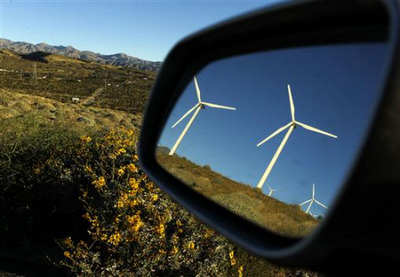
wind turbines reflected in a car mirror
The technology needed to cut the world’s greenhouse gas emissions by 85% by 2050 already exists, according to a joint statement by eleven of the world’s largest engineering organisations, including the UK's Institution of Mechanical Engineers (IMechE).

The problem lies with politicians and the consequent lack of legislation and finance needed to ramp up efforts.

The professional bodies, together representing 1.2 million engineers, submitted their opinion last Friday to the South African Deputy High Commissioner as part of preparations for the UN Framework Convention on Climate Change which is to be held in Durban from November 28 to December 9, (COP 17).

They unanimously agree that not only is climate change real, and a danger, but that we can fight it by "generating electricity from wind, waves and the sun, growing biofuels sustainably, zero emissions transport, low carbon buildings and energy efficiency technologies" which have already "all been demonstrated".

The reason why we are not doing so on a sufficient scale to match the problem, their letter says, is "a desperate need for financial and legislative support from governments around the world".

“While the world’s politicians have been locked in talks with no output, engineers across the globe have been busy developing technologies that can bring down emissions and help create a more stable future for the planet," said Dr Colin Brown, Director of Engineering at the Institution of Mechanical Engineers.

Expressing hope that the December talks will achieve what those in Cancun last year and Copenhagen the year before failed to, he said, “We are now overdue for government commitment, with ambitious, concrete emissions targets that give the right signals to industry, so they can be rolled out on a global scale”.

The statement calls for agreements at Durban to:
  • let greenhouse gas emissions peak by 2020, then substantially reduce

  • make sure that policies do not unfairly impact on one particular industry or country

  • emphasise energy efficiency first - "the best available measure to bring down emissions in the short and medium term".

  • begin an intensive training programme in deploying environmental technologies


Pessimism for Durban talks


The Durban summit will focus on the future of the Kyoto Protocol, still the world's only treaty that mandates emission cuts. Its obligations expire at the end of 2012 and its future is uncertain because China and the United States, the world's top two polluters, are not subject to its constraints.

COP17 is seen as the last chance to make new commitments before then.

But with Japan, Canada and Russia having rejected a new round of carbon-cutting commitments, and the United States and the European Union having already said there is no chance of reaching a binding emissions deal in Durban, the problem is clearly a political, not an engineering one.

Maesela John Kekana, a senior policy adviser at South Africa's national Environmental Affairs department, told a parliamentary workshop on climate change this week that instead of a binding deal, "a second scenario" might be approved in Durban.

"This would involve the provisional application of a second commitment period for nations signed up to the Kyoto Protocol to reduce their emissions – due to come into effect in January 2013, after the first commitment period now in effect expires – while non-protocol nations like the US would agree to 'comparable obligations'”.

There would then be a transitional period until a new regime had been agreed after a review in 2015.

“That to me seems to be the more realistic scenario of what can happen,” Kekana said.

South Africa's environment minister has also called on rich countries to help poor countries reduce greenhouse gas emissions, ahead of the UN climate talks.

Edna Molewa said during the meeting on Monday, "We want to come out of the COP 17 saying that we have demonstrated our commitment, the will and capacity of our country and our people, as well as corporates, to lead a change revolution against climate change".

The stakes are perilously high, but pessimism is the order of the day.

A failure to make progress at the UNFCCC (UN Framework Convention on Climate Change) talks could result in a "collapse of the system", said NJ Mxakato-Diseko, ambassador at Large for COP 17/CMP 7, Department of International Relations & Cooperation South Africa, speaking last week at a Business for the Environment Climate Summit (B4E) in London.

This summit again beseeched political leaders to act, with over 250 high-level business, NGO and civil society leaders from 26 countries signing a document containing plans for industry commitments and political demands to speed up the change to a green economy.

The document will be communicated through to the Durban summit, to demonstrate, alongside the engineers' positive view, clear industry support for change to the climate negotiators.

The engineers' joint statement came out of The Future Climate 2 conference, also held in London last week, which saw international speakers from government, academia and engineering institutions discussing the technologies needed to combat climate change. The eleven engineering institutions that signed up to the joint statement are:
  • The Institution of Mechanical Engineers (IMechE) (UK)

  • Institution of Engineers (India)

  • Association of German Engineers (VDI) (Germany)

  • Japanese Society of Mechanical Engineers (JSME) (Japan)

  • Association of Professional Engineers, Scientists and Managers (APESMA) (Australia)

  • Danish Society of Engineers (IDA) (Denmark)

  • Civil Engineer Organisation of Honduras (CICH) (Honduras)

  • Swedish Association of Graduate Engineers (Sweden)

  • Norwegian Society of Engineers (NITO) (Norway)

  • Finnish Association of Graduate Engineers (TEK) (Finland)

  • Union of Professional Engineers (UIL) (Finland)


The IMechE sees the 'green revolution' as "the lifeblood of UK manufacturing growth" and is organising a one day UK Energy Summit on Tuesday 1 November.