Showing posts with label Greenpeace. Show all posts

Thursday, April 13, 2017

Trump, Putin and a new "axis of fossil fuels"

When Trump and Putin finally meet, we could well see the emergence of a new axis of resurgence for the fossil fuel industry.

A spokesman for Russian President Vladimir Putin said a week last Friday that the Russian leader is keen to meet with US President Trump. That now seems an age ago, since Trump's U-turn on Syria.

It seemed likely then that the meeting would be soon. But when they do finally meet, as they must, even if they don't have policy on Syria and the Ukraine in common, there's something else on which they do share much: a love of coal, gas and oil.

A pre-sarin-attack-in-Syria version of this article appeared on April 6 on The Fifth Estate.

Both Trump and Putin support this industry – and the mining industry in general – and deprecate climate change and the Paris Agreement.

People close to the powerful Russian oil community say that both countries see energy cooperation as one of the few common grounds to move the strained relations forward.

Putin and Trump have much in common on the topic of energy. As InsideClimate has pointed out last year:

Russia is the fifth-largest emitter of greenhouse gases in the world. Yet the plan it submitted under the Paris agreement to reduce its greenhouse gas emissions by 2020 is one of the weakest of any government and actually permits Russia to increase carbon pollution over time. The Paris Agreement went into effect last November, but Russia is the only major emitter that has not ratified it. Instead, it has laid out a timetable that would delay ratification for almost three years.

Trump’s climate-sceptic appointee to head the Environmental Protection Agency, Scott Pruitt, has not confirmed whether the United States will remain in the global climate change pact.

Artic exploration

The meeting looks likely to happen in Finland once it assumes chair of the Arctic Council. This is significant because the Council is a forum for discussing access to the mineral rights of the sea-bed within the circle.

Due to climate change (which Trump does not believe in) and melting of the Arctic sea-ice, more energy resources and waterways are now becoming accessible.

Both leaders want access to the vast reserves of oil and gas known to exist there. Their desire is vigorously opposed by environmentalists. Putin’s government famously imprisoned Greenpeace activists in 2013 for protesting about Russian oil exploration in the Arctic.

Igor Yusufov, Tillerson and Russia

Igor Yusufov, Russian energy minister (2001-2004) who presided over the privatisation of the industry is now, oddly, head of US$3 billion energy investment Fund Energy. This fund does deals in oil and gas projects with the likes of US oil service multinational Halliburton.

Yusufov has issued a statement supporting greater cooperation between the two superpowers. He believes that Russia and the USA will discuss the development of coal production and corresponding technologies. Russia is in possession of the world’s second largest coal reserves.

Yusufov has known Trump’s Secretary of State Rex Tillerson, formerly head of ExxonMobil, since 2002. He is enthusiastic about Tillerson’s involvement in building bridges between the two countries – and forging links on energy.

Tillerson has been involved in Russian energy projects since January 1998 when he took over ExxonMobil’s operations in Russia and the Caspian Sea region.

ExxonMobil and Gazprom did very well out of Tillerson’s involvement in Russia. Both sides will be hoping this success can be repeated.

In connection with the ongoing suspicions about Mr Trump’s connections to Russia, and the degree of support he received from Mr Putin, John McCain, a senator from Arizona, has said he is “very concerned” about Tillerson’s 2013 acceptance of Russia’s Order of Friendship from Mr Putin.

The man Tillerson will be talking to is foreign minister Sergei Lavrov, whom Yusufov speaks admiringly about and says “also possesses a profound knowledge in energy”.

Trump will be jealous of Russia’s achievements with its coal industry. Contrary to the state of affairs in the US, which he wants to reverse, in the last five years Russian coal production increased by 12.7 per cent. Yusufov attributes this to the benefits of privatisation.

Much of the increase is due to open-cast mining, which has lax environmental controls – another (non)-policy favoured by both Trump and Putin.

The end of the Paris Agreement?

Yusufov says that Russia is concerned about the likely slowdown in global demand for coal due to the Paris Agreement. But its Energy Ministry still forecasts an increase in production to 425 million tons in 2020 and to 480 m tons in 2030.

How does this square with being a signatory of the Paris Agreement? It doesn’t. Russia says one thing and does another. This is its form of Orwellian “doublethink”.

An example is Yusufov’s statement: “We see [the Paris Agreement] as a cornerstone of the future environmentally conscious world. At the same time we clearly understand, that at this stage the Russian economy would not survive without hydrocarbons our companies explore and produce.”

At least Russia is honest about wanting to have its climate cake and eat it.

As with the West’s misplaced faith in carbon capture to achieve this dual end, Putin believes in nanotubes. He mentioned them in Paris prior to the climate change conference. He said that these Russian-made fibres, one billionth of a metre in diameter, will “cut Russian CO2 emissions by 160-180 million tons”.

Russia currently emits 2322 Mt CO2 a year, or 5.4 per cent of global emissions.

In the US last week, Trump signed an order – which would need to be passed by Congress – rolling back former President Barack Obama’s climate change policies, including the Clean Power Plan to slash carbon emissions from power plants.

This would damage the United States’ ability to meet its Paris commitments.

Only the U.S. Congress stands between this emerging alliance and the goals of the Paris Agreement.

The world will be watching this summit more closely than it has watched any summit in the last few years.

David Thorpe is the author of a number of books on energy, buildings and sustainability. See his website here.

Tuesday, August 28, 2012

Greenpeace heroes thrown into Arctic Sea by Gazprom oil workers


Greenpeace activists protesting at Arctic oil drilling thrown into the freezing Pechora Sea this morning by Russian sailors working for oil giant Gazprom

Activists protesting at Arctic oil drilling were thrown into the freezing Pechora Sea this morning by Russian sailors working for oil giant Gazprom.

The action is occurring as Arctic sea ice cover reaches its lowest ever extent four weeks earlier than the previous record five years ago, according to the US National Snow and Ice Data Center (NSIDC).

The ice extent was 4.10 million square kilometers (1.58 million square miles) on August 26; 70,000 square kilometers (27,000 square miles) below the previous record low extent of 4.17 million square kilometers (1.61 million square miles), recorded on September 18 2007.
graph showing how unprecedented the drop in Arctic ice cover is in historical terms

The graph above shows how unprecedented this drop in ice cover is in historical terms.

NSIDC scientist Walt Meier called it "an indication that the Arctic sea ice cover is fundamentally changing", and its Director Mark Serreze, commented that: "The previous record, set in 2007, occurred because of near perfect summer weather for melting ice. Apart from one big storm in early August, weather patterns this year were unremarkable. The ice is so thin and weak now, it doesn't matter how the winds blow."

There is little doubt now that this pattern of ice loss is due to the unexpectedly fast increase in the rate of global warming. And yet the reaction of countries bordering the Arctic Ocean has been to see it as an opportunity to access the resources that lie on its seabed.

On Sunday, Royal Dutch Shell asked the U.S. Interior Department to extend a September deadline to complete planned drilling in the Chukchi Sea off Alaska’s northern coast, because it realised that its Arctic Challenger ship would become icebound later in the season than it had previously estimated. Shell also plans to drill in the Beaufort Sea.

Greenpeace is mounting a global challenge, which it claims is supported by almost two million people, to stop the drilling for oil and gas in the region. It argues that firstly any spillage or accident would have disastrous consequences and be almost impossible to clean up, and secondly that it is madness to continue to use fossil fuels when the climate of the planet is so obviously radically changing.

Its activists have been in the Arctic for five days. For the first three days they occupied the first permanent oil rig in the offshore Russian Arctic.

Then, Greenpeace International Executive Director Kumi Naidoo and six other Greenpeace activists in the Pechora Sea headed in two high-speed boats to intercept the Anna Akhmatova, a passenger vessel carrying workers to the rig, and were soon supported by two other boats carrying seven more.

14 activists from 10 countries attached themselves and their boats to the anchor chain of the Anna Akhmatova in order to prevent it from sailing out to the Prirazlomnaya oil platform.

When the first officer sought orders from management in Moscow he was told to “use any means at your disposal to continue operations," according to Greenpeace. At 5am this morning, he ordered two Gazprom ships to train high-pressure water cannons onto the Greenpeace inflatable boats.

Their occupants were washed out of the boats, and thrown into icy water some distance away. They were rescued and are safe, and not long afterwards the action was called off.

The Prirazlomnaya is the first permanent oil platform in the offshore Arctic and marks what Greenpeace calls “the creeping industrialization” of the Arctic. The construction phase on the platform is nearly complete, and Gazprom is eager to begin drilling and become the first oil company to commercially produce oil from the offshore Arctic.

However, Greenpeace has warned that Gazprom has no strategy to prevent oil spills or clean them up if they occur. “Despite extreme operating conditions, Gazprom has only released a summary of its oil spill response plan to the public. Yet even this document shows that the company would be completely unprepared to deal with an accident in the Far North, and would rely on substandard clean-up methods, such as shovels and buckets," it said in a statement.

All countries that border the Arctic Ocean are lining up to exploit its riches. This includes Britain, which, under David Cameron's leadership, signed an agreement with Norway in June that commits it to tapping gas and oil reserves in the Arctic.

While campaigners reissued their call at the Rio+20 Earth Summit in June for the Arctic to be made a scientific reserve along the lines of the Antarctic, the World Ocean Council has convened a meeting of the “Arctic Business Leadership Council” which is the start of a forum for representatives of shipping, oil and gas, fisheries, aquaculture, tourism, marine science/technology and other industries with interests in the Arctic to see how they can “responsibly" exploit the new opportunities presented by the melting ice.

They will meet on 17 September in Reykjavik. The draft agenda calls for the setting up of a roadmap to show how it can be exploited. It also asks for opinions from industry on how the guidelines for Corporate Social Responsibility and Sustainable Business could be applied in the region.

Greenpeace said in a statement: “We're determined to save the Arctic. We know this is a different fight, at a different time; not least because the Arctic is home to millions of people who have a critical say in the future of their region; and because the threat is not just from industrial development, but from the global crisis of climate change."

Monday, February 27, 2012

Greenpeace's arguments against nuclear power

Here is some important text from a new Greenpeace document, Renewable energy is the future: nuclear energy is the past that sums up the arguments against nuclear power and for renewables.

Nuclear energy and the conflict with renewables 

The nuclear industry often claims that nuclear energy is needed to combat climate change.

This is wrong.

Research by Greenpeace and others shows that continuing to operate nuclear plants prevents the large-scale integration of renewable energy into the electricity grid.

Nuclear also channels investment away from renewables where investment can make a difference in fighting climate change.

The argument that nuclear power could help fight climate change is seriously flawed.

If the entire global fleet of reactors was quadrupled, a completely far-fetched scenario, this would lead to, at most, a 6% reduction in global CO2 emissions, and only after 2020, well beyond the deadline that climate scientists have set for avoiding catastrophic climate change.

A key problem with nuclear power is that it must run around the clock with a constant output capacity, which is called ‘baseload’.

The nuclear industry presents this as an advantage, which it is not.

First, a permanent power generation mode –̶ independent from the actual need in the power grid – is needed to generate as much electricity as possible to make generation costs low.

If the operational hours were reduced to half, the cost would double.

So the ‘baseload’ strategy is more an economic than a technical concept.

Second, unlike modern gas turbines, which can react within seconds to fluctuating demand in the electricity grid, nuclear power stations are unable to react to the demand curve, and demand must follow the operation mode of nuclear power plants.

This leads to the inefficient use of electricity.

In almost all countries with a winter heating demand, a large share of nuclear in their power mix goes hand in hand with the expansion of highly inefficient electrical heating systems.

For example, France, with about 80% nuclear in its power mix, had an overall power demand of 101GW on a cold day in February 2012, while Germany, which has 15 million more people than France, with 20% nuclear in its power mix had a demand of just over 50GW on the same cold day.

(Bunesnetzagentur – German Grid Authority – 9 February 2012).

Germany has far better insulated houses and a significantly lower share of electrical heating systems.

The inflexibility of nuclear reactors has a negative effect on renewables.

For technical and safety reasons, nuclear plants cannot easily be turned down so wind operators are often told to shut off their generators to give priority to electricity from nuclear plants, an economic and ecological mistake.

As a result, nuclear energy blocks the development of renewable energy technologies by commandeering space on the electricity grid and reducing income for wind operators.

Renewable power plants can be built much more quickly than nuclear and are safe.

In addition, renewables can replace several times more of the carbon that is leading to climate change for the same cost as nuclear and at a far faster pace.

At present, over 90% of the Japan’s reactors are offline. The rest may be offline by May 2012.

Given that only three of 54 reactors are operating and there have been no significant problems with the electricity supply, Japan has shown that it can survive without nuclear power.

Monday, June 20, 2011

The Government fails to stand up for the Arctic environment

Greenpeace protest over Arctic drilling
On Friday Greenpeace's director Kumi Naidoo was apprehended while trying to board a drilling rig off the coast of Greenland, in order to stop Cairn Energy drilling for oil and gas in this critically sensitive environment.

Speaking before he set out to scale the platform, Mr Naidoo, said: "The Arctic oil rush is such a serious threat to the climate and to this beautiful fragile environment that I felt Greenpeace had no choice to return, so I volunteered to do it myself."

Greenpeace feels compelled to act because the UK Government won't.

Last week, Energy Minister Charles Hendry said in public for the first time what had thus far only been said in private - that it is UK policy to support drilling for oil and gas in the Arctic.

Since when did this become UK policy? And why has the House of Commons never debated it?

Hendry told an energy conference that Arctic drilling is "entirely legitimate" and that, "given the ability to carry out this work safely, this should be part of the work of the industry".

Energy and mineral companies are taking a great deal of interest in the area now that climate change has caused the ice cap over the Arctic Ocean to melt during the summer months more than ever before in recent history, thereby easing access to the seabed.

A report issued by the US Geological Survey in 2009 estimated that the Arctic contains as much as 13% of the world's remaining undiscovered oil and 30% of its undiscovered gas.

Of course, this is just speculation, but the melting ice has exposed something else: an absence of regulation to protect this fragile and beautiful environment.

Britain, not being an Arctic state, nevertheless has clear interests in the region. It is an observer on the Arctic Council, along with France, Germany, Netherlands, Poland and Spain.

The Council's full members are Canada, Denmark (representing also Greenland and Faroe Islands), Finland, Iceland, Norway, Russia, Sweden and the USA. It has several working groups which investigate the environmental and social aspects of developing the area.

But the Council is not a legally empowered body. It does not have the muscle to veto the actions of members, who in turn are not obliged to act in accordance with its deliberations.

In fact, it is a talk shop, which gives the appearance of collaboration between interested parties, while behind the scenes they frantically scurry to gain competitive advantage over access to the trillions of dollars of riches on the continental shelves surrounding the ocean. "There is in fact no strong consensus between the states," comments Anna Galkina, a researcher on this issue at think-tank Platform.

British companies BP, Shell and Cairn Energy are amongst those behind this struggle, which has recently seen BP spectacularly falling out with Russian giant Rosneft despite heavy UK government lobbying on its behalf.

BP's troubles seem all the more ironic when you know that on 14 January 2011 BP CEO Bob Dudley and Eduard Khudainatov, CEO of the Russian state oil giant Rosneft, following a meeting with Vladimir Putin, signed their original agreement in the presence of our Energy and Climate Change Secretary Chris Huhne.

In the absence of any regulatory body capable of controlling this oil and gas rush, it has fallen to NGOs to try and put a brake on exploration.

Cairn Energy is at the forefront of the rush and is about to commence drilling off the Greenland coast. Twice this year Greenpeace has attempted to stop them with direct action, and in response Cairn has just obtained an injunction preventing them from boarding their rigs.

Hendry's phrase, "the ability to carry out this work safely", cannot be tested in public because Cairn refuses to publish its Oil Spill Response Plan despite a petition signed by almost 50,000 people and a highly unusual admonition by a judge in Amsterdam, who said that doing so would make absolute sense, even to the company concerned, if it really wanted to maximise the chances of preventing an accident.

I am putting in an FOI request to find out if Hendry, or anyone at DECC, had been shown Cairn's Oil Spill Response Plan for its Greenland operation before coming out with such unequivocal support. Because if he has seen it, why can't we all? And if he hasn't, how can he so confidently support the company?

Or has he forgotten BP's rather costly adventure in the Gulf of Mexico last year?

The US National Commission on the BP Deepwater Horizon Oil Spill and Offshore Drilling concluded in its final report in January 2011 that "detailed geological and environmental information does not exist for the Arctic exploration areas and industry and support infrastructures are least developed, or absent

Lord Howell, at the Foreign and Commonwealth Office, is one minister heavily responsible for UK policy on the Arctic, and is involved in lobbying to support British oil companies' commercial interests abroad.

Yet the British Parliament has not had a chance to debate and decide this policy. The only time it has come remotely near to being discussed was in a poorly attended and very short debate in the House of Lords on the 6th December 2010, led at 8.02pm by Lord Jay.

There, Howell admitted that besides ostensibly protecting the Arctic environment, "our second aim is to protect crucial UK energy supplies from the region and promote UK business interests. Thirdly, we want to ensure access to fisheries and transport routes in the region, including the ones that may open up in the future-not just in summer but in winter."

Only then did he say that a fourth aim is "to promote wider UK Government objectives with regard to sustainable development, environmental protection and climate change".

It's not that he is unaware of the fact that all of this exploration is only possible because of climate change. He even commented on "the irony that the melting of the ice means that all sorts of possibilities open up for access to the huge hydrocarbon resources in the region." But he only talked of "how" - not whether - these "colossal reserves" might "be got out economically and in line with all the other restraints that the world wants."

I asked the Department for Energy and Climate Change if they would clarify their position. This is what I received in response: "regulation of Cairn's drilling proposals in the Arctic is a matter for the Greenland Government. As an observer in the Arctic Council, the UK has contributed to the development of the guidelines recently agreed by the Council on oil and gas, and supports robust provisions on environmental protection and sustainability in Arctic waters.

“More generally, the UK is participating in the G20 initiative to promote best practice and regulatory standards, to ensure that oil and gas activities carried out anywhere in the world align with industry best practice and are managed so as to ensure minimum impacts to the environment.”

Nothing about climate change.

The Arctic Council's guidelines on exploration were in fact agreed in 2009. They include acknowledgement of the principles of "polluter pays" and "the precautionary principle", and they recognise that the area "has high sensitivity to oil spill impacts and the least capacity for natural recovery".

Given the overwhelming threat of climate change, many NGOs, including Greenpeace and WWF, are demanding that no fossil fuels be extracted from the area. They are calling for the Arctic to become a scientific reserve, as the Antarctic is, and left alone.

There is, sadly, little chance of this. An important discussion document published in Washington in January this year - The Shared Future: A Report of the Aspen Institute Commission On Arctic Climate Change - supposedly takes "a hard and new look at climate change in the Arctic".

But does it call for a moratorium and a ban on drilling in the area? No. Its main recommendation is that "governance in the Arctic marine environment, which is determined by domestic and international laws and agreements, including the Law of the Sea, should be sustained and strengthen by a new conservation and sustainable development plan using an ecosystem-based management approach".

Amongst its 10 principles of Arctic governance is number 4: "Avoid exacerbating changes that may be difficult or impossible to reverse in temperature, sea-ice extent, pH and other key physical, chemical and biological ecosystem parameters."

It's hard to see how any exploration can go on in such harsh conditions which do not contain the risk of doing so. But the document falls short of admitting this.

Instead, it says that Arctic governments should take immediate steps to begin developing an Arctic Marine Conservation and Sustainable Development Plan by 2012, which "should also open the door to a new model of natural resource governance in the Arctic that promotes an ethic of stewardship and multinational use of best management practices".

Fine words. But while energy companies can't even publish their safety plans there is fat chance of this happening.

Diana Wallis, Vice President of the European Parliament and MEP for Yorkshire and the Humber, and the Green Party's Caroline Lucas are alone amongst legislators in pushing for stronger regulation. Wallis' website allows people to vote on whether there should be a moratorium on oil exploration in the Arctic. Two thirds of voters there think there should be.

What she and I want to know is: why isn't the British Government standing up for the Arctic? Why is it caving into commercial interests?

And why can't there be a proper debate in the House of Commons on this crucial issue?

Monday, April 18, 2011

The government puts all of the UK's environmental legislation under threat

Environmental groups are horrified by the coalition government's inclusion of every single one of the UK's 278 environmental laws in a list of legislation that it is offering for the axe, under its new, populist "Red Tape Challenge".

The list includes the Climate Change Act, laws protecting air and water quality, rights of way, national parks, animal safety and promoting energy efficiency, rules against flytipping, litter and environmental pollution.

The above website states that "Good regulation... protects consumers, employees and the environment, it helps build a more fair society and can even save lives."

It goes on then to add "But over the years, regulations – and the inspections and bureaucracy that go with them – have piled up and up. This has hurt business, doing real damage to our economy. And it’s done harm to our society too".

The crowdsourcing exercise is designed purely to make businesses think that the Governmnet is on their side. In reality, much of this legislation cannot be repealed - especially those of European origin like the EcoDesign Directive or the Waste Directive - without encountering severe penalties. The rationale for including them is to look at instances of ‘gold-plating’ – where the UK has gone beyond the minimum required by the EU legislation.

But even Lord Davidson himself stated in his report on the topic of gold-plating two years ago: “it is sometimes beneficial for the UK economy to set or maintain regulatory standards which exceed the minimum requirements of European legislation. The EU may not always set the most appropriate level of regulation. The decision to introduce or maintain higher standards or stricter regulatory regimes than is required by EU directives could bring benefits as well as costs”.

The Climate Change Act is a flagship piece of recent legislation - the first in the world to commit a government to emission reduction, and something which business has been calling for to provide the certainty necessary to inspire investment.

Last month, a campaign was launched by climate change sceptics to repeal the law - but it is not coming from business and is not popular - the only news on its website has been Tweeted just four times.

So why is the act also included? Margaret Ounsley, Head of Public Affairs at WWF-UK said: "Allowing precious and hard-won environmental laws to be repealed in this manner would be ridiculous. Frankly we credit the Government with more sense than to tear up incredibly important legislation such as the Climate Change Act in an attempt to appear consultative or dynamic."

And John Sauven, director of Greenpeace, added: "We don't yet know if this is cock-up or conspiracy. If it's a cock-up, David Cameron needs to come out and say the Climate Change Act, central to the push for a clean technology revolution, is safe from the axe. But if ministers are serious about scrapping it and other vital environmental regulations then we'll be looking at something akin to the worst excesses of the Bush-Cheney White House. When did clean air and green jobs become a burden?"

Adrian Wilkes, Executive Chairman, The Environmental Industries Commission, said, "BIS’ latest deregulatory threat is dangerously misguided and poses a potentially major threat to the UK’s environmental industry – bizarrely at a time when the Chancellor is promoting green job creation in his Plan for Growth".

The Red Tape Challenge website says that ministers and government officials will use the feedback they get "to help them cut the right regulations in the right way".

Every few weeks the laws relevant to different topics are up for feedback. Environmental laws affect multiple and various categories such as transport, waterways, energy, manufacturing and quarrying.

The Government has already axed the Eco-Driver Training bill, which would have trained drivers of large goods vehicles and passenger carrying vehicles to drive more cost-effectively, that was consulted upon by the previous administration.

An end to 'gold-plating'


The Department for Business, Industry and Skills (BIS) has also already begun (last December) an initiative to end the practice of going beyond the requirements of European Directives so that they "are not unfairly restricting British companies".

This initiative, however, is far from new - it was begun under the previous administration, in a review by Lord Neil Davidson QC who published his final report on 28 November 2006.

BIS has now adopted Guiding Principles for EU legislation to tackle what it calls 'regulatory creep'.

In the past, in the environmental arena, this exercise has been largely about avoiding duplication. For example, in the Waste Framework Directive it's possible for there to be exemptions made from the standard requirement to obtain a waste permit. Defra is consulting with the Environment Agency to update guidance on waste to make more effective use of the permit exemption provision. Inert waste was being controlled twice and this has been amended. The Environmental Permit Programme (EPP) has merged and streamlined the regulatory regimes for Waste Management Licensing (WML) and Pollution Prevention and Control (PPC), which means that a site now only needs to have a single environmental permit for these activities.

Sometimes, however, it is necessary to increase environmental protection.

Business leaders in Scotland agreed with Davidson's view that sometimes gold-plating is necessary. The Scottish Chambers of Commerce response said: "the gold plating of EU directives will not necessarily lead to increased business compliance costs; there is a need to simplify and streamline the nature of regulation; ensure implementation in the clearest and most efficient way".

Friends of the Earth has argued that the charge of gold-plating Energy Performance Certificates (EPCs) was misplaced and believes the term itself is "unhelpful and inaccurate".

CIWEM (the Chartered Institution of Water and Environmental Management) goes further, calling it "a pejorative term" which "implies that any environmental regulation that goes beyond the absolute minimum is an unnecessary burden and to be accepted only under extreme circumstances".

Instead CIWEM believes that the UK should be seeking to have "the best environmental regulation in Europe rather than the weakest, where this can be achieved at reasonable cost and particularly in cases where there is clear benefit-cost advantage."

The new red tape challenge exercise seems to be designed as an exercise in pandering to prejudices - it is hopefully not serious, since in practice not a huge amount can be changed.

Nevertheless it is clearly important for every business in the green sectors to tell the government that they need the laws to protect them as well as us and our environment.

What lunacy, and what a waste of time from the so-called "greenest government ever".

Thursday, March 17, 2011

The curse of uranium mining

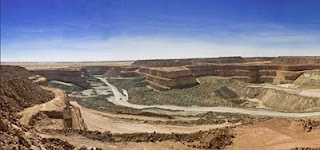
Uranium mine in Niger
“The people here don’t know about radioactivity, but there are still many people who do not drink the water in Arlit...They say they are sick when they drink it,” says Almoustapha Alhacen, who lives in a town built for nuclear mine workers in northern Niger, a parched desert area.
global supply lines for uranium

This is a glimpse of life at the other end of the uranium fuel supply route (right: where uranium originates and goes) for a plant like Fukushima.

Can nuclear-power ever be sustainable? Not unless it cleans up its act. It is just as criminally irresponsible in sourcing its raw materials as the fossil fuel industry. Read on...

Hell on earth


In a harsh environment in sub-Saharan Niger, French nuclear company AREVA has created a hell on earth amongst its indigenous population.

Here you would find great clouds of dust, caused by detonations and drilling in the mines, which cloud the air at the end of the day. Mountains of radioactive industrial waste and sludge sit in huge piles, exposed to the open air.

And the shifting of millions of tonnes of earth and rock have contaminated the groundwater source, which is quickly disappearing due to industrial overuse.

AREVA's majority shareholder is the French government. In 2009 Niger produced nearly 7% of the world’s uranium and is one of the four largest suppliers of uranium to the European Union. Northern Niger holds the world’s third-largest uranium deposit.

Foreign investors from China, Australia, South Africa, America, and Canada have flocked to the landlocked Saharan state recently. At least 139 research and exploitation permits have been sold in less than a year without any transparency or prior public discourse, says a local NGO.

Evidence has emerged that the permits corruptly enriched Mr. Tandja, the ousted president, and devastated the Touareg population.

Abject poverty


A landlocked-Saharan place in West Africa, Niger is a country where 60 percent of people are facing severe food shortages; it has the lowest human development index on the planet, despite the fact that Areva makes huge profits from its mining operations.

Arid desert, scarce arable land and intense poverty are hugely problematic - unemployment, minimal education, illiteracy, poor infrastructure and political instability are rife.

Mountains of tailings left from the uranium mine
AREVA established its mining efforts in northern Niger 40 years ago, creating what should have been an economic rescue for a depressed nation.

Yet, AREVA’s operations have been largely destructive, claims Greenpeace, whose experts visited the area at the beginning of last year together with experts from French independent laboratory CRIIRAD.

In 40 years of operation, a total of 270 billion litres of underground prehistoric water have been used, contaminating the water and draining the aquifer, which will take millions of years to be replaced. There have been consequent droughts and the death of farmers' cattle. No compensation has been provided.

Health and environmental findings


In collaboration with the French independent laboratory CRIIRAD and the Nigerien NGO network ROTAB Greenpeace have found the following:

• The concentration of uranium and other radioactive materials in a soil sample collected near the underground mine was found to be about 100 times higher than normal levels in the region, and higher than the international exemption limits.

• On the streets of Akokan, radiation dose rate levels were found to be up to almost 500 times higher than normal background levels. A person spending less than one hour a day at that location would be exposed to more than the maximum allowable annual dose.

• Although AREVA claims no contaminated material gets out of the mines anymore, Greenpeace found several pieces of radioactive scrap metal on the local market in Arlit, with radiation dose rate reaching up to 50 times more than the normal background levels. Locals use these materials to build their homes.

• In four of the five water samples that Greenpeace collected in the Arlit region, the uranium concentration was above the WHO recommended limit for drinking water. Historical data indicate a gradual increase in uranium concentration over the last 20 years, which can point at the influence of the mining operation.

• A radon measurement performed at the police station in Akokan showed a radon concentration in the air three to seven times higher than normal levels in the area.

• Fine (dust) fractions showed an increased radioactivity concentration reaching two or three times higher than the coarse fraction. Increased levels of uranium and decay products in small particles that easily spread as dust would point at increased risks of inhalation or ingestion.

• Death rates due to respiratory infection in the town of Arlit (16.19%) are twice that of the national average (8.54%).

AREVA, with its attempt to create a nuclear renaissance, brings to these communities the threat of losing the most basic elements necessary for life - poisoning their air, water and earth.
“We worked with our bare hands! ...The mining company never informed us about the risks... we relied on what God decided.” - Salifou Adinfo, a former driller for AREVA, Arlit, Niger, November 2009.
Women wash their clothes at a tap so generously provided by Areva
“We are already radiated. We are no more useful. We can only watch.” SOMAIR laundry worker Gigo Zaki, seen here at a tap so generously provided by AREVA.

“AREVA is coming to our country and making money, but we are the ones suffering and this must be addressed,” - Fatima Daoui.


Corruption and profits while locals are in poverty


Government spokesman Mahaman Laouali Dandah says there is ample evidence that corruption is an important part of doing business in Niger Production at COMINAK, located a few kilometres from the town of Akokan, commenced in 1978.

Unlike SOMAIR, COMINAK is an underground mine.

With a depth of 250 metres and over 250 kilometres of galleries, COMINAK is the largest underground mine in the world.

On average, the mines produce over 3,000 tonnes of uranium and net €200 million in sales each year.

A third mine, Imouraren, is planned to start production in 2013 and is projected to be the largest uranium mine in Africa and the second largest in the world, with an annual production capacity of 5,000 tonnes of uranium.

AREVA’s revenues for 2008 (most recently published) were €13.1 billion, with a profit of €589 million.

SOMAIR generated €161.7 million of that revenue by producing 1,743 metric tonnes of uranium.

COMINAK earned sales of €100.6 million for its supply of 1,289 metric tonnes of uranium concentrate.

Nuclear power sustainable? Don't make me laugh.

Tuesday, February 15, 2011

Treasury told carbon floor price would subsidise nuclear

Green groups have said Treasury plans to impose a floor price on carbon used in electricity generation amounts to giving billions of pounds to the nuclear industry – something the coalition government said it would not do.


They said that it was a secret way of subsidising the nuclear industry, which could benefit by up to £3.4 billion.

The Treasury's consultation on the “carbon price floor" closed at the end of last week.

Greenpeace and WWF said this would breach the coalition's agreement not to subsidise nuclear power.

The £3.4 billion figure is based on a minimum carbon price of £40 per tonne. However, sources suggest it is more likely to be lower, perhaps half that figure. Nevertheless the resultant amount going to the nuclear industry, of £1.7 billion, which would be over 13 years, is still a considerable amount.

These figures are based on the existing amount of nuclear capacity and do not take into account any new nuclear plants, which would increase the amount.

WWF and Greenpeace are calling for a windfall tax on existing nuclear generators alongside the carbon floor price mechanism, that would be used to support energy efficiency and emerging renewable technologies through the Green Investment Bank.

They have issued scenarios which describe how the world could power itself by up to 95% renewable energy by 2050, and regard nuclear power as unnecessarily risky and harmful.

Dr Douglas Parr, Chief Scientific Adviser and Policy Director, Greenpeace UK said: “This is yet another taxpayer handout to a failing nuclear industry. The economics of nuclear power have never added up and it has been continually propped up with money from hard-working families."

The eventual policy is to be determined in concert with the ongoing Electricity Market Reform (EMR) consultation.

Thursday, February 15, 2007

The sham of a consultation

The Low Carbon Kid said from the start of the Energy Review 'consultation' that it was a sham and a foregone conclusion.

The Review was the reason for starting this blog. Now Greenpeace's courageous action in challenging the result has been vindicated by the High Court.

Greenpeace's Emma Gibson told the BBC: "The government's so-called consultation was a sham and we are very pleased the judge has agreed with us on that."

Mr Justice Sullivan said "something has gone clearly and radically wrong".

LibDem environment spokesman Chris Huhne said: "It's a real slap in the face for prime minister's sofa style of government."

Shadow trade and industry secretary Alan Duncan said: "The government has been shown up as fundamentally deceitful."

The government should immediately channel the money devoted to laying policy foundations and R&D in new nuclear power to the most promising emerging renewable technologies, in particular local power and marine energies.

There is no safe solution to nuclear waste.