Showing posts with label carbon emissions. Show all posts

Wednesday, July 12, 2017

Harmony in Food and Farming – blueprint for a revolution

A review of the Harmony in Food and Farming conference on 10-11 July 2017 in Llandovery College, Wales.

Agriculture is responsible for 24% of global greenhouse gas emissions. We need to feed a growing population a better diet, more sustainably. This conference explored how.

The Harmony 2017 conference was inspired by Charles Windsor's eponymous book and initiated by Patrick Holden, founder of the Sustainable Food Trust – which he set up following his disillusionment with the Soil Association.

Harmony Charles Windsor book cover


In his opening speech, before whizzing off in a chopper (how eco is that?), Windsor mentioned that harmony in Welsh is cydseiniad (m.) or cynghanedd (f.) and to work in harmony is cyd-dynnu. Literally this is 'work-together'. The conductor Sir John Gardiner later said in his keynote speech, "music is the foundation of harmony. It is 'the state of being in agreement'".

Harmony is not a word normally used in agriculture. Windsor said that "we can't separate what we are from what we do", and that the bottom line should not be the chief motivating factor in the production of food.


"Spirituality, nature and man are not separate things. Where we do separate them, therein lies the root of the problem. Nature is not an autonomous machine. Farms are not factories, and we must be more balanced and harmonious and diverse. We must put back at least as much as we take out."

He believes that attitudes are changing, to greater realisation that we are all part of the web that supports all life on earth, and that this is why biodiversity needs to be encouraged everywhere.

Fifty speakers and moderators at the conference took up and explored this theme, as did the chef and his team, providing all the meals for 200-300 people over two and a half days, using local, specially prepared very delicious and nutritious food, which, unusually for a conference, was celebrated and made centre-stage.

Closing loops

Ellen MacArthur
Ellen MacArthur

Dame Ellen MacArthur gave a great presentation of her Foundation's work with large corporations, getting them to make their products more recyclable in line with the idea of the 'closed loop economy'. In the diagram illustrating this concept below, on the left are the biodegradable items which should usually be recycled back to the land to feed the soil.

Closed Loop resource use


On the right is the technological 'stuff'. "The loops should maximise the restorative and regenerative potential for the earth," she said. Companies like Renault and BMW (making reusable cars) and Apple's Upgrade system (reusuable phones) are on board.

But there was disagreement privately in the audience, a feeling that the corporations are part of the problem, and what is needed is system change, working locally. Yet others said system change cannot solve everything, particularly in cities or to make large scale, rapid change, and corporations have a place.

MacArthur called cities 'great aggregators' of resources and materials – especially nutrients. The opportunities to collect and reuse these is described in her Foundation's latest publication, URBAN BIOCYCLES, which "highlights the opportunities to capture value, in the form of the energy, nutrients and materials embedded in the significant volume of organic waste flowing through cities, through the application of circular economy principles".

Ending the disconnect

Gunhild Stordalen
Gunhild Stordalen

Gunhild Stordalen is an amazing woman from the EAT Forum in Sweden, who believes food is the main issue around which coalesces all the others: climate change, poor health, social inequality, soil loss, biodiversity loss. "Food is the biggest driver of climate change. As 2 billion more people will be added to the planet this century and more people become affluent, more will eat meat and there is no scientific consensus on solving these interconnected problems," she said. "We need action to change this and to end the disconnect between consumption and production". She thinks this can be done by collaboration across sectors. "We need new business models as much as new practices."

Peter Seggers, of Blaencamel Farm, Cilycennan, feeds his 300 strong community with year-round organic produce by feeding the soil and using polytunnels. He is a thermophilic compost freak. This is his passion, and he composts absolutely everything that is compostable to feed microbes to the soil which increases the nutrients in the food and gives greater protection to the crops from disease.

The heat from compost can be captured and used to grow fruit and other crops that would not grow outside in this climate, inside polytunnels (as it was in Victorian times, such as in the Heligan Estate). There was a trip to his farm on Tuesday afternoon.

He believes that the trick to ending this disconnect between consumers and producers is educating the consumers about the add-on benefits of this kind of food – fighting climate change, feeding the soil, improving biodiversity – through passionate communication, and telling them of the damage done by intensive farming.

Others, such as the veteran Craig Sams, founder of Whole Earth Foods, Green and Black's chocolate, and biochar firm Carbon Gold, think that this disconnect will never change until the price of real food is cheaper than fake food. This should be achieved with a tax on the carbon cost of fake food (you know what that is) and a rebate to real food (and that) producers for the amount of carbon they return to the soil.

Richard Young, of the Sustainable Food Trust, agreed with the principle but thought Sams' solution was too technically difficult to implement and that instead a tax on nitrogen fertiliser to reflect the external costs of its use would be easier to implement and just as effective.

Carbon sequestration in soil


Soil care is the central issue. Sams mentioned the 4p1000 initiative – increasing the amount of carbon in the soil by 4 parts per thousand each year would counteract all human GHG emissions, = 16bn tonnes/yr. He said La Vialla farm in Italy sequesters 7 parts per year – the link is to a peer-reviewed research report validating and explaining this.

Other things we shouldn't do, said Seggars, are burn food or food oil or even wood. "Burning wood contributes to premature deaths through air pollution and is a waste of carbon which should be sequestered (in buildings) or returned to the soil in compost or biochar," he said. "We should pay people to sequester carbon – planting trees, feeding the soil and building with timber."

Richard Young is a strong advocate of grassland use and ruminants. He said that grassland sequesters carbon for 50-100 years while cropland loses it for the same period. "It is a myth that ruminants' emissions are a really big problem if they are on grassland in the UK. They are only a problem in indoor intensive farming and in pasture created by deforestation." The latter, he said. is responsible for 15% of global GHGE. Ruminants' methane emissions in the UK form 2% of total emissions – a fair bit but not a lot, and this can be replaced by sequestering more carbon in the soil.

As this crucial paper shows, a range of management practices reduce carbon losses and increase carbon sequestration in grassland soil:
  1. avoiding soil tillage and the conversion of grasslands to arable use;
  2. moderately intensifying nutrient-poor permanent grasslands;
  3. using light grazing instead of heavy grazing;
  4. increasing the duration of grass leys;
  5. converting grass leys to grass-legume mixtures or to permanent grasslands.
This was scientific data which I had been seeking for a while, which confirms that conversion is problematic unless grassland is replaced with agroecological methods of horticulture – which are more intensive in human labour (employing more people) but use minimum tillage and no fossil fuels. They are also more productive per hectare.

Otherwise, despite the cruelty and methane emissions, to feed the world, much existing grasslands should be used for for sheep and cows. Conversion to agroecology produces higher yields of nutritional value per hectare (feeding more people) than pasture. I believe that in the future, as this type of food provision increases in the most appropriate places (for climate and soil quality, such as south-facing, well-drained, sheltered and flood-free areas), some grassland no longer needed can be re-wilded to promote biodiversity and tree-growing.

I urge that there is still a great need for more research on the comparative productivity of agro-ecological and permaculture methods compared to large scale conventional farming methods using artificial inputs. Such figures would really help to make the case for a faster shift away from artificial fertilisers to practices which promote soil care.

There were also talks on local food projects – Farmdrop and The Cambridge Sustainable Food Hub – and Jane Davidson talked about One Planet Development and the sustainability drives of Trinity St. David's University and Wales as a whole, with its world-leading Well-Being of Future Generations Act.

Education

Education was another theme and Richard Dunne, headmaster of Ashley School in Surrey, said schools should feed themselves. He described how he had made the school menu 100% organic and locally sourced, including getting the children to grow and prepare some of it and making the kitchen into a classroom. The school has won the Soil Association Catering Award Scheme, Gold level. They keep prices down by using less meat and parents pay 10p/day more. They teach the geometry of nature and weigh their food waste every day.

The programme also contained sessions on bringing harmony into our lives and conflict resolution.

The whole conference was attended by delegates from as far as Norway and California. They all left feeling that this had been a very special event, hopefully the start of something big, and were determined to put it into practice what they had learned in some way in their own lives and work.

For me, it was inspirational and I met many very interesting people, also meeting curiosity about The One Planet Life and the work of Calon Cymru Network. It was especially weird for me in that it took place inside the grey metal shed (a 'carbuncle'?) that I stare at beyond my office window every day – the Sports Hall of Llandovery College, behind which I live and work!

My view of Llandovery Sports Hall
My view of Llandovery College Sports Hall – inside of which the pictures above were taken.

David Thorpe is the author of The One Planet Life.

Thursday, August 07, 2014

How Sustainable is a 'Sustainable Building' in Practice?

The first major review has been published of pioneering development One Brighton's performance against its challenging 2020 One Planet targets and show where it has succeeded and where it has failed over its sustainability targets.

One Brighton is a development by Crest Nicholson BioRegional Quintain LLP in Brighton, the coastal city south of London which has set itself the goal of being a one planet city.

The One Planet Brighton policy was decided on 18 April 2013 in Brighton & Hove by the local authority. As an evolution of BioRegional's One Planet Living philosophy the local authority approved a Sustainability Action Plan that would use BioRegional's methodology and embody the city's existing initiatives and climate change strategy, to be carried out by a wide-ranging partnership.

In this context, BioRegional worked with developers Crest Nicholson to develop an example of how this might work in practice with a development called One Brighton. This contains 172 residential units and 10,000 sq ft of office and community space on a former locomotive manufacturing site. The 0.39 ha parcel of land is close to Brighton train station.

The development has achieved an ‘Excellent’ rating under EcoHomes, a now-defunct national sustainability standard assessment for new homes, and was considered to be “Zero Carbon” under this assessment. Construction started in 2008 and the first residents moved in during 2009.

A post-occupancy assessment has now been completed to see exactly how well the development has performed against expectations. Was it really zero carbon? On the answers to this type of question hinges the performance of future buildings and developers should take note.

 One Brighton embodied carbon emissionsThe developers are relieved to find out that One Brighton has significantly reduced lifetime greenhouse gas emissions, when compared to the average UK home, by 60%. However, its current emissions performance is not yet achieving design targets: its ‘as built’ lifetime CO2e emissions are 53% higher than those of the
‘as designed’ model.

The gap is mainly because of the intermittent availability of the wood-pellet (biomass) burning boiler which supplies space heating and hot water. This has met approximately 30% of building’s heat and hot water demand, the remainder being supplied by natural gas.

If BioRegional’s target of meeting nine tenths of the building’s heat demand from biomass is achieved, One Brighton’s overall lifecycle carbon savings would be 78% lower than the average UK home’s (UK per capita CO2e emissions = 9,122 kg/yr in 2011). This would be in line with achieving the (near) Zero Carbon target for operational emissions by 2020.

But under this assessment it's a good job that the EcoHomes standard is now defunct since it was clearly erroneous in its judgement.

One Brighton's sustainability features

One Brighton operational inputs to the building envelopeRight: features of the building envelope and operational inputs affecting carbon emissions.
One Brighton was designed and is managed in a way to facilitate sustainable lifestyles. Design and management initiatives include:
  • Only a very small number of parking spaces for disabled car users and shared car club vehicles, encouraging low levels of car ownership and use;
  • Food-growing space on rooftop terraces, facilities for taking in deliveries of ‘veg boxes’ to individual apartments and a vegetarian cafĂ©;
  • Recycling and waste disposal initiatives (including the on-site in-vessel composting system for green and food waste).
The construction used a ‘green concrete’ frame containing blast furnace slag and an exterior wall made up of highly insulating clay blocks fired at low temperatures. Both features helped to reduce the building’s embodied carbon emissions, which came in 25% lower than for the average UK home.

Developer Crest Nicholson BioRegional Quintain set up an energy supply company (ESCo) for One Brighton to purchase electricity entirely generated from renewable sources. All owners/tenants sign an energy supply agreement with the ESCo. All of the electricity sold by the ESCo is backed by UK ‘Renewable Energy Guarantee of Origin’ (REGO) certificates issued by energy industry regulator Ofgem. This was a main plank of the near Zero Carbon strategy for the building devised at the outset.

One Brighton key lessons

The results of the one-year post-occupancy study have allowed comparison with the expected performance over its lifetime with actual performance to a limited extent. The report is honest about the conclusions, which also form recommendations for other developers attempting a similar kind of project:
  • 67% of the buildings ‘as designed’ life cycle GHG emissions are attributed to embodied emissions and 33% are attributed to operational CO2e.
  • Largest embodied impacts come from concrete in the floor slab, plasterboard and recurring impacts associated with painting and carpets.
  • Largest operational impacts associated with energy consumption (REGO very low carbon grid electricity scenario) are due to gas backup for hot water and for the emissions associated with water supply and waste water treatment.
  • Considering the model under a standard PAS2050 scenario (using UK average grid intensity) than the dominant emissions from electricity use come from appliances, cooking, white goods, refrigeration and MVHR (mechanical ventilation with heat recovery).
 The impact of building materials on carbon emissions
Pooran Desai, BioRegional ‘s cofounder who led the organisation’s involvement in One Brighton, said: “We’re really encouraged by the findings of this LCA, which shows the very low carbon fundamentals of this building are sound. But we are working to get greatly improved performance from the biomass boiler, to reduce operational emissions significantly and take us to our 2020 target.”

The life cycle analysis was conducted by eTool, whose director, Patrick Hermon, observed: "An LCA never fails to raise interesting design questions surrounding not only material selection but operational energy, water, transport, waste and functionality. This LCA of One Brighton is no exception, particularly thanks to the transparency of the developers and post occupancy monitoring - an important step forwards in closing the performance gap.

"The LCA will also be compliant with international standard EN15978. This methodology (also broadly used in BREEAM LCA credit criteria) standardises the LCA process and verifies the environmental performance benefits claimed within the LCA given the upstream data used, the methodologies applied and the documentation provided. A complete EN15978 report will be completed very soon."

It concentrates mainly on factors associated with the building itself, including materials, assembly, maintenance, transport of materials, operational energy use and end of life disposal. But there are other factors that would significantly influence the total LCA CO2e emissions of the designs, to which the developers should take at least some responsibility, including:
  • Personal transport of the occupants;
  • Impacts associated with foods, goods and services (purchases made by residents, clothes leisure activities etc);
  • Impacts associated with occupant waste and recycling;
  • Embodied impacts of non permanent building fixtures such as furniture and appliances;
  • Embodied impacts relating to building planning and sales.
These factors listed are considered out of scope of the LCA but nevertheless warrant declaration.

The main conclusion in general terms is that developers should beware of declaring that a development is zero carbon, and that there continue to be difficulties in achieving anything like this in practice. All credit to the developers in this instance to taking the trouble to examine their building's performance. If only more developers were to do the same.

Tuesday, December 31, 2013

How businesses can become more sustainable and increase profits

In the drive to make industry more sustainable, when authorities attempt to pressurise the sector, squeals of "But jobs!" and "Competitiveness!" are heard.

Different sectors within industry respond to the "green-and-clean-yourself" call with varying degrees of enthusiasm. High energy users like cement and steel are notorious squealers. But all of them can benefit from not having a knee-jerk reaction and paying attention to leaders within their sectors who are heeding that call and seeing as a result a turnaround in their fortunes.

Because for an organisation to be able to survive into the future, it has to see all of its operations – its requirements in terms of materials, energy and water, its fixed assets – as equal in importance to its core activity.

Case study: Low carbon tomatoes

Low carbon tomatoes - grown on waste CO2 from a factory next door.Terra Nitrogen, a company based in Billingham in the northeast of England, produces nitrogen chemicals and methanol for industry, but as an unfortunate by-product also produces a lot of carbon dioxide emissions.

It linked up with John Bader Ltd, which now diverts carbon dioxide from the plant into 38 acres of greenhouses erected next door to grow tomatoes.

Terra Nitrogen is also supplying electricity to the greenhouses, allowing them to continue production through the winter and removing the need for the UK’s supermarkets to import so many tomatoes from Spain.

The benefits include the successful reuse of waste heat, reduction of 12,500 tonnes of carbon dioxide emissions and the creation of 65 new jobs.

Case study: Unilever

Unilever is a much larger company that is leading the way. Its CEO, Paul Polman, is the visionary behind a Sustainable Living Plan, launched in November 2010, which seeks to double sales and halve the environmental impact of its products.

It is working. He believes that this fundamental shift in the business paradigm is partly a reaction to the financial crisis, from a rules-based one back to a principles-based one, but it has financial benefits.

Procurement of new equipment

It follows that a policy like this should translate into a procurement strategy. Part of any such strategy should be to purchase equipment that is sustainable and consumes the least energy, or has the least environmental impact, over its lifetime compared to comparable products.

Lists of these products, together with standards, may be found on the website of the U.S. Energy and Efficiency and Renewable Energy office, and on the European Market Transformation Programme website, with further information on the Energy Using Products Directive website.

Standby power load should also be a choice factor in procurement. For instance, US federal agencies must purchase products with a standby power level of 1W or less. Standby power typically occurs when the product is switched off for not performing its primary purpose. The standby power data centre lists compliant products.

Sustainable procurement is a specialism in itself. Specimen framework agreements to ensure the supply of sustainable goods and services are available from the website of the UK Sustainable Procurement Centre of Excellence (currently down but may be available via the UK National Sustainable Public Procurement Programme (NSPPP)). There, you might also find a knowledge base of information on sustainable procurement, commodity areas, carbon reduction, whole life costing, legislation, toolkits, case studies and best practice.

For ICT, ENERGY STAR® is a voluntary labelling scheme for products which use less than a specified energy consumption in typical use. It was originally developed by the US Environmental Protection Agency (EPA) for common computing equipment, but is now a joint activity with the European Commission.

This means that specification of ENERGY STAR compliance in tenders is compatible with EU procurement rules. A list of compliant models is at www.euenergystar.org.

A key factor in the energy consumption of ICT is user behaviour. It is now possible to purchase software which monitors actual PC use within an enterprise. Advanced versions permit energy managers to set power policies that reflect a certain level of usage, reducing both energy consumption and carbon emissions. They reveal when users are using their PCs by monitoring key strokes and mouse movements.

Energy managers can then match the power state of each subset of PCs, by location, with the activity level of employees. They can also identify unused or underutilised PCs on the network, further eliminating the management overheads of maintaining these machines; ensure that a computer in a low-power state can be woken up and accessed on demand when a user is working remotely; and that applications which prevent a PC from being powered down can be overridden while the PC is not in use.

Supply chain optimisation

It then becomes necessary for businesses and organisations seeking to reduce their carbon footprint to turn attention to that of their products and services, and this involves looking at their supply chains.
According to the American Council for an Energy-Efficient Economy (ACEEE), supply chain optimisation can result in up to 60 per cent of energy intensity reductions. For example, in food production and distribution, much perfectly good food is wasted due to spoilage, both in the supply chain and at the retail level. This means that all of the energy embedded in the food is wasted as well.

By modelling the supply system throughout the chain, opportunities may be identified to significantly reduce waste by changing processing, handling, packaging and delivery systems. The result is frequently fresher food delivered faster and of a more consistent quality. There is less waste and greater savings.

Case study: PepsiCo

UK snack foods manufacturer Walkers, and its parent company PepsiCo, have been working with the British Carbon Trust on energy efficiency and carbon management. They have saved over 2,000 tonnes of CO2 per year, reducing energy bills by approximately £225,000 (US$350,000).

Having done this they moved on to looking at their supply chain in order to demonstrate a continuing commitment to emissions reduction. They began by looking at their raw material production, which includes potato and corn producers, sunflower oil and vegetable oil manufacturers, corrugated cardboard manufacturers and so on.

They then began to optimise the distribution of raw materials using logistics and network planning. They have already optimised the manufacture of products. The next step was product distribution, again tackled by the network strategic planning department. Finally, they wanted to make sure that redundant packaging could be recycled.

Energy Management in Industry

Energy Management in Industry: The Earthscan Expert GuideThis is an extract from my latest book, Energy Management in Industry: The Earthscan Expert Guide, which is a companion to my Energy Management in Buildings, published in November 2013.

Energy demand reduction is fast becoming a business activity for all companies and organisations because it can increase profits regardless of the nature of their core activity.

The International Energy Agency believes that industry could improve its energy efficiency and reduce carbon dioxide emissions by almost a third using the best available practices and technologies.

This guide looks at the many ways available to energy managers to achieve or even exceed this level of performance, including: base-lining consumption planning a monitoring and verification strategy metering (including smart, wireless metering) energy supply management motors and drives compressed air and process controls.

It also looks at topics covered in greater detail in its companion volume, Energy Management in Buildings: insulation, lighting, renewable heating, cooling and HVAC systems. Uniquely, it includes a whole chapter on greening data centres. Further chapters examine minimising water use and how to make the financial case, both to prioritise measures for cost effectiveness, and to get management on board.

This title is aimed at all professional energy, industry and facilities managers, energy consultants, students, trainees and academics and can be read alongside training for ISO 50001 - Energy.

'David Thorpe's book Energy Management in Industry is an easy to read book about how you can save energy in your company…He does this without [needing] to over complicate it with technical details and scientific formula. I enjoyed reading this book and would highly recommend it to energy managers and anyone who would want to reduce energy consumption.' - Kit Oung, Energy Consultant and author of Energy Management in Business, Committee Member, British Standards Institute BSI-KSA.

Selected Table of Contents

Preface. Introduction. 1. Measuring Energy Consumption 2. Metering 3. Airtightness and Insulation 4. Lighting, Daylighting and Controls 5. Heating and Cooling 6. Heating, Ventilation and Air Conditioning Systems 7. Energy Reduction Technologies 8. Motors, Drives and Compressed Air 9. Refrigeration 10. Process Controls 11. Data Centres 12. Minimising Water Use 13. Making the Financial Case Conclusion. Appendix.

Wednesday, October 03, 2012

EC shies back from curbing shipping emissions

smokestack on a ship

The European Commission will launch a shipping emissions monitoring system early next year, in a move widely seen as postponement of action to reduce emissions.

In a disgraceful abdication of its responsibilities, its solution will only cover “a simple, robust and globally feasible approach towards setting a system for monitoring, reporting and verification of emissions based on fuel consumption", it said in a statement issued by Vice-President of the European Commission Siim Kallas and EU Commissioner for Climate Action Connie Hedegaard.

This 'might' form the basis for bringing shipping into a maritime emissions trading scheme or imposing bunker fuel levies.

According to Elina Bardram, the head of the EU DG Climate Action's international carbon markets unit, setting up such a scheme would be easier and could happen “more quickly than for aviation".

The reason for the policy U-turn is simple: other European Commission departments are intensely opposed to action to curb shipping emissions.

They have been ruffled by the ongoing trade disagreements with China and legal threats from the United States over bringing aviation emissions into the European Emissions Trading System (EU ETS).

There are feelings that doing the same for shipping emissions would be “too difficult, to politically charged", said a senior official in the Transport Directorate.

Rather than take action separately from the International Maritime Organisation (IMO), as it has with aviation and the International Civil Aviation Organization (ICAO), the Climate Action directorate now says that it would prefer to work with the IMO.

"The shipping industry itself is best placed to take the lead in delivering fast and effective greenhouse gas emission reductions – thereby cutting cost and making the sector fit for the future. The Commission is ready to play its part, in the EU and at IMO level", it said in a statement.

Pressure groups Transport and Environment and Seas at Risk have expressed disappointment at a "new postponement to cut shipping emissions".

They said:"The EU has thus far not taken any measures to tackle GHGs from the shipping sector, and progress within the International Maritime Organisation on a global market-based measure has stalled amid arguments over technology transfer and global climate change policy," in a statement.

They also want to see other pollutants such as sulphur oxide and nitrogen oxide monitored.

In July 2011 the IMO introduced the Energy Efficiency Design Index for reducing emissions from shipping, but it only applies to new ships and will not come into force until 2015.

Friday, August 31, 2012

UK coal generation, emissions, up due to low carbon price

Burning coal to generate electricity in the UK increased by over a third in the first half of 2012, compared with a year earlier, as it became more profitable.

This has caused analysts at Thomson Reuters Point Carbon to forecast that the country's greenhouse gas emissions from the energy sector will hit 158.7 million tonnes in 2012, up 14% on the previous year.

Figures released yesterday by the Department of Energy and Climate Change show that coal-fired generation increased by over a third in the first half of 2012, compared with a year earlier. Coal-fired plants produced 67.2 terawatt-hours (TWh), compared to 49.56 TWh the year before.

This trend was helped by a drop of 50% in the price of carbon permits over the year, which meant that it became, and continues to be, at times, almost cheaper to burn coal than gas.

At the same time, the output of nuclear power fell by 5%, or 2.6TWh, due partly to the retirement of plants at Oldbury and Wylfa, Anglesey.

But output from renewable sources increased over this period, with wind power rising 28.3% to 7.17TWh.

The whole of the UK's energy sector emitted 139.8 million tonnes of CO2 in 2011, according to EU data, cuasing it to leap 28 million tonnes above its permitted cap in the EU Emissions Trading Scheme, meaning it will have to purchase emission credits.

The high profitability of coal means the UK is becoming more reliant on the dirtiest form of energy production, a trend that has been ongoing for the last few years.

Tuesday, July 17, 2012

Do electric cars really save carbon emissions?


Smart grids, together with electric vehicles, will enable their owners to sell power back to the grid, make money for themselves, and help keep the network from overloading.

But research shows that the cost of reducing carbon emissions this way is high compared to other methods.

Smart grids will be essential to the mass public uptake of electric vehicles (EVs) without overloading the electricity network, according to a report, Smart Grids and Electric Vehicles: Made for each other? from the OECD's International Transport Forum that was published yesterday.

It is assumed by governments that electric vehicles can be a significant means of decarbonising transportation to make it more climate-friendly. However, there would be a concomitant increase in demand for electricity, that must be clean.

The report finds that smart grid technologies, if rolled out nationally, make an ideal partner to EVs, because they enable demand management and therefore a reduction in peak electricity supply requirements, meaning fewer power stations would have to be built.

Moreover, EVs will be able to use their batteries to store intermittent solar and wind power supplies at off-peak times and feed the power back into the grid when needed, should the vehicle not require it.

"Vehicles are parked on average 95% of the time, providing ample opportunity for the batteries to be used in this way," the report observes.

EV owners would be paid for permitting this, reducing the overall lifetime cost of owning such a vehicle. This cost is already, on average, less than that of an internal combustion engine, despite the higher purchase price, because of the vastly reduced running costs.

The report therefore recommends that governments or network controllers should change the tariff pattern of electricity pricing to encourage the take-up of smart grid technologies and the use of electric vehicles for supplying power to the grid.

EV owners would have the added benefit that their vehicles could provide backup supply in case of power cuts.

Do EVs really save carbon?

But do electric vehicles really reduce carbon emissions when compared to the internal combustion engine (ICE)? A discussion paper, produced in April for the OECD, compared the lifetime impacts of different vehicles, taking into account various electricity generation scenarios.

It found that, for 4-door sedan and 5-door compact cars, the cost was at the high end of the range of costs of measures to reduce carbon dioxide emissions in the transport sector: between @500 and €700 per tonne of CO2 avoided. That is a lot.

The compact electric van was more of a bargain, largely because it travels further, therefore saving on fuel costs.

But the degree of carbon abatement benefit does depend on the electricity generation mix in the country concerned. If a large amount of coal is burned there may be no carbon dioxide savings over conventional vehicles.

The study adds “even in regions where baseload generation is relatively low carbon, high rates of peak hour charging will come from marginal electricity generation which may be much more carbon intensive", like coal, oil or gas. It adds: “the timing of recharging will have a significant impact on overall greenhouse gas emissions for electric vehicle use)".

The study also found that households may well not buy electric vehicles as 'like-for-like' replacements for fossil-fuelled cars. For many urban households, the electric vehicle may be a two-wheeler or other small, purpose-built, low range, agile, easy-to-park and congestion-beating urban electric vehicle.

The 4x4 will still be used for long or family journeys.

What is a smart grid?

The scenario above would take off after 2020, the date for the UK target of installing smart meters into every building in the country, provided that current concerns with privacy over data provision from smart meters are dealt with.

Many companies are currently positioning themselves to provide this service, and a huge amount of capital is being invested.

The digital technology installed in the metering network will enable communication, and, where permitted, switching capability, to be two-way between the utility and the customer's premises. Consumption and pricing information will be available almost in real time.

Utilities will therefore be able to dynamically manage the system "as efficiently as possible, minimising costs and environmental impacts, while maximising system reliability," the report says.

Motorists will be able to plug in their cars to recharge either at the end of the working day and overnight, or, if their employer permits, during the day while they are at work.

It has so far been assumed that off-peak priced electricity would only be available overnight, but the report suggests that smart grid technologies will let these tariffs apply automatically regardless of when the owner is charging their vehicle.

This will provide opportunities for EV owners, business fleet managers and employers, to make money from reselling electricity they purchase in this manner, as well as minimising carbon dioxide emissions from electricity generation.

EVs could feed electricity either back into the grid, or into homes and buildings. Smart meter technology could be programmed to determine, on the fly, at any given moment, which is the most financially advantageous use of this stored electricity.

EV ownership could grow to account for a substantial share of electricity consumption and peak load. Some scenarios put the increase in peak demand by over 20% in the long-term. The greater the increasing consumption, the larger the potential benefits from using smart grid technologies.

So far however there has been no study I know of that attempts to calculate the lifetime carbon emissions impact of installing the smart grid.

Batteries must do better

The report notes several issues that need to be addressed before this scenario can be realised. Firstly, the availability of such capacity during peak demand periods is uncertain and needs to be mapped.

Secondly, battery technology is not yet at a point where units that can perform efficiently in this way over a long period of time are commercially available.

Also, the capability of the smart grid to provide this function has not yet been demonstrated on a large scale. The report adds: “the sheer number of electric vehicle connection points that would need to be managed makes it prohibitively expensive at present".

Two technical developments therefore are required: charging times must be reduced significantly and battery storage capacity increased dramatically.

There have been as exciting developments in this respect: at the beginning of last year, the University of Illinois, and nearby Northwestern University, announced a breakthrough in charging time, and last October Nissan, working with Kansai University in Japan, announced that it had reached the charging time of just 10 minutes.

All these solutions use changes to the design of electrode and are lithium-ion batteries. Nissan said it would take up to a decade to get such batteries to the marketplace. One of the main challenges to overcome is to minimise the reduction in capacity of the battery over time as a result of such fast charging and frequent discharging.

In a way, the question of carbon impacts are immaterial. People will desire cars for the foreseeable future. The market will meet this demand. The grid will be decarbonised anyway.  Eventually.

But don't write off the internal combustion engine just yet, especially as they will become more and more efficient.

Thursday, June 07, 2012

Car manufacturers to get new targets that will cut driving costs

Siim Kallas, Vice President of the EC
 in charge of Transport (left), and Dieter Zetsche, Chairman of Daimler AG and Head of Mercedes-Benz Cars, at yesterday's CARS 21 group meeting.
Moustaches in the driving seat: Siim Kallas, Vice President of the EC in charge of Transport (left), and Dieter Zetsche, Chairman of Daimler AG and Head of Mercedes-Benz Cars, at yesterday's CARS 21 group meeting.

The European Commission is next month to propose tighter carbon emissions standards for new European cars with a 2020 target of 95gm CO2 per kilometre, that will cut costs for motorists by 25%.

But the Commission has not decided whether to make the target binding, and there are calls for the target to be even stiffer in order to save drivers even more on fuel costs.

Currently, manufacturers have to reach a binding target of 130gm CO2/km by 2015, which they are on target to attain. Fines for failure are presently €95 for every gram over the target per vehicle and these would be kept at the same level in the future.

Long-term carbon dioxide emission standards for new passenger cars, for 2025 and 2030, are also envisaged by the Commission. These would be set by the end of 2014 at the latest.

The new limits would cut fuel consumption in cars and vans by up to a quarter and save European citizens an estimated 25 billion euros ($31.2 billion) per year, as we reported last month. The estimated fuel savings from implementing the 2020 target would more than compensate for the expected cost of compliance.

The average motorist would save around €500 per year on fuel from the 95 gram 2020 target, based on a driving distance of 20,000 km per year and a fuel cost of 1.4 euros per litre.

Greg Archer, programme manager at the Transport and Environment campaign group, welcomed the news, but said that drivers should be helped to save even more. "Drivers have been short-changed," he said. “A 2020 target of 80g CO2/km is perfectly attainable."

The European Commission is currently assessing the feasibility of a 70gm CO2/km target by 2025.

In an interview in Der Spiegel people last December, Guenther Oettinger said "German automakers will have to fight hard [to meet the new emissions targets], but they will meet them".

But they will not have to fight that hard, being already well on the way towards meeting the 2015 target. According to the Society of Motor Manufacturers & Traders (SMMT)'s report on new car CO2 emissions, last year average emissions had fallen to 138.1g/km, down 4.2% on 2010 and 23.7% below the 2000 average.

Low emission cars are gaining market share


Lower emission, cheaper to run cars are also becoming more popular. In 2011, registrations of alternatively-fuelled vehicles rose by 11.3% to over 25,000 units, and accounted for a record 1.3% share of the total market. All market segments reported a further decline in CO2 emissions in 2011, highlighting the broad nature of the total market shift to more efficient cars.

The SMMT says that the continuing challenging economic situation has increased consumer awareness and the desire to reduce running costs by purchasing lower CO2-emitting cars.

While the UK has to comply with emissions standards set at the EU level, it has also introduced its own complementary policies to incentivise the uptake of low-carbon vehicles. These include a plug-in car grant scheme, a fund of over £300 million, which offers motorists up to £5,000 for the purchase of cars with tailpipe emissions of 75g CO2/km or less. A similar grant has been created to encourage the purchase of ultra-low emissions vans. However, take-up of this has been low so far.

British consumers and businesses also benefit from a favourable tax regime, with plug-in vehicles receiving Vehicle Excise Duty and Company Car Tax exemptions, as well as Enhanced Capital Allowances.

Furthermore, the Plugged-In Places programme has made £30m available to match-fund eight pilot projects installing and trialing recharging infrastructure in the UK to support the Carbon Plan commitment to install up to 8,500 charge points.

Support for the automotive industry


Although in the UK, the auto market is doing surprisingly well given the recession, the story is not the same across the whole of Europe, where altogether it supports 12 million jobs, a €92 billion trade balance, and receives €30 billion investment in R&D.

So yesterday the European Commission announced a series of actions to support the industry, with a proposed action plan that will include providing EU financing for research, in particular to help the sector adapt to the technologies of tomorrow, through reinforcing European Investment Bank lending.

It will also help to manage business costs by applying smart regulation, and improve exports through trade negotiations and work on global regulatory and procedural convergence with the ultimate aim of achieving the approval of a worldwide car type. This would mean that any car produced in the world can be marketed in every country of the world.

Also yesterday, members of the CARS 21 High Level Group, which consists of ministers and senior industry representatives, met for the final time and approved a report which sets out a complete vision for the automotive industry in 2020.

It calls for, amongst other things, support for the development of "a portfolio of propulsion technologies, dominated by advanced combustion engine technology, that would be increasingly electrified. In addition, the deployment of vehicles with alternative powertrain concepts (such as electric and fuel cell vehicles)".

Parallel to this they also called for "appropriate refilling and recharging infrastructure for alternative fuel vehicles" to be built up, "in line with their market potential".

European Commission Vice-President Antonio Tajani, responsible for Industry and Entrepreneurship, said: "The automotive industry needs to be in good shape first in order to realise this vision. We therefore need to act now and decisively in order to counter current economic difficulties by mobilising financing for research, carefully evaluating any new regulation and supporting the expansion on third markets”.

The future for low emission vehicles


This is still largely driven by European legislation, although high fuel prices and concerns about climate change are playing a large part, especially outside of Europe.

Under the 2009 Renewable Energy Directive, fuel suppliers are required to source 10% of their transport fuel from renewable sources (although this policy has been met with controversy due to concerns over unsustainable biofuel cultivation).

One in four business leaders have already making use of, or are considering introducing, alternative fuel vehicles to their business operations, partly as a response to oil prices remaining stubbornly high, according to a report last month from Grant Thornton. This finds that 24% of businesses globally are looking to alternative fuel vehicles, such as electric cars, hybrids, LPG and fuel cell cars, to help mitigate rising transport costs.

The survey covered 12,000 businesses per year across 40 economies, finding also that the price of oil prices was the leading cause driving business owners to consider alternative fuel vehicles, for 69% of survey respondents globally.

The drive towards clean alternatives is being largely steered by mature markets, with 28% of businesses in the G7 at least considering adopting such vehicles, compared to just 15% in the BRIC economies.

55% of businesses cited tax relief and 62% cost management as key motivators for switching to low emission vehicles. Businesses are also increasingly aware of the environmental impact of their fleets with 58% citing saving the planet as a driver towards the adoption of alternative-fuel vehicles.

Amongst those who have not considered alternative fuel vehicles, cost (49%) emerges as the greatest constraint, closely followed by the difficulty of charging/refuelling (48%) and a lack of choice (38%).

The trend toward alternative fuels is also visible in global sales of hybrid electric vehicles (HEVs) and battery electric vehicles (BEVs), which are projected to reach 5.4 million vehicles by 2021 (more than 6% of the automotive market).

But a recent KPMG report found that electrified vehicles will not exceed 15% of annual global new car registrations before 2025, because of cost and lack of charging infrastructure; for the immediate future, hybrids will continue to be more popular than pure battery-powered cars.

Over time, fuel cell vehicles are seen as a more promising prospect than battery-electrified cars, especially in the BRICs countries. They find that 9–14 million new electric vehicles will be registered in TRIAD and BRIC markets by 2026.

Commission calls for liberalised energy market and 2030 targets for emissions reduction

Energy Commissioner GĂĽnther Oettinger
 European Energy Commissioner GĂĽnther Oettinger

The European Commission has called for continent-wide 2030 goals for carbon emission reduction to be set as soon as possible in order to promote investment.

Any agreed milestones “should enable renewable energy producers to be increasingly competitive players in the (liberalised) European energy market," a statement said. The document examines four different possible scenarios.

To reach the current 2020 targets, of 20% of electricity supplied from renewable sources, Member States have rapidly to implement their national plans and double investment in renewable energy to €70bn. However, the lack of certainty on the direction of future policies beyond 2020 is perceived to be hindering this process.

The statement proposes that renewable energy such as solar and wind power should be generated wherever they are cheapest on the continent, but that no overarching European goal should be set for the amount to be generated. Instead, goals for renewable energy, energy efficiency and greenhouse gas emissions would be set at a national level. This would mean that the main instrument for cutting carbon emissions and encourage investment in renewables would be the EU Emissions Trading Scheme (ETS).

Subsidies for renewable energy would be gradually withdrawn as they become cost-competitive with other sources of electricity and heat. Support schemes should also be consistent across Europe, to avoid unnecessary barriers.

"We should continue to develop renewable energy and promote innovative solutions. We have to do it in a cost-efficient way," said Energy Commissioner GĂĽnther Oettinger.

The Commission repeated its backing for an integrated market and a pan-European grid that would connect to large solar and wind farms in Northern Africa. Morocco already has an aim of generating 40% of its electricity from solar by 2020. The Commission foresees an increased use of the cooperation mechanisms contained in the Renewable Energy Directive, which allow Member States to achieve their national binding targets by trading renewable energy between them.

Greater cooperation is particularly called for in the Mediterranean. "An integrated regional market in the Maghreb would facilitate large-scale investments in the region and enable Europe to import renewable electricity," the statement says.

Oettinger wants agreement on a new policy regime before he leaves post along with the rest of the Commission officials in 2014. “Without a suitable framework (after 2020) renewable energy growth will slump,” he warned.

Liberal Democrat MEP Graham Watson supported the call for a single, liberalised energy market and consistency across Europe. "More trading of renewable electricity within the EU is exactly what we need,” he said. “We all need to be importing and exporting our renewables. The sun is always shining and wind always blowing somewhere in Europe, and a single market for renewables will make the green energy switch work."

But he cautioned that this would not happen without investment in new high-voltage direct current grid infrastructure, and the budget for this is currently under threat. "The next EU budget is due to put €9bn towards cross-border energy links, but that money is being squeezed," he said.

The Commission's energy infrastructure package estimated that about €100bn is needed for new electricity transmission lines alone. The creation of the single market, the introduction of new technologies, market players and ancillary service providers, all depend on the construction of new infrastructure and the implementation of the smart grid.

Hans ten Berge, the secretary general of Eurelectric, the association representing Europe’s electricity industry, reacted to the statement by calling for “a level playing field for mature RES and other generation technologies", and consistent policies to be applied under the EU ETS. "With technologies like onshore wind and solar PV reaching maturity, Europe must integrate renewable energy into the market," he said.

However, many in the industry think that there should be a binding target for renewables for 2030 just as there has been for 2020, because without it there would be no guarantee of realising the aims of the overarching EU 2050 carbon reduction target of 80-95% and the EU Energy Roadmap 2050.

The Coalition of progressive European energy companies, which represents SSE, Eneco, DONG Energy, EWE, Acciona, Sorgenia, PPC, EDP Renewables and Stadtwerke, said this “is needed to bridge the policy gap between 2020 and 2050 and to allow the renewables industry to mature and to reach cost competitiveness."

"European Ministers must turn this message into action and back a renewable energy target for 2030, as supported by the Strategy's Impact Assessment", added Stephane Bourgeois, Head of Regulatory Affairs of the European Wind Energy Association (EWEA). "A legally binding renewable energy target for 2030 is crucial if we want to foster Europe's leadership in wind energy, and in particular offshore wind".

Agreement also came from LĂĽbbeke, Senior Renewable Energy Policy Officer at the World Wildlife Fund, who argued that it would "keep Europe at the forefront of innovation, aiding economic recovery by boosting jobs and help to cut the hundreds of billions of euros Europe pays every year for important coal, oil and gas".

The Commission is to shortly produce proposals to further develop the EU's sustainability framework and the most appropriate use of bioenergy after 2020, and guidance on best practices and experience gained on support schemes to encourage greater predictability, cost-effectiveness, avoid over compensation.

Wednesday, June 06, 2012

The EC must urgently tackle the low price for carbon

We're burning more fossil fuels and greenhouse gas emissions are increasing. It's all down to one thing: the low price of carbon.

Here is a statistic we should not be reading at this point in history: the amount of electricity produced from coal in the UK rose by 19.3% in the first quarter of the year, compared with a year earlier.

Coal use hasn't been this high since the winter of 2007, and is attractive to generators due to the record low CO2 prices in the EU-ETS (Emissions Trading Scheme) helping to boost profits from burning coal.

It means that UK greenhouse gas emissions will continue to rise, following an increase in 2010-2011, which was the pattern throughout the EU.

What about renewable energy? Renewables supplied just 4.7% of fuel for Britain's electricity in the first quarter of 2012, compared to 3.3% a year earlier, according to new figures from the Department for Energy and Climate Change (DECC).

Renewables' position did improve, with a 46.8% rise in wind output. Other renewable sources, which include waste and biomass were also up, by 31.5%, partly due to the conversion of Tilbury power station to 100% biomass, despite Tilbury being offline in March due to a fire. This shows the importance of biomass, but since most of the timber is imported, its actual, global effect on carbon-emission reductions is unclear.

Low-carbon nuclear use fell by 11.6%, following a rise of 11.1% in 2011, with gas (which has a lower global warming potential than coal) use down a whopping 30.4%.

Needless to say, none of this is good for the UK's greenhouse gas emissions.

The same is true in Germany. The increase in the burning of coal in that country cannot wholly be attributed to the closure of nuclear plants: it’s partly due to the low price of carbon.

Overall, the amount of fuel used in the UK for generation in the first quarter of 2012 fell by 2.9% on the same period a year earlier, due to a milder winter, which will have slightly reduced emissions, but it does follow a rise of primary electricity output in 2011 of 14.6%.

The contribution of renewable energy is improving, but not fast enough. Between 2010 and 2011, according to the latest energy production figures, there was a rise of 70.5% for hydro and PV, 59.4% for wind and 24.8% for biomass and waste.

However, combined, they still only provided 4% of all fuel for electricity production in 2011, according to the provisional figures. This compares to 37% provided by coal, 35% by gas, 23% by nuclear and 1% by oil in 2011.

What all this means is that there is a long, long way to go for renewables to reach the magic 20% point.

The root of the problem: low carbon prices


If EU carbon allowance prices are low, it makes burning coal cheaper. These permits to pollute have lost 60% of their value over the last year. There is currently a glut of over 900 million of them.

Last month saw yet more calls from business leaders for action in the European Commission to boost their price. Representatives from Spanish company Acciona, Royal Dutch Shell, Unilever, Philips, Deutsche Telekom and Vodafone met European Commission President Jose Manuel Barroso to demand ambitious future targets on renewable energy and carbon emissions reduction, as well as urgent action to bolster carbon prices.

There have been many such calls since the end of last year, but so far the European Commission has done absolutely nothing.

Two days ago, a survey by PwC found that 80% of respondents were in favour of cutting the supply of permits in order to boost carbon prices from their current €7 level. Of these, two thirds called for regulators to cut supply by taking on deeper 2020 emissions targets rather than just by temporarily withdrawing some allowances from the market.

This would mean increasing the target to a 30% emissions cut below 1990 levels rather than the current one of 20%, a move supported by the UK Government.

The European Commission is taking ages to decide whether to delay the sale of allowances from the early years of the EU Emissions Trading Scheme's third phase (2013-2020) to combat the glut. Its dithering is having a dire effect on emissions.

Other options for intervention proposed by those surveyed included setting a target of 50% cut in emissions for 2030, and the creation of a central carbon bank to monitor prices and regulate supply of permits. Neither of these seem likely at the moment.

But if supply were to be cut and Europe's economy were to recover, the report finds that the price of allowances could rise to €38 by 2030, which would provide a much more powerful price signal to generators to cut the use of burning fossil fuels.

Participants in the survey also doubted that the ICAO, the membership organisation for airlines, will launch a global-and-trade market for airlines before 2015 but were more optimistic that the International Maritime Organisation will take action by that year to curb emissions from shipping. Most survey participants thought that airline carriers would, despite protests, comply with the requirements of the EU-ETS.

The Commission is expected to outline what action it will take to improve the situation before it takes a recess in August. The sooner it does so the better.

Noises from inside the Commission say that a legal decision on reform of the trading system is possible by the end of the year. It could be 2013 before the structural reforms necessary to improve the effects of the Emissions Trading Scheme are in place.

With the pace being so slow, it looks very much from the outside as if they are fiddling while Rome burns. Almost literally.

Tuesday, May 01, 2012

The carbon emissions cost of an 80mph speed limit on motorways


80 mph speed limit on motorways

The Government is to take forward its proposal for increasing the motorway speed limit to 80 mph by trialling the new limit on selected managed motorways.

Roads Minister Mike Penning said this week that his Department "is carrying out work to assess the potential economic, safety and environmental impacts of trialling 80mph speed limits on motorways where variable limits are currently in place”.

He said it hadn't yet been decided which stretches of managed motorway would be included in any proposed trial.

“We plan to bring forward detailed proposals and start consultation during the next few months,” he said.

Ministers are also believed to be pressing the police to use a lower enforcement threshold than the current guideline of 10% +2mph that equates to 90mph, which is the reason why motorists aren't presently stopped for driving over 70 mph.

Carbon emissions


Environmentalists have criticised the proposal for upping speed limits on the grounds that it would increase carbon emissions.

But how much difference would it make?

Greenhouse gas emissions from transport currently account for 21% of total UK domestic emissions.

Motorways account for less than 1% of Britain's total road length, yet account for 19% of total annual road mileage, of which 75% is accounted for by cars and taxis.

This means motorway traffic accounts for emissions of 21.917 MtCO2e per year, given that UK total annual emissions last year were 549.3 MtCO2e (million tonnes of carbon dioxide equivalent).

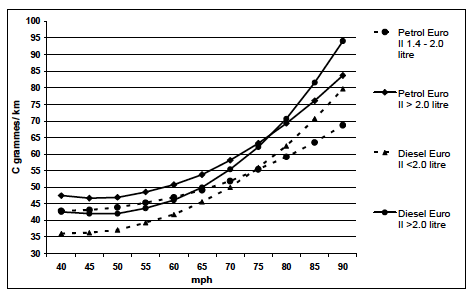
Under relatively steady speed driving conditions carbon dioxide emissions increase by around 14% between 70 and 80 mph and decrease by around 10% between 70 mph and 60 mph, according to modelling done for the carbon reduction strategy, said Lord Shutt of Greetland (the Deputy Chief Whip in the House of Lords, a Liberal Democrat) in a Parliamentary answer recently.

An increase of 14% would therefore mean an increase of half of one percent of UK total current annual emissions.

When asked whether he would support an increase in the speed limit given its impact on carbon emissions, Energy Minister Ed Davey said last month that the increasing number of vehicles on the roads in the coming years with lower emissions would offset any increase caused by higher speeds.

Is this true? The Department for Transport’s Carbon Reduction Strategy is arguing that by 2022, vehicles will be “vastly more fuel-efficient”.

“This will primarily be delivered through advances in the efficiency of the internal combustion engine. Alongside this, new ultra-low emission vehicles will have made their transition onto the mass-market,” it says.

On the other hand, the International Energy Agency has previously suggested that a temporary reduction of motorway speed limits to 90kph as a way of addressing fuel shortages would be a low cost measure that can lead to ‘large oil savings’ and, in a report, Saving Oil and Reducing CO2 Emissions in Transport, has recommended a general lowering of motorway speed limits that would not be restricted in time.

 The effect of vehicle speed on carbon emissions, from the Environmental Change Institute at the University of Oxford
What difference would this make? An enforced 70mph speed limit could cut carbon emissions by 1 million tonnes of carbon (MtC) per year by 2010, and a new 60mph limit could double this to 1.94 MtC, according to research by the Environment Change Institute, at the University of Oxford.

If added to the transport measures in the UK Climate Change Programme, carbon savings would increase by 15% (70 mph) or 29% (60 mph), they calculated.

What next?


It was last September, when Philip Hammond was Transport Secretary, that the Government announced it would be consulting on an increase in the speed limit, but it has yet to happen.

Mr Penning has said that any proposals would come with an impact assessment that would include research about road safety as well as emissions.

The Government is currently reliant for this on 2010 research about the relationship between road safety and speed limits.

Yesterday, a consultation ended on a call for evidence on the impact of speed limit changes to support the development of an appraisal tool to help local authorities assess the full costs and benefits of local speeds.

There is currently no published timescale for the initiative.

Friday, March 30, 2012

Renewables generated 9.5% of UK electricity in 2011

wind turbine

Renewable energy generation expanded by 10% and carbon emissions fell by 7% in 2011.

Renewable energy generation was responsible for 9.5% of all electricity supplied in the UK in 2011, failing to hit the magic 10% mark that had been predicted, according to the latest energy statistics from DECC - but renewable transport fuels are lagging behind targets.

But this is an increase of 35.1% on the previous year, when renewables accounted for 6.8% all electricity.

The lion's share of this was from thermal renewables, i.e. biomass, landfill gas and waste-to-energy, which accounted for 13.27TWh, and onshore wind which accounted for 10.42TWh.

Renewable electricity capacity also rose, by 32.1% on the previous year to 12.2 GW at the end of 2011.

Latest figures (March 25) show that the U.K.'s solar photovoltaic capacity for installations under the feed-in tariff is now 1.02 GW spread over a total of 298,762 installations.

Greenhouse gas emissions fall

The U.K.'s greenhouse gas emissions also fell by 7% last year, according to new figures released today.

This means that since 1990, the baseline year for the Kyoto Protocol, the U.K.'s carbon dioxide emissions have decreased by 23%, while overall energy consumption has decreased by 5%.

The fall last year is mainly due to reduced use of gas in the domestic sector, where emissions fell by 22%, but also due to more nuclear coming back on stream after outages the previous year, and reduced energy overall consumption due to the recession.

Total consumption of fuel fell by 2.2% last year, with gas taking the largest hit with a fall of 8.9%. Consumption of coal and other solid fuels rose by 9.3%

Emissions from the energy supply sector were estimated to be around 24% lower in 2011 than they were in 1990.

Commenting on the figures, Energy and Climate Change Secretary, Edward Davey said: “This is more evidence of how the UK is leading the way in the fight against climate change. Carbon emissions are down, homes are more energy efficient and low carbon power is up. Thanks to the Green Deal and the Government’s reforms to the electricity market I hope to see this trend continue and gather pace.”

Expansion continues

The improved renewable generation figures were helped by high rainfall in areas where hydroelectric generation takes place, and increased wind speeds. Hydro had a 58% increase on the previous year.

In fact, all renewable energy sources experienced expansion as the following table shows:

Renewable electricity sourceTWh% change on 2010
Onshore wind10.42+45.9
Offshore wind5.11+67.9
Hydro5.69+58.0
Thermal renewables (inc. co-firing)13.27+11.4
All renewables34.75 +35.1

Primary electricity consumption from nuclear and non-thermal renewables rose by 16.3%.

Nuclear generation rose by 11.1% mainly because there were extensive outages the previous year.

This means that low carbon generation including renewables accounts for 28.4% of all electricity generation in 2011 compared to 23.3% the previous year.

Renewable transport fuel

In the area of renewable transport, in 2011, biofuels accounted for just 3.5% of all transport fuels, less than the previous year.

The UK has a target of 5% under the Renewable Transport Fuels Obligation (RTFO) and now has one year to reach that target.

1,577 million litres of liquid biofuels were consumed in 2011, a fall of 5.9% on 2010's record annual high of 1,676 million litres,

A spokesperson for the Department for Transport said that despite the figures the UK is on track to meet the target because suppliers are stockpiling certificates to surrender in the future, representing the difference between what is used and what is held in stock by them.

Under the RTFO, suppliers can either produce or buy biofuels, or pay into a buy-out fund or purchase certificates from another company. Certificates can account for no more than 25% of the biofuels they hold. One Renewable Transport Fuel Certificate (RTFC) is equivalent to one litre of biofuel or kg of biogas.

The official said that companies hold certificates over from one year to the next if it is profitable for them to do so. They are currently betting that they will get a better prices in the coming year.

Transport is the hardest area to tackle in terms of reducing emissions. Its emissions are roughly unchanged from 1990 levels. Between 2010 and 2011 transport emissions decreased by 1.4%, and are now at their lowest since 1992, but they had been rising up until the recession began in 2007.

Since December 2011, the RTFO includes mandatory sustainability criteria, which included accounting for the carbon emissions of growing and transporting the fuels, and the impact on land use for food production.

Prices

Average industrial gas prices, including the CCL, were 15.9% higher in real terms in the last quarter of 2011 compared to the same period in 2010, whilst prices excluding CCL were 16.1% higher.

Average industrial electricity prices worth 3.5% higher including the CCL and 3.6% excluding it in the last quarter of 2011 compared to the corresponding quarter a year earlier.

Prices of all fuels, of course, rose last year, by an average of 9.5%, but within this electricity prices rose the least, by only 3.5%.

In fact it was heavy fuel oil which rose the most, by a staggering 19.1%, followed by gas prices which rose by 15.9%. Despite this, the price of unleaded petrol rose by only 4.6% and diesel by 5.1%.

UK industrial gas prices were the lowest in the EU15 for all types of consumer including and excluding tax.

During the last half of the year, industrial medium, large and extra large electricity consumers suffered prices higher than the median for the EU15 countries but small and domestic consumers had lower than average prices.

This means that the average domestic gas bill rose by £61 and the average electricity bill rose by £36 last year, the lowest and fourth lowest in the EU 15 respectively.

Wednesday, March 14, 2012

“Perfect storm" has arrived for efforts to reduce carbon emissions

Drax power station

Efforts to reduce carbon emissions in the UK and across Europe are facing a combination of factors strongly hindering investment in low carbon power generation and energy efficiency and promoting the burning of coal.

Now who do you believe? Today, one British tabloid newspaper is reporting that the construction of gas power plants is “twice government predictions", while another is reporting the exact opposite.

The Guardian reports Friends of the Earth analysis of the latest Government figures, from October, saying that while about 5GW of new gas-fired power generation will be needed to supply the UK in the coming decades, “power stations with more than 3GW of capacity are already now under construction and nearly 10GW of plants have received planning permission. In addition, nearly 10GW of capacity is in the earlier stages of planning".

Meanwhile, the Financial Times is warning that with 11GW of mainly coal-fired generation due to close by 2015 under the EU’s Large Combustion Plant Directive, we are burning more coal because it is currently cheaper than gas.

What is the truth?

Actually, both, at different time scales. Either way, however, it's not good news for the climate.

Coal is too cheap

Gas is today trading at just over 58p per therm, yielding baseload power for delivery today from gas generation of £45.20 per megawatt-hour. This does not leave much room for profit when electricity is trading at 45.50 £/MWh, and this is why coal generation is now favoured over gas.

The FT says “coal plants have been pumping at more than 75 per cent capacity, compared with 25 per cent a year ago".

This is a continuation of the trend of burning more coal over the last two years which is helping to push up the U.K.'s carbon emissions.

Partly as a result of increased demand, UK Coal moved from an interim loss of £93.2 million to a profit of £22.1 million in the six months to last June, following losses totalling £270 million over the previous three years. (However, this has not stopped it from announcing plans today to close the U.K.'s biggest coal mine, Daw Hill, near Coventry, by early 2014 when current seams are exhausted.)

The demand is driving strong imports of U.S. and Colombian coal into Europe, and prices have fallen to just over $100 (£64) a tonne.

This figure is wildly different from that predicted by the government just six months ago: $124 (£80).

(In fact, the price of coal wasn't even the price that DECC's report said it was at the time it was published; yet these now wildly inaccurate figures are those on which the Government bases its energy policy.)

The low price for coal is also partly the reason why Drax announced last month that it was scrapping plans for a new biomass power station, calling for more support for biomass generation from the Renewables Obligation to counter an increase in its fuel costs; although it put these fuel costs at just £33.3 per megawatt-hour, significantly less than that for gas.

Too many carbon credits


None of this is helping the UK, or Europe, meet its greenhouse gas emission targets.

The problem is that with coal prices low, a recession on, and an over-abundance of EU Emissions Allowances resulting in a low price of carbon, there is insufficient disincentive to burn coal, let alone gas, and consequently even less incentive to build renewable energy generation, nuclear power stations or develop carbon capture and storage.

Hence the need for DECC's
announcement this week of a £20 million competition to develop Carbon Capture and Storage technology, in the hope that it will reduce the price of this still unproven technology.

This combination of factors is the perfect storm for attempts to reduce carbon emissions this decade.

Carbon prices fell by over half during 2011 and are now still trading for under €8.

Despite rumblings from Brussels, the Commission is dragging its feet on moves to set aside allowances in order to restrict demand and stimulate the price.

Instead, it seems to be hoping that by the end of the year, when airlines begin being required to purchase carbon-emission allowances as part of their role in the Emissions Trading Scheme, this will stimulate a price rise. But that is still nine months away.

According to carbon market analyst Steven Knell, from IHS CERA, the ETS in no longer the main policy tool for reducing emissions ″because the supply and price of allowances are fixed and predetermined. The market is poorly equipped to deal with disruptions in demand levels," he says.

“This, plus the financial crisis, the consequent fall in emissions, and the fragile nature of the recovery, added to recent price decline due to the expectation that policy risks will deprive the market of demand, mean that action to fix the problem is urgently required".

The oversupply means that only 6.8% of all EUAs are trading; a poor proportion. This amounts to 550 million tonnes, which is equivalent to all the emissions of the non-power generation industry members of the market in Europe, i.e., the high energy users like steel and concrete; or, to put it another way, all of the U.K.'s allowances.

“This yields a long position and indicates what the price will be like in 2020: that it will not change sufficiently to stimulate the demand required for investment in energy efficiency and renewable energy lesser-known carbon capture and storage or nuclear power," says Knell.

The supply of carbon-emission allowances needs to decline more aggressively and prices need to be higher.

The policy overlap in Europe needs addressing, he says. “The latest agreements give the possibility to set aside some EU Allowances to promote energy efficiency in the draft of the Energy Efficiency Directive, but the amount set aside would need to be substantial," he says.

“Strong medicine is needed."

“Strong medicine is needed," concludes Knell. He points to an increase in European ambition for emission reduction cuts from 20% to 30% by 2020, which, he says is achievable due to the recession's effects.

However, Poland has just vetoed this target at last Friday's meeting of environment ministers because of its own addiction to coal-fired electricity generation. This vote is not binding on a Commission decision however, and it remains to be seen what will happen.

In the meantime, only two strategies are available to individual governments, because they can't control the price of oil, and these are to tax carbon and support the carbon price.

Therefore, any measure that favours the energy-intensive industries by reducing the impact of carbon-penalising policies in next week's Budget from the Chancellor, George Osborne, will send precisely the wrong signals to the market.

The setting of the carbon price floor, and reform of the energy market are urgently required to favour carbon-reduction investment and weather this storm.

But contrary to the impression given by the Financial Times article, whatever happens the lights will stay on in Britain, because of the number of gas-fired power stations that have received planning permission; they may not be built just yet, but they will be built when coal and nuclear generation comes off-line in the future, to meet any demand not met by offshore wind.

But whether it's coal or gas, it locks in more UK carbon emissions than desirable for the next 20 or so years. Chancellor: are you paying attention?

Wednesday, February 08, 2012

U.K. emissions rise for second year; CCS remains a pipe dream; new energy efficiency unit in government


UK 2012-11 carbon emissions chart

The U.K.'s net carbon dioxide emissions rose in 2010/11 by 3.8% on the 2009 figure of 477.8 Mt., even more than earlier provisional figures had suggested.

Much of this increase was due to the residential sector, which was 15.8% (11.8 Mt) up, while the energy supply sector was up 3.1% (5.8 Mt)

The blame is being put on the cold period at the beginning of last winter and the downtime of some nuclear plants, which caused "a rise in residential gas use", and the burning of more coal in power stations.

But in fact it is a new trend: the previous years' figures also show an increase in net carbon dioxide emissions of 3.8%, and follow a period when they were sharply falling.

In 2010 there were technical problems at some nuclear power stations. In particular, Sizewell B, the largest nuclear power station, was offline for six months, which DECC says contributed to an increase of around 4% in emissions from electricity generation between 2009 and 2010.

Emissions from international aviation fuel use are not included in these figures, but the report does estimate them for 2010, at 31.8 million tonnes carbon dioxide equivalent.

This is assessed to be 4.4% lower than the 2009 figure of 33.3 million tonnes, but is still more than double the 1990 level. High altitude aviation has a greenhouse effect over and above that of carbon dioxide alone, but this is not reflected in these estimates.

International shipping emissions, also kept out of the headline figure, were estimated at 8.8 million tonnes carbon dioxide equivalent, a 13.3% drop on the 2009 figure of 10.1 million tonnes.

They are now at the same level as in 1990. The figures are estimated from the state of UK shipping bunkers, but DECC observes that "UK operators purchase most of their fuel outside the UK". Therefore the figure cannot provide a true picture of emissions.

The next report on progress towards meeting the UK's carbon budgets, as required under section 16 of the Climate Change Act, will be made by the end of March and detail exactly how well the country is doing in trying to meet its reduction targets, but, DECC's current estimate is that UK greenhouse gas emissions were 23% lower in 2010 than in 1990, and that we are therefore on target.

However, once the official Defra "consumption emissions" are factored in (up 20% since 1990), then it reveals a drop of just 3% in the overall greenhouse gas emissions for which the UK is responsible since 1990 (and this does not include the above emissions from shipping and aviation).

€1 billion for carbon capture and storage


If burning coal, and to a lesser extent gas, is one principle reason for this, then a solution sought by some is carbon capture and storage (CCS).

The 2050 Energy Roadmap, adopted by the European Commission in December, expects CCS to be responsible for between 19% and 32% of total European Union emission cuts by 2050.

Further funding for the development of this presently unproven and uncommercial technology is expected to come from the European Union's energy infrastructure package, which is currently being drafted.

AntĂłnio Correia de Campos, a rapporteur whose job it is to steer the package through the European Parliament, said yesterday that about €1 billion, or “around 10%-15%” of the €9.1 billion funding in the legislation is likely to be allocated to pilot programmes for CCS.

The cash from the infrastructure fund “will be fundamental for it,” said de Campos.

Twelve demonstration plants were supposed to be running by 2015, but due to cancellations, “the programme will deliver four to six projects, tops, and some say that’s optimistic,” according to Eric Drosin, a spokesman for Zero Emissions Platform, a group of private and public partners lobbying for CCS.

Most European countries lack enthusiasm for CCS, because of its huge cost.

For example, a Spanish project, Ciuden, was given €180 million euros in 2009 to develop a means of collecting waste carbon dioxide from coal burning, cooling it to a liquid and pumping it for indefinite storage into underground rock formations.

It was meant to be completed by 2015, but is now "unofficially mothballed" due to a lack of match funding.

At this rate of development, Arthouros Zervos, president of the European Renewable Energy Council, believes "it won’t be commercially viable until 2030, and if you give the money to CCS you subtract it from other electricity infrastructure projects which Europe needs urgently”.

Zervas says that “even the people building CCS say this".

The draft report of the European Parliament on the energy infrastructure package is due on 28 February, just before publication of the ENTSO-E (European Network of Transmission System Operators for Electricity) 10-year network development plan, which will be the blueprint for Europe's interconnected grid.

And without that transmission grid, new renewable energy generation capacity will have no way of getting power to the homes and businesses that will need it.

Meanwhile, it seems, without more action on using energy more efficiently, we must keep on burning coal and letting the emissions rise.

New energy efficiency team

Therefore it is good news that Ed Davey, the new Energy and Climate Change Secretary has just announced details of a new 50-strong Energy Efficiency Deployment Office (EEDO) in DECC.

In his first speech as Secretary of State, Mr Davey he is “hugely enthusiastic about energy efficiency. It’s the cheapest way of cutting carbon – and cutting bills for consumers. It has to be right at the heart of what we do.

“EEDO will be a centre of expertise, challenging our work and making energy efficiency real and relevant to people’s everyday lives. Two out of three consumers think their home is wasting energy, but only one in three is going to do anything about it. That has to change. We need to get out there and show people what energy efficiency can really do for them.

“The Green Deal will play a huge part in this work and will also support jobs in the insulation and construction industries– as many as 65,000 right across the country by 2015. It can help us deliver a fairer, greener economy. And help us get young people back into work – or into work for the first time."

The team, which will be based at DECC’s headquarters in London, will pull together expertise from across the Department. EEDO staff will continue to support the delivery of the Green Deal, the rollout of smart meters and the increase in renewable heat as well as developing a new energy efficiency strategy to identify the potential for further energy efficiency across the economy.

As well as having its own expertise, EEDO will work with leading industry experts to ensure we have the best possible evidence, analysis and policy response to this challenging agenda.

Mr. Davey said that today DECC is launching a call for evidence to help underpin the energy efficiency strategy.