Showing posts with label DECC. Show all posts

Wednesday, August 19, 2015

In 2013-14 every UK taxpayer spent £252.53 on looking after nuclear waste. Why make more?


We don't know what to do with nuclear waste, which is toxic for thousands of years and is extremely expensive to look after. In 2013-14 every UK taxpayer spent a staggering £252.53 on looking after this waste. Why make more?

How much is there? 

4.5 million cubic metres (4.9 million tonnes), enough to fill Wembley Stadium four times over. 1,100 cubic metres is very dangerous high level waste and 290,000 cubic metres is intermediate level waste. It's managed by a government body called the Nuclear Decommissioning Authority (NDA).

4% more will be produced in the future from the UK's continuing nuclear defence capability (waste estimated up to 2060) and its continuing nuclear-powered submarine programme (waste estimated up to 2100). [Source: NDA]

How much does it cost?

It costs £3.31 billion a year to manage the nuclear waste mountain, of which £2.09 billion comes from taxpayers. [Source: NDA]

The government funding comes from the Department for Energy and Climate Change (DECC). Its total annual budget last year (2014-15) was £3.4 billion, so two thirds of this is for looking after Britain's nuclear waste mountain.

So on this basis, every one of the 29.7 million taxpayers in the UK spends £114.48 a year on looking after nuclear waste.

But this figure is not the same every year. In 2013/14, 95.8% of the roughly £7.9 billion DECC budget (£7.5 billion) went towards cleaning up the UK's nuclear legacy

Above: pie chart of the DEL budget. Chart by Carbon Brief.

On this basis, every UK taxpayer spends £252.53 a year on looking after nuclear waste.

Whatever the average in the future will be, it will continue for hundreds, if not thousands of years. Perhaps as long into the future as the building of Stonehenge is in the past. And we have no idea why that was built, so will people in the future know what our relics are?


The above chart of DECC's budget during 2013/14 shows what government calls "annually managed expenditure" (AME). Most of this relates to nuclear decommissioning. Most went towards cleaning up the UK's nuclear legacy. Source: Cabinet Office and DECC annual report and accounts. Chart by Carbon Brief.

The costs are rising.

The estimated costs of cleaning up the Sellafield nuclear site rose an estimated £5 billion to £53 billion in February this year, according to a March statement from Public Accounts Committee chair Margaret Hodge. She says: "It has taken far too long for the Authority to deal with management incompetence at Sellafield".

A private consortium, Nuclear Management Partners (NMP), that had been running the clean-up at Sellafield was stripped of its contract in January for reasons of incompetence.

Until the recent cuts DECC's budget was just 1.2% of the total government budget. Since then it's been told by George Osborne to save a further £70 million. The nuclear waste amount can't be changed for safety reasons.

Since most of DECC's budget is for managing nuclear waste, shouldn't the department be renamed The Department for Nuclear Waste?

Where should the waste go?


It's now held in temporary storage ponds on the north west coast of England, in Sellafield. These ponds are deteriorating, and leaks occur. So for 50 years the government and the industry has been looking for a permanent storage place underground.

It has not found one, because nobody wants it beneath their feet, not even the good people of Sellafield themselves.

So, since April the government can override local councils and force nuclear waste dumps on a community, under a law that was rushed through in the final hours of the last parliament. This is like the recent announcement that would allow fracking anywhere that the onshore oil and gas industry wants, against local wishes, if the government says so.

Is this what you want?

None of the above gives me any reason to be confident about Britain building a new generation of nuclear power stations.

Renewable energy can give much better value for money and provide baseload power in the cases of hydroelectric and marine power, and renewable gas, while electricity storage solutions are fast-tracked for Research and Development to store intermittently generated electricity from wind and solar, without leaving a toxic and expensive legacy.

Friday, July 19, 2013

DECC tables plan to support independent renewable energy suppliers

Energy Minister Greg Barker.
Energy Minister Greg Barker said: “Our new reforms will create the framework for a far more dynamic and entrepreneurial market”.
The Department for Energy and Climate Change (DECC) has published plans to help independent renewable generators gain entry to the electricity market, in order to promote competition and innovation.

Energy Minister Greg Barker has tabled an amendment to the Energy Bill that will make it easier for independent generators of renewable electricity to sell their power to suppliers via Power Purchase Agreements, thereby improving their access to market.

Energy Minister Greg Barker said: “The Coalition is committed to driving much greater plurality, innovation and competition in the electricity market.

“Our new reforms will create the framework for a far more dynamic and entrepreneurial market, while still ensuring that we get the large scale investment that industry needs. Opening up the electricity market to more competition is a fundamental part of the reforms we are introducing through the Energy Bill.

“It will also allow new smaller players to gain a greater share of the exciting renewable electricity market.”

The amendment allows for the creation of an off-taker of last resort to be enabled, providing ‘back-stop’ power, providing greater certainty for renewable generators and investors.

Independent generators do not usually have a strong supply arm that sells electricity direct to consumers and have been finding it hard to enter the market, which is dominated by the ‘Big Six’ vertically integrated energy companies.

DECC says such companies "play an important role in helping to meet the country’s renewable energy targets, account for a significant chunk of the new energy infrastructure projects that are awaiting final investment decisions", and also introduce innovation and competition into the market.

The amendment would enable the Government to establish a scheme obliging suppliers to buy electricity from renewable generators under specified conditions if they were unable to agree a commercial contract. It would be used as a last resort, to strengthen routes to market and stimulate competition.

Detailed proposals will be developed and consulted on later this year.

Independent generators often sell their power to suppliers via power purchase agreements, and this is how they gain a route to market. The definition can cover a range of technologies and sizes.

Earlier this week DECC also published a draft delivery plan for Contract for Differences (CfDs) and the reliability standard of the future Capacity Market to guide how much capacity is auctioned in 2014 for delivery in 2018 to 2019.

Unveiling the plan, Secretary of State Ed Davey said it should "provide investors with further certainty of government's intent" to help incentivise up to £110 billion of funding for new electricity infrastructure by 2020.


Woodfuel conditions


DECC also issued a condition that new standalone biomass power plants will not be eligible for some subsidies unless they also generate heat, meaning many new plants could be cancelled, according to the Renewable Energy Association (REA), which represents large biomass generators. Gaynor Hartnell, its chief executive, said that combined heat and power (CHP) could not easily be retrofitted onto projects that had already been approved.

The move was welcomed by the Combined Heat and Power Association, which has lobbied in its favour. CHP is seen as much more efficient, as otherwise the heat goes to waste.

DECC also plans to restrict subsidies for biomass to 400MW per plant under the Renewables Obligation, which will operate until 2018.

The restriction does not apply to plants converting from coal-fired power, such as Drax, Britain's biggest power station. This means that large scale, controversial imports of wood pellets to Britain will continue, at least until the subsidies phase out in 2027.

On Wednesday, Mr Davey said that importing wood and burning it as biomass was not a long-term answer to the country's energy needs, leading to expectations that the government would reverse its support policy, but this has not materialised.

"This is something we already knew and does not mark a change in government policy," a Drax spokeswoman said.

DECC does believe that biomass is a transitional technology, "to be replaced by other, lower carbon forms of renewable energy in the medium to long term", it said in a statement.

Environmental groups are concerned that growth in Britain's bioenergy industry will mean the felling of virgin forests for fuel, a practice that was commonplace in Europe and North America before coal was used to power the industrial revolution. They are also worried that it takes 50 years to absorb from the atmosphere the carbon dioxide that is emitted during the burning of a tree.

Drax asserts that the woodfuel it imports has cut emissions in converted units by 80% compared with burning seaborne coal, and that it is certified as sustainable.

Last week, RWE npower said it would close a newly converted 750-megawatt biomass plant at Tilbury by July 21 because of a forecast drop in UK power prices and lack of capital from the Germany-based parent RWE.

Last year Drax also scrapped plans to build a new dedicated biomass plant on its site in North Yorkshire, due, it said, to insufficient government support.

Energy Minister Greg Barker said: “Our new reforms will create the framework for a far more dynamic and entrepreneurial market”.

Tuesday, July 02, 2013

New prize to stimulate dynamic demand innovation

Stewart Reid, Future Networks Project Manager for SSE’s NINES project, says dynamic demand response will make wind power more effective and efficient.
A Dynamic Demand Challenge Prize has been launched to help meet the challenge of satisfying ever-increasing demands on the UK’s power grid, as highlighted by last week’s Ofgem report on tightening electricity margins.

The prize is the initiative of Nesta, the UK’s innovation foundation, and hopes to find new ways of managing demand to shift electricity consumption from peak to off-peak times, reducing carbon emissions and better responding to demands on UK energy supplies.

Solutions will depend upon the smart grid: new data-driven, demand side response-enabled products, technologies or services, that reduce carbon emissions by shifting energy use to off peak times or towards renewable generation.

Dynamic demand, or demand side response (DSR), is the exchange of information between electronic devices, responding to signals from the grid directly or indirectly.

It will be built into the capacity market, being created by the new Energy Bill, to can help shift electricity consumption away from peak hours where electricity consumption is high, or enable greater usage of excess electricity generation from renewables, as well as help maximise the use of the smart grid.

A number of trials are taking place at the moment through initiatives such as Low Carbon London, DECC/Ofgem’s Smart Grid Forum and the Low Carbon Network Fund.

Currently the UK’s biggest smart grid initiative is a £54 million scheme called the Customer-led network revolution in which 14,000 homes and businesses are finding ways to reduce both their energy spend and carbon emissions.

The project includes decentralised generation and demand reduction through efficient smart appliances and is trialling demand response through the combination of generation and flexibly operated appliances. It is supported by Low Carbon Network Fund, with partners UK Power Networks, Northern PowerGrid, British Gas, Durham University and EA Technology.

A new project called Smart Hooky is now trialling a range of new technologies to create a community–scale smart grid that will help Western Power Distribution understand how a rural community uses electricity at different times of the day in order to manage peak demands and let electricity networks accommodate more renewable energy.

The Dynamic Demand Challenge Prize will offer incentives, financial support and expert guidance for shortlisted projects, with a prize of £50,000 for the solution that demonstrates the most significant impact.

Constance Agyeman, development manager, Nesta’s Centre for Challenge Prizes, commented: “The Dynamic Demand Challenge Prize will support innovations that create a measurable shift in energy use. This is important because there is increasing demand on the UK’s electricity supplies and we therefore need to find new ways to manage this.”

Partners in the challenge include the Centre for Carbon Measurement, the Department for Business Innovation and Skills and National Grid. Neil Hughes, NG's head of technology, explains, “Balancing the grid will become more complex as more renewable generation comes onto the system and our goal is to help new service providers understand those challenges and develop technologies to meet that growing need”.

Jane Burston, head of the Centre for Carbon Measurement at the National Physical Laboratory notes, “Climate change and a secure, clean energy supply are two of the biggest challenges of our time. Demand side response is a critical step in supporting the shift in supply towards renewable generation. This will only be successful with engaging tools and technologies we want to use in our homes and offices.”

The challenge is open to entries from anyone across the European Union, but the solution must be applied within a UK context.

Northern Isles New Energy Solutions (NINES)

NINES is another important dynamic demand response solution that is being developed by SSE in Scotland. It aims to support Shetland’s sustainable energy future by developing and managing the electricity distribution network more effectively.

Measures used here include replacing old inefficient storage and water heaters with modern 'smart' storage heaters, and adding a new electric boiler to the existing district heating system, both of which help to balance the electricity network.

This is crucial, says Tim Rotheray of the Combined Heat and Power Association, because currently wind turbines generating electricity that is not needed at that point in time are paid constraint payments per megawatt not to feed their power into the grid.

To combat this waste, often seized upon by opponents of wind power as a reason to oppose wind farms, the power can instead be stored in the form of hot water using the systems being installed here, even diverting the power for a few seconds, as when there are spikes of generation during blustery weather.

NINES is also deploying new technology that will allow more small-scale renewable generators to connect to the network and introducing new commercial arrangements to encourage businesses to change the times at which they use most energy, similar to ones that will be in the new capacity market.

Finally, it is also installing a 1MW battery, part-funded by the Department for Energy and Climate Change, at Lerwick Power Station.

The project will help SSE plan for the replacement of its existing Lerwick Power Station, which is nearing the end of its useful life, with a smaller station than would otherwise be required.

This type of demand side response solution is already used in Denmark, for example in the Skagen District Heating system, which utilises electric as well as gas-fired CHP boilers.

Silver Springs

Silver Springs is a company which already has 10 years' experience in this area in north America and Asia Pacific. With a customer-focussed attitude to smart meters, it works directly with end users and communities and has recently established an office in the UK.

Their Oklahoma Smart Hours Programme is a demand response initiative to encourage customers to shift their energy use to off-peak hours that works by establishing local communications infrastructure and installing programmable communicating thermostats to control air conditioning units at times of peak demand.

The programme has helped 44,000 users save an average of $191 each, and delivered more than 67 megawatts of load reduction in 2012.

In the UK, another pioneer is The Ouse Valley Energy Services Company Ltd, formed by members of the Transition Town Lewes Energy Group, which includes decentralised generation and demand reduction and is currently investigating local electricity and heat distribution networks for villages and towns within the District.

The community-owned MOZES (Meadows Ozone Energy Services Company) is also delivering decentralised generation and demand reduction, with the aim of helping the community to become self-sufficient in energy use, and then to become an energy generating community.

All of these initiatives are exploring and developing models that fit with the new paradigm of using available low carbon energy in real time more efficiently, one of the chief challenges of moving to a low carbon future, that is being supported by the NESTA challenge.

Friday, September 14, 2012

DECC "pleased with progress" towards climate change targets says chief civil servant

Phil Wynn Owen, Director General of DECC's International Climate Change and Energy Efficiency group
Welshman Phil Wynn Owen, Director General of DECC's International Climate Change and Energy Efficiency group.

The British Government is pleased with its progress towards meeting its climate change targets and in steering the European Union and the United Nations climate talks in a satisfactory direction, according to a senior official within the Department for Energy and Climate Change (DECC).

Speaking exclusively to me at The Energy Event at Birmingham's National Exhibition Centre yesterday, the official said that, given the long timescales involved, DECC is happy with progress so far.

Phil Wynn Owen is Director General of the International Climate Change and Energy Efficiency group. Before that, he was an official in the Treasury. His remarks, paraphrased below, give an insight into thinking within senior levels of government.

UN discussions

The top-level Conference of the Parties (COP) United Nations Framework Convention on Climate Change (UNFCCC) talks, designed to reach global agreement on limiting greenhouse gas emissions, happen at the end of each year. At the last of these talks in Durban, it was agreed that nations would put in place by the end of 2015 a binding legal agreement to curb greenhouse gas emissions that will take effect in 2020.

The UK government was pleased and surprised by this outcome, given the pessimism that preceded these talks.

In between these annual talks are interim negotiations. UK officials were disappointed by the progress made at the last of these, which took place in Bonn earlier this year and ended without agreement. They therefore led calls, together with Christiana Figueres, the Executive Secretary of UNFCCC, for a further meeting, which happened in Bangkok at the end of August and beginning of September.

Whereas outside reports expressed dismay at the lack of progress made there, too, DECC officials believe that significant progress was made, laying the groundwork for a legal agreement.

There was also good progress in negotiating a successor framework to the Kyoto Protocol.

DECC had a large team negotiating in Bangkok, who played a significant part in the production of the first draft of a full negotiating text. This will be discussed at the next Conference of the Parties (COP 18) in Doha, Qatar in late November this year.

The UK Government believes it is very important that these forthcoming talks will take place in the heart of the oil-producing Gulf states.

Energy and Climate Change Minister Greg Barker told an All Party Parliamentary Group meeting at the House of Commons on Monday that he feels the talks “offer a unique opportunity to encourage the major oil and gas producing states to recognise the benefits of signing up to a low carbon agenda".

DECC is thinking particularly about Saudi Arabia, which has recently announced a huge commitment to solar power. At previous COP negotiations its team has resorted to blocking and delaying tactics and watering down mitigation targets. DECC believes that this November's talks offer an opportunity for Saudi Arabia to see the benefits of behaving otherwise.

The long view

The senior DECC official turned to the disparity between Government and business attitudes towards the low carbon agenda, the latter of which on the whole are enthusiastic, since the sector is one of the few areas of the economy which is experiencing significant growth.

Here, with the longsighted vision of a long-serving civil servant, Mr Owen paid tribute to the manner in which the UK Government conducts its consultations and discussions on developing its energy policies.

While recognising that some sectors would like government to move faster, most appreciated that, with resources tight due to the ongoing recession, it was necessary to have a debate which took in the views of all sides on the most cost-effective way to decarbonise the country and adapt to climate change.

Dominant thinking is now that the greatest opportunities lie in cutting energy use, reducing demand, and energy efficiency.

The beginning of Mr Owen's presentation to delegates yesterday morning was taken up with extremely depressing figures about the rate of increase of climate-warming emissions and their likely effects on overall average global temperatures.

At present trends, the world is headed for at least 3°C warming, which will create a “very high risk of economic impact", he said.

By 2020 there is likely to be an atmospheric concentration of carbon dioxide greater than 550 ppm, which means that after that year emissions will need to reduce by up to 2.5% per year, a daunting prospect.

DECC is still very aware of the recommendations of the 2007 Stern Review, which said that early action to tackle climate change would be much cheaper than waiting and taking action later. Mr Owen reported that its author, Nicholas Stern, is “very pessimistic" these days.

He, however, remains optimistic. Turning around the behaviour of a whole country, let alone the whole world, is bound to take far longer than turning around the behaviour of any single company, no matter how large.

Moreover, companies have a completely different command structure to government and nations, unless they are totalitarian and can therefore act more quickly. This explains the long timescale required.

Mr Owen said that the measures contained in the Green Deal, the introduction of 53 million smart meters by 2019 in 30 million properties, and the Renewable Heat Incentive, which will increase the proportion of renewable heat from the current 1% to 12% by 2020, all give grounds for optimism.

Within the proposed Electricity Market Reforms, the capacity mechanism, the carbon price floor, and contracts for difference, will all help to leverage the £110 billion of investment required by 2020 to decarbonise the energy infrastructure.

He backed Ed Davey's defence of these measures, published yesterday, saying that they will create at least a quarter of a million jobs.

Moreover, energy intensive users will be compensated for the effects of the measures on their energy bills.

Mr Owen added that DECC is still lobbying within the European Union for it to commit to a 30% target for reducing emissions by 2020.

Mr Owen is clearly proud of his department's achievements; that it, and therefore the UK as a whole, is playing a vitally important role in steering the whole world away from completely disastrous climate change.

Government should set a 2030 decarbonisation target

Osborne's Liberal Democrat deputy, Danny Alexander
George Osborne's Liberal Democrat deputy, Danny Alexander will call for a target and criticise his boss's attitude to low carbon tech at the Lib-Dem party conference.

The role of gas-fired generation and the setting of a 2030 decarbonisation target for the electricity market has become the focus of a bitter battle between Lib Dems and George Osborne.

Yesterday, Edward Davey, Secretary of State for Energy and Climate Change, responded to a letter from the Committee on Climate Change, signed by its new Chairman, Lord Deben, criticising the recent Government statement that gas would continue to play an important role in the energy mix beyond 2030, not restricted to providing backup to renewables".

The letter added that this position could be illegal under the Climate Change Act 2008, and “weakens the signal provided by carbon budgets to investors" in clean tech.

It also recommends the setting of a clear carbon emission objective for electricity market reform, of around 50g of CO2 per kilowatt-hour by 2030.

Earlier this year George Osborne ruled out such a measure, expressing concern that such a target would undermine investor confidence in the gas industry, which he wants to build up.

In short, the argument between Osborne and DECC is about whether investment should be predominantly directed into renewables or gas. Gas, being cheaper, is favoured by Osborne.

But it is also an argument between the Lib Dems and Conservatives. Osborne's Liberal Democrat deputy, Danny Alexander, has signalled that he will call for a 2030 decarbonisation goal to be implemented when he speaks at the party's conference in two weeks.

He will also use his speech to attack the Conservatives for not acknowledging the economic benefits of investing in low carbon tech.

In reply to the CCC letter, Mr Davey, who this week adopted responsibility for renewables policy that was previously the ex-energy minister Charles Hendry's brief, issued a statement.

This said that a target is "under consideration" but argued that the Government's "existing plans are consistent with significant decarbonisation of the power sector".

Davey is known to believe that a limit on carbon emissions from the sector could be achieved using a statutory instrument instead of being included in the Energy Bill.

Osborne is currently sanguine about DECC's consultation on a carbon emissions limit for 2030, because he doesn't think it would make a material difference in practice.

But Davey's ace in his hand remains the carbon budgets that have been agreed by Parliament, which could trump Treasury policy provided that it is played with a strong suit.

Davey's response to the Committee's letter emphasises this, that the statutory carbon budgets that are set by the Committee, and agreed by Parliament, underscore all policy and planned market reforms.

“We have always said [our reforms] will include gas fired plant," the statement says, “which is quick to build and flexible." But "after 2030 we expect that gas will increasingly be used only as back up, or fitted with Carbon Capture and Storage technology.

"Alongside up-scaling of renewables, nuclear new build, and eventually with carbon capture and storage, gas has an important role to play in the transition to a low carbon grid."

But how much gas generation could be installed and still permit the UK realistically to meet its carbon budgets?

“Our numbers show that we can accommodate around 30 to 45GW of unabated gas over the next twenty years and still hit our carbon targets, but any further fossil fuels will need CCS, which is not yet commercially viable," Davey said on Wednesday.

This means over a dozen new gas-fired power plants in the next 15 years.

While the Committee's letter was greeted with approval by the clean tech sector, this response by Davey has been met with scepticism.

Utility company SSE tweeted that, contrary to the Treasury view, a "2030 decarbonisation target in EMR would provide much-needed certainty for low-carbon investors and developers".

Climate and energy campaigner for Greenpeace, Joss Garman, calculated that “where you have as much as 45GW of unabated gas in 2030 (and if you assume demand by then of around 420TWh), this would require that all those gas stations are only operating for 15% of the time if we are to keep on track with carbon targets. It also requires all of the UK’s coal stations are shut down or operating with fully functioning Carbon Capture and Storage (CCS)."

"The UK is already over-reliant on gas, which was the main driver behind recent energy bill rises," said Keith Allott, head of climate change at WWF.

The cross-party energy select committee, led by Tim Yeo, has also reiterated calls for a 2030 decarbonisation goal.

“Our gas generation strategy work is about providing certainty to investors to ensure sufficient investment comes forward, whilst also living within our legally binding carbon budgets,” concluded Ed Davey's statement.

To Garman and the other objectors, this seems like trying to have your cake and eat it.

Thursday, September 13, 2012

Energy efficiency is cheapest energy reform, say top UK Government officials

 Chris Pook, Deputy Director of Green Economy, at the Department of Business Innovation and Skills (BIS)
 Chris Pook, Deputy Director of Green Economy, at the Department of Business Innovation and Skills (BIS)

Energy efficiency was affirmed by Government officials from two departments on Tuesday as being by far the cheapest way of meeting the UK’s climate commitments and decarbonising its electricity grid.

Speaking at The Energy Event at Birmingham's NEC, Trevor Hutchings, Head of Strategy and Delivery, DECC, and Chris Pook, Deputy Director of Green Economy, at the Department of Business Innovation and Skills (BIS), both referred to sources of research, including studies by McKinsey, which show that most measures to reduce energy usage have negative costs, compared to building more energy generation plant or carbon capture and storage.

Trevor Hutchings said that DECC's Energy Efficiency Deployment Office (EEDO) is still compiling its evidence base, since its formation earlier this year, and will publish its recommendations in the autumn.

The key challenges, he said, were how to drive innovation to cut costs of both manufacturing and installation, and how to speed up installation.

Thinking up ways of getting the public onside and engendering behaviour change to make it the social norm for people to save energy, is also part of EEDO's work.

Hutchings said that he regarded it as an early success that the UK had played its part in the negotiation of the Energy Efficiency Directive.

This deal, struck in June, was formally adopted by the European Parliament yesterday in Brussels. It clears the way for the Directive to enter force by the end of October, and sets a voluntary 20% energy saving target for the whole of Europe.

However, earlier this month, Greg Barker cast doubt on whether the UK had really signed up to a 20% target, when he responded to a Parliamentary question from Zac Goldsmith by saying that the target “applies to the European Union as a whole. The UK does not currently have a target to reduce primary energy consumption by 20% by 2020 relative to business as usual.

"Under article 3 of the Energy Efficiency Directive, the UK is required notify the European Commission of its indicative target for final energy consumption in 2020 by 30 April 2013."

EEDO will play its part in overlooking the implementation of the Directive, Hutchings said.

The Coalition for Energy Savings believes that the Directive is only a first step towards making energy efficiency the prime consideration for European energy policy. It believes it can secure at least 15% energy savings by 2020, up from the currently projected 10%.

“It is the first time that the EU has established binding annual energy savings targets, combined with a broad range of new energy efficiency improvement requirements covering the whole energy system, from energy generation and distribution to consumption and building renovation," said Stefan Scheuer, Secretary General of the Coalition for Energy Savings.

Speaking for BIS, Chris Pook said that the department had signed up to the carbon budgets set by the Committee on Climate Change. "It aims underpin our policies, but determining those policies is complex," he admitted. “Electricity market reform, the Green Deal, and the carbon price floor, are all problematic."

The division in Government over energy policy is even more apparent since the Cabinet reshuffle, with Vince Cable's speech on his industrial strategy yesterday overshadowed by calls from business leaders to get the rest of the Cabinet on his side, if he wants it to be a success.

At this week's Energy Event, energy-intensive users expressed delight at the recent ministerial appointments. Andrew Bainbridge, Chairman of the Major Energy Users’ Council, said that at last they might "see some sense" in government energy policy. These users are worried that a planned carbon price floor will raise their electricity costs above those of European rivals.

The MEUC is encouraging its members to take on board energy efficiency, however, and launched yesterday the third in a series of workbooks linked to training sessions, called How To Accelerate Your Energy Efficiency Training Programme, written by Dr John Ryan.

Thursday, August 02, 2012

Scandal of the unclaimed renewable heat grants

solar water heating
Only one solar thermal installation has so far been completed under the Renewable Heat Incentive.

Only half of the grants offered by Government to businesses and councils to install renewable heating schemes are being claimed.

One of the main reasons appears to be lack of publicity, but the grant conditions also are claimed to be too tight.

Under the Renewable Heat Incentive, businesses and public sector bodies can claim a subsidy for every unit of power generated from technologies such as solar water heating panels, biomass boilers and heat pumps, in the same way as can be claimed for renewable electricity under the feed-in tariff scheme.

The first tranche of the scheme, launched last year by the Department of Energy and Climate Change (DECC), was underspent by 50%: £5.5 million of the £10.8 million budget was unclaimed. According to Ofgem, just 176 schemes are receiving payment, a pitifully small number.

The second stage, worth £7 million was launched in March, and the latest figures show a total of only £817,250 claimed. The vast majority of these are for solid biomass boilers.

If this rate of uptake continues until the scheme closes in March 2013, just £3.9 million will be spent.

New figures, released yesterday, show that DECC's current estimated expenditure for 2012/13, based on the total number of RHI applications received to date, is £18 million. The cap on spending is £70 million. At this rate DECC estimates only £42 million will be spent.

As the figure is based on applications rather than fully accredited installations, the eventual figure is likely to be lower.

The Renewable Energy Association's head of policy, Paul Thompson, said the difficulty in giving away the grants is due to three factors, all decided by DECC: the time-limit, the lack of publicity, and the small amount of support on offer, which, he said was “not enough money to influence people's decisions".

He said: "You've got to have a bright idea that's pretty much developed to be in a position to be able to meet the deadlines".

He called upon DECC to use unspent funds to run a publicity campaign. The Department is currently deciding what to do with unspent funds from the social landlord's scheme.

DECC also launched an £8 million competition for community groups on 24 July, to install renewable heating. Grants up to £160,000 are available but applications must be in by 7 September, which is too early for some groups to manage. In addition, the completion schedule is tight: projects have to be completed by the end of the financial year.

EU targets dictate that 12% of the nation's heating needs to come from renewable sources by 2020, an increase of 2.2% on 2011 levels.

What is mystifying is the lack of installation of solar thermal. In the previous support system run by DECC, solar water heating was by far the most popular technology. It has proved to be very successful in this country, much more so than solar PV in terms of value for money.

In fact, renewable heat in general it is more cost-effective than renewable electricity, at a small scale.

Yet the Ofgem figures show that there has been just one solar thermal scheme supported under the RHI. The full figures are:


Technology TypeNo of accredited installations / Registered biomethane producersInstalled Capacity (MW)
Biogas10.113
Solid Biomass Boiler1626.02
Deep Geothermal00.000
Ground Source Heat Pump (GSHP)110.378
Municipal Solid Waste00.000Solar Thermal10.008
Water Source Heat Pump (WSHP)10.024
Bio-Methane00.000

At the end of July DECC also published new regulations that introduce the stand-by mechanism for budget management to the RHI Scheme, part of the impact of which is to introduce an immediate change for biomethane producers who wish to register for the Scheme.

DECC's current consultation on the Renewable Heat Incentive long-term budget management has, as its preferred option, gradually reducing the tariff levels for new installations if deployment levels exceed forecasts.

On current trends, that is not likely to happen, and there could well be a third renewable heat underspend by the Department.

One would be forgiven for wondering if this is part of a deliberate pattern.

Wednesday, July 25, 2012

Davey buys £20m for onshore wind in exchange for £500m for gas


Subsidies for onshore wind farms will be reduced by 10%, not the 25% demanded by the Treasury, says Energy Secretary Ed Davey, but at a long-term cost to carbon emissions.

To win this agreement, the Department has had to concede that gas generation will continue "to play an important part in the energy mix well into and beyond 2030, while meeting our carbon budgets".

This "important part" is ensured with a grant of £500 million for gas field exploration. To put this in context, the dispute between the Treasury and DECC centred over a difference of around just £20 million in support for 1GW of onshore wind.

The effect on greenhouse gas emissions after 2030 is likely to be alarming. David Nussbaum, chief executive of WWF-UK, sent a letter to David Cameron yesterday, complaining of "a clear bias on the part of Mr Osborne towards investment in new gas-fired power stations" which would imperil the UK's climate targets and could raise bills for consumers.

“The proposal that emissions from gas plants built before 2015 will effectively never have to limit their emissions jeopardises our ability to meet UK carbon targets," he said. “The announcement on this, which was slipped out late on a Friday and which had the Chancellor’s fingerprints all over it, is another example of the Treasury’s malign influence on energy policy."

John Sauven, Greenpeace's executive director, also commented that: “The Treasury is fighting tooth and nail to oppose a 2030 decarbonisation target or support for future renewables targets. Mr Osborne has rebranded himself Mr Polluting Gas. It's up to Nick Clegg to stick what's left of Lib Dem principles back into this process."

£25 billion investment

However, marine energy developers will celebrate a 250% increase in their support from 2 ROCs (renewable obligation certificates) to 5 ROCs per MWh, subject to a 30MW limit per generating station.

"The case for investment in renewable energy is so strong and that is why, across government, we are backing it," said Energy Secretary Mr. Davey, making the announcement.

He said that representatives of industry and business support the subsidy cut of 10%, but not of 25%. “And that will bring forward investment between £20 and £25 billion between 2013 and 2017, and create hundreds of thousands of jobs," he promised.

"No one would want to over-subsidise an industry," he said.

He tried to reassure the wind industry by saying that there would not be a further change in the support levels or targets for carbon reductions in the autumn.

"The climate legislation says that if there has been a change in any of the generation costs for a renewable technology, whatever it is, we should have a review. So if it does change dramatically, then of course everyone agrees that we should have a review."

When pressed by James Naughtie on the Today programme this morning, Ed Davey said that meeting emission reduction targets depended on carbon capture and storage and nuclear power coming on stream by 2030, as well as major investment in renewables. He did not mention demand reduction.

"We don't have a target for the amount of energy to be generated from renewable sources at the moment," he said. Mr Davey said that there was cross-party agreement on the legally-binding targets to reduce carbon emissions. "What we're discussing is whether there should be an intermediate target for decarbonising the power sector. There is a debate to be had about that, around the Energy Bill," he said. That is expected in the Autumn.

The announcement of the results of the Banding Review consultation for the Renewables Obligation was delayed last week, following intervention from the Treasury, but was finally announced today.

The Department for Energy and Climate Change (DECC) quantified the impact on consumer bills between 2013 and 2015, as a reduction of £6 off household energy bills next year and £5 the year after.

By 2017, DECC hopes that this will deliver as much as 79 TWh of renewable electricity per annum in the UK, 11 TWh more than at present, which still not enough, just 74%, of the 108TWh of electricity needed to meet the UK’s 2020 renewable energy target.

The Renewables Obligation is the Government’s main mechanism for supporting large-scale renewables, and the review covers the final period of support, 2013-17 (2014-17 for offshore wind), before the scheme ends.

The announcement comes ahead of the Government's Global Investment Conference and series of 17 business summits taking place at the British Business Embassy at Lancaster House during the upcoming Games, which aim to secure further investment into the UK.

John Cridland, CBI Director-General, welcomed the announcement, saying it “will help to encourage investment into our energy sector, creating jobs and supporting growth". He also thought that "the Government is right that gas should play a crucial role in any future energy mix. We have argued that there is no need for a false choice between renewables, nuclear, gas, and carbon capture and storage. It’s clear from the evidence that we need a diverse supply.”

Support for onshore wind from 2013-17 will be reduced by 10% to 0.9 ROCs, guaranteed until at least 2014 but could change after then if there is a significant change in generation costs.

If there is evidence of significant reduction of generation costs in early 2013, then subsidies will again reduce in April 2014. The Government will also consider how local communities can have more of a say over, and receive greater economic benefit from, hosting onshore wind farms.

Biomass and solar

There will be a new band to support existing coal plant converting to sustainable biomass fuels. This will increase the amount of renewable energy produced at less cost to consumers.

The new enhanced co-firing band will be split into two new bands: mid-range at 0.6 ROCs/MWh, and high-range co-firing at 0.7 ROCs/MWh in 2013/14, rising to 0.9 ROCs/MWh from 2014/15.

This was welcomed by Dorothy Thompson, Chief Executive of Drax, the country's largest coal burning plant, which is in the process of conversion to be able to burn more and more biomass. She said that she is now “confident that we can transform Drax into a predominantly biomass fuelled generator".

Generators will need to burn at least 50% biomass in a unit to be eligible for support. Bioliquids are excluded from this.

There will be a consultation on lowering the support level for standard co-firing to 0.3 ROCs/MWh in 2013/14 and 2014/15, increasing to 0.5 ROCs/MWh from 2015/16.

Support for generation using 100% biomass is to be set at 1.5 ROCs/MWh, degressing to 1.4 ROCs/MWh for new accreditations and additional capacity added after 31 March 2016.

There will be no immediate reduction in support for large-scale solar, but, as with onshore wind, the level will be kept under review. Installations under 5 MW will only be eligible for feed-in tariff support.

New landfill gas generating capacity will not receive any support from 1 April 2013, but new generators using gas wholly from closed landfill sites will be eligible for support at 0.2 ROCs/MWh and electricity generated using new waste heat to power generating capacity will be eligible for 0.1 ROCs/MWh at both existing stations as well as new stations using gas from any landfill site.

The gas bill

In return for this extra 11 TW hours, DECC has given its commitment to a new dash for gas, provided that gas remains cheap.

It will have “a key role in ensuring that we have sufficient capacity both to meet everyday demand and complementing an increasing amount of relatively intermittent and inflexible generation", the DECC statement says. "We do not expect the role of gas to be restricted to providing back up to renewables, and in the longer term we see an important role for gas with CCS."

£500m of grants are being made available for large shallow water gas fields in the UK Continental Shelf, and more information on the Government's strategy will be set out in the Autumn.

The full bill impacts of current bandings and 2013-17 bandings:

Absolute contribution to average household electricity bills of RO support costs under current bands and the revised bands
£2011 prices 2013/14 2014/15 2015/16 2016/17
Current bands 44 47 49 50
Revised bands 38 42 50 53
Difference between revised and current bands -6 -5 1 3

(Using household electricity demand before the impact of other policies)

Bandings for all technologies:
Table 1 - Bandings under the Renewables Obligation
Renewable electricity technologies Current support (2012-2013) ROCs per MWh Post-consultation decisions
Level of support (ROCs per MWh)
Comment and other changes
Advanced gasification  2 2 in 2013/14 and 2014/15; 1.9 in 2015/16 and 1.8 in 2016/17
One ACT band supporting ‘standard’ and ‘advanced’ ACTs at the same ROC level
Advanced pyrolysis 
Anaerobic digestion 2 2 in 2013.14 and 2014/15; 1.9 in 2015/16 and 1.8 in 2016/17 Closure of band to new projects at or below 5 MW from 1 April 2013, subject to consultation
Biomass conversion No current band but 1.5 ROCs under current banding arrangements  1 New band. Unit by unit approach. No energy crops uplift. Change to definition of relevant fossil fuel generating station.
Biomass conversion with CHP No current band but 2 ROCs under current banding arrangements 1.5 in 2013/14 and 2014/15 New band. Unit by unit approach. No energy crops uplift. Change to the definition of relevant fossil fuel generating station. Close band to new accreditations from 1 April 2015.
Co-firing of biomass (standard) 0.5 Solid and gaseous biomass (less than 50% biomass co-fired in a unit): 0.3 (proposed) in 2013/14 and 2014/15; 0.5 from 2015/16. Unit by unit approach. ROC levels in 2013/14 and 2014/15 subject to further consultation.
Bioliquids (less than 100% biomass co-fired in a unit): 0.3 (proposed) in 2013/14 and 2014/15; 0.5 from 2015/16.
Co-firing of biomass (enhanced) No current band but 0.5 ROCs under current banding arrangements Mid-range co-firing (50-less than 85%): 0.6 New band. Unit by unit approach. Excludes bioliquids (other than energy crops). Cost control mechanism to be introduced, subject to consultation
High-range co-firing (85-less than 100%): 0.7 in 2013/14; 0.9 from 2014/15
Co-firing of biomass with CHP (standard) 1 0.5 ROC uplift in addition to prevailing ROC support available to new accredit-ations until 31 March 2015 Unit by unit approach. Close band to new accreditations from 1 April 2015.
Co-firing of biomass with CHP (enhanced) No current band but 1 ROC/MWh under current banding arrangements 0.5 ROC uplift in addition to prevailing ROC support available to new accredit-ations until 31 March 2015 New band. Unit by unit approach. Close band to new accreditations from 1 April 2015.
Co-firing of energy crops (standard) 1 0.5 ROC uplift in addition to prevailing ROC support for co-firing of biomass (standard). No uplift available for mid-range or high-range co-firing. Band to be closed, subject to consult-ation. Unit by unit approach. Changes to definition of energy crops.
Co-firing of energy crops with CHP (standard) 1.5 0.5 ROC uplift in addition to prevailing ROC support for co-firing of energy crops (standard). Band not available for mid-range or high-range co-firing. Band to be closed, subject to consultation
Unit by unit approach.
Changes to the definition of energy crops. Close band to new accreditations from 1 April 2015.
Dedicated biomass 1.5 1.5 until 31 March 2016; 1.4 from 1 April 2016 Introduction of a supplier cap, subject to consultation
Dedicated biomass with CHP 2 2 in 2013/14 and 2014/15 Changes proposed to add fossil derived bioliquids, to exclude biomass conversion and to close this band to new accreditations from 1 April 2015
Dedicated energy crops 2 2 in 2013/14 and 2014/15; 1.9 in 2015/16 and 1.8 in 2016/17 Changes to the definition of energy crops
Dedicated energy crops with CHP 2 2 in 2013/14 and 2014/15; 1.9 in 2015/16 and 1.8 in 2016/17 Changes to the definition of energy crops.
Energy from waste with CHP 1  1 Decision to retain support at current level following consultation
Geothermal 2 2 in 2013/14 and 2014/15; 1.9 in 2015/16 and 1.8 in 2016/17
Geopressure 1  1
Hydro-electricity  1  0.7 Closure of band to new projects at or below 5 MW, from 1 April 2013, subject to consultation.
Landfill gas   0.25 0 for open landfill sites New bands for closed landfill sites and Waste Heat to Power.
0.2 for closed sites
0.1 for new Waste Heat to Power band at open and closed sites.
Microgeneration 2 2 in 2013/14 and 2014/15; 1.9 in 2015/16 and 1.8 in 2016/17
Offshore wind 2 in 2013/14; 1.5 from 2014/15 onwards 2 in 2013/14 and 2014/15; 1.9 in 2015/16 and 1.8 in 2016/17
 Onshore wind 1 0.9 Closure of band to new projects at or below 5 MW, from 1 April 2013, subject to consultation
Sewage gas 0.5 0.5
Solar photovoltaic  2 Banding proposals subject to re-consultation. Closure of band to new projects at or below 5 MW, from 1 April 2013, subject to consultation.
Tidal impoundment (range) – tidal barrage (<1GW) 2 2 in 2013/14 and 2014/15; 1.9 in 2015/16 and 1.8 in 2016/17
Tidal impoundment (range) – tidal lagoon (<1GW)
Tidal stream 2 5  up to a 30 MW project cap. 2 above the cap.
Wave
Standard gasification 1 
2 in 2013/14 and 2014/15; 1.9 in 2015/16 and 1.8 in 2016/17
One ACT band supporting ‘standard’ and ‘advanced’ ACTs at the same ROC level 
Standard pyrolysis 

Alongside publication of the banding review results, DECC has also published an assessment of how incineration of waste to produce energy and heat can be made more efficient.

DECC has not yet published its impact assessment.

Monday, July 23, 2012

MPs slam Treasury, send draft Energy Bill back for redrafting

Chloe Smith, Treasury Minister
Cowboy antics: This woman (Chloe Smith, Treasury Minister) with her boss, George Osborne is delaying and damaging investment in low carbon generation. They should both get out of the way of the experts.

Government policy needs to do more to reduce the demand for energy, say MPs examining the draft Energy Bill, as well as find better ways of subsidising low carbon energy.

They also say that, as it stands, the Bill will reduce competition in the market and raise costs. Furthermore, vacillation in Government is causing delays in the much-needed investment in new energy infrastructure.

The “demand-side needs to be given a much higher priority in the Bill," not least because it is likely to deliver much more cost effective solutions than building ever greater levels of generating capacity," says the Select Committee on Energy and Climate Change, which is scrutinising the Bill.

The MPs want the Bill to be redrafted in order to capture much more than the 35% of possible energy saving already in the draft, as identified by last week's report on energy efficiency, commissioned by the Department for Energy and Climate Change (DECC).

They condemn the Treasury for failing to provide a witness to their enquiries or even answer their questions in writing, which has “seriously undermined" their ability to do their job. The MPs were told by numerous witnesses that Treasury policy, and in particular the levy control framework, under which the Treasury holds the purse strings of DECC, is having a direct impact on decisions about investing in new energy infrastructure.

Tim Yeo MP, Chair of the Committee, said: "Electricity market reform is essential, but the new contracts proposed by the Government will not work for the benefit of consumers in their present form." He said the Government needs to get back to the drawing board over the summer "to make sure that the Bill is fit for purpose in the autumn and is not subject to any further delays".

Commenting on the report, John Cridland, CBI Director-General, said:
“The Committee rightly highlights the importance of agreeing the design of the contracts for difference, and this must be done by the autumn. But companies are also eager to get on with investing now, and the decision on the renewables obligation support rates cannot wait any longer.”

The Bill’s key measures


The draft Bill contains four key measures: a Feed-in Tariff for low-carbon energy, a Carbon Price Floor, an Emissions Performance Standard and a Capacity Mechanism. The Carbon Price Floor has already been legislated for through the Finance Act 2011, so the Bill focuses on the remaining three measures.

The MPs say that Feed-in Tariffs with a Contract for Difference (CfD) are far too complicated in their presently proposed form. These are a contrivance at the heart of the Energy Bill designed to make it more attractive for investors to put money into low carbon generation, because it is more expensive to construct but cheaper over the long-term.

There are three problems associated with the model, they say. Firstly there is “genuine uncertainty" whether they are legally enforceable.

Secondly, Treasury insistence on capping DECC's spending will increase the risk to developers, possibly causing funding streams to dry up. Drily, the MPs send a message to the Treasury, that in the absence of any word from them, they assume that the statement in the Bill that the UK's statutory climate obligations have priority over the levy cap, means that the Treasury would allow further spending than the cap permits, in order to meet the country's climate change targets. They therefore invite an explanation from the Treasury about how the working of the levy will be modified to make this possible.

The third problem with the model is that by removing an obligation on the part of utilities to purchase renewable energy, this could actually lead to fewer players in the market, and “greater levels of vertical integration", reinforcing the power of the Big Six, which is the opposite of what the Bill is supposed to do. In fact, they say, the Bill should do more to support the entry of smaller players into the market and their continued existence.

They want to see a single counterparty to contracts that is underwritten by the Government, with a contract and design that is legally enforceable, because this is the best way to reduce the cost of capital. At present, what is proposed is a "multiparty payment model" whereby liabilities are borne collectively by all energy suppliers.

They also want to change the registration process for allocating CfDs in order to reduce risk, and extend the eligibility threshold for small-scale Feed-in Tariffs to at least 10MW, again to permit smaller scale generators and community-owned schemes to take part, and call for a fixed Feed-in Tariff to support community renewable energy schemes "up to at least 10MW and potentially up to 50MW in size".

Regarding nuclear power, they want to see more transparency for the process for agreeing a strike price to avoid the perception that decisions are being made “behind closed doors". They want to see a committee of independent experts appointed to oversee this negotiation process.

They don't believe that auctions of strike prices are a great way to deliver a cheaper outcome, because they can actually deter participation by smaller generators due to the uncertainty and expense of taking part. Instead, they propose that the Government should set out a planned reduction pathway for strike prices. This would guarantee a reduction in the level of subsidy paid by consumers over time.

They also want Government to provide clarity on the strike price level beyond 2017 as soon as possible, to help secure investment for emerging technologies like wave and tidal power.

Whilst admitting that the Government is right to prioritise security of supply as a policy condition, they say that ironically the possibility of a capacity mechanism appears to be freezing the prospect of new investment. Therefore, the Government must urgently give more clarity about how the capacity mechanism will work, and give more consideration to the consequences of feeding a large quantity of intermittent generation into the National Grid.

Further modelling is also required to reduce the likelihood of policies leading to a new dash-for-gas, they say. This should include the modelling of demand-side reduction strategies and energy storage, which themselves may need some form of support in order to gain traction in the marketplace

They slam the Emissions Performance Standard as “at best pointless" and, at worst, by grandfathering the initial level until 2045 undermining our ability to meet long-term carbon targets.

They want to see MPs scrutinise any decision taken to exempt generation plant from Emissions Performance Standards, which is permissible in the draft Bill for reasons of maintaining security of supply.

Nor do they think the National Grid should be the body that delivers Electricity Market Reform because it would lead to unnecessary extra costs to consumers and represents a potential conflict of interest.

The Energy Bill is a framework Bill, and will need secondary legislation in order to effect the required changes. Because time is slipping away, the MPs suggest that draft secondary legislation, including a model Contract for Difference, is prepared in time for the House of Commons' formal consideration of the Bill.

Tim Yeo concluded his comments on the Bill by saying that if it “does not set a target to largely decarbonise the electricity sector by 2030, then the UK may miss one of the biggest opportunities it has to create a low-carbon economy in the most cost effective way."

Thursday, July 19, 2012

The hydrogen economy could be starting here

Dr Graham Cooley, CEO of ITM Power, David Green, CEO of Eco-island, celebrating their win alongside a Hyundai electric fuel cell vehicle


The Isle of Wight's pioneering Eco-island project is to host a test bed for using renewable energy to make hydrogen fuel for cars, vans and boats.

It is one of five projects selected for an award by the Technology Strategy Board, which aim to speed-up the adoption of energy systems using hydrogen and fuel cell technologies, bringing them into everyday use.

The projects will show how these technologies can be integrated with other energy and transport components, such as renewable energy generation, refuelling infrastructure and vehicles, to develop whole systems which work together.

The five projects, selected through a competitive process, will be led by Air Products, BOC, ITM Power, Rutland Management and SSE.

Hydrogen cars and boats


The Eco-island Partnership CIC, which aims to make the Isle of Wight almost entirely self-sustaining by the end of the decade, will play an integral role in one of these, a £4.66m project to be led by the energy storage and clean fuel company ITM Power.

The project focuses on the integration of an electrolyser-based refueller with the island’s renewable energy. This allows the electrolyser refueller to act as a demand side management load, which enables low-carbon hydrogen to be produced for use as a vehicle fuel for a fleet of hydrogen vehicles including Hyundai, Microcab and River Simple.

Vehicles will include Fuel Cell Electric Vehicle (FCEV) cars and Hydrogen Internal Combustion Engine (HICE) vans. They will refuel from a 100kg per day unit to be installed on a centrally located business park.

A smaller 15kg per day refueller, located on the south coast of the Island, will be used to fuel a Hydrogen Internal Combustion Engine boat.

ITM Power will design and build the two refuellers and take a key role in the system integration.

Eco-island will assist in site surveying, planning applications, and will operate the hydrogen car club, members of which include Vestas, SSE and Southern Water.

Other partners include Toshiba, IBM, Cable and Wireless and Cheetah Marine, as well as National Physical Laboratory, Arcola Energy, and the Universities of Glamorgan and Nottingham.

Graham Smith, MD of Toyota Europe, a National Partner of Eco-island, welcomed the establishment of the hydrogen fuelling infrastructure, and said, "The roll-out of such infrastructure is critical to the future commercial launch of Hydrogen Fuel Cell Vehicles which we plan from 2015”.

Dr Graham Cooley, CEO of ITM Power, commented: “Eco-island represents a quantum leap for renewable technologies in the UK. ITM’s energy storage and clean fuel technology will be at the heart of this project that gives us an ideal opportunity to link our equipment with world leading smart grid technologies to create the integrated energy grid of the future”.

David Green, CEO of Eco-island, which he calls “the UK's leading sustainability project", said: “Eco-island is delighted to have been selected as the location for this exciting hydrogen trial, the first of its kind in the country. With the Eco Business Park as its home, and the inclusion of the car club, the refueller will mean that people living here and visiting Eco-island will get the chance to share the hydrogen experience first-hand”.

Other winners


The other four winners of the Technology Strategy Board’s ‘Fuel Cells and Hydrogen: Whole System Integration’ competition for research and development funding are:
  • The creation of the UK’s first end-to-end, integrated, green hydrogen production, distribution and retailing system, centred around a fully publicly accessible, state-of-the-art, 700-bar renewable hydrogen refuelling station network across London (Air Products plc).
  • The delivery of solar-generated hydrogen for Swindon’s existing public access hydrogen refuelling station, via an electrolyser, and its use in materials handling vehicles and light vans at Honda’s manufacturing plant (BOC Ltd).
  • The demonstration of a viable solar-hydrogen energy system, with benefits shared by multiple end users of a business park in Surrey, through the 24/7 provision of green electricity and heat (Rutland Management Ltd).
  • The demonstration of a whole renewable hydrogen system, conjunction with an Aberdeenshire wind farm powering a1MWe electrolyser that is connected to the grid, to explore the grid impacts and energy storage potential of hydrogen generation, which will in this case power a fleet of fuel cell buses (SSE plc).
Making the announcement, Business Minister Mark Prisk said that the UK has innovative businesses developing world-leading hydrogen and fuel cell technologies. "By developing a coherent capability and a vibrant industry, we’ll be in a position to capture a share of the global market, encourage international partnerships and inward investment, thus growing the economy and creating jobs," he said.

"These projects will complement the joint government/industry project UK H2 Mobility which is currently evaluating potential roll-out scenarios for hydrogen for transport in the UK," he added.

Energy and Climate Change Minister Greg Barker, whose department helped to select and is funding the projects, said: “Hydrogen and fuel-cell technologies are at the cutting edge of new low carbon energy solutions. We need to see how these technologies can be integrated with other energy and transport products, and these exciting government-supported projects will do just that.”

The Technology Strategy Board and DECC will provide grant funding of £9 million. The total value of the projects, including contributions from the industrial partners, is in excess of £19 million.

DECC is supporting innovation in low carbon technologies with a capital budget of over £200 million for low-carbon technologies over the current Spending Review period, and has already given funding to offshore wind manufacturing at port sites; offshore wind components; marine energy array demonstration; buildings energy efficiency projects; carbon capture and storage; bio-energy innovation and energy entrepreneurs.

Wednesday, July 18, 2012

Areva/EDF's nuclear ambitions are in disarray

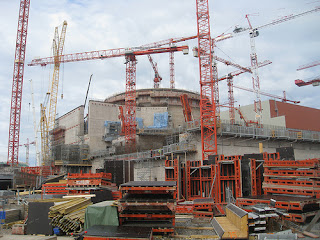
Areva's European Pressurised Reactor Olkiluoto 3
Areva's European Pressurised Reactor Olkiluoto 3 is now over five years behind schedule. Its design faces 28 unanswered questions from the UK regulator.

EDF and Areva are facing delays, high costs, and problems satisfying the regulator, over trying to get their flagship European Pressurised Reactor nuclear plant design approved for building in the UK, even as EDF seeks a £165/MWh price guarantee from the Government.

The two companies have resolved just three of the 31 problems blocking their proposed nuclear reactor from receiving environmental and safety approval from the Environment Agency and the Office of Nuclear Regulation (ONR).

They are greatly behind schedule and will not receive final approval this year, as they had hoped.

Their design for a new generation European Pressurised Reactor (EPR) has to pass through the generic design assessment (GDA) process before any reactors can be built.

EDF is hoping to use two of the reactors in a 3.2 gigawatt plant at Hinkley Point, Somerset.

Meanwhile, it is seeking a subsidy in the form of a guaranteed price of £165 per megawatt hour (MWh) for electricity from the plant from the Department for Energy and Climate Change (DECC) and the Treasury, according to the Times newspaper.

This expensive figure is more than the £150/MWh strike price estimated by Dr. David Toke, Senior Lecturer in Energy Policy at the University of Birmingham, and about the same as a £166/MWh estimate by Citi bank analyst, Peter Atherton.

The EPR design was given interim approval by the ONR and the Environment Agency last December but EDF has to come up with answers to 31 separate questions.

They cover issues such as security, reliability, strength of the inner containment wall, test results, and independent assessment of predictive calculations.

Significantly, the report says: “some of the deliverables have been late or did not provide the required quality of arguments or evidence".

It adds: "a number of the metrics are amber or red, indicating that, if no action is taken to improve matters, it is unlikely that the GDA [Generic Design Approval] Issues will be closed-out on the timescales indicated in the current resolution plans", in other words that the design will receive approval by November. EDF and Areva are reviewing their timescales and a new date will be announced shortly.

ONR takes a while to make its progress reports publicly available. Although published on July 5, the latest quarterly report actually covers the three months up to March 31. The reports are not easy to find on the website, especially because a link leading to them is broken.

The EPR is now the only reactor design being assessed following Westinghouse's withdrawal from the market with its AP1000 reactor design.

More EPR delays

To add to the two French companies' woes, the reactor being built by Areva in Finland, the 1,600 megawatt Olkiluoto 3, will now “not be ready for a normal level of electricity production in 2014" according to a statement issued on Monday by Areva's partner, the Finnish utility Teollisuuden Voima Oyj (TVO). TVO adds, dryly: “we are not pleased with the situation".

It was supposed to have been ready in 2009, and last year TVO said it would start in 2014. It is more than €2 billion over budget. TVO is locked in a bitter legal wrangle with Areva.

There are similar delays and cost overruns at Areva's EPR project in Flamanville, France.

The nuclear subsidy dilemma

Under the draft Energy Bill, the Government will introduce ‘contracts for difference’, a tariff system intended to subsidise renewables, nuclear, and carbon capture and storage. But it will not be in place until 2014, two years after EDF says it needs to make an investment decision on the Hinkley Point plant.

The EPR clearly is much more expensive than EDF had originally said publicly. The Government has repeatedly said it is committed to nuclear power.

Offshore wind power is currently subsidised at a price of £130 per MWh under the Renewables Obligation Commitment. The Secretary of State, Ed Davey told the House of Commons Select Committee on Energy and Climate Change yesterday that details of changes to the Renewables Obligation Commitment subsidy levels, which had been expected to include a reduction in this subsidy and were anticipated this week, have been delayed due to pressure of time impacting on his department’s discussions with the Treasury and other departments.

He said “there are over 4,000 responses to the consultation, and it is very complicated”. Pressed by MPs, he said an announcement will be made by the end of September. He also denied that there was any outside interference in the decision-making process.

Regarding the issue of a subsidy for nuclear power, Ed Davey, is on record as saying: “There will be no levy, direct payment or market support for electricity supplied or capacity provided by a private sector new nuclear operator, unless similar support is also made available more widely to other types of generation.

"I want to make clear … that this means that nuclear will not receive a higher price than comparable generation technologies whether they be renewables or indeed gas generation, once its emissions have been abated by carbon capture and storage.”

Tuesday, July 17, 2012

UK could cut electricity demand by 40% by 2030

Greg Barker when he launched DECC's Energy Efficiency Deployment Office
Greg Barker when he launched DECC's Energy Efficiency Deployment Office, which commissioned the report, back in February.

The UK could decarbonise its electricity supply system at a much lower cost through greater demand reduction, according to new Government-sponsored research.

A huge total of 40%, or 155 terawatt-hours, of present demand could be eliminated by 2030. Reducing demand by such an extent would mean that many of the more expensive or risky forms of generating electricity currently being considered could be put on the backburner.

The figure comes from a draft report, 'Capturing the full electricity efficiency potential of the U.K.', commissioned from McKinsey and Co., that has been published by the Department of Energy and Climate Change for peer review.

The analysis says that current Electricity Market Reform proposals would only realise 54 terawatt-hours (TWh), or around one third of the full potential savings. Further measures would therefore be required to capture the remaining savings.

The review concentrates on the three largest categories of abatement measures per sector, which it says could together deliver 127 TWh of savings, or 80% of what is possible.

In the residential sector, these measures include better insulation, energy-efficient lighting and more efficient appliances, which could achieve 58 TWh reduction. Three quarters of this demand reduction is already expected to be achieved through current or planned policies, primarily in increased appliance efficiency.

In the services sector, the measures include better insulation, lighting controls and heating, ventilation and air conditioning (HVAC), which could achieve 45 TWh reduction. 15% of this is expected to be achieved through current or planned policies.

In the industrial sector, the measures include pump, motor and boiler optimisation, totalling 24 TWh of savings, of which only about 5% is expected to be captured through current or planned policies.

The researchers reckon that by 2020, 115 TWh could be saved, of which 60% is expected to be achieved by current policies.

Catch-22

But the energy efficiency sector seems to be caught in a Catch-22 situation. Because it doesn't seem worthwhile for many business users to invest in energy efficiency, the market has not matured. However, it won't mature unless there is sufficient demand. It is therefore up to the government to nurture that demand.

For example, a green finance provider said that energy service companies have to bring in people from outside to provide quality advice on energy efficiency for clients. A utility company said that even if one could save 20% of an annual average bill for an SME, it still wasn't worth the initial investment. This was because of the “high transaction costs... such as closing the business for two days".

The research included interviews with key stakeholders, and uncovered 11 similar barriers to capturing the remaining demand reduction potential. They range from market-based mechanisms to regulatory ones like taxes and obligations on suppliers.

It found that while policy is quite good at addressing barriers in the residential sector, those in the service and industrial sectors are less well addressed.

Moreover, the complex and constantly changing policy landscape results in confusion and delays investment in energy efficiency. Consequently, utility companies and many intensive industrial users largely focus on buying new renewable energy sources to reach their carbon targets.

One commercial user said: "The biggest barrier is the shifting sands that the Government has introduced by changing the goal posts (e.g., solar FiTs). This curtails investment. The carbon reduction landscape is extremely complex and I would like to see that simplified."

A utility company representative offered the following insight: "We would appreciate more visibility and stability in terms of policy. CRC [the Carbon Reduction Commitment] has changed significantly and we still don’t know what it will look like tomorrow."

Payback periods need to be more favourable to attract the initial investment which is often perceived as being too high. The commercial and industrial sectors expect payback periods of around two years, but investments on average have a payback period of around five years.

In the residential sector, it is the rental subsector which needs the most attention. The review says that changing people's behaviour remains a significant opportunity here, and will capture as much as 15% of savings, though this proportion will diminish as technical innovations spread.

In the commercial sector, 61% of commercial space is leased, and 75% of the corporate sector outsources its facilities management requirements. In general, neither of these presently offer incentives for reducing energy use.

While electricity-intensive users do focus on demand reduction, the majority of users, which represents 60% of total industrial electricity demand, are less likely to achieve the potential opportunities.

One industrial user pointed out that their investments in biofuels and waste fuels reduces their carbon emissions but increases their electricity usage, while a utility company commented that 90% of its energy efficiency programmes were directed toward saving gas and electricity.

"There’s a mass of different assistance in energy efficiency areas," said one electricity-intensive user. "It’s bewildering what’s on offer. I have never heard of the Enhanced Capital Allowance. Maybe that could help some of our business cases."

Yet government agencies have been offering information about Enhanced Capital Allowances and similar measures for at least ten years.


Barrier-busting options

Amongst the policy options considered to stimulate the market are the use of tradable certificates in energy efficiency, as piloted by Connecticut Energy Saving Certificates in the United States. In that case, suppliers are obliged to meet 4% of electricity supplied through the purchase of the certificates.

Also in the States, an EPA Portfolio Manager is an online benchmarking tool for commercial buildings which helps tenants and buyers find the most efficient solution to their problem. Participation in a similar scheme here could be either voluntary or compulsory.

The ISO New England scheme is a forward capacity market which allows demand-side resources to compete with generation. Capacity payments provide sponsors with the incentives and stability to encourage investment in energy efficient products. Implementing a similar scheme in the UK would involve expanding the role of the National Grid in order to manage the market.

Finally, the report considers a scheme in Texas managed by utilities using two types of incentives: which allow standard offer programs consumers to choose the most cost-effective measures; and market transformation programmes would incentivise specific efficiency measures that need help to overcome structural barriers.

The report vindicates findings by campaign groups like Zero Carbon Britain and Greenpeace, which have themselves previously floated scenarios which contain similar levels of demand reduction in order to arrive at a 100% renewably-powered Britain by 2050.

DECC is welcoming feedback on the report, which is available on its website.

Wednesday, May 09, 2012

Revealed: the cost of government support for nuclear power

The full costs of managing the country's stockpile of plutonium was estimated at £3 billion last December.

The Government's budget for developing and delivering new nuclear was £11 million from January to April 1.

And £167 million, or almost 30%, of the Department for Energy and Climate Change (DECC)'s budget went to the Nuclear Decommissioning Authority in the first three months of this year.

These are astonishing figures gleaned from DECC's last quarterly report.

They show just how much the government is spending on supporting nuclear power.

They reveal that DECC is experiencing severe budget cuts at the same time as this is going on, and that this is impacting particularly on delivery of Green Deal measures and the Renewable Heat Incentive.

For DECC, its quarterly budget of £468 million was down to just 52% of the same time last year.

Of this, just £13 million was spent on bringing about a low carbon Britain.

Although the full costs of managing the country's stockpile of plutonium was estimated at £3 billion last December, and this figure dwarfs the other budgets, it is not up to date, the report admits.

Moreover, we are unlikely to find out the true figure even when it is finally determined.

This is because, the report says “it is likely that these [figures] will be commercially sensitive.

"This cost data is therefore not included in the aggregated whole life cost figure for all DECC's major projects."

This means that the public will not know the true amount it pays for managing existing nuclear waste.

The budget for developing and delivering new nuclear is £11 million.

This is almost as much as the £13 million for developing a low carbon Britain - or is it part of that figure?

Of course, the government will argue that this is not a subsidy.

Nevertheless it is taxpayers' cash spent on promoting nuclear power as a policy objective and trying to secure new nuclear power stations, despite nuclear operators pulling out.

The latest companies to be interested are Chinese. Do we really want our new nuclear power stations to be built and managed by Chinese companies?

That £11 million should instead be spent on developing and supporting new renewable energy installations made by British workers in this country.

These would certainly be up and running far earlier than any new nuclear power station.