Showing posts with label global warming. Show all posts

Monday, January 12, 2015

How we can keep global warming to 2°C or below

There is no greater challenge for the world this year than to reach an agreement at Paris' climate change talks in December that will limit global warming to within 2°C. This is the threshold, moving beyond which scientists agree would create terrible and irreversible damage for our planet and all who dwell upon it.

chimneys emitting smoke

Amongst the main issues to be solved is the long-standing difference of opinion between poor and rich countries over who pays for the required mitigation measures. The poor countries' view is that since the wealthy nations put most of the planet-warming gases into the atmosphere, then they should pay for it. These rich nations in turn do not dispute this, but argue that many of the poorer countries are now producing a huge and growing amount of the gases, and themselves must accept a share of the responsibility.

Then there are the extent to which all nations will be bound by whatever agreement is reached, and, crucially, how it will be monitored, since many nations, such as China, have said they would regard it as a breach of national sovereignty were their emissions to be scrutinized by outsiders. Instead, they demand to be trusted, something which others are uncomfortable about.

Then there is the collapse in the price of oil, which is almost back at $50, previously thought unreachable again. This makes the cost of renewable energy and energy efficiency measures seem much more expensive by comparison. It is leading some to call for stronger taxes on carbon to redress the balance.

On the positive side, the evidence of the reality of climate change is now hitting home in peoples' minds, despite the increasingly hollow-sounding voices of sceptics. 2014 was the hottest year on record - and 10 of the warmest have been since 1998.
Graph of yearly global temperature increases
Graph of yearly global temperature increases.

We are increasingly seeing more of a push by cammpaigners, scientists, artists, writers and musicians, as well as religious leaders such as the Pope, to build a mass, global consensus that we have to act, and do what the science demands.

If an agreement is reached then we can expect a huge mobilization of activity, but not staight away because an agreement reached in Paris in eleven months would not become binding for another four years.

In order to achieve the 2 °C climate target with a likely probability (>67%), cumulative global CO2 emissions in the 2010–2100 period need to be constrained to about 1000 GtCO2 (range of 800–1200 GtCO2). The projected global 2020 greenhouse gas emission level is now around 10% above the 2010 level.

The ‘least-cost’ 2°C scenarios show lower 2020 emission levels, in the range of 38 to 47 GtCO2eq. But these typically assume immediate implementation of mitigation policies in all countries and sectors.

If large emission reductions by 2020 are unlikely it will become increasingly harder to reach the 2°C target; global emission reduction rates will need to be much higher, and so, therefore, will the mitigation costs.

This in turn raises the risk of missing the 2°C target and the requirement for deploying technologies that often meet with public resistance.

A new analysis of the models (Long-term climate policy targets and implications for 2030  a Dutch PBL Policy Brief) shows that achieving the 2°C target critically depends on well organised international policies, in the short term, to realise stringent reductions during the 2020–2030 period.

This means formulating ambitious mitigation goals and increasing the participation of all parties in climate policy.

And it necessitates taking real action; implementing long-term incentive structures to reduce emissions (given the inertia in economic and energy systems) and stimulating innovation.

The biggest challenge is, in a tough economic climate, with a low price for oil, how to increase the motivation to implement ambitious climate mitigation policies.

It is therefore useful to look at ways of doing so that additionally achieve synergies with other policy areas, such as job creation, poverty relief, food provision, energy security, economic opportunities and risks, air pollution and ecosystem degradation.

The costs of meeting the 2°C target would be lowest if the global emissions level were to peak within the next 10 years.

Can we achieve this? Right now, emissions are increasing, but the rate of increase is slowing. The average growth in emissions over the last decade – excluding the global financial crisis between 2007-2012 was 3.8% per year. A 2.5% growth is projected by PwC and the International Monetary Fund in 2015.

What can cities and regions do? They can set unilateral targets and work with partners on their own strategies. Individuals can put pressure on their local representatives. All can help to put pressure on national governments to reach a firm and proper agreement in the Paris talks.

To borrow two clichés: all hands on deck – it will be touch and go.

David Thorpe's book, The 'One Planet' Life: A Blueprint for Low Impact Development has received the following praise:

"An excellent and immensely practical step by step guide" – George Marshall, author of Don't Even Think About It, Why Our Brains Are Wired To Ignore Climate Change.

“This year’s must have book.” Jane Davidson, former Environment Minister for Wales and Director of INSPIRE

"There is much inspiration to be had from this comprehensive and beautifully illustrated book. David Thorpe is a master of lucid writing on one of the most important topics of our time.  I highly recommend this book to anybody who is interested in assuring that we leave a habitable planet to our children." Herbert Girardet, founder of The World Future Council.

"Makes the irrefutable case for ‘one planet living’" – Oliver Tickell, editor, The Ecologist

Thursday, September 06, 2012

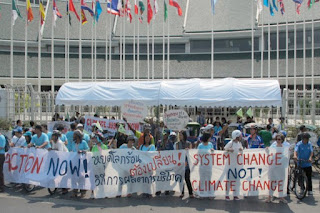
Bangkok U.N. climate talks make little progress. World headed for 3°C rise.

climate protesters at Bangkok United Nations talks
 Protesters in Bangkok outside the UN climate talks.

The U.N. climate talks featuring delegates from 190 nations, that have been ongoing for the last week in Bangkok, Thailand, and which conclude today, have produced few concrete results.

The talks were happening against a backdrop of record Arctic ice melt, recent flooding in the Philippines, Asam and other areas, recent drought in the US, and an ongoing food crisis in the Sahel.

Last December at the Durban COP talks, the world's nations agreed that they would sign a legally-binding pact to cut emissions and help developing nations adapt to climate change, from 2020. Part of this agreement included a promise to deepen existing promises to cut emissions by the end of the decade.

However, after one week of talks in Thailand, not a single country has made a fresh commitment, and US negotiators stunned delegates by calling for any new treaty to be ‘flexible’ and ‘dynamic’ rather than legally binding, representing a complete U-turn on its previous position.

In response, 130 developing countries sought to put pressure on developed countries by threatening to deny them access to Clean Development Mechanism (CDM) credits, which developed countries use to offset their emissions by financing projects in the poor ones.

But this tactic could backfire, as Takehiro Kano, a senior climate negotiator with Japan, said that if they went ahead, Japan's response might just be to lower its voluntary target of cutting emissions 25% below 1990 levels by 2020, and Justin Lee, Australia's climate change ambassador, retorted that the Australian government would anyway "take international action that best supports Australia's domestic initiatives".

The United States and other developed countries blamed the global economic crisis for the lack of funds that they are able to make available to combat climate change. In a reaction to this, developing countries earlier tried to play down requests for finance and technology commitments, in favour of greater efforts by developed countries to reduce their greenhouse gas emissions.

But this created yet another deadlock, as Japan, Canada and Russia, which refused to sign up to an extension to the Kyoto Protocol as last December's climate summit, dug their heels in and refused to rejoin the process. The European Union argues that it cannot afford to up its reduction targets, and the United States is in an election year, which paralyses its ability to act.

This has led one observer, Sanjay Vashist, director of Climate Action Network South Asia, to comment that, "the existing deadlock on taking up ambitious climate action will only delay the necessary adaptation finance to vulnerable countries."

Christiana Figueres, executive secretary of the UN’s climate secretariat, Was putting a brave face on it. “Government negotiators have pushed forward key issues further than many had expected and raised the prospects for a next successful step in Doha," she said.

This leaves many political decisions that will have to be taken at this next meeting in Qatar.

With the present level of commitments to reduce emissions, the world is still on for at least a 3°C temperature rise, which would have catastrophic repercussions.

Rich nations failing to cut emissions


At the summit, the U.N. released a report showing that several rich nations will not even meet their existing pledges to cut greenhouse gas emissions by the end of the decade, made at Copenhagen in 2009.

These nations include Australia, Canada, Japan, Mexico, South Africa, South Korea and the US.

The report, from the UN Environment Program, adds that even if all nations do meet their existing pledges, emissions of greenhouse gases will still reach between 50 and 55 billion tonnes of carbon dioxide equivalent, that is 11 billion tonnes, or 20%, more than what is needed to try to keep temperature increases below 2°C.

“It's still possible to meet a 2°C pathway, if there is sufficient political will," commented Niklas Hoehne, and author of the report on Tuesday. "We’re not facing a participation gap here – it’s an ambition gap.”

Meanwhile, developed countries want the industrialised developing countries such as India, China and Brazil, to take more responsibility for cutting their emissions.

They say that if this was resolved, it would allow the issues of technology, finance, intellectual property lies and emissions from aviation and shipping, which are stymied, to be set aside while the responsibilities of the emerging economies are increased in the short and long-term and the rich countries take stronger action after 2020.

But this is unlikely to happen without further commitments from developed countries. Depressingly, it seems the stalemate continues.

Saturday, June 09, 2012

For sale: neglected planet; one previous, careless, owner.

And This Global Warming cover

Yesterday I went to a special award ceremony, to celebrate the winners of a poetry competition, that has been judged by Britain's Poet Laureate Carol Ann Duffy and Elin ap Hywel. It is on the theme of climate change.

Many of the winning poets were there, there were readings by Susan Richardson, Elin ap Hywel, Dafydd Wyn and Emily Hinshelwood, and a collection of 40 of the poems, entitled And This Global Warming, was launched. The picture above is on the cover. It is the second year of the competition, and it attracted a whopping 672 entries.

Carol Ann Duffy said that the quality of the entries “was fantastic, especially the children's entries" (there is a separate section for children).

The poems describe anger at politicians, the desolation of forest fires, a poignant memory of ice, the absurdity of an estate agent's spec on the earth, and the personality of thunder. They make you laugh, cry, smile and, of course, they raise anger at what is being done to the Earth in our name and our seeming incapacity to do anything about it.

Sadly, one of my own poems is not included! I console myself at the thought that I can praise the work of these other poets, who all deserve to be widely read.

And I want to mention especially the organiser of the competition, Emily Hinshelwood and her partner Dan McCallum. The battle to preserve communities, fight climate change and support renewable energy has many unsung heroes around the world, and this couple are among them.

For, 14 years ago, they began to set up what quickly became a thriving community project, Awel Aman Tawe, to regenerate a former coalmining area in the Swansea and Amman valleys in South Wales. They have fought and won many battles, not the least of which is to build a community-owned wind farm on the hillside overlooking the town.

It has taken over 10 years to get this through planning, and it is still not quite there. The project has shrunk from an original six turbines to just two, despite strong grassroots support. The perseverance and commitment to achieve this is awe-inspiring.

Emily believes in the power of art in its widest sense to inspire people. She knows that touching people’s lives can never be done with technology or economics alone, or even at all. So Awel Aman Tawe has run a broad programme of arts activities specifically themed around climate change. She sees the arts "as an opportunity to engage local people in what can be a controversial and unpopular subject".

The programme encouraged people to imagine the reality of many different aspects of climate change using a range of media including film, animation, poetry, printmaking, design, collage and performance. The performance was a play called Nine Meals from Anarchy, themed around food transport. Another project was Postcards from the Future in which participants in different communities were invited to design postcards depicting their image of the future to send to people in the present.

Climate change can be a difficult subject to get across. It feels impersonal, distant both in time and place. How can we make it relevant to people's lives? How can we break through the filters of indifference, ignorance and cynicism?

I feel that the best efforts come when you cut straight through to the emotions, the things that people hold precious in their lives, or when you can make people laugh, because laughter bypasses our normal, cynical, so-called rational prejudices. Art helps to shock people into seeing things in a different light.

So, I'll devote the rest of this column to someone else's words, one of my favourite poems from the collection, by Richard Foreman. It's called 'For Sale'.

quiet location on spiral arm of the Milky Way
well presented, detached planet
seven spacious and charming continents
set amidst rolling, cerulean oceans
heating system in need of some renovation

ideal first time investment for extra-terrestrial species
with suitable technology and know-how
to stem a rampant excess of carbon dioxide
methane, nitrous oxide, ozone...
the whole, roiled gamut of greenhouse gases
fantastic opportunity to restore
depleted, misused, natural resources
scattered fragments of once vast rainforests
homelands engulfed by rising seas
and the vestigial remains of polar ice-caps
potential to update and extend
vastly depleted wildlife species
compromised attempts to establish
sustainable industries, renewable energy supplies
and responsible agricultural development
this planet enjoys an elevated position
with outstanding, panoramic views of the universe
an elegant world, with versatile accommodation
previous owners
now deceased
You can probably buy copies of And This Global Warming here, and support this valuable project.

Monday, May 28, 2012

We're heading for 6 degrees rise says IEA. Here's a way to stop it.

I've got good news and bad news. Which would you like first?

OK, here's the bad news, and it's really bad. According to the latest figures from the International Energy Agency, greenhouse gas emissions reached a record high last year of 31.6 gigatonnes, an increase of 1Gt, or 3.2%, on 2010.

IEA’s energy pathway, that seeks to limit the average global temperature increase to a still-risky 2°C, requires CO2 emissions to peak at 32.6 Gt no later than 2017, i.e. just 1.0 Gt above 2011 levels.

Clearly this is no longer possible.

"When I look at this data, the trend is perfectly in line with a temperature increase of 6 degrees Celsius (by 2050), which would have devastating consequences for the planet," Fatih Birol, IEA's chief economist, commented.

This constitutes nothing short of a global emergency. Panic stations. Hit the red button. Call International Rescue. Something must urgently be done, right?

Yet negotiators from over 180 nations, meeting in Bonn last week to try to get a new legally binding global climate pact signed by 2015, failed abysmally in their efforts. Tragically, reports coming out suggest that they became bogged down in procedural wrangling and got lost on the road to nowhere. Any deal reached ideally needs to be ratified at the annual climate talks in Qatar in December.

That’s all bad enough. But then there's the economic paralysis gripping Europe that is stifling both investment confidence and the setting of ambitious climate-protecting legislation.

So in the face of this perfect storm, how could there possibly be any good news?

What we need is money. Lots of it. And we need the conditions necessary for it to be invested in low carbon infrastructure. Everywhere.

We are told there isn't any. But there is.

In 2009, the most recent year for which figures are available, $16.8 trillion in total was held in pension fund assets around the world, according to the OECD.

$1.589 trillion of capital is held in UK pension funds alone (just over 10% of that total), with $9.58 million held by US pension funds.

What is more, $399.6 billion is also written in insurance premiums in the UK.

Let's confine our considerations of the potential of this pot of money to the UK, although clearly a bigger sum could be unlocked on a global level.

In 2008, the rate of return on pension fund investments in the UK was negative, by a large amount, reflecting falls in the stock market. The figure represented a drop in value of around 14%. I don't have corresponding figures for the insurance industry, but I would imagine they are not too different.

Both industries are known to be conservative with their investments. Mostly, they don't invest in low carbon and environmental infrastructure. But last week's official figures show that this is one sector of the economy that is actually defying the recession and the growing, not just in the UK, but globally.

Wouldn't it make sense for these industries to invest in this sector?

Faced with a stagnant economy, all governments seem to be able to think of doing in a vain attempt to stimulate it, is to inject more cash into it. But, according to Charles Cowling, managing director of JLT Pension Capital Strategies, this is exactly the wrong thing to do, because it forces up costs (by forcing up liability values) for the very funds that could be invested in infrastructure.

Joanne Segars, Chief Executive of the National Association of Pension Funds (NAPF), protested against the prospect of another round of quantitative easing only last week.

Furthermore, the UK's pension system is threatened with having its tax income drained by ballooning retirement costs as we all get older.

Actually, this should provide it with a further incentive to obtain a higher rate of return from its investments. But investment conditions are not yet right. And, surprisingly, nor are the attitudes of the fund managers.

According to Christopher Greenwald, head of sustainability application and operations at Swiss-based Sustainable Asset Management (SAM), which provides the data for the Dow Jones Sustainability Indexes, while companies are taking on board the sustainability agenda, investors are lagging 15 to 20 years behind.

They do not yet fully understand the impact of sustainability on their business performance and financial returns, and this is why they are experiencing losses from their investments. "Investors are about where companies were in 1995 when sustainability reporting was just getting off the ground," he says.

Clearly, they need some training in the importance of sustainability issues in evaluating company performance.

At the moment, just 1% of pension funds' assets around the world are invested in infrastructure. Regulation is one of the major drivers of pension funds investment strategies.

So what is the Treasury doing to improve the confidence of fund managers that any money they might put into investing in infrastructure in the UK will have a good ROI, and will not fall into a black hole due to the usual British disease of cost overruns and missed schedules?

Last November, the National Association of Pension Funds signed a memorandum of understanding with the Treasury to support the establishment of a new Pension Infrastructure Platform owned by pension funds, to bring as much as £2bn of investment by early 2013. Its representatives have been meeting regularly with officials in the Treasury ever since.

£2bn is not much nowadays, but it's a good start. If just 2% of that $1.5 trillion or £1 trillion in assets were invested in infrastructure, that would represent £200 billion, or the amount required for investment in low carbon infrastructure up to 2020. No one is suggesting that all of this money should be invested in low carbon infrastructure. And we haven't even considered investment companies' assets.

This gives an indication of the opportunity that the Chancellor and the Treasury has, to create the right conditions for these companies to feel confident to invest in this area.

At the moment, the cost of government debt is so low, because George Osborne wanted to lock in current low borrowing costs by issuing perpetual bonds, that there is scant reason for fund managers to be interested in the potentially much more costly mechanism to fund infrastructure projects.

But the NAPF says it is working with a core of 10-12 pension funds and the Pension Protection Fund on the details of the Pension Infrastructure Platform. “The Platform, which will be owned by pension funds for pension funds, will seek to invest in a wide range of infrastructure assets," said Joanne Segars. "It aims to raise £2 billion which could be leveraged up to £4 billion of new money for investment in infrastructure and be open for business in early 2013.”

I hope this happens. It should be just the start. There is precious little light in the gloom, but this is some of it. Let's not let this chance pass us by.

Goldman Sachs, while being investment bankers rather than pension funds, are leading the way with a $40 billion clean energy investment plan announced last week. They clearly see a good bet. Let others follow.

Oh yes, and someone should also educate pension fund managers about the advantages of looking at the sustainability performance of companies.

Wednesday, April 27, 2011

Perhaps only self-interest can save us from catastrophic climate change

The failure of international negotiations on climate change has left the field open for those countries and even companies which take action now to dominate the emerging economic markets in the future.

Next December, UN negotiators will meet in Durban, South Africa, for the next attempt at the top level to secure international agreement on limiting climate change.

On the basis of current legislation and action, the world as a whole is now headed towards unavoidable global warming of between 2.6 and 4°C Celsius above pre-industrial levels. This is well ahead of the maximum permissible amount of between 2 and 1.5°.

It will result in large tracts of the planet becoming uninhabitable.

To keep warming limited to the 1.5° target, global total emissions need to drop below 44 billion tonnes of carbon dioxide-equivalent per year (CO2e/yr) by 2020. Currently, there is a gap of 12 billion tonnes of CO2e/yr.

At the climate change conference in Cancun at the end of 2010, countries discussed a wide range of options. If they implemented the most stringent reductions they proposed then, together with the most stringent accounting, the remaining “reduction gap" would shrink to 8 billion tonnes of CO2e/yr.

Failure to secure binding, legal agreements at the last two sessions in Copenhagen and Cancun has resulted in many countries instituting their own domestic climate change legislation.

A new survey of such legislation, as enacted in 16 countries, shows the extent to which this is happening.

It concludes that, although current legislation does not add up to what is required to avoid dangerous climate change, much greater attention should be paid to national level policy and legislative development, as building blocks towards a global deal.

The countries who have steamed ahead include large developing ones such as Brazil, China, India, Mexico and South Africa. Together, they amount to a formidable economic growth engine and are demonstrating their determination to forge ahead and dominate future markets in low carbon technologies and energy efficiency.

The report's author is GLOBE, (‘Global Legislators Organisation for a Balanced Environment’), founded in 1989, based at the London School of Economics, which is trying to create a critical mass of legislators that can agree common legislative responses to the major global environmental challenges.

Its president, John Gummer (a former Conservative environment minister), said: “The study illustrates that the shape of the debate on climate change is shifting from being about sharing a global burden – with governments naturally trying to minimise their share – to a realisation that acting on climate change is in the national interest.”

National interest is surely a much more powerful motivator than external pressure. For example, the Chinese and Brazilian governments see it in their national interest to create conditions for their countries to be world leaders in renewable energy.

International agreement will only reflect domestic political conditions, not the other way round. This is why the American government finds it so hard to commit to international climate change agreements - its long history of world dominance based on oil still provides its political direction with huge momentum.

On the other hand, Brazil, which has been a pioneer in bioethanol from sugar cane since the 1970s is now exporting its expertise and products.

The legislators who craft these laws meet periodically - the last time was barely a month and a half ago, in Brazil. There will be another, much more significant, meeting just ahead of the United Nations Rio +20 Summit on 4th - 6th June 2012.

This Earth Summit, otherwise known as the United Nations Conference on Sustainable Development, will assess progress, and absolutely must recharge international and national political commitment to sustainable development in the face of many new and emerging challenges.

The climate legislation being enacted in many countries is also putting in place the legal and policy frameworks to monitor, report, verify and manage carbon. Monitoring was a key stumbling block in previous negotiations. For example, it was the subject of a huge disagreement between the United States and China which stalled the 2009 negotiations.

National experience in instituting monitoring and verification systems could help inform and support an international MRV mechanism to prevent this being a barrier again in Durban.

As of April 2011, the UK had the most climate change related laws, with 22, and South Africa had the fewest with just 3. However, this is a poor indicator of effectiveness since some laws are comprehensive and others narrow in scope. But Britain is the only one to have a climate change act with binding reduction levels.

In addition, there is much legislation in preparation: the Chinese government is drafting a comprehensive climate change law to support the goals in its new 12th Five Year Plan; Mexico’s General Law on Adaptation and Mitigation and General Law on Climate Change are being debated; and the South African government is expected to publish a White Paper ahead of hosting the UN climate change negotiations in Durban in December.

Finally, much is happening at a regional level - California has amongst the most ambitious renewable energy targets in the world, and Wales almost uniquely has sustainable development enshrined in its constitution. Such regions are positioning themselves to be better protected in the emerging low carbon economy.

Clearly, a greater sense of urgency is required and the negotiations at Durban must be a success if disaster is not to be avoided.

But if it is not altruism that will save us. Human beings are not renowned for their altruism in the face of vague and distant threats.

It is instead in countries' selfish national interests that they pioneer and implement radical climate change legislation. As the UK is now a global leader in this respect (despite its limitations and domestic criticism of it), it has much to teach the world and much to be proud of.

As UK Energy and Climate Change Secretary Chris Huhne said on Tuesday, ″The race is on, and the pioneers are the most likely winners.″

Perhaps no amount of legislation can save us from catastrophic change. Perhaps the logic of capitalism - seeking permanent growth and ever-expanding markets - is incompatible with sustainability and living on a finite planet.

I guess we'll find out some day.

Wednesday, January 26, 2011

Latest data confirms the world is warming

graph showing increase in global average temperatures to 2010
Globally, 2010 tied with 2005 and 1998 as being the hottest year on record, despite ending in Britain with a cold spell, according to the World Meteorological Organization.

Last year, global average temperature was 0.53°C (0.95°F) above the 1961-90 mean.

“The 2010 data confirm the Earth’s significant long-term warming trend,” said WMO Secretary-General Michel Jarraud. “The ten warmest years on record have all occurred since 1998.”

The WMO's statistics are based on data sets maintained by the UK Meteorological Office Hadley Centre/Climatic Research Unit (HadCRU), the U.S. National Climatic Data Center (NCDC), and the U.S. National Aeronautics and Space Administration (NASA).

In addition, Arctic sea-ice cover in December 2010 was the lowest on record, with an average monthly extent of 12 million square kilometres - a staggering 1.35 million square kilometres below the 1979-2000 average for December.

This follows the third-lowest minimum ice extent recorded in September. It is this phenomenon that is paradoxically thought to be responsible for the cold weather in northern Europe in December.

The WMO said that over land, few parts of the world were significantly cooler than average in 2010, the most notable being parts of northern Europe and central and eastern Australia.

Another predicted feature of climate change is extreme weather and climate events, and 2010 experienced a high number of these, including the heatwave in Russia and the devastating monsoonal floods in Pakistan. These were described in WMO’s provisional statement on the status of the global climate issued December 2010.

Despite this scientific evidence, climate change denialism is still common, and even increasing in America. The Republican Study Committee last week released a list of proposed budget cuts totaling $2.5 trillion, including a recommendation to withdraw U.S. funding from the Intergovernmental Panel on Climate Change (IPCC).

In the U.S., much anti-climate change rhetoric is funded by the oil industry. Chief amongst these is Koch Industries, as identified by Greenpeace.

Last month they were the target of a hoax by unknown perpetrators, who made a fake website and fake news release that falsely announced the company was discontinuing its funding for denialist organizations such as Americans for Prosperity. Last week, Koch Industries filed a federal lawsuit in Utah seeking the identities of the people behind it.

Friday, October 19, 2007

How influential are you?

So you care about climate change and take a few actions like turning the lights off. Great, but is there more you can do?

One thing's for sure, if we sit around waiting for governments to act, we'll be waiting a long time.

Are you any good at helping others around you to realise the problems and what they can do about it, say, by leading by example?

Here's a way to find out. Take this Green Beacon Test.

Energy Saving TrustIt's created for the Energy Saving Trust for Energy Saving Week (which starts on Monday) and measures your awareness of climate change and energy saving, and compares it with what you do about it.

The Trust is asking you to use your influence within whatever communities you're part of during Energy Saving Week, to encourage others to commit to save their 20%.

The week's theme is 'A Community a Day'. Each day a diifferent group will be targeted - faiths, women, men, internet communities, etc.

> Green Beacon Test.

Wednesday, October 17, 2007

Your name on a paper plane

I had a nice letter from Asi Sharabi asking me to promote "the WWF (World Wildlife not the wrestling...)'s new campaign to strengthen the UK Climate Change Bill".

I agree with him when he describes the Climate Change Bill (which was hard fought for by grassroots groups) as "one of the most important pieces of legislation ever to go before the UK Parliament".

But surprise, surprise a funny thing's happened on the way to the statute book - it's been watered down. 

What's needed from you and me is pressure to include carbon emissions from international aviation and shipping – the fastest growing sources of emissions – in the bill's targets.

"Excluding them is  a bit like going on a diet but not counting the calories from chocolate!" he says.

So WWF plans to build a massive paper boat and paper plane, put all the names of the people who signed the petition on the boat/plan, and then deliver them to the Houses of Parliament. 

Your name could be on it, if you click here.!

He adds: "PS: Funnily enough my wife bought me Hybrids recently (she said I spend more time with my laptop then with her but thats just not true.... ) I didn't have the chance to read it yet but looking forward!"

While we're on the subject I've also been asked by the Energy Saving Trust to encourage people to pledge to commit to save their 20% of their energy use.

Currently only 106,000 have signed up, and they aim to reach one million by Christmas!

Energy Saving Week is next week, so I suppose I'll be banging on about this again then.

Monday, September 24, 2007

The cost of nuclear new build

The UK Government’s public consultation on the possibility of building new nuclear power stations runs until October 10. Have your say.

This blog looks at the cost of nuclear new build and its context.

The international picture


There are 76 reactors on drawing boards worldwide - and uranium is scarce.

China aims to build 30 nuclear plants over the next 15 years. India is planning 19 and Russia is switching a quarter of its energy supply to nuclear power.

The US is looking at 17 plants over the next six years.

The UK picture


According to a New Economics Foundation report published last month, the costs involved in building new reactors is up to three times higher than supporters say.

"Nuclear power has been promoted as a solution to climate change and an answer to energy security. It is neither," the report concludes. "As a response to global warming it is too slow, too expensive and too limited."

The think tank rejects the government's cost estimate of 2.2-5.0 pence per kilowatt hour of power produced by new nuclear power plants, instead putting the cost at 3.2-7.5 p/kWh.

Another recent report agrees. Poyry Energy Consulting says the commercial case for building new nuclear plants is shaky and that none will be built without a higher long-term carbon price than that set by the current European Union Emissions Trading Scheme (ETS).

A nuclear power programme requires a huge capital investment of up to three-quarters of its costs, compared to a gas plant’s 25%. Interest costs during construction mean that delays can make or break a nuclear project.

"Despite the rhetoric, it is difficult to see much new nuclear capacity coming into the market before 2020," Poyry director Andrew Nind said.

"Beyond then prospects look better, but the future of nuclear probably depends on the creation of a long-term carbon price guarantee. In its current form, the ETS will not suffice."

Several recent estimates of future carbon price movement show that it won't reach €35, the price the White Paper argues makes nuclear economically feasible, for a long time.

Market forecasts say there will be an over-supply of credits from developing countries, and a continuing over-allocation of credits in Europe. The price has mostly been below 20 euros a tonne over the last year. This market over-saturation will keep the price low.

For this reason the nuclear lobby is arguing in Brussels that nuclear should be classed as renewable in order to be eligible for ETS-subsidies, like solar and wind are.

This would be barmy. But of course that wouldn't deter the EC.

As I said, uranium is scarce and the price will rise. The future of the ETS after 2012, however, is uncertain, and investors don't like that.

The nuclear companies' new plans


Here in Wales, Hugh Richards, of the Welsh Anti-Nuclear Alliance, also believes there are strong grounds for believing that new nuclear power stations may prove financially unviable.

He has examined the four power station designs that were registered with the nuclear regulator last month for pre-licence assessment. (The Government is moving to pre-license standardised designs and streamline planning procedures in order to reduce the lead times for nuclear construction.)

(However this increases the risk that the public will lose confidence in the regulatory process, and experience suggests that it will not speed up projects. In England, where public inquiries were scrapped for all the advanced gas-cooled reactors, an average 10-year construction over-run resulted.)

None of the four Generation III designs submitted to the regulators for pre-licensing assessment in July are proven commercially; they are design concepts without working prototypes to test their safety. No attempt has been made to test their financial robustness, says Richards.

British Energy, bought back out with £5bn of public money in 2002, has the only experience of operating nuclear reactors in Britain.

Of the six foreign operators expressing an interest in building reactors here, from Germany, France, Spain and Belgium, five say they want to have a choice of the best available designs, but none of these designs are proven.

The Finnish reactor under construction now, whose economic model is widely touted as being the way forward, by preselling power to private buyers, will not work here, and anyway has been shown to be based on faulty accounting.

Three of the operators have non-nuclear plants in the UK - Scottish Power recently acquired Iberdrola, npower is owned by RWE, and Eon-UK. Ironically, they all put great emphasis on renewables in their marketing.

So where are we?


  • Environmental regulations could force many of Britain's coal fired power plants to close over the next decade
  • all but one of its nuclear power plants are expected to shut by 2020
  • The government has refused to pay for nuclear or build the plants with public money
  • A spokeswoman for BERR said on 17.09 the government was already trying to work out how the country will cope if no nuclear power plants are built
  • It has admitted that the current target of getting 20 percent of its power from renewable sources of energy by 2020 is already "very challenging"
So we may have to become still more dependent on imported gas, while slashing demand.

And actually as the price of oil and gas rises coal becomes more and more economic.

Which is why they're currently trying to build the largest open cast coal mine in Europe in South Wales.

And all because the civil servants are allergic to renewables.

(And we haven't even talked about transport, responsible for more global warming than electricity.)

Tuesday, July 31, 2007

A disaster affecting 200 million people doesn't make news

Floods:
  • millions of hectares of farmland submerged
  • more than 200 million people affected
  • over 500 killed
  • hundreds of thousands of homes damaged or destroyed
  • more flash floods, downpours and landslides expected in the coming days

Not the UK or the US, but China. If it were the US or UK it would be all over the media.

These are the worst floods in ten years in China where every year at least 5000 people die in floods.

Five thousand years ago, soil depletion and flooding due to deforestation led to starvation and disaster in China (source: Clive Ponting's Green History of the World). They are still repeating the same errors.

Some say only a huge disaster will wake us up and force us to do something abut global warming and unsustainable land management. 200 million affected is clearly not a sufficient scale.

I am not confident that those who typically lead human communities are able to make long-term and rational decisions, while the majority of the rest of us quite naturally want to have our cake and eat it, if it's available.