Showing posts with label Hinkley Point. Show all posts

Tuesday, September 20, 2016

Hinkley C – the shock of faith in the wrong technology

The British Government's decision to back Hinkley C nuclear power station is another success for the snake oil salesmen of a defunct technology that sends completely the wrong message.

I once wrote a novella about nuclear power that satirised the ease with which politicians fell for its sales pitch, seduced by that strong subtext of sexual potency, the Promethean glamour of seeming to commission the ultimate power source.

Except the reality was and remains a lengthy catalogue of dangerous failures, ineptitude, accidents and catastrophes – of which Chernobyl is the most famous.

A recent scientific study shows that "accidents on the scale of the 1979 meltdown at Three Mile Island in the USA (a damage cost of about 10 Billion USD) are more likely than not to occur every 10-20 years".

The same study highlights the "'flawed and woefully incomplete' public data from the nuclear industry" that is "leading to an over-confident attitude to risk".

Once nuclear power was sold to us as electricity supply that would be "too cheap to meter". Now, even though the British Tory government knows it's amongst the most expensive power sources on the planet...

relative cost of nuclear, wind power, solar power, and gas powered electricity


... they're still keen to sell Hinkley C to a British public that doesn't want it [original data here].

They know, too, that the specific technology to be deployed at Hinkley C already has "a lengthy catalogue of dangerous failures, ineptitude, accidents and catastrophes" at the previous attempts to deploy it – Flammanville, Taishan and Olkiluoto – but they still want to commission another one like it.

They know that the nuclear industry was forced to become so secretive that its secrets – usually cover-ups of the lengthy catalogues of dangerous failures, ineptitude, accidents and catastrophes – were kept from governments and the public for years (and who knows what has yet to come to light) – and yet the fact that the Chinese government might have access to the secrets of the British nuclear industry and national grid is only offered as a bogus concern, not a serious obstacle to the much more important aim – remaining in the Chinese and French governments' good books.

If I didn't think that it was unlikely that members of the Tory government have read my novella, I'd think it was a case of life imitating or parodying art. (Although I wouldn't put it past the potential of civil servants to be consciously doing so – twisted, devious creatures capable of not just double-think, but triple-, quadruple-, and even octople-think that they are.)

I have observed the British government's grotesque and contorted dance of death with EDF and Hinkley C since it was begun by Tony Blair, with a mixture of fascination, horror and contempt, of the sort I normally reserve for watching the calculated relapse of an ex-alcoholic drawing themselves into a terminal vortex, the culmination of which is starkly obvious to all powerless onlookers.

When Theresa May hit the pause button on approving the Hinkley C decision when everyone expected her to rubber stamp it, she was like the pantomime villain horsing around with the expectations of the audience, just so that when they finally commit the Terrible Deed, they can reap even more opprobrium from the audience than they would have received had they dealt the blow straight away.

There has been so much coverage in the press that everyone can see what a terrible decision this is. The tail has wagged the dog, but it's the taxpayer who will foot the bill if the thing ever does get built. Here's 5 reasons why it shouldn't be built.

There is still a chance it might not. There is still a chance that May could be playing a double bluff: in her wish not to offend the Chinese she has greenlighted the project even though she knows it is an awful bet (she can't be so blinkered that she doesn't know this, can she?) hoping that some other factor – technical, financial, legal – there are a few in the pipeline – will prevent it ever being built, thereby exonerating her from possible future blame by the Chinese.

There's a chance, but it's a slim one. I wouldn't bet on it if I were a gambler.

The whole thing is a farce, but it's more than that, it's a parody of a farce that is still a farce. A post-post-modern farce. Grotesque, and embittered with the self-hypnotised reflection of irony in love with itself.

Meanwhile, if you have a spare hour, watch the video below which shows how, by the time Hinkley C is built, technological disruptions in the fields of energy storage, electric vehicles, autonomous vehicles, solar power and computing will mean there will be absolutely no market for its over-expensive electricity.

It will be old. Out of date. Unnecessary. But still producing nuclear waste we cannot yet render safe.


David Thorpe is the author of:

Wednesday, July 18, 2012

Areva/EDF's nuclear ambitions are in disarray

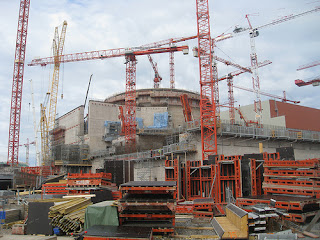
Areva's European Pressurised Reactor Olkiluoto 3
Areva's European Pressurised Reactor Olkiluoto 3 is now over five years behind schedule. Its design faces 28 unanswered questions from the UK regulator.

EDF and Areva are facing delays, high costs, and problems satisfying the regulator, over trying to get their flagship European Pressurised Reactor nuclear plant design approved for building in the UK, even as EDF seeks a £165/MWh price guarantee from the Government.

The two companies have resolved just three of the 31 problems blocking their proposed nuclear reactor from receiving environmental and safety approval from the Environment Agency and the Office of Nuclear Regulation (ONR).

They are greatly behind schedule and will not receive final approval this year, as they had hoped.

Their design for a new generation European Pressurised Reactor (EPR) has to pass through the generic design assessment (GDA) process before any reactors can be built.

EDF is hoping to use two of the reactors in a 3.2 gigawatt plant at Hinkley Point, Somerset.

Meanwhile, it is seeking a subsidy in the form of a guaranteed price of £165 per megawatt hour (MWh) for electricity from the plant from the Department for Energy and Climate Change (DECC) and the Treasury, according to the Times newspaper.

This expensive figure is more than the £150/MWh strike price estimated by Dr. David Toke, Senior Lecturer in Energy Policy at the University of Birmingham, and about the same as a £166/MWh estimate by Citi bank analyst, Peter Atherton.

The EPR design was given interim approval by the ONR and the Environment Agency last December but EDF has to come up with answers to 31 separate questions.

They cover issues such as security, reliability, strength of the inner containment wall, test results, and independent assessment of predictive calculations.

Significantly, the report says: “some of the deliverables have been late or did not provide the required quality of arguments or evidence".

It adds: "a number of the metrics are amber or red, indicating that, if no action is taken to improve matters, it is unlikely that the GDA [Generic Design Approval] Issues will be closed-out on the timescales indicated in the current resolution plans", in other words that the design will receive approval by November. EDF and Areva are reviewing their timescales and a new date will be announced shortly.

ONR takes a while to make its progress reports publicly available. Although published on July 5, the latest quarterly report actually covers the three months up to March 31. The reports are not easy to find on the website, especially because a link leading to them is broken.

The EPR is now the only reactor design being assessed following Westinghouse's withdrawal from the market with its AP1000 reactor design.

More EPR delays

To add to the two French companies' woes, the reactor being built by Areva in Finland, the 1,600 megawatt Olkiluoto 3, will now “not be ready for a normal level of electricity production in 2014" according to a statement issued on Monday by Areva's partner, the Finnish utility Teollisuuden Voima Oyj (TVO). TVO adds, dryly: “we are not pleased with the situation".

It was supposed to have been ready in 2009, and last year TVO said it would start in 2014. It is more than €2 billion over budget. TVO is locked in a bitter legal wrangle with Areva.

There are similar delays and cost overruns at Areva's EPR project in Flamanville, France.

The nuclear subsidy dilemma

Under the draft Energy Bill, the Government will introduce ‘contracts for difference’, a tariff system intended to subsidise renewables, nuclear, and carbon capture and storage. But it will not be in place until 2014, two years after EDF says it needs to make an investment decision on the Hinkley Point plant.

The EPR clearly is much more expensive than EDF had originally said publicly. The Government has repeatedly said it is committed to nuclear power.

Offshore wind power is currently subsidised at a price of £130 per MWh under the Renewables Obligation Commitment. The Secretary of State, Ed Davey told the House of Commons Select Committee on Energy and Climate Change yesterday that details of changes to the Renewables Obligation Commitment subsidy levels, which had been expected to include a reduction in this subsidy and were anticipated this week, have been delayed due to pressure of time impacting on his department’s discussions with the Treasury and other departments.

He said “there are over 4,000 responses to the consultation, and it is very complicated”. Pressed by MPs, he said an announcement will be made by the end of September. He also denied that there was any outside interference in the decision-making process.

Regarding the issue of a subsidy for nuclear power, Ed Davey, is on record as saying: “There will be no levy, direct payment or market support for electricity supplied or capacity provided by a private sector new nuclear operator, unless similar support is also made available more widely to other types of generation.

"I want to make clear … that this means that nuclear will not receive a higher price than comparable generation technologies whether they be renewables or indeed gas generation, once its emissions have been abated by carbon capture and storage.”