Showing posts with label climate talks. Show all posts

Thursday, September 06, 2012

Bangkok U.N. climate talks make little progress. World headed for 3°C rise.

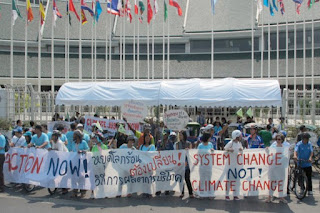
climate protesters at Bangkok United Nations talks
 Protesters in Bangkok outside the UN climate talks.

The U.N. climate talks featuring delegates from 190 nations, that have been ongoing for the last week in Bangkok, Thailand, and which conclude today, have produced few concrete results.

The talks were happening against a backdrop of record Arctic ice melt, recent flooding in the Philippines, Asam and other areas, recent drought in the US, and an ongoing food crisis in the Sahel.

Last December at the Durban COP talks, the world's nations agreed that they would sign a legally-binding pact to cut emissions and help developing nations adapt to climate change, from 2020. Part of this agreement included a promise to deepen existing promises to cut emissions by the end of the decade.

However, after one week of talks in Thailand, not a single country has made a fresh commitment, and US negotiators stunned delegates by calling for any new treaty to be ‘flexible’ and ‘dynamic’ rather than legally binding, representing a complete U-turn on its previous position.

In response, 130 developing countries sought to put pressure on developed countries by threatening to deny them access to Clean Development Mechanism (CDM) credits, which developed countries use to offset their emissions by financing projects in the poor ones.

But this tactic could backfire, as Takehiro Kano, a senior climate negotiator with Japan, said that if they went ahead, Japan's response might just be to lower its voluntary target of cutting emissions 25% below 1990 levels by 2020, and Justin Lee, Australia's climate change ambassador, retorted that the Australian government would anyway "take international action that best supports Australia's domestic initiatives".

The United States and other developed countries blamed the global economic crisis for the lack of funds that they are able to make available to combat climate change. In a reaction to this, developing countries earlier tried to play down requests for finance and technology commitments, in favour of greater efforts by developed countries to reduce their greenhouse gas emissions.

But this created yet another deadlock, as Japan, Canada and Russia, which refused to sign up to an extension to the Kyoto Protocol as last December's climate summit, dug their heels in and refused to rejoin the process. The European Union argues that it cannot afford to up its reduction targets, and the United States is in an election year, which paralyses its ability to act.

This has led one observer, Sanjay Vashist, director of Climate Action Network South Asia, to comment that, "the existing deadlock on taking up ambitious climate action will only delay the necessary adaptation finance to vulnerable countries."

Christiana Figueres, executive secretary of the UN’s climate secretariat, Was putting a brave face on it. “Government negotiators have pushed forward key issues further than many had expected and raised the prospects for a next successful step in Doha," she said.

This leaves many political decisions that will have to be taken at this next meeting in Qatar.

With the present level of commitments to reduce emissions, the world is still on for at least a 3°C temperature rise, which would have catastrophic repercussions.

Rich nations failing to cut emissions


At the summit, the U.N. released a report showing that several rich nations will not even meet their existing pledges to cut greenhouse gas emissions by the end of the decade, made at Copenhagen in 2009.

These nations include Australia, Canada, Japan, Mexico, South Africa, South Korea and the US.

The report, from the UN Environment Program, adds that even if all nations do meet their existing pledges, emissions of greenhouse gases will still reach between 50 and 55 billion tonnes of carbon dioxide equivalent, that is 11 billion tonnes, or 20%, more than what is needed to try to keep temperature increases below 2°C.

“It's still possible to meet a 2°C pathway, if there is sufficient political will," commented Niklas Hoehne, and author of the report on Tuesday. "We’re not facing a participation gap here – it’s an ambition gap.”

Meanwhile, developed countries want the industrialised developing countries such as India, China and Brazil, to take more responsibility for cutting their emissions.

They say that if this was resolved, it would allow the issues of technology, finance, intellectual property lies and emissions from aviation and shipping, which are stymied, to be set aside while the responsibilities of the emerging economies are increased in the short and long-term and the rich countries take stronger action after 2020.

But this is unlikely to happen without further commitments from developed countries. Depressingly, it seems the stalemate continues.

Wednesday, June 08, 2011

Carbon market in a slump as climate talks continue in Bonn

Forest planted and managed for carbon offsetting
As world environment ministers and representatives meet in Bonn for climate talks this week, investors in the carbon market are hoping, probably in vain, for some kind of certainty as to what will happen after 2012.

After five consecutive years of robust growth, the total value of the global carbon market has stalled at $142 billion due to uncertainty as to what will replace the Kyoto Protocol's Clean Development Mechanism (CDM) after next year. The recession has also had an effect on the market.

A report from the World Bank, The State and Trends of the Carbon Market 2011, covering the last five years up to 2010 and issued last week, shows that the value of the primary CDM market fell by double digits for the third year in a row, ending lower than it was in 2005, the first year of the Kyoto Protocol.

The Assigned Amount Unit (AAU) market, which grew in 2009 with strong governmental support, shrank as well in 2010. Finally, the market that had grown most in 2009 allowances under the U.S. Regional Greenhouse Gas Initiative (RGGI) saw that year's gains erased in 2010.

This meant that the European Union's Allowances (EUAs) market became especially important. EUAs accounted for 84% of global carbon market value last year.

If you take into account the value of secondary CDM transactions, their share, driven by the EU Emissions Trading Scheme rose to 97%, dwarfing the remaining sections of the market. If it was not for Europe's commitment, virtually nothing would be happening elsewhere in the world.

Voluntary carbon market


There is good news, however, in another report released last week about the state of the voluntary carbon market, which posted a 34% gain in 2010, trading a record 131 million tons of carbon dioxide equivalent (MtC02e).

This is an annual report by Ecosystem Marketplace and Bloomberg New Energy Finance which gathers data from almost 300 market participants.

While the US accounted for the majority of trading activity, worth $424 million in total, market growth was strongest in developing countries.

Voluntary offsetting is due to businesses' CSR (Corporate Social Responsibility) commitments. These markets are investing particularly in renewable energy and forests.

The need for political commitment


Loss of political momentum on setting up new cap and trade schemes in several developed economies such as the United States and in the Far East, is a further reason for the decline in the non-voluntary sector.

Last week, California's proposed cap and trade scheme was challenged in the courts and is likely to be delayed by a year.

Christiana Figueres, executive secretary for the UN Convention on Climate Change, lambasted the US for inaction on climate change at the Carbon Expo in Barcelona last week.

Andrew Steer, World Bank Special Envoy for Climate Change, summed up the message of the report at the Expo. "The global carbon market is at a crossroads. If we take the wrong turn we risk losing billions of lower cost private investment and new technology solutions in developing countries. This report sends a message of the need to ensure a stronger, more robust carbon market with clear signals.”

The report's authors predict that in the next two years the difference between the gross demand for the cumulative supply of carbon credits generated under the Kyoto mechanisms will be below $140 million, and virtually all of this demand will be from Europe.

Looking beyond 2012, although potentially the demand for emission reductions could reach 3 billion tons or more, so far the only certain demand is from Europe estimated at just 1.7 billion tonnes.

This means there is little incentive for project developers to invest further and create a future supply of emissions reductions.

This is the effect that political uncertainty is having on political and business efforts to combat climate change at a time when its threat is reported to be even greater than previously assumed.

"Carbon market growth halted at a particularly inopportune time: 2010 proved to be the hottest year on record, while global emission levels continued to rise relentlessly,observes Alexandre Kossoy, World Bank Senior Financial Specialist.

“At the same time, other national and local low-carbon initiatives have picked up noticeably in both developed and developing economies. Collectively, they offer the possibility overcome regulatory uncertainty and signal that, one way or another, solutions that address the climate challenge will emerge."

Eight countries receive $2.8m


The World Bank's response is centred around the $100 million Partnership for Market Readiness, launched in Cancun in December 2010, which aims to support mitigation activities.

Last week it dispersed its first funding to eight countries: Chile, China, Columbia, Costa Rica, Indonesia, Mexico, Thailand, and Turkey. Each received an initial grant of $350,000 to help design, pilot, and eventually implement market-based instruments for greenhouse gas mitigation. They will now develop a "Market Readiness Proposal" to detail their plans. Another seven countries will receive grants shortly.

The fund is supported by ten contributors Australia, the European Commission, Germany, Japan, the Netherlands, Norway, Spain, Switzerland, the United Kingdom and the United States which together have pledged nearly US $70 million.

A number of the World Bank's carbon funds and facilities, such as the Carbon Partnership Facility, the second tranche of the Umbrella Carbon Facility, and a new facility for low-income countries currently under development, also respond to future needs by supporting scaled up mitigation and purchasing carbon credits beyond 2012.

Furthermore, the Forest Carbon Partnership Facility is supporting REDD+ initiatives which, to date, have not been included under the CDM. The Bank sees carbon markets as an important and versatile tool to provide incentives for a shift to lower carbon development paths.