Showing posts with label Greg Barker. Show all posts

Monday, February 03, 2014

The UK fails to deliver: fuel poverty is up, support for energy efficiency down

Ed Davey, UK Secretary for Energy and Climate Change The UK is letting down its population by failing to deliver on energy efficiency. As a result, fuel poverty is up at the same time as fuel prices, and support for energy efficiency has plummeted and will continue to do so at the current rate.

This is happening under the watchful eye of Ed Davey, UK Secretary for Energy and Climate Change (right).

The most expensive and exclusive homes in Britain are the least well insulated, while the majority of the UK’s local authorities (LAs) are in breach of European regulations, and needlessly wasting energy, according to new research.

Not only that, but despite a year of public outcry about the cost of energy, the number of energy efficiency installations around the country has plummeted and Government has told energy companies that they can get away with insulating far fewer homes than before.

Whereas 1.61 million lofts were fully insulated in 2012, in the year to the end of October 2013, just 110,000 had been treated - a staggering 93% drop.

The same kind of drop has happened with cavity wall insulation, from 640,000 in 2012 to 125,000 in the year to October 2013, a pro-rata fall of 77%. These figures are official, from the Department of Energy and Climate Change (DECC).

The reason is because grants for such measures were dropped when the Government launched the Green Deal, a loan system that was intended to see a swathe of energy efficiency makeovers across the country, but which has so far failed to ignite public enthusiasm.

This is all despite the country having a Climate Change Act and an Energy Efficiency Strategy, which has an aim of cutting energy use by 196TWh by 2020 (an 11% cut), and carbon emissions by 41 MtCO2.

 the case for energy efficiency

The Rich Don't Seem To Care

The rich don't seem to care about saving money, heat or climate change. In the exclusive parts of London, most occupied by millionaires, a staggering 83% of homes in Kensington and Chelsea and 79% in Westminster have uninsulated walls and a lack of loft insulation, coming at the bottom of a national league for energy efficient homes.

At the other end of the country, in colder Aberdeenshire and the Outer Hebrides, homes are insulated to the highest standard, with 65% and 66% respectively having installed wall insulation.

Utility company npower found these figures in data licensed from the Energy Saving Trust. They reveal that over half the 26 million homes in Britain allow too much heat to escape through the building fabric.

As a result, together with rising fuel prices, fuel poverty is higher than ever in the UK, with seven million people, including 2.2 million children, living in fuel poverty in England, a rise of 26% compared to a year ago. People are going without food in order to pay their energy bills. No wonder they can't afford the insulated their homes. This is exactly why they need help.

A telephone survey by npower found that just 20% of households asked have insulated their domestic hot water storage tank. When asked, the main reasons given for not installing energy efficiency improvements were:
  • 42%: not being able to afford it;
  • 36%: lack of government support;
  • 33%: I can afford to waste energy (or words to that effect).
On the positive side, one third of those asked said they had made some improvements, such as installing loft insulation (39%), a new boiler/furnace (33%) and cavity wall insulation (30%).

The Green Deal Flop

The UK Government launched the Green Deal last year as a flagship policy to enable households to invest in home energy efficiency at little cost to them. But it has been a shambles, due to the difficulty of finding assessors, lack of publicity, and the cost of getting an assessment done.

Greg Barker, Energy MinisterThis week, Greg Barker (right), an Energy Minister, claimed that: "It has been an encouraging first year for the Green Deal. It has not exactly developed in the way we anticipated [but] together with the ECO, the Green Deal has improved over 400,000 homes in their first eleven months".

He puts a nice spin on it. The ECO is the Energy Company Obligation under which utilities are forced to install energy efficiency measures in their customers' homes. The detailed figures show that 98% of those 400,000 homes' improvements were conducted through ECO, and not through the Green Deal.

The figures actually show that just 1,612 households had Green Deal Plans up to the end of 2013.

At this rate it would take 16,000 years to treat all of the nation's homes.

It Will Get Worse

The situation is going to get worse, not better. The Chancellor George Osborne announced in his Autumn Statement that the energy companies’ ECO target for insulating solid wall homes will be slashed by two thirds – meaning they are now only required to tackle 100,000 homes by 2017.

This change in policy comes after profits of the 'Big Six' energy companies (British Gas, Npower, Scottish & Southern Energy (SSE), Scottish Power, E.ON and EDF) rose 75% in 2012 on 2011, according to the regulator, Ofgem. The same companies complained to George Osborne before his Autumns Statement about 'green tariffs' such as the ECO adding to their costs.

The Green Deal has been slammed by many, such as the members of the Federation of Master Builders (FMB), whose chairman, Brian Berry, has politely said that the scheme "has not achieved the desired results in its first full year, with the majority of SME installers and homeowners failing to engage, and the financial package underpinning the scheme proving unattractive to most consumers."

He repeated the oft-made call that: "the single most effective measure to kick-start demand would be to reduce the rate of VAT from 20% to 5% on all domestic energy-efficiency work".

Paul King, chief executive of the UK's Green Building Council, was more forthright this week when speaking at a conference on the Green Deal. He called on the Government to "recognise energy efficiency as a national infrastructure priority and be prepared to delve into its purse to make its flagship policy more appealing through stronger incentives and more attractive finance options".

Local Authorities Flout the Law

Government and local government don't even practice what they preach themselves.

Separate research conducted by the Property and Energy Professionals Association (PEPA) has found that over half of local authorities throughout the UK are failing in their obligation to display up-to-date 'Display Energy Certificates' (DEC), as required by the European Union's Energy Performance of Buildings Directive (EPBD).

PEPA, the trade body that represents business engaged in the provision of Energy Performance Certificates (EPCs) and Display Energy Certificates (DECs), says that as a result they are missing out on the opportunity to use them as effective tools to reduce energy costs.

PEPA conducted a freedom of information exercise with all local authorities in England and Wales and found that only 47% of authorities claimed to be compliant with the DEC requirements, meaning 53% are potentially ‘breaking the law’.

A 2011 study by the Chartered Institute of Building Service Engineers (CIBSE) showed that where DECs had been used in government buildings as a proactive means of managing energy usage, savings of nearly 14% were achieved.

If these figures were applied to the estimated £750 million per annum of energy costs incurred by local authorities then energy savings of £65 million could be possible. This is a significant sum at a time when local authorities are cutting public services.

£1.9 million of public money is given to local authorities' Training Standards officers each year to ensure compliance with the EPBD regulations. But PEPA believes it is never used for that purpose since it isn't ring-fenced.

"There seems to be no political will within DCLG (the government department responsible for local authorities) to address non-compliance with the EPBD regulations and anecdotally is believed to regard the Directive as unnecessary European bureaucracy, something which is likely to end up with a fine from Brussels," said Stephen O’Hara, Chairman of PEPA.

“The whole situation regarding DECs defies logic and common sense. The proactive use of valuable energy information has been proved to reduce costs to the taxpayer, but government, both central and local, are either ignorant of this fact or do not seem to care. It is irresponsible of DCLG to show disdain for the regulations which they themselves have laid down as the law of the land, and potentially to incur swingeing financial penalties from Europe as a result.”

“Regardless of your views on climate change and reducing carbon emissions, saving money and reducing pressure on hard pressed energy supplies must surely make sense even to those who want to cock a snook at Europe.”

Employment Down

The drop in energy efficiency measures has had a knock-on effect on employment in the industry.

There are now at least 7,000 fewer people were employed in delivering insulation in homes than in 2012, according to Andrew Warren, CEO of the Association for the Conservation of Energy. “A lot of people went out and set up new small companies," because they thought the Green Deal would mean an increase in the amount of work. "They have been completely sold down the river,” he said, by the failure of government to deliver.

Andrew has for three decades been championing the cause of energy efficiency.

It's just a shame that no one at Whitehall, or in the town halls up and down the country, is really listening.

Notes

The European Union is conducting a household energy affordability study in conjunction with the University of York. You may take the survey here: http://energyaffordability.eu/?lang=en

The Energy Saving Trust says that the average (gas-heated, semi-detached) three bedroom home in the UK could save the following each year on their energy bills:
  • Cavity wall insulation - £140;
  • External Solid Wall insulation - around £490;
  • Loft insulation - up to £180;
  • New boiler (furnace) - up to £310.

Energy efficiency infographic courtesy of The Trillion Fund

Friday, July 19, 2013

DECC tables plan to support independent renewable energy suppliers

Energy Minister Greg Barker.
Energy Minister Greg Barker said: “Our new reforms will create the framework for a far more dynamic and entrepreneurial market”.
The Department for Energy and Climate Change (DECC) has published plans to help independent renewable generators gain entry to the electricity market, in order to promote competition and innovation.

Energy Minister Greg Barker has tabled an amendment to the Energy Bill that will make it easier for independent generators of renewable electricity to sell their power to suppliers via Power Purchase Agreements, thereby improving their access to market.

Energy Minister Greg Barker said: “The Coalition is committed to driving much greater plurality, innovation and competition in the electricity market.

“Our new reforms will create the framework for a far more dynamic and entrepreneurial market, while still ensuring that we get the large scale investment that industry needs. Opening up the electricity market to more competition is a fundamental part of the reforms we are introducing through the Energy Bill.

“It will also allow new smaller players to gain a greater share of the exciting renewable electricity market.”

The amendment allows for the creation of an off-taker of last resort to be enabled, providing ‘back-stop’ power, providing greater certainty for renewable generators and investors.

Independent generators do not usually have a strong supply arm that sells electricity direct to consumers and have been finding it hard to enter the market, which is dominated by the ‘Big Six’ vertically integrated energy companies.

DECC says such companies "play an important role in helping to meet the country’s renewable energy targets, account for a significant chunk of the new energy infrastructure projects that are awaiting final investment decisions", and also introduce innovation and competition into the market.

The amendment would enable the Government to establish a scheme obliging suppliers to buy electricity from renewable generators under specified conditions if they were unable to agree a commercial contract. It would be used as a last resort, to strengthen routes to market and stimulate competition.

Detailed proposals will be developed and consulted on later this year.

Independent generators often sell their power to suppliers via power purchase agreements, and this is how they gain a route to market. The definition can cover a range of technologies and sizes.

Earlier this week DECC also published a draft delivery plan for Contract for Differences (CfDs) and the reliability standard of the future Capacity Market to guide how much capacity is auctioned in 2014 for delivery in 2018 to 2019.

Unveiling the plan, Secretary of State Ed Davey said it should "provide investors with further certainty of government's intent" to help incentivise up to £110 billion of funding for new electricity infrastructure by 2020.


Woodfuel conditions


DECC also issued a condition that new standalone biomass power plants will not be eligible for some subsidies unless they also generate heat, meaning many new plants could be cancelled, according to the Renewable Energy Association (REA), which represents large biomass generators. Gaynor Hartnell, its chief executive, said that combined heat and power (CHP) could not easily be retrofitted onto projects that had already been approved.

The move was welcomed by the Combined Heat and Power Association, which has lobbied in its favour. CHP is seen as much more efficient, as otherwise the heat goes to waste.

DECC also plans to restrict subsidies for biomass to 400MW per plant under the Renewables Obligation, which will operate until 2018.

The restriction does not apply to plants converting from coal-fired power, such as Drax, Britain's biggest power station. This means that large scale, controversial imports of wood pellets to Britain will continue, at least until the subsidies phase out in 2027.

On Wednesday, Mr Davey said that importing wood and burning it as biomass was not a long-term answer to the country's energy needs, leading to expectations that the government would reverse its support policy, but this has not materialised.

"This is something we already knew and does not mark a change in government policy," a Drax spokeswoman said.

DECC does believe that biomass is a transitional technology, "to be replaced by other, lower carbon forms of renewable energy in the medium to long term", it said in a statement.

Environmental groups are concerned that growth in Britain's bioenergy industry will mean the felling of virgin forests for fuel, a practice that was commonplace in Europe and North America before coal was used to power the industrial revolution. They are also worried that it takes 50 years to absorb from the atmosphere the carbon dioxide that is emitted during the burning of a tree.

Drax asserts that the woodfuel it imports has cut emissions in converted units by 80% compared with burning seaborne coal, and that it is certified as sustainable.

Last week, RWE npower said it would close a newly converted 750-megawatt biomass plant at Tilbury by July 21 because of a forecast drop in UK power prices and lack of capital from the Germany-based parent RWE.

Last year Drax also scrapped plans to build a new dedicated biomass plant on its site in North Yorkshire, due, it said, to insufficient government support.

Energy Minister Greg Barker said: “Our new reforms will create the framework for a far more dynamic and entrepreneurial market”.

Tuesday, July 09, 2013

Minister meets 'test family' in zero carbon home

Energy Minister Greg Barker MP (right) with Laura and Nik Glazebrook and Paul Hicks of VELUX, outside the CarbonLight Homes in Northamptonshire.
Energy Minister Greg Barker MP (right) with Laura and Nik Glazebrook and Paul Hicks of VELUX, outside the four bedroom CarbonLight Homes project in Kettering, Northamptonshire.
Energy and climate change minister Greg Barker yesterday saw for himself the benefits of living in a low energy house when he met one of two test families who are living in a 'CarbonLight Home' as part of a 15 month study.

The VELUX CarbonLight Homes are located in Kettering, Northamptonshire. Mr Barker toured the houses accompanied by Kettering Borough Council’s leader Cllr Russell Roberts, and met the Glazebrook family, who are living in one of the homes as part of a study to measure the homes’ energy performance and monitor their effect upon the families’ overall health and well-being.

“This energy-efficient home is inspirational," said Mr Barker at the end of his visit. "It dispels the myth that green living involves sacrifices of style, luxury or comfort. It’s so bright, light and airy, with high ceilings and lots of family space.

"It’s clearly delighting the couple and their kids who live here. This vision gives something to learn from for the rest of the country."

He used the opportunity to promote the Green Deal, which he said "is giving people a chance to retrofit their homes with energy efficiency measures by removing expensive upfront costs.

“And it’s great to see new, efficient, homes, like these ones in Kettering, being built as well.

“Our housing stock is currently among the least energy efficient in Europe, so upgrading older homes and building new more efficient ones is absolutely vital if we’re going to cut our emissions and help people reduce their energy consumption.”

Paul Hicks, Sustainability & Design Manager at VELUX, added: "It is crucial that the green agenda is placed at the forefront of government policy-making. We hope the Minister’s visit to the CarbonLight Homes has demonstrated that innovative design can be employed to create inspirational carbon neutral houses, encouraging a wholly sustainable lifestyle and offer a viable solution to the challenge of reducing carbon emissions.”

The two homes meet the future demands for sustainable buildings and were developed with a focus on the health and well-being of their occupants. They are also designed to interact with local conditions and use natural resources to reduce carbon emissions.

While in the area, the Minister also met with the MP for Kettering, Philip Hollobone, and a range of public and private sector partners to understand more about the area’s innovative approach to energy efficiency and sustainability issues.

Councillor Russell Roberts, Leader of Kettering Borough Council, said that Mr Barker's visit "follows an on-going dialogue with him on the opportunities that exist in Kettering and we are keen to continue this dialogue in the future."

The VELUX CarbonLight Homes

These homes have been designed and built to the new government definition of ‘zero carbon’, and are intended for ordinary people. They make use of their surrounding environment in an intelligent way to maximise daylight and encourage a sustainable lifestyle.

Design-wise they are open plan and incorporate high levels of daylight and natural ventilation in order to minimise energy consumption among residents and generate a sense of community.

They intended to demonstrate that common-sense design can be used to create inspirational sustainable houses that can be easily replicated by the UK’s volume house builders.

The CarbonLight Homes were developed in a strategic partnership between the VELUX Group, HTA Architects, Kettering Borough Council, Willmott Dixon and the North Northants Development Company, WindowMaster, VELFAC, Drexel and Weiss and Sonnenkraft supplied the products for the house.

The CarbonLight Homes are one of six buildings in Europe to be constructed by the VELUX Group as part of the Model Home 2020 project.

Model Home 2020

Model Home 2020 is an experiment launched by the VELUX Group that represents its vision of how future buildings can be both climate-neutral and comfortable and attractive places to live, through use of daylight and fresh air.

The project is designed according to the next generation of design principles, called ‘Active House’, in order to achieve a balance between energy efficiency and optimal indoor living conditions.

The building dynamically adjusts to its surroundings and yet is climate-neutral. Each instance of the design must reflect and respond to the different climatic, cultural and architectural conditions of the countries in which it is constructed.

Model Home 2020 comprises six demonstration projects. Each was implemented in close cooperation with local and regional partners, suppliers, architects, engineers and researchers.

The demonstration houses will be open to the public for 6-12 months after completion and then sold. They will then be monitored during occupancy to learn how the experiments turn out in real-life conditions.

The experiments in Denmark, Home for Life in Aarhus and Green Lighthouse in Copenhagen, have been in use for a year, those in Germany and Austria opened in the autumn of 2010, and those in the UK and France opened in 2011.

Thursday, July 04, 2013

Larger community renewable energy schemes to receive extra support

Energy and Climate Change Minister Greg Barker
Energy and Climate Change Minister Greg Barker said: "The expansion of our reformed Feed-in Tariff will encourage even more communities to get on board.”

New proposals to benefit community energy schemes have been unveiled by the Government.

In its response to feedback from community groups on the type of financial incentive that works best for them, the Department for Energy and Climate Change (DECC) has said it will increase the generation threshold under which community projects are eligible for feed-in tariffs (FITs) to enable larger projects to benefit.

Support for community renewable projects over 5MW is currently available under the Renewables Obligation (RO). But this pays a lower amount per kilowatt-hour than that available under FITs.

The reforms, to be written into the Energy Bill and underpinned by secondary legislation, will permit community schemes up to 10MW in size to continue to benefit from the levels of support available to those below 5MW.

Projects such as solar PV on school roofs or panels on libraries, community owned wind turbines and hydro power from local streams could all benefit under the proposed new rules.

There is also money on offer to pay for excess power exported back to the grid.

Energy and Climate Change Minister Greg Barker said: "The Coalition is determined to drive a step change in the deployment of community energy.

"We want to help consumers, businesses and communities generate more of their own clean, green electricity locally, becoming less reliant on centralised power generation. The expansion of our reformed Feed-in Tariff will encourage even more communities to get on board.”

The announcement comes on top of the launch last week of a £15 million Renewable Community Energy Fund to help community groups with the cost of feasibility studies and seeking planning permission.

DECC is also keen to explore what needs to be done to kickstart even more projects across the UK, with a call for evidence currently underway and the UK’s first community energy strategy to be launched in the Autumn.

The call for evidence wants to hear about the potential benefits of community energy, the barriers to community energy, and what might be innovative and new approaches.

The proposed changes to the FITs rules will be made as part of the Energy Bill process. Once this Bill comes into force, the Government will consult on what it will mean in practice for community schemes.

The Solar Trade Association welcomed the proposals. Its chief executive, Paul Barwell, said: “Community solar farms on lower grade agricultural land help farmers diversify their risk away from increased weather risks to their land, while at the same time fostering dual purpose land use and biodiversity. Community ownership will help secure better community acceptance for more ambitious solar farms over the existing 5MW threshold.”

However, the STA  believes that there is still an issue which needs clarifying that is preventing many community schemes from getting off the ground.

Currently all solar schemes over 50kW (the size of e.g. a school scheme) are subject to very stringent capacity constraints. For example, in any quarter, if more than 200MW of capacity of 50kW+schemes is installed, this will result in a 28% cut in all the tariffs from 50kW through to 5MW.

Furthermore, for schemes over 250kW (larger commercial or community schemes), the FIT is too low to work, leading to just a handful of projects at this size since last July. This is despite schemes over 250kW being more cost effective than many large-scale renewables supported under the Renewables Obligation (RO).

STA Head of External Affairs, Leonie Greene, said: “Solar is being unfairly constrained. It is this 'normal' mid-size of solar, dominant in markets overseas, that needs urgent attention.”

The STA is currently finalising its best practice guidance for high standards in solar farm construction, which recommend avoiding prime grade agricultural land, and provide a set of criteria which developers, builders and land tenants can use to ensure best practice.

Wednesday, July 03, 2013

Greg Barker touts UK cleantech as success model for India

Minister for climate change, Greg Barker, made the case that investment in a low carbon future was good for everyone.
The mean damage caused by delay on acting on climate change is greater than the cost of taking action, according to new research published in Nature, meaning that governments and businesses cannot use the economic slump as a reason not to invest in tackling climate change.

This argument was used by Greg Barker, Minister for Energy & Climate Change, yesterday, speaking to an audience of government and business representatives while on a trade mission to Hyderabad, India.

He said that "policies that tackle climate change, while serving a noble cause, and given the tiny emissions per head of the Indian population, can seem like a long-term luxury that developing economies can ill-afford".

But he said this attitude was wrong, adding that it was a "myth that low-carbon means a break on economic growth, that caring for the environment means leaving millions in poverty, that resource-efficiency means a break on aspiration for hundreds of millions of young people, and that a green economy is a brake on competitiveness for India as a whole".

His speech was dedicated to making the case for an alternative future, and was peppered with examples of success stories in the British economy.

These included Artemis, a university spin-off which invented a new hydraulic system for use in wind turbines that was later bought by Mitsubishi, and Romag, which is producing self-cleaning solar panels which Barker thought would be of great value in India.

The minister also cited another British company, Highview, which is developing an energy storage solution that uses excess energy to chill air, which, when warmed, drives a wind turbine.

Research backing Barker's economic argument is found in an article published today in the academic Nature Climate Change journal.

It concludes that the cost of emitting an additional tonne of carbon dioxide today is $107 per tonne, based on economic growth in developed countries being around 2% per year. Conversely, if these countries continue to be in a state of economic stagnation, then this figure rises to $138 per tonne.

The authors, Dr Chris Hope (Reader in Policy Modelling, Cambridge Judge Business School) and Mat Hope (School of Sociology, Politics, and International Studies, University of Bristol) argue that the main reason for the greater damage in a low growth world is that people will have less money than expected when the worst impacts of climate change hit, and so each dollar of damage will be felt more keenly.

The researchers used an integrated assessment model called PAGE09 to estimate the mean social cost of CO2 for a wide range of economic growth scenarios. It measures the net present value of the extra damage caused by the emission of one more tonne of CO2 today.

The results show that in a world with sustained lower economic growth the mean social cost of CO2 increases, because the climate impacts occur in a relatively poor world, suggesting that, if anything, mitigating climate change should be a higher priority for policymakers in a low-growth world.

However, rapid economic growth (over 3% per year) also increases the damage from emitting carbon dioxide, because the greater resulting emissions are more likely to give rise to a greater degree of climate change.

The authors point out that the tension between pursuing policies to revive the major economies of the world and those to reduce emissions was put into stark focus by the Chancellor, George Osborne, when he argued at the 2011 Conservative party conference that "we are not going to save the planet by putting our country out of business".

According to the World Bank, economic stagnation is expected to continue into the foreseeable future.

Investment in low carbon growth, the authors say, is therefore both desirable for climate protection reasons, but also as a stimulus to the economy.

Tuesday, July 02, 2013

UK power "will be 85% more expensive" without energy storage

Edwin Koot, CEO of SolarPlaza
Without large-scale energy storage, the UK government won't meet its renewable energy ambitions, says Edwin Koot, CEO of SolarPlaza.
The price of power in the UK will be 85% more expensive than in Germany (Europe’s biggest energy market) by May 2015, according to data compiled by Bloomberg.

U.K. power will cost £53.06 per megawatt-hour in May 2015, compared with €33.30 in Germany, according to fair value calculations on Bloomberg as of 8:40 a.m. in London.

They attribute the stark difference to Germany’s advanced renewable energy programme, which accounts for 30% of power generation, compared to the UK’s, currently standing at 11.3%.

The 2015 picture compares with an average premium of 17% over the past five years and 80% today, according to data from Marex Spectron Group Ltd., a London broker.

While Germany is seeking to consolidate its status as Europe’s biggest producer of wind and solar power by boosting its share of renewables-sourced energy to 35% in 2015 from 22% last year, the UK is targeting 15% from 11% over the same period, and is predicted to fail to meet the 20% 2020 EU-wide target.

Statkraft AS is closing money-losing gas-fed plants in Germany, while Macquarie Group Ltd. (MQG) and Vitol SA are buying British power stations, betting on gains of as much as 19% in U.K. prices by 2016, according to Societe Generale SA.

“The U.K. has built significantly less renewables to date,” Ilesh Patel, a partner at Baringa Partners LLP, a consulting firm that counts EON SE and Electricite de France SA (EDF) among its clients, said. “Germany has been on a fast-track wind and solar plan.”

Many critics of investment in renewable energy in the UK point to the fact that Germany, which is investing heavily in renewable technologies in its push to abandon its reliance upon nuclear power, currently has higher power prices than the UK.

However, Ed Davey, Energy Secretary, has consistently said that Britain's programme of supporting renewable energy will eventually lead to lower prices.

The key to this development may be investment in energy storage.

Germany is offering incentives worth €25 million to help subsidise the installation of batteries alongside solar PV systems to store electricity for use at night time. Simon Daniel, Founder of energy storage company Moixa Technology, says this "is helping our European neighbour to realise the full potential of renewable technology".

The UK Minister for Energy and Climate Change, Gregory Barker, is to deliver the keynote speech during the upcoming Solar Future UK ’13 event on July 16 at which he is expected to enlarge on his announcement, made at the recent Intersolar conference, that Britain hopes to deploy 20 GW of PV by 2020, in relation to how this affects Britain's energy storage capacity.

At the Intersolar event, Barker said that "the UK Government is totally committed to building a world-class renewables industry” and quoted Prime Minister David Cameron as saying that he wants to "make Britain a global showcase for green innovation and energy efficiency".

At the following day's Energy Storage UK '13 conference, leading industry spokespeople and cleantech businesses from the UK’s energy storage sector will discuss how the latest energy storage systems (ESS) will advance the integration of renewable energy, such as solar PV and wind.

"Deployment potential of solar PV is greater than the UK’s grid storage capacity," comments the CEO of SolarPlaza, Edwin Koot. "Without large-scale energy storage solutions, the UK Government’s ambition to reach this figure presents a significant challenge for National Grid, which has already warned that building more than 10GW will make it difficult to manage the network in its current form."

Director of the Electricity Storage Network, Anthony Price, is warning that "if the Government does not support the use of storage as part of the solution to meet our power shortfall, we will lose this opportunity, and live to regret it.

"What is low cost now will take us down power’s one-way street. It will be difficult and costly to reverse. Our plans for the Smart Grid show we need storage and we must seize this opportunity now.”

The intermittency of solar PV and wind requires utilities to maintain additional spinning reserve from polluting power stations to pick up loads, or, in the future, use demand-side reduction techniques in the capacity market, in the event of peak demand spikes.

If the potential of intermittent renewables is to be fully realised, the National Grid will require fast-acting energy storage systems that can dispatch power and respond quickly to network imbalances, says Price.

That the power industry and policy makers are not paying sufficient attention to the challenges arising from integrating intermittent power generation into the system was felt by 60% of attendees polled at the recent POWER-GEN Europe and its co-located conference, Renewable Energy World Europe, between 4-6 June at the Messe Wien, Vienna.

Monday, June 10, 2013

Exposed: Fossil fuel connections of ministers who voted against the decarbonisation target

38 of the ministers who voted against the amendment to set a decarbonisation target for 2030 last week in the House of Commons have received support from, or are in some way connected to, the fossil fuel industry.

Together with other accusations of influence by lobbyists on MPs, and the alleged giving by Tim Yeo of advice to a rail freight company seeking to influence Parliament, the revelations give fresh impetus to calls for MPs and ministers not to get involved in decision-making on matters in which they have an interest.

The list, together with their connections, is published at the bottom of this article. It is noteworthy that none of the ministers with connections to the fossil fuel industry voted for the decarbonisation target.

The list comes from cross-checking the list of those who voted against the amendment with the list of ministers with such connections published in March by the World Development Movement, which itself had collated it from numerous publicly available sources.

The WDM's exercise found that one third of all 125 government ministers have such connections.

This does not account for any connections held by backbench MPs, such as Peter Lilley, who voted against the amendment. He, for example, is a non-executive director of Tethys Petroleum Ltd, as well as having been paid £22,462 in July 2011 for giving advice to Ferro Alloys Corporation Limited on the management and flotation of a power generating subsidiary.

Top ministers with fossil fuel connections include William Hague, Vince Cable, George Osborne, Michael Fallon and Greg Barker. They all have links with big finance, oil and coal companies that are driving climate change.

Foreign secretary William Hague, who used to work for Shell, helped Tullow Oil escape paying a £175m tax bill in Uganda, one of the world’s poorest countries. Mr Hague made a personal phone call to the Ugandan president on Tullow Oil’s behalf.

Vince Cable, secretary of state for business and skills, in charge of regulating companies, worked for Shell and was referred to as "contact minister for Shell" by a top Shell executive in 2012.

His business and now also energy minister, Michael Fallon, was an independent non-executive director responsible for inter-dealer broking (until 2012) of Tullett Prebon plc, specialising in Energy & Commodities.

Chancellor George Osborne accepted donations worth £38,000 from the head of CQS, a hedge fund that channels millions of pounds into climate-warming energy. Also, his father-in-law, Lord Howell, is president of the Shell and BP-funded British Institute for Energy Economics. Lord Howell was a Foreign Office minister until 2012.

Energy minister Gregory Barker, who shamefully voted against the amendment, has been the head of international investor relations for Anglo Siberian Oil and Sibneft, a Shareholder in New Star European Growth Fund plc and Henderson High Income Trust plc and corporate finance director of the Australian-owned International Pacific Securities.

The vote on the amendment would have been different if just 12 MPs had voted differently.

It would be in the interests of democracy, let alone the planet in this case, that MPs should be barred from voting on matters in which they have a financial interest.

By the way, mandatory carbon reporting introduced by the government will force fossil fuel companies to disclose their carbon footprints, but banks and other institutional investors will not have to declare the emissions arising from their loans and investments.

Yet without them, big oil, gas and coal companies like Shell, BP and Rio Tinto would not be able to raise billions from pension funds, banks and other financial investors based in the City of London and beyond.

By including these ‘financed emissions’ in mandatory carbon reporting regulations, Vince Cable could force financial institutions to disclose their full carbon impact and fully expose the degree of exposure that these institutions have to the carbon bubble.

The 'carbon bubble' is the name given to the assets held by these institutions which may become worthless if they are not allowed to be exploited by national or global level agreements to curb global warming.

It is therefore in the interests of these companies themselves to account for the impact of such investments.

The lists:

Here is the list of ministers who voted against the amendment, together with their connections to the fossil fuel industry:

Gregory Barker Anglo Siberian Oil (1998–2000) Head of International Investor Relations for Sibneft (1998) 50 Shareholder in New Star European Growth Fund PLC and Henderson High Income Trust PLC.51 Corporate Finance Director of the Australian owned International Pacific Securities
Vincent Cable Chief economist and other positions at Shell International (the world’s most carbon intensive oil company: A leaked memo addressed to Cable from Shell’s chief executive referred to him as “contact minister for Shell”) (1990-1997).
David Cameron Accepted £10,000 from Jonathan Green of hedge fund GLG Partners. GLG is a frequent investor in fossil fuels. Accepted £10,000 from Mark Foster Brown of hedge fund Altima Partners (2005), which deals in fossil fuel shares, including Cadogan Petroleum and Lonrho plc,29 which is a multi-sector company involved in building port terminals in Africa “to support the oil and gas industry"
Kenneth Clarke Director of Foreign and Colonial Investment Trust plc (until 2007)
Nick Clegg Accepted £9,000 from Neil Sherlock, head of public affairs at auditors KPMG (2006-2008)
Michael Fallon Director of Tullett Prebon Plc (independent non-executive); inter-dealer broking (until 2012)
Robert Goodwill  Shareholding in Barclays, Gazprom and Lukoil. Accepted £11,000 donation from Mountboon Investments Ltd financiers (2010)
Dominic Grieve Total shareholdings of more than £240,000 in Anglo American, Standard Chartered, Rio Tinto and Shell
Michael Gove Accepted £10,000 donation from Aidan Heavey, founder and chief executive of global gas and oil company Tullow Oil(2010)
William Hague Worked for Shell UK (1982-83). Accepted over £25,000 in non-cash donations from CQS
Stephen Hammond Director Commerzbank Securities (2000–Present) Has shareholdings in Peal Gas Ltd
Greg Hands Worked or three different firms in an eight year banking career. (1990-97)
Matthew Hancock Payment of £3,000 from UBS AG for speech (2011)74
Mark Hoban Payment of £1,300 from JP Morgan Chase for speech (2010)76
Nick Hurd Represented a British bank in Brazil (1995-1999).
Sajid Javid Directorships and other senior positions at Deutsche Bank AG, (2000-2009), JP Morgan Partners LLC (1997-2009) and Chase Manhattan Bank (1991-1994)
Jo Johnson Investment banker at Deutsche Bank (until 1997)
David Lidington Worked for BP (1983-86) and Rio Tinto (1986-87)
Mark Lancaster Management consultant at Palmer Capital a privately owned venture capital and fund management business. (resigned 2012)
David Laws Vice President JP Morgan’s Treasury Division (1987-1992) Managing Director Barclays De Zoete Wedd (1992-1994)
Maria Miller Marketing manager Texaco (1990-1994)
Francis Maude Member of Barclays’ Asia-Pacific Advisory Committee. (2005-2009). The Conservative Party’s Implementation Team which reported to Maude also received significant donations in kind from accountancy firms KPMG, PriceWaterhouseCoopers, Ernst and Young and Deloitte.
Theresa May Shareholdings held by self and spouse in Prudential Corporation plc. Accepted donation in kind from Michael Hintze who runs the hedge fund management firm CQS Asset Management. (2009)
David Mundell Accepted £5,000 from Caledonia Investments PLC investment trust. (2010)
George Osborne Accepted donations and donations in kind from Michael Hintze of CQS hedge fund worth £38,700. Leading beneficiary of donations in kind to the then shadow cabinet from audit firms KPMG (£62,500) and Deloitte (£60,000) both of which have specialist oil and gas departments. (2009) Also, his father-in-law, Lord Howell, is president of the Shell and BP-funded British Institute for Energy Economics. Lord Howell was a Foreign Office minister until 2012
Andrew Robathan Worked for BP (1991-92)
Desmond Swayne Manager of Risk Management Systems at the Royal Bank of Scotland and other senior positions (1989-1997)
Elizabeth Truss Commercial manager at Shell (1996-end date unclear)
David Willets Senior advisor to Punter Southall a leading actuaries and actuarial consultants.

This is a list of other ministers who were absent for the vote, but who also have such connections:

Alan Duncan
Oil trader and other positions at Shell (1979-1992) Consultant for Vitol.
Philip Dunne SG Warburg (1981-88) Former Managing Director of Lufkin & Jenrette a US investment bank.
Philip Hammond Director of Consort Resources Ltd later purchased by Caledonia Oil and Gas (1999-2003)
Oliver Letwin Directorships and other senior positions at Investment bank NM Rothschild (1986-2009)
John Nash Assistant Director Lazard Brothers and Co Ltd (1988-1989)
Hugh Robertson Assistant Director and management head Schroder Investment Management (1995-2001)

Finally, here is a list of ministers in the House of Lords with such connections: Lets see how they vote when the Energy Bill comes before them:

Lord Ahmad of Wimbledon
Senior positions at NatWest, Alliance Bernstein, and Sucden Financia (1991-present)
Lord Deighton Chief Operating Officer for Europe and other positions at Goldman Sachs. (1983-2005)
Lord Freud Vice-chairman and other senior positions at S G Warburg (later known as UBS Investment Bank) (1984-2003)
Lord Green of Hurstpierpoint Chairman and other senior positions HSBC (1992-2010)
Earl Howe London director of Adam & Co. plc (1987-1990)

Sunday, August 12, 2012

Green Deal loans to be underwritten by Government

Danny Alexander, Chief Secretary to the Treasury
Danny Alexander said said that there are over 30 expressions of interest so far in Green Deal infrastructure loans.
The Green Deal is to be an early candidate for UK Infrastructure Guarantees scheme, said Danny Alexander, Chief Secretary to the Treasury, last week.

In other Green Deal news:
  • the register for Green Deal providers, assessors and installers has been opened
  • a £7 million loan has been advanced to the Green Deal Finance Company (GDFC)
  • and social landlords are being encouraged to take up the millions of pounds still on offer for Renewable Heat Premium Payment Scheme.

Infrastructure Guarantees

The Infrastructure Guarantees scheme is a new credit enhancement scheme set up to kick-start critical infrastructure projects by stimulating the injection of private finance with loans underwritten by the Government.

Mr. Alexander said that there are over 30 expressions of interest so far.

"The Green Deal is the largest ever programme for investing in the energy efficiency of our housing stock," Mr. Alexander told the Global Business Summit on infrastructure in London, “And we are looking at whether and how a guarantee could ensure that the finances are in place to get the programme off to a very strong start."

A spokesperson for the Department of Energy and Climate Change (DECC) said that it "is currently undertaking discussions with interested parties, such as the banks and investors on whether and how a guarantee could support the provision of low cost finance for Green Deal."

Attracting loan financing has been one of the stumbling blocks inhibiting the full launch of the scheme this October. The Institution of Civil Engineers (ICE)'s Director General, Nick Baveystock, expressed relief at the news: “When this scheme was announced, we and others across industry voiced concerns around whether the criteria for accessing guarantees were too high to attract applicants," he said.

"The news that there are over 30 expressions of interest so far is positive and we look forward to further updates from Government on which [other] projects it will be providing guarantees for.

“Reducing demand by making existing older homes more energy efficient is a vital if we are to have a resilient, affordable and low carbon energy system in future years," he added. But he cautioned that the government must make public "figures on exactly how many projects are actually moving forward as part of the scheme”.

DECC also announced yesterday that it has advanced a £7 million loan to the Green Deal Finance Company (GDFC), the not-for-profit company that will provide low-cost Green Deal finance to homeowners and businesses. Longer term, it expects to secure finance from the bond markets to ensure residents taking the Green Deal will be offered sufficiently low rates to attract their interest.

The GDFC is also in discussions to secure financing from the new Green Investment Bank (GIB). The GDFC's members include British Gas, Carillion, Clifford Chance, E.ON, EDF Energy, Goldman Sachs, HSBC, Insta Group, Kingfisher, Linklaters, Lloyds Bank Corporate Markets, Mark Group, npower, PwC, RBC Capital Markets and SSE.

It was forced to suspend operations earlier in the summer because it had not been able to secure the funding it needed through UK Green Investments, which had been set up to provide funding ahead of the GIB receiving State Aid approval.

State Aid approval has still not been given but is expected by the end of the year.

Green Deal register


DECC also announced that it has opened the register for Green Deal providers, assessors and installers. This register will give the 'seal of approval' to businesses that successfully go through the Green Deal authorisation process.

A Green Deal Quality Mark will show who is authorised and protect consumers.

"The opening of the Green Deal register will enable businesses to start becoming Green Deal authorised and the Green Deal Quality Mark will show they have met our standards. Crucially, this will protect consumers, who will know that anyone displaying the Quality Mark has been through the required process to become authorized," said Energy Minister Greg Barker.

Anyone with questions about the guidance should contact the Green Deal Oversight and Registration Body on 020 7090 1031 or visit their website at www.decc.gov.uk/orb.

Businesses wishing to become Green Deal Providers can apply directly online, while accredited certification bodies will be able to submit the details of Assessors and Installers to be authorised.

Many housing associations are hoping to become Green Deal providers and include: Gentoo, Affinity Sutton, Places for People, Alliance Homes and the Aster Group.

Social landlords


These and other social landlords have also been encouraged to take up the millions of pounds still on offer for renewable heat.

This is under the Renewable Heat Premium Payment (RHPP) scheme, which had failed earlier in the year to disburse all of the funds at his disposal.

The competition is being reopened, with a millions of pounds available for social landlords to get kit such as biomass boilers, solar hot water panels and heat pumps into social tenants’ homes.

Energy and Climate Change Minister Greg Barker said: “I would urge social landlords across the nation to apply and take advantage of all this scheme has to offer.”

Registered providers for social housing, such as local authorities and social housing associations, can bid for funds up to the Sterling equivalent of €200,000, which currently amounts to around £156,000 each. Up to £2.5 million of additional funding will be allocated under this element of the competition.

Tuesday, July 17, 2012

UK could cut electricity demand by 40% by 2030

Greg Barker when he launched DECC's Energy Efficiency Deployment Office
Greg Barker when he launched DECC's Energy Efficiency Deployment Office, which commissioned the report, back in February.

The UK could decarbonise its electricity supply system at a much lower cost through greater demand reduction, according to new Government-sponsored research.

A huge total of 40%, or 155 terawatt-hours, of present demand could be eliminated by 2030. Reducing demand by such an extent would mean that many of the more expensive or risky forms of generating electricity currently being considered could be put on the backburner.

The figure comes from a draft report, 'Capturing the full electricity efficiency potential of the U.K.', commissioned from McKinsey and Co., that has been published by the Department of Energy and Climate Change for peer review.

The analysis says that current Electricity Market Reform proposals would only realise 54 terawatt-hours (TWh), or around one third of the full potential savings. Further measures would therefore be required to capture the remaining savings.

The review concentrates on the three largest categories of abatement measures per sector, which it says could together deliver 127 TWh of savings, or 80% of what is possible.

In the residential sector, these measures include better insulation, energy-efficient lighting and more efficient appliances, which could achieve 58 TWh reduction. Three quarters of this demand reduction is already expected to be achieved through current or planned policies, primarily in increased appliance efficiency.

In the services sector, the measures include better insulation, lighting controls and heating, ventilation and air conditioning (HVAC), which could achieve 45 TWh reduction. 15% of this is expected to be achieved through current or planned policies.

In the industrial sector, the measures include pump, motor and boiler optimisation, totalling 24 TWh of savings, of which only about 5% is expected to be captured through current or planned policies.

The researchers reckon that by 2020, 115 TWh could be saved, of which 60% is expected to be achieved by current policies.

Catch-22

But the energy efficiency sector seems to be caught in a Catch-22 situation. Because it doesn't seem worthwhile for many business users to invest in energy efficiency, the market has not matured. However, it won't mature unless there is sufficient demand. It is therefore up to the government to nurture that demand.

For example, a green finance provider said that energy service companies have to bring in people from outside to provide quality advice on energy efficiency for clients. A utility company said that even if one could save 20% of an annual average bill for an SME, it still wasn't worth the initial investment. This was because of the “high transaction costs... such as closing the business for two days".

The research included interviews with key stakeholders, and uncovered 11 similar barriers to capturing the remaining demand reduction potential. They range from market-based mechanisms to regulatory ones like taxes and obligations on suppliers.

It found that while policy is quite good at addressing barriers in the residential sector, those in the service and industrial sectors are less well addressed.

Moreover, the complex and constantly changing policy landscape results in confusion and delays investment in energy efficiency. Consequently, utility companies and many intensive industrial users largely focus on buying new renewable energy sources to reach their carbon targets.

One commercial user said: "The biggest barrier is the shifting sands that the Government has introduced by changing the goal posts (e.g., solar FiTs). This curtails investment. The carbon reduction landscape is extremely complex and I would like to see that simplified."

A utility company representative offered the following insight: "We would appreciate more visibility and stability in terms of policy. CRC [the Carbon Reduction Commitment] has changed significantly and we still don’t know what it will look like tomorrow."

Payback periods need to be more favourable to attract the initial investment which is often perceived as being too high. The commercial and industrial sectors expect payback periods of around two years, but investments on average have a payback period of around five years.

In the residential sector, it is the rental subsector which needs the most attention. The review says that changing people's behaviour remains a significant opportunity here, and will capture as much as 15% of savings, though this proportion will diminish as technical innovations spread.

In the commercial sector, 61% of commercial space is leased, and 75% of the corporate sector outsources its facilities management requirements. In general, neither of these presently offer incentives for reducing energy use.

While electricity-intensive users do focus on demand reduction, the majority of users, which represents 60% of total industrial electricity demand, are less likely to achieve the potential opportunities.

One industrial user pointed out that their investments in biofuels and waste fuels reduces their carbon emissions but increases their electricity usage, while a utility company commented that 90% of its energy efficiency programmes were directed toward saving gas and electricity.

"There’s a mass of different assistance in energy efficiency areas," said one electricity-intensive user. "It’s bewildering what’s on offer. I have never heard of the Enhanced Capital Allowance. Maybe that could help some of our business cases."

Yet government agencies have been offering information about Enhanced Capital Allowances and similar measures for at least ten years.


Barrier-busting options

Amongst the policy options considered to stimulate the market are the use of tradable certificates in energy efficiency, as piloted by Connecticut Energy Saving Certificates in the United States. In that case, suppliers are obliged to meet 4% of electricity supplied through the purchase of the certificates.

Also in the States, an EPA Portfolio Manager is an online benchmarking tool for commercial buildings which helps tenants and buyers find the most efficient solution to their problem. Participation in a similar scheme here could be either voluntary or compulsory.

The ISO New England scheme is a forward capacity market which allows demand-side resources to compete with generation. Capacity payments provide sponsors with the incentives and stability to encourage investment in energy efficient products. Implementing a similar scheme in the UK would involve expanding the role of the National Grid in order to manage the market.

Finally, the report considers a scheme in Texas managed by utilities using two types of incentives: which allow standard offer programs consumers to choose the most cost-effective measures; and market transformation programmes would incentivise specific efficiency measures that need help to overcome structural barriers.

The report vindicates findings by campaign groups like Zero Carbon Britain and Greenpeace, which have themselves previously floated scenarios which contain similar levels of demand reduction in order to arrive at a 100% renewably-powered Britain by 2050.

DECC is welcoming feedback on the report, which is available on its website.

Tuesday, May 29, 2012

£10 million for renewable heating for social housing tenants

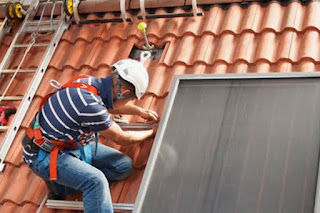
installing solar water heating modules on a roof


Social housing landlords can now apply for grants of up to £175,000 to install solar hot water panels, heat pumps and biomass boilers into the homes of their tenants.

It follows the launch of a second round of the Renewable Heat Premium Payment (RHPP) scheme by the Department of Energy and Climate Change (DECC), with a total budget of £10 million.

It is expected that around 60 projects will win funding across England, Scotland, and Wales. Good news as it is, the budget will only benefit about 5,000 individuals, however, just 0.1% of the 3.9 million who live in social housing. The vast majority of these households live in fuel poverty and would welcome this type of help.

A further scheme targeted at communities who want to develop district renewable heating schemes will be launched later in the summer; interested participants can register for details here for when the announcement is made.

The closing date for applications for this round is July 4 and it is running on a first-come first-served basis; once the budget for the scheme is reached then applications will no longer be considered.

Eligible technologies include biomass boilers, solar thermal panels, ground source heat pumps, air-to-water heat pumps and water-to-water heat pumps.

“Last year our low carbon heating scheme for social landlords helped nearly 1000 householders stay warm and reap the benefits of clean, green heat,” said Energy and Climate Change Minister Greg Barker. “This year we have increased the cash available, which will help even more people move away from expensive old heating systems to low carbon, more sustainable alternatives.”

In the opening round last year, 37 social housing providers received a total of nearly £4.4 million. Only two of these were in Scotland and three in Wales. The rest were in England. One social landlord, New Linx Housing Trust, even received two grants. Just eleven received the total amount possible of £175,000.

Air source heat pumps were the most popular technology, probably because they are easiest to install. They represented 35% of installations, with solar water heating systems coming second at 33%. 19% of installations were ground source heat pumps and just 13% biomass boilers.

However, there are question marks over the efficiency of air source heat pumps compared to other forms of renewable heat.  In some circumstances they can cost more and emit more carbon than the form of heating that they may replace.

The scheme was welcomed by Philip Sellwood, Chief Executive of the Energy Saving Trust, which manages it and will evaluate the bids for funding. He said that it “offers real value to tenants as not only does it help them save money on their energy bills, but also helps them to reduce their energy usage”.

Criteria for funding include value for money, the type of fuel being replaced (with high carbon polluting fuel favoured), the presence of loft insulation to 250mm and cavity wall insulation (where practical), and the organisation's track record on delivering similar projects.

Those who have recently removed a mains gas heating system or currently heat their home with mains gas are only eligible to apply for solar thermal.

The amount of funding depends on the type of technology to be implemented:
TechnologyVoucher Value
Solar Thermal Hot Water£300 
Air-to-Water Heat Pump£850
Ground-Source or Water-Source Heat Pump£1250
Biomass boiler£950

Vincent Wedlock-Ward, Project Officer at Southern Housing Group (Isle of Wight Region), a previous social landlord competition winner, said that they received £175,000 from DECC under last year’s RHPP scheme. "This helped us replace old overnight storage heating systems with air source heat pumps for 40 householders living off the gas grid. Without this funding, this would not have been possible".

She reported that residents with the air source heat pumps fitted have found that their bills have been cut by half.

A programme of seminars is touring the country to explain what the scheme entails to local authorities and housing associations.

There is also an advice line on 0800 512 012 for more information. Winners will know whether they have been successful in early August.

Friday, October 28, 2011

No more PV subsidy for energy inefficient buildings - Barker

Solar pv on domestic roof
Greg Barker has told the domestic solar industry that all new domestic PV sites from April 2012 must meet minimum energy efficiency standards.

Speaking at the Solar Power UK conference yesterday in Birmingham to an audience of PV installers angry at the cut in Feed-in-Tariffs for PV that has thrown their business models onto the rubbish heap, he defended the cuts but then said that there will be "no more PV subsidy for energy inefficient buildings".

Barker admitted in his speech: "It cannot be right to encourage consumers to rush to install what are still expensive electricity generating systems in their homes before they have thoroughly explored all of the sensible options for reducing their energy consumption first".

This is an official acknowledgement that the Government's three key domestic energy policies have been implemented in the wrong order.
Since it is more economical to improve the energy efficiency of a property than to install generation capacity, the first policy should have been the Green Deal, followed by the Renewable Heat Incentive, then by the Feed-in-Tariffs for renewable electricity, a reversal of the actual order.
This is because renewable heat is more efficient and practical on the domestic scale in this country than renewable electricity.
Mr Barker drew back from announcing the widely expected cuts to the subsidies for PV electricity from 43p per kWh to around 20p per kWh, and refused to take questions from delegates, who fear that the cuts will kill their industry.

Instead, he told them that he expects the successful renewable energy companies of the future will be more like Energy Service Companies (ESCOs) in the sense that they will "diversify into new sectors and join the transformation of the energy efficiency market" with the same "gusto" as they have microgeneration.

ESCOs sell the service of energy supply, and so it is inherently in their interest to do so in the most efficient way in order to maximise profit and competitiveness.

Barker said that the forthcoming Comprehensive Review of the tariffs which DECC will soon hold, will seek ways to put FITs in the context of a "whole-house approach which prioritises energy efficiency and supports the right low-carbon heat and electricity technologies".

The consultation will also ask how business premises and non-domestic sites should be treated in the future.

Barker promised that the scheme will also be streamlined to make sure it works with the minimum of bureaucracy.

In an attempt at contrition, he did confess the need for "much greater coherence right across the green agenda" to synergise the Green Deal and energy efficiency measures, Feed in Tariffs for Microgeneration and the RHI.

He said he hopes to put an end to "stop start reviews". "We owe you that much," he told the sceptical PV industry representatives listening and thinking about their job security.

He said that the lower tariffs would mean "uptake" of the FITs "could continue to grow in a sustainable way" - sustainable to the Treasury budget, that is.

"The future of solar PV in the UK needs to be one based not on subsidy but on sound underlying economics," he explained.

Solar thermal


He therefore emphasised that he wants solar thermal water heating to have an important role.

In most parts of the country this can cut gas or electric water heating requirements by around 40% over the year, and so have a much bigger impact than solar electricity on bills and carbon reduction.

Barker said he is "keen to see a much greater integration of solar thermal and PV offerings in the marketplace – providing consumers with the best advice and the right technologies for their situation".

He also said that he will shortly be announcing support for 34 renewable heat projects from social housing providers, valued at over £4m, which represents "an increase of 33% on the original budget set aside for this competition".

Reclaiming the green agenda


Both Barker and Chris Huhne have been keen this week to try and undo the perception of damage to the Government's green image caused by George Osborne's recent pronouncements.

This subject was debated in the House of Commons yesterday, where MPs discussed a composite motion suggesting that most of the Government's avowedly green policies were failing.

These include the attempts to attract global investment in environmental technologies; the Waste Review, the planning regime changes, and the 27% cut in flood defence investment. It also called on the Government to "ensure mandatory carbon emissions reporting for all large UK companies to kick-start green jobs and growth".

Defra minister Richard Benyon hotly defended the Government's record against Labour and Green Party criticism.

Voting was split exactly on party lines with the 302 Tories and LibDems voting against and the remaining 222 voting for the motion.

New source of company advice


Outside of all this political jockeying, the Carbon Trust continues its steadfast work to make it as easy as possible for companies to save energy and money.

It latest wheeze, launched yesterday, is a new limited company, Carbon Trust Implementation, which will help UK companies reduce their energy costs and install greener, more efficient technology.

It is to provide independent, objective evaluation of the most effective energy efficiency and renewable energy technologies for a company; and help them choose "trusted, accredited suppliers" to carry out the work, as well as helping customers to run competitive tenders for their projects.

In order to make up for the cuts in public funding to the Trust, the service is funded by a flat rate commission from suppliers. This also means there is no cost to the company itself in obtaining this support.

Tom Delay, chief executive at the Carbon Trust said the new business "will help unlock £9 billion of investment into energy efficient equipment".

"We are confident that our new business will catalyse organisations to take action and in turn benefit from implementing cost effective energy efficiency and renewable energy projects and help the UK capitalise on green growth,” he said.

This is because it dovetails with the flexible Energy Efficiency Financing scheme that the Carbon Trust and Siemens Financial Services Ltd (SFS) launched in April 2011.

Tuesday, October 11, 2011

CBI urges Government to give investors certainty so business can fight climate change

Neil Bentley
Businesses want to and must maintain the trend to low carbon innovation, but need more investment, which requires commitment from politicians, both CBI Deputy Director-General Dr. Neil Bentley and Christiana Figueres, Executive Secretary of the UN Framework Convention on Climate Change (UNFCCC) told an audience of business leaders and the Energy Secretary Chris Huhne at the CBI’s first international Green Business Dinner in London last night.

Ms. Figueres also said that when countries like Britain fulfilled ambitious climate change targets this encouraged poorer countries like China and India to follow suit.

Companies are being given the wrong value by world stock markets, because the cost of their exposure to climate change is not being factored in, she said. "As long as these companies [that emit large quantities of greenhouse gases] have a high value, we are giving out the wrong signals," she said. "It has got to be that those companies that are investing in the technologies of the future are recognised."

She said that companies ought to take on board the political target of keeping global average temperatures below 2oC above pre-industrial levels. "We are moving to a low-carbon future – businesses need to understand that signal. This is a megatrend."

She said that by 2031 businesses will need to extract five times the economic value that they do today for every tonne of carbon dioxide emitted, calling on both governments and businesses to unleash the investment needed for "a transformation of the economy".

How committed are the Conservatives?


In the UK, the overwhelming feeling in the environmental industries sector is that George Osborne's speech to the Tory Party conference last week signalled an about-turn in Treasury thinking regarding support for low carbon technology.

Further evidence came from a Sunday Times article that Osborne is delaying rubber-stamping the Renewables Obligation Certificate banding review despite anger from David Cameron and other Ministers from DECC and Vince Cable's Business Department.

The consultation on an increase in speed limits, the proposal to reinstate weekly bin collections and, most importantly, Osborne's commitment to ensure the UK's carbon targets do not exceed those adopted by Europe were defended on Sunday's BBC Politics Show [22 minutes 20 seconds in] by Chris Huhne as marking either no change in the UK's position or not yet proven to have an impact on carbon emissions.

Osborne had hinted in his speech that part of his motivation for being cautious on the low carbon front was that there was opposition to green policies from members of the CBI.

Yet last night at the Green Business Dinner, the CBI’s Dr. Neil Bentley told the Government that British businesses are committed to tackling climate change, but blamed politicians at home and abroad for failing to provide clarity and certainty for investors about issues such as Electricity Market Reform, the Green Deal and a globally-binding emissions deal.

He said, "the case for a global emissions deal is even more compelling".

“Today, we find ourselves not ahead of the pack, but out on a limb," he said. "We’ve got no international deal, no global carbon price, no meaningful EU price and the UK tying itself in costly green policy knots.

"The UK is in danger of straining to hit its targets but missing the point: that we need an economy that’s low carbon and competitive.”

"We wanted first-mover advantage," he said, "We acted on the expectation of a global deal to address our competitiveness concerns. We acted without realising what was around the corner economically."

He blamed dithering and tinkering from Coalition politicians - such as making the Carbon Reduction Commitment into a straightforward tax, "adding to bottom-line costs and doing nothing to help businesses achieve their green goals" - as well as the low price of carbon due to an ineffectively managed EU Emissions Trading Scheme.

Europe's Environment Ministers, also meeting yesterday, are in agreement. They admitted that the number of "Assigned Amount Units (AAUs)" - free permits to pollute given to countries and industry - continues to be a problematic issue affecting the carbon price, but that suddenly reducing the number allocated would cause a mass sale and a price fall, which represents a double bind dilemma.

"We're going to have to continue to work on it," admitted Polish Environment Minister Andrzej Kraszewski after the meeting in Luxembourg.

Dr. Bentley also felt that that "the renewables target has skewed the economics of our energy market". The Treasury's carbon price floor is meant to address this but is not yet in force.

As a result, “investors are struggling to understand how to invest against the proposed framework while the resulting costs could damage parts of our manufacturing sector".

He also said there was "reluctance from financiers to take the risk of underwriting" the Green Deal, which could cause it to fail.

But yesterday, Energy and Climate Change Minister Greg Barker defended the Government's record.

In a statement responding on behalf of DECC to the Environmental Audit Committee's report on carbon budgets, which echoed the CBI leader's criticisms, he said the UK is "doing more than any other country in providing long term certainty to those investing in the low carbon economy".

He added the government was actually doing UK industry a favour by reviewing progress towards the EU emissions goal in 2014, to make sure it wasn't "disadvantaging British industry" and leading to "emissions being shipped overseas".

“Getting the rest of Europe to go further and faster in providing certainty to green investors is vital which is why we’re not letting up in pushing the EU to up its emissions reduction target to 30%,” Barker said.
 

The need for a deal at Durban


Dr. Bentley's speech underlined the necessity for a deal at the upcoming COP17 UNFCCC climate talks at Durban, since "last year saw the highest level of carbon emissions in history".

"Patience is wearing thin," he said, citing the failure at Copenhagen in 2009 and Cancun last year to reach global agreement. Wrangling "mustn’t drag on and on like the Doha Trade Round".
 
“In the absence of a deal," he continued, "companies have committed to get on with it because they understand that it’s not about what business can do for sustainability. It’s about what sustainability can do for business, driving innovation in new products and services."

He said the CBI is calling for two main outcomes from Durban: “Certainty that the Kyoto carbon markets will persist even if the protocol expires: if the Clean Development Mechanism is derailed, we’ll lose the most successful part of Kyoto and potential investment.
 
“And second, getting carbon finance flowing across the world, to places where it can encourage energy efficiency and help countries leapfrog high-carbon development and go straight for those green technologies. This will give the global economy the boost it needs."
 
He called for "a global, binding and comprehensive climate change deal. Otherwise business and nations will lose faith.”

EU ahead of targets


The EU will go to Durban well on its way to meeting its emissions targets from the Kyoto Treaty, which requires 20% cuts in Europe's emissions from 1990 levels by 2020.

Environment ministers in Luxembourg yesterday also committed to signing up to a 'Kyoto II' agreement at Durban, if other countries agreed.

Despite a 2.4 % emissions increase in 2010, and despite economic growth of 41% over the same period, Europe's greenhouse gas emissions were 15.5% below 1990 levels, according to estimates released yesterday by the European Environment Agency (EEA) on progress to meeting the continent's Kyoto targets.

In fact, the EU is likely to overshoot this target, which has inspired some member states, like the UK, to argue that it should be increased by to 30% cuts by 2020.

Climate Commissioner Connie Hedegaard said the figures showed that the EU has successfully decoupled emissions from economic growth through the wider use of low carbon technologies.

"The EU continued decoupling emissions from GDP during the recession," she said in a statement. "Between 2008 and 2009, emissions fell by 7.1 per cent in the EU-27, much more than the around four per cent contraction in GDP."

Of the 15 EU Member States with a common commitment under the Kyoto Protocol (the 'EU-15'), emissions were 10.7 % below base year levels (1990 in most cases), which is well beyond the collective 8 % reduction target. However, Austria, Italy and Luxembourg were still behind their targets.

"Many different policies have played an active role in bringing down greenhouse gas emissions", Professor Jacqueline McGlade, EEA Executive Director, said.

"Alongside renewable energy or energy efficiency, efforts to reduce water pollution from agriculture also led to emission reductions. This experience shows we can reduce emissions further if we consider the climate impacts of various policies more systematically."

Back at last night's Green Business Dinner, Christiana Figueres also was hoping that major progress will happen at Durban.

“Governments are willing to consider a document that is equivalent to a letter of intent of all Governments to move towards a comprehensive agreement that is binding to all and incentivising to all at some point in the future.”

She admitted that any agreement will take years to draw up but it would be a major leap forward if all countries agreed to the principal of a legally binding treaty.

She also hoped that Governments would agree on how to raise the $100 billion per year by 2020 they have committed to for adaptation to climate change, technology sharing and saving forests.

Wednesday, March 02, 2011

DECC minister Barker attacked over retrofit financing

DECC Minister Greg Barker came under attack yesterday for the confusion at the heart of Government attempts to improve energy efficiency in the domestic sector. He was being quizzed at the Ecobuild exhibition in the ExCel Centre, London.

The method of financing the Green Deal programme to retrofit the country's 28 million homes is still unclear and there are reports that potential backers are unsure about jumping on board.

In this context Kevin McCloud, presenter of TV's Grand Designs, and Robert Peto, president of the Royal Institution of Chartered Surveyors, suggested that another way to stimulate interest would be to reduce VAT on energy efficient products for refurbishment.

“The government should be focused on VAT if they want to engage with the public," said Mr Peto. "The knock-on effect of increasing work in the building industry would be £2.50 into the economy for every £1 spent on retrofit but all the conversations I have had with ministers are them saying we can't afford it.”

UKGBC chief executive Paul King said that the Energy Bill should be used to force people in the owner-occupier sector to retrofit.

Barker rejected both approaches, saying that the financial deficit couldn't support a VAT cut and that home owners would be "pissed off" if they were forced to improve their properties to a certain standard before they could be sold.

Peto therefore accused the government of an absence of long-term thinking when it came to green building policy, echoing the CBI, which warned recently that the scheme risked becoming a "lame duck" unless the Coalition improved the incentives.

The Green Deal is to be bolstered by two others policies in the Energy Bill. The first will compel landlords to use the Green Deal to improve their domestic and commercial properties.

Secondly, an Energy Company Obligation (ECO), to replace the current Carbon Emissions Reduction Target (CERT) from 2013-20, will compel gas and electricity suppliers to deliver set levels of CO2 savings and home energy efficiency improvements through grants to fuel poor households funded, like Feed-in-Tariffs, by a levy on all customers' bills.

Richard Baines, environmental consultant for the Black Country Housing Association, questioned Greg Barker over how much of the £1.3 billion which Baines expects to be raised from ECO (the Government hasn't admitted a figure yet) will be in addition to or included in the money accessible under the Green Deal.

Barker said that DECC was still working this out, but tentatively mentioned that it was at least above the 20% mark.

Baines, speaking at a later seminar on retrofitting for energy efficiency, expressed further concern that there won't be sufficient finance available for 'The Great British Refurb'.

He said that the social housing sector and local authorities were in a double bind. "They fear that if they accept Green Deal cash, they will not be able to access other sources of funding under state aid rules. Secondly, as the value of their properties is already used as guarantees for other loans, they cannot raise further cash for these improvements themselves."

He continued, "The Green Deal, worth perhaps £6,000, will take care of the 'low hanging fruit' - efficient boilers, cavity wall and loft insulation. The ECO scheme should be used to tackle those jobs with a longer payback that won't result in the quick returns on investment expected under the Green Deal, such as external wall insulation, airtightness and window or door replacement.

"However, I have calculated that to raise homes to the necessary 80% CO2-saving standard, which may be £20,000-£50,000 per home, using a cut of everyone's energy bills, the bills would have to rise by over 40%. Clearly this wouldn't be popular!"

The Government still envisages a wide range of companies and public bodies being involved in the Green Deal & DIY chains such as B&Q, retailers like Marks & Spencer, gas and electricity suppliers, banks, local councils, housing associations and builders, plumbers and gas installers.

DECC's own impact assessment forecasts that up to six million home packages could be installed by 2020 at a cost of £21bn. Benefits are put at £33bn from energy savings, reduced CO2 emissions, improved air quality and more comfort inside homes. The accumulated CO2 savings for 2013-20 are put at 5.9 million tonnes.

European action for energy efficiency


Meanwhile, at the European level yesterday, EU diplomats said that 20 states have so far submitted their energy efficiency National Reform Programmes ahead of an April deadline.

The chair of the European Parliament's Environment Committee also told the EU executive that the Committee will fight to make enforceable the 20% energy-efficiency improvement target by 2020. This is the only one of the EU's three 2020 targets that is not currently compulsory, and the only one not on track to be met. Instead, savings of just 9-11% are forecast based on the current levels. Even with the submitted national plans this rises only to 14% savings.

A published draft of the Commission's Energy Efficiency Action Plan says that for the next two years, the Commission will only monitor the implementation of voluntary national efficiency targets.

"If, nevertheless, the 2013 review shows that the overall EU target is unlikely to be achieved," the document states, "then as a second stage the Commission will consider whether to propose legally binding national targets".