Showing posts with label solar electricity. Show all posts

Tuesday, May 23, 2017

Innovative eco-social housing neighbourhood reaches completion in Wales


A version of this article was published on The Fifth Estate on 17 May.
 Glen Peters standing outside one of the  two-bedroomed semi-detached houses.
Glen Peters standing outside one of the two-bedroomed semi-detached houses.

The first tenants have moved into Pentre Solar, an eco-social housing neighbourhood being constructed in Glanrhyd, Wales. ('Pentre' means village in Welsh.)


Dr Glen Peters, chief executive of Western Solar, has an ambition for his company to supply 1000 homes and to work with housing associations and local authorities to provide social housing.


The South-facing front of a three bedroomed house with plenty of glazing to capture the sun's heat. Inside it falls onto a black, melamine-covered concrete floor to absorb the heat.

The North-facing rear of a three bedroomed eco-house. The homes are clad in local larch. This is projected to last at least 25 years before it needs replacing.
The North-facing rear of a three bedroomed house. The homes are clad in local larch. This is projected to last at least 25 years before it needs replacing. Much care in the detailing of the design should extend the cladding life well beyond this point.

Peters estimates the build cost is about £120 per square foot (AU$19 a square metre). This has led him to set a rental cost of the two-bedroom houses of £480 a month (AU$836), a level in line with the local 106 planning condition of no more than 80 per cent of local market rents. The three-bedroom houses are set at £620 a month (AU$1080). For the developer, this gives a 3.5-4 per cent return on investment.

A pair of two-bedroomed semi-detached houses. All the homes have solar roofs.

Local materials and labour

Costs have been kept low and as much as possible of the houses manufactured locally from local materials. In total 80 per cent of the building is manufactured locally out of local timber and 40 per cent – the airtight frames – are manufactured in a nearby factory – a converted cowshed – to be assembled on site.

Peters says the multiplier effect of the benefit to the local community for every £1000 invested is £2200, a factor of 2.2.


The timber frames are kept out of direct contact with the ground to prevent damp from rising:

The timber frame footing kept out of direct contact with the ground to prevent damp from rising.
A footing protected from damp on the patio.


The homes’ design builds upon the developer’s experience of a prototype house, Ty Solar:

The prototype Ty Solar (Ty is Welsh for House so the name means Solar House in English) in West Wales.
The prototype Ty Solar (Ty is Welsh for House so the name means Solar House in English) in West Wales. In the background can be seen the first solar farm in Wales which finance the building of Ty Solar.
Ty Solar was constructed in 2010 using the profit from Peters’ solar farm, the first in Wales. It cost about £75,000 (AU$130,640) to build with a £47,000 (AU$81,870) grant from the Sustainable Development Fund.

The unit costs of the Glanrhyd houses, built on the site of a now-demolished garage, were higher than normal, mainly because of the land reclamation, provision of services and unusual weather-related costs, as well as complying with planning conditions in an area of outstanding natural beauty.

The three-bedroom homes occupy 100 square metres, the two-bed ones slightly less, but still feel spacious.

The company is focused on providing social housing as Peters believes there is a reasonable business in creating good quality affordable housing, as none of the large developers seem to interested in doing so.

While it is economic and technically feasible to build these homes, politically Peters’ route has not been easy.

”Politicians have been unduly influenced by volume building companies, and while they love the houses it has been difficult to persuade local authorities and housing associations of the benefit of backing this design, despite the fact that occupants have virtually zero energy bills. The key performance indicators imposed on housing associations are unduly skewed towards capital costs rather than tenant and community welfare,” he says.

He is hoping that when he has occupancy data to back up his case, more housing associations and councils will be interested in the model.

Zero energy bills

The timber frame houses are built according to passive house principles, though are not validated as such due the cost of doing so, versus the benefits.

Each monopitch roof sports 8kW of integrated photovoltaic panels. Over a year these generate surplus energy, providing an income from a feed-in tariff, as well as giving the occupants free electricity. Total energy demand is about 12 per cent of a conventionally built home. Beneath the solar panels is a galvanised steel sheet that laps over the timber frame.

They sit on a concrete slab, unlike the prototype, which was constructed using the box beam method with a suspended timber floor. Peters says concrete is more durable, with more thermal mass and has a lower maintenance requirement, although with a greater carbon footprint.

The windows are double, not triple-glazed, to keep costs low as Peters believes that the incremental benefit of the extra pane of glazing is cancelled by the cost in the mild local climate.

The insulation is all 27cm of recycled newsprint pumped into the cavity. This type of eco-insulation is in general the most economic and ecological. The paint is clay-based – breathable and with no off-gassing. Although more expensive per litre, it requires fewer coats on bare plaster.

The houses all come fitted out with the most efficient washing machine, condenser drier, kitchen, water-saving bathroom with occupancy sensors in areas such as toilets, internet connection, Wi-Fi and an outside socket for charging an electric vehicle. There are LED lights throughout.

modern eco-kitchen

modern eco-bathroom

modern eco-utility room

modern eco-living room in passive solar house
All of these relatively spacious homes are provided with the most energy-efficient appliances and exceptional attention to detail.

Communal electric car


A Nissan Leaf electric car charging outside a solar eco-house.
The Nissan Leaf charging outside one of the houses.
The occupants of the estate have been given a Nissan Leaf to use collectively, charged by the solar panels on the roofs.

“It’s a way of getting neighbours to cooperate with each other and eliminate the need for a second car,” Peters says.

Energy storage

The South-facing homes are generous in their space, their form determined by the maximum depth allowed by the passive heating.

The rest of the heating is provided in a surprising manner, using the best of old technology with new: solar electricity and storage heaters.

A storage heater charged by solar electricity.
An installed storage heater; proven, old technology meeting the new.
Storage heaters contain thermally massive blocks that are heated up by an element. They then release that heat gradually over many subsequent hours.

This form of energy storage was introduced to British homes in the 1960s and ’70s on a special tariff called Economy 7. Since nuclear power stations could not be switched off, unlike other forms of electricity generation, these tariffs allowed people to use nuclear electricity at night – at a lower rate when national demand was low – to charge the storage heaters.

The problem was that by the time the heat was needed, the following evening, they were often too cool and many people subsequently removed them and installed central heating instead.

Here, the idea is to let the storage heaters be heated up during the day by the solar panels on the roof, meaning they are able to provide adequate heating through the evening and night provided that there has been average sunshine (50 per cent of a June summer’s day) during the day.

This may not be the case in the depths of winter and so the homes are also grid-connected. They export surplus energy when there is some – after the electric car and storage heaters have been topped up – and purchase it when not enough has been generated.

“Storage heaters are incredibly cheap,” Peters says, “and a well proven technology. Whereas the storage we had to start with in the prototype house – lithium-ion batteries – were designated a fire risk and we had them taken out. They are also much more expensive.”

A pair of two-bedroomed semi-detached passive solar houses.
The prototype house has been monitored and has well exceeded the predicted generation capacity, providing twice the electricity used over the year.

Peters says: “We have spent £2 million (AU$3.5m) researching and developing a sustainable timber building system that is 100 per cent British, powered by solar energy. We hope now to create 1000 homes across Wales and the UK, once the current political uncertainty is out of the way and we have won the argument on the efficacy of timber housing.”

David Thorpe is the author of a number of books on energy efficiency, sustainable building and renewable energy, including:
Find out more and buy the books here.

Monday, July 08, 2013

As PV installations double, everyone is urged to install LEDs

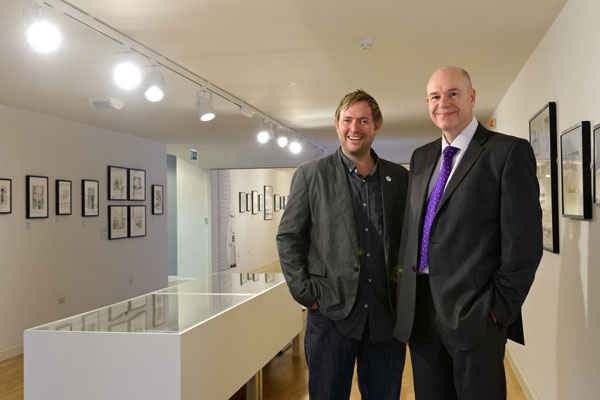
Simon Creed (left), head of technical resources at mac birmingham, with Paul Hutchens, managing director of Eco2Energy.
“It’s important for mac birmingham to be as sustainable as possible,” says Simon Creed (left), head of technical resources at mac birmingham, here seen with Paul Hutchens, managing director of Eco2Energy in the art gallery.
There was a huge increase in installations of feed-in tariff-linked solar PV systems in Britain during June 2013. 64.4MW of PV were installed over a four-week period from June 3 to June 30, according to figures supplied by DECC.

That is over double the 30.7 MW installed over the previous four-week period.

As prices have come down, the number of installations has increased throughout 2013, with 215MW installed in the first six months of the year.

Even so, there is no denying that the upfront investment is high. For those in charge of commercial and domestic environments, there is a wide choice of much easier ways to reduce a carbon footprint and see drastic reductions in energy bills.

According to Steven Ellwood, Managing Director of lighting provider BLT Direct, switching conventional lights for LEDs can provide a quicker, more reliable and higher return on investment than installing PV solar, since it is so easy and prices of these units are also tumbling.

They fell by 1% on the global market in the same month, June.

“Energy-saving lighting solutions are a much faster and more convenient way to give a home or business an eco-friendly twist," says Ellwood. "They are easy to install, they start making savings immediately, and there is not a huge initial outlay to add them to a home or commercial environment.”

The vast majority of the energy-saving LED lighting solutions that are on the market nowadays have bases which are compatible with existing fittings in many buildings.

Often it is just a case of simply replacing the old bulbs or strip lights. However, it is recommended that reputable installers and brands are used, since some products now available are of poor quality.

Even ‘feature lighting’, such as those commonly reserved for high energy-using halogens, are available in LED fittings, reducing energy usage by around four-fifths or 80%.

Although more expensive, LEDs can pay for themselves through the energy saved within six to nine months.

These bulbs also have much longer lifespans, meaning that once installed, they immediately begin to save money and contribute towards helping the environment for many years at any time of the day or night, says Ellwood.

Moreover, he adds that they also make a good companion to solar panels, since they reduce overall electricity requirements, meaning that the electricity from the panels will go further.

Birmingham's arts centre lights the way for sustainability

For instance, Birmingham’s popular arts centre, mac birmingham, is set make significant energy savings and reduce its light pollution, thanks to advanced LED lighting installed by energy efficiency specialist Eco2Energy.

The £7,000 investment is expected to save mac over £3,000 per annum on energy running costs and reduce CO2 usage by approximately 5,918kg each year.

Attracting over 850,000 visitors per year, centre is planning to make even more energy savings by replacing a further 250 lights.

“By making a relatively small investment, we’re able to further reduce our carbon footprint and save on energy costs,” commented Simon Creed, head of technical resources at mac birmingham. “It wins on every level and with payback on our investment expected in less than three years, we couldn’t be happier."
It is not the first investment in green technology at mac birmingham.

The complex kick started its ‘green initiative’ in 2012 with a 9.9-kilowatt solar PV system installed by Eco2Energy’s sister company Eco2Solar.

It now generates over 9,000 units of green energy per annum, equivalent to making 214,000 cups of tea.

“It’s important for mac birmingham to be as sustainable as possible; our aim is to be as energy efficient as we can and share this with our visitors by creating a ‘green zone’," said Simon Creed.

Midlands based Eco2Energy, part of Eco2 Solutions Group, was appointed as project installer to replace 100 track lights with high energy efficient LED lighting in the complex’s public galleries and main gallery.

Paul Hutchens, managing director of Eco2Energy said: “mac birmingham is a prime example of how businesses can invest in smart energy technologies and see immediate savings.”

“It’s excellent to see such a prominent complex in the regional arts community be so passionate about becoming totally energy efficient.”

Eco2Energy has developed its own ‘business friendly’ smart energy assessment designed to make energy efficiency simple for businesses.

Eco2Energy’s low carbon consultants work with businesses to review current energy usage, identify where savings can be made and make recommendations on the best efficiency measures to reduce carbon omissions and energy bills.

With a comprehensive range of smart energy technologies including LED and Low Energy Lighting, Voltage Optimisation and Building Energy Management. Other energy-saving solutions include Energy Efficient Cooling and Insulation.

Monday, March 26, 2012

UK Solar industry predicts 1GW of installations in the next year

ground-mounted solar farm in the UK
We're going to see a lot more of these in the UK.

The UK solar industry now sees a bright future for itself following last Friday's decision by the Supreme Court to refuse the Government permission to appeal on the ruling that solar PV installations registered after December 12 last year and before March 3 this year could qualify for the 43.3p kWh subsidy rather than the 21p rate the Government tried to enforce.

Many companies have plans for large-scale solar in particular because they see new possibilities from the Renewables Obligation Certification scheme (ROCs), which gives two ROCs for each MWh for schemes over 5MW, and under which there is no size limit.

There is even talk of solar farms as large as those found in Europe, up to even 40MW in size, in the south of England. One player predicts 1GW of plant installed in the UK over the next year.

Emma Hughes of Solar power Portal says that "now that the feed-in tariff fiasco has reached a conclusion many are looking forward to working in the UK solar industry in 2012, especially now there is opportunity under the Renewables Obligation."

REC Solar, Canadian Solar, Q-Cells and many others are all of the opinion that if the component prices decline as expected, and energy bills continue to rise, opportunities for ground-mounted solar to become cost-effective will increase.

REC Solar is hoping to double its capacity this year by installing approximately 60MW, a large proportion of which will be ground mounted.

Superhomes


At the domestic and business consumer level, more than anything else the government has done, the installation of panels on so many roofs across the country has got people talking about energy and its importance.

All over the country this weekend, owners of homes who had installed green equipment or upgrades threw open their doors for visitors interested in doing eco-refits themselves.

Besides solar PV systems, visitors to the 'green showhomes' on these tours saw every type of upgrade from simple insulation and draught proofing measures to complete overhauls and rebuilds, involving many types of green heating from woodchip fired boilers to solar water heating systems, and even in one case, a tank which combined four different kinds of heating.

Many of those on the tours had had their interest in the subject first aroused by seeing solar panels on neighbours roofs.

This indicates that a chief aim of government policy has succeeded: increasing public awareness in energy matters, even though investment in photovoltaic technology in this country is not cost-effective at the level of subsidy initially set by the feed in tariffs.

But although many of the thousands of people on these tours knew about the Feed-in Tariffs, a high level of ignorance was revealed about the follow-up schemes, the Renewable Heat Incentive and the Green Deal, indicating the huge amount of work that the Government yet has to do to publicise these initiatives.

The 'Superhomes' tours were organised by volunteers in many towns and cities in England and Wales, either by the network members themselves, or local Transition Towns groups.

Several were oversubscribed, indicating the increased popularity of the subject, further evidence of which was the changed nature of last week's Ecobuild exhibition in London, which was far more upbeat, corporate and mainstream than it had been in previous years, with much floor space taken up by solar and heat pump installers.

Speaking at the Ecobuild exhibition, Energy and Climate Change Minister, Greg Barker said: “This is an aspirational agenda. We know people are always looking to improve their home even in times of austerity. It’s part of the British DNA.”

John Gaffney, who organised a tour in and around Llandeilo in Carmarthenshire, said “many of the homes we have seen this weekend who have solar photovoltaic panels installed still think it is worth the investment even with the reduced tariff."

“It seems so complicated from the outside, knowing what to do," said one of the super homes tourists, Peter Jones of Llangadog, "But seeing what other people have already done is a terrific help in getting ideas about what is possible in your own circumstances."

A highlight of this tour was a home which had both water and space heating supplied by both a ground source heat pump and solar water heating panels, with the electricity for the pumps supplied by photovoltaic solar panels supported by FITs. “We generate more energy than we need, so we are still actually paid by the energy supplier after we have used all the energy ourselves," said owner Caroline Langdon.

Green Deal red tape removed


Last week, Greg Barker sought to remove doubts that the Green Deal implementation would be delayed, but did say there will be a “managed” roll-out of the scheme, meaning that some aspects will launch before others, chief of which may be the Energy Company Obligation, which is simpler to arrange.

He said that the Government would be responding to the Green Deal consultation in April and secondary legislation would appear “by summer recess”.

"This doesn't affect the planned October launch,” he said.

He told attendees to the exhibition that red tape was being removed from those who wanted to become accredited installers, including the requirements to have a surety bond in place prior to being authorised; to hold warranties for the 25 year length of the plan when they were longer than standard industry warranties, e.g. for boilers,; and the requirement that installers pay for an Independent Conciliation Service.

Instead, a new Green Deal Ombudsman capable of handling complaints will be appointed.

"Remove stamp duty"


UK Green Building Council chief Paul King has called the Government’s handling of the solar FITs “catastrophic” and said it is now crucial that the Government instills confidence in businesses preparing for the Green Deal.

This weekend, many visitors on the superhomes tours expressed fears that if they invested in renewable heat systems that the tariff rate for these would be reduced in the future. Many appeared unaware that tariff rate reductions did not affect those whose installations had met the deadlines.

In this respect the public perception arising from the solar FITs fiasco has been extremely damaging.

To rebuild confidence, and create more publicity, Paul King has called on the Government to link the Green Deal with stamp duty and council tax, making less energy efficient homes pay more through the tax system.

He said it didn't matter if the implementation of the Green Deal was delayed if it meant that its integrity would be preserved and the fine detail was in place and did not have to be amended subsequently.

He said: “I would much rather delay it rather than go and blunder it as it will take 10 years to get it out of the public consciousness.

Collective energy purchasing


In a further bid to engage consumers with energy purchasing, today, Ed Davey has written to all of the energy suppliers asking them to support collective purchasing schemes as another way of helping householders engage easily with the electricity market and bring prices down.

He wrote: "I want to make it easier for consumers to club together and use their collective purchasing power to engage with the market and to get good deals on their gas and electricity."

This was a key part of the Consumer Empowerment Strategy that Ed Davey launched as a Minister in the Department for Business Innovation and Skills last year.

He said particular you want to see schemes that reached out to “include more vulnerable customers and people who don't shop around for their gas and electricity".

The purpose of the letter is to encourage all energy suppliers to engage with these organisations on their ideas.

Friday, February 10, 2012

FITs reductions get mixed reaction from renewables industry

PV solar modules on roof
One installer says the new proposals "could spell Armageddon for the industry".

The solar industry has responded with mixed feelings to DECC's new proposed changes to the Feed-In Tariff system for small scale renewable energy, announced yesterday.

In its response to the consultation on FITs for solar PV, the Government admits that 81% of respondents disagreed with their proposed reduced tariffs for solar PV installations and with the proposed reference date of 12 December 2011, compared to 12% who agreed.

Nevertheless, it is proceeding with the tariff reductions, and the appeal to the Supreme Court over the legality of the cut-off date for the high tariff rate.

The new tariff rate includes a drop to 21p/kWh for systems under 4kW, until June 30. It estimates the cost to taxpayers of all the new tariffs to be £1.2 billion over 25 years.

The reductions are based on research showing that the average cost of a 2.6kW system has dropped from £15,000 in 2010 to £12,000 in 2012. They aim to provide an approximate 5% rate of return to their owners for well located installations.

DECC projects around six million installations by 2020 based on the new tariffs, which over their lifetime will involve total costs, the Impact Assessment says, of £54.3 billion. [Note: the document contains several errors so this figure, high as it seems, may not be correct.]

Nevertheless, the Impact Assessment calculates a net benefit of around £400 million because the savings on social costs outweigh the overall costs, compared to a loss of £600 million under the original scenario.

The response does contain a concession to objectors from the solar industry: that the energy efficiency requirement that will be a condition of receiving FIT support should be based on an Energy Performance Certificate (EPC) rating of level ‘D’ or above, not the more stringent level ‘C’, as previously mooted, as this excluded too many homes.

Even so, it will almost certainly exclude the majority of old, solid-walled homes, that do not have wall insulation. DECC estimates that about half of all properties are already at the ‘D’ rating level.

A second concession is that the threshold at which the multi-installation tariff rates would apply has been increased from more than one PV installation to over twenty five. These rates are set at 80% of the standard tariffs to reflect the economies of scale gained from tackling several roofs at once.

Individuals or organisations with 25 or fewer installations will still be eligible for the individual rate.

"This will help community groups, small businesses and councils who do not benefit from the economies of scale that larger aggregators can obtain," said Energy Secretary Ed Davey.

DECC says it is using budget flexibility to cover the overspend resulting from high PV uptake of 240,000 installations over the last year, while still allowing £460 million for new installations over the Spending Review period.

The statement says this will not impact any further on consumer bills, since DECC is juggling overspends and underspends in the overall amount allocated to it for renewables under the Comprehensive Spending Review between the budgets for FITs, the Renewables Obligation, and the Warm Home Discount.

What happens beyond June?


A new consultation is beginning, and it is this which so far appears to be the most disheartening for the solar industry, for it proposes a reduction of 10% of solar PV tariffs every six months, with an added deployment trigger to ensure that subsidy levels keep in step with the market.

It is based on projections which estimate that system costs will fall by two thirds by 2020.

The proposals would make the tariffs from 1 July onwards dependent on the levels of actual deployment of new eligible installations seen in March and April.

They outline three ways of calculating the level, which could bring rates down as low as 13.6p/kWh for installations below or equal to 4kW.

This structure is aimed at protecting the scheme's budget and creating long term certainty for consumers and investors about what the FIT rates will be.

However, one installer said this "could spell Armageddon for the industry. Yet again the Government, even with a newly appointed Energy Secretary in Ed Davey, seem happy to watch the solar industry lurch from one crisis to the next," said David Hunt, a director with Eco Environments.

Friends of the Earth's Executive Director Andy Atkins also said that the "distinctly unclear solar road map leaves a dark cloud hanging over thousands of jobs".

But others welcomed the news.

Robert Goss, Managing Director of Conergy UK, called it "a very good day for British solar. There will be a boom in May and June as people look to complete installations before the June tariff reduction, with returns of seven to nine percent".

A spokesperson for Good Energy said they considered this "a step forward".

"The industry was in desperate need of more clarity and the government has moved to provide that," said its CEO, Juliet Davenport. "The rate changes proposed for solar PV are a reflection of the well-known problems with the FIT budget and it will take time to fully digest what they mean."

Ed Davey said the proposals, "will remove the need for emergency reviews, consistent with our commitment to a stable, predictable future for solar PV and for the whole FITs scheme.

"It will also help to keep the long-term costs of supporting solar PV down, increasing the number of people able to benefit from FITs over time," he added.

The consultation closes on 3 April.

Other FIT technologies


A further consultation has been launched on tariffs for technologies other than PV, including potential arrangements for community projects.

Significantly, it proposes an increase in the rate of return available for micro-combined heat and power, as ministers believe this could bring multiple benefits.

It also outlines potential tariff guarantees for wind, anaerobic digestion and hydro projects, to provide greater certainty about what rates of return they will receive.

This was welcomed by Don Leiper, Director of New Business at E.ON, which has been investing for a few years in micro-CHP for the home market.

He called it "a key step towards building a mass market for what is a smarter home heating and power solution that can save customers money and contribute to saving the planet".

E.ON calculates that under the new Feed-in Tariff scheme, homeowners installing microCHP could see financial savings of more than £600 per year, including electricity savings of £194 and export payments of £46.

This consultation closes on 26 April.

Concluding the announcements, Climate Change Minister Greg Barker said: “Our new plans will see almost two and a half times more installations than originally projected by 2015 which is good news for the sustainable growth of the industry.

"We are proposing a more predictable and transparent scheme as the costs of technologies fall, ensuring a long term, predictable rate of return that will closely track changes in prices and deployment."

The impact of the FIT cuts on solar have captured the headlines, but they have also affected small wind power installations.

Trade association RenewableUK said tariffs for these have been slashed by over 40%, while farm and small business-scale turbines have seen cuts of over a quarter, and it expressed anxiety over the possible impact on jobs.

Story: David Thorpe, News Editor

Thursday, January 26, 2012

Next stop: the Supreme Court. Isn't this a waste of taxpayers' money?

Lord Justice Moses


DECC's decision to ask the Supreme Court to overrule yesterday's unsuccessful High Court appeal against its recent ruling on solar PV feed-in tariffs means continued uncertainty for the industry.

Lord Justice Moses at the Court of Appeal ruled that on the question of whether the Secretary of State "has power" to apply a tariff cut before a consultation period is over: "In my view, he plainly has no such power".

As campaigners celebrated their victory, Energy and Climate Change Secretary Chris Huhne said: “The Court of Appeal has upheld the High Court ruling on FITs, albeit on different grounds. We disagree and are seeking permission to appeal.

“We have already put before Parliament changes to the regulations that will bring a 21p rate into effect from April for solar PV installations from 3 March to help reduce the pressure on the budget and provide as much certainty as we can for consumers and industry.

“We want to maximise the number of installations that are possible within the available budget rather than use available money to pay a higher tariff to half the number of installations. Solar PV can have strong and vibrant future in UK and we want a lasting FITs scheme to support that future and jobs in the industry,” he said.

Industry reaction to the High Court decision is relief mixed with apprehension. Chris Hopkins – Managing Director of Ploughcroft and successful contestant on the BBC’s Dragons Den, called it "excellent news for homeowners".

But the Electrical Contractors’ Association (ECA) warned of a "wild ride" ahead for an industry that is "already reeling from Government announcements in the last few months".

Paul Reeve, its Head of Environment, cautioned: “Before anyone celebrates, we should remember that future funding for FITs is not unlimited. "Some of the available cash could now be used up in a second ‘rush to install’ before 3 March, when FITs will be halved to 21p/kWh,″ he said.

The first ‘rush to install’ took place up to 12 December to beat the Government’s initial deadline for halving FITs and resulted in far more PV installations than DECC had planned. These will now be receiving the high rate for 25 years.

"A second rush now could put even more pressure on future FITs,” observed Reeve.

Nathan Goode, Head of Energy, Environment and Sustainability at tax auditors Grant Thornton, agreed that the "judgement is prolonging the agony. Whatever the theoretical rights and wrongs of the case we need to get to a position of stability as quickly as possible to provide the solar industry and investors with the certainty needed to allow them to move forward".

The Renewable Energy Association (REA) called for an end to the "fiasco" so that "the UK solar industry can get back to business".

The Solar Trade Association and Friends of the Earth continue to warn ministers of risks to 29,000 jobs as a result of subsidy losses, arguing that the tariffs could be paid for from tax payments which the industry generates.

They put this figure at £330m per year minimum, from income taxes, corporation tax, and VAT.

But Energy and Climate Change Minister Greg Barker said in the Government's defence that the higher tariff will cost consumers £1.5bn over 25 years and sought to blame Ed Miliband for the chaos, as he introduced the system.

Howard Johns, of the Solar Trade Association, countered that it wasn't the cut, but the way Greg Barker's department had managed it which was the problem.

The coalition of campaigners also wants the Government to look again at what FoE calls "over-strict energy efficiency rules that will prevent 90 per cent of houses from claiming solar subsidies".

This refers to a new rule that, from April 1st 2012, properties must have an Energy Performance Certificate (EPC) rating of C or above, to be eligible for the feed-in tariff.

This will penalise many old, solid-walled properties which, even with double-glazing, low-energy lights, a condensing boiler, thermostatic radiator controls and loft insulation, can only score D or E on the EPC due to a lack of wall insulation.

Green electricity supplier Good Energy commented that, "it looks as if rather than encouraging greater energy efficiency, the EPC standard is just another way of discouraging FIT take-up".

Campaigners also want the Government to keep housing associations, schools, councils and other community projects on the higher tariff rate.

"Helping more people to plug into clean British energy will help protect cash-strapped households from soaring fuel bills," said Friends of the Earth’s Executive Director Andy Atkins.

Much of the industry laments the chaotic way the Government has managed the situation. Andy Boroughs, CEO of Organic Energy says he "understands that solar payments must be cut in line with falling costs, but the Government must now accept that its illegal actions were putting the industry and thousands of jobs at risk.

“The industry needs stability," he said, adding that "if the Government is serious about its commitment to the renewables, it should accept this ruling and get back down to the business of supporting a sector which is helping to grow the UK economy as well as creating sustainable jobs”.

DECC's consultation on feed-in tariffs closed on 23 December with over 2,000 responses.

Greg Barker has promised that the outcome will be announced by 9 February 2012, in time for any resulting legislative changes to come into effect from 1 April 2012.

"Our aim is that this announcement will be accompanied by a set of reform proposals for the next phase of the comprehensive review of the FITs scheme, which will be the subject of a further consultation," he added.

All of which means that the solar industry will soldier on through a fog of insecurity for some time yet.

Afterthought: Germany currently has the highest power prices within the EU (24.4 cents per kilowatt-hour), but a recent survey by Forse for the German Association of Municipal Utilities found that an overwhelming majority of Germans are willing to pay the price as long as they get green power in return.

Wednesday, December 21, 2011

Could this solar power breakthrough kill off nuclear power?


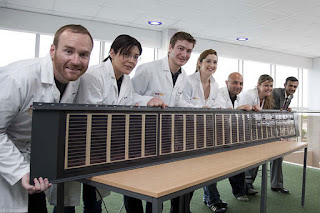
Tata Steel and Dyesol team with the worlds largest dye sensitised PV module

New breakthroughs in solar technology have been announced which could mean a complete game changer in the way electricity is generated.

The technology involves printing a new type of solar cell onto building materials, such as steel and glass, and allowing them to generate electricity.

The chief announcement is the result of joint ventures between Australian company Dyesol and, in Wales, Tata Steel, and in America Pilkington Glass.

Researchers are being cautious as to the timescale, but it is estimated that in about five years time industrial production on a large scale could begin.

Speaking at a recent conference on solar power, James Durrant of the Department of Chemistry and Energy Futures Lab at Imperial College London, said “If just 10% of Tata's annual steel output were coated with DSSC, this would represent the output capacity equivalent to a 1GW nuclear power station per year".

Dye-sensitised solar cells (DSSC)


These 'dye-sensitised solar cells' (DSSC) employ a photoelectrochemical system similar to that employed by plants to capture solar energy.

In the manufacturing process, a nanocrystalline titanium oxide film plus a sensitiser dye are printed onto glass, polymer or steel and covered with glass or plastic.

Modules made from the cells currently have efficiencies up to 8% depending upon a compromise between stability and cost, but cells in the lab have reached 13% efficiency, and Dyesol is confident they can reach 10% under mass-production conditions in five years time.

DSSC has the following advantages over conventional silicon photovoltaic modules:

  • it can output a constant operating voltage in all light conditions, including low light and dappled conditions typical of urban and city environments, making it an ideal renewable resource for closely packed buildings
  • it has an optimum working temperature of 40o-50oC, unlike silicon PV, which becomes less efficient at higher temperatures
  • it uses little energy in manufacture due to the low temperature processes and absence of high vacuum technology needed for second generation technologies (thin film PV)
  • due to the nanoparticulate nature of the titanium dioxide, modules can generate electricity from light from any direction, removing the need for them to be pointed directly at the sun
  • it can be produced in a range of natural colours and light transmission effects including transparent, translucent or opaque
  • it uses no polluting dopant
  • the ability to produce a constant operating voltage in all light conditions
  • it is ideal for integrating into building cladding.

The race to mass production


Many companies are racing to produce this type of cell at an industrial scale.

Notable organic and dye-sensitized solar cell (DSSC) developers include, beside Dyesol: Eight19, EPFL, G24i, Heliotek, Konarka (printing large molecule polymers), Mitsubishi, Peccell, Plextronics, Solarmer, SolarPress and SolarPrint.

SolarPrint is also developing nanomaterials and processes to print the cells onto polymer substrates. Other researchers are experimenting with printing on fibreglass.

Eight19 Limited has raised $5 million from the Carbon Trust and Rhodia to develop plastic organic solar cells. The name "Eight19" refers to the time it takes sunlight to reach the earth.

The reason why Dyesol is a front-runner is because of its teamwork with Pilkington and Tata Steel. These joint ventures are already ahead of the game in terms of applying coatings on a continuous roll, as opposed to a batch process, output.

Existing coatings applied to steel include galvanising layers to prevent rust, colours, anti-static, and self cleaning layers, all of which are guaranteed for 40 years.

Tata's Rodney Rice, speaking from their DSSC Demonstration Roof at the PV Accelerator in Shotton, North Wales, where the process is being tested, told Energy and Environmental Management, "we use high speed large scale coating, on steel rolls 1.5m wide, put through at a speed of 200 metres per minute.

"This adds up to 200 million square metres of steel per annum, of which half ends up on buildings. If we assume 10 to 20% of this is on a roof or wall and the PV is operating at between 8 and 10% efficiency, then this will easily equate to 1 GW per year.

“We are developing our knowledge of printing coatings to printing the ability to generate electricity and to steel. It uses reasonably straightforward materials which are reliable, simple to apply and easy to scale up as there is no vacuum and fewer people involved.

"This means it has the perfect attributes for the mass-market and the technology will work well in northern Europe where there are large surface areas of roof tops."

The Dyesol-Tata partnership has obtained considerable support from the Welsh Government, and over the last four years has spent £11 million on R&D.

“Lowering the price is the objective and we are now developing processes that will allow us to do this in manufacture," continued Rodney.

"Initially steel rolls will be one metre wide with 10% efficiency leading to a production of 400 MW per year," he said.

Tata use coated steel and coated polymer electrodes, whereas Pilkington are using coated glass electrodes.

In America, the Pilkington-Tata joint venture has won $1 million from the Ohio Third Frontier Fund, and intends to complete its proof of concept project for large glass substrate panels by the summer of 2012.

Its chief competitor, American company Konarka’s technology, is a photo-reactive polymer material invented by Konarka co-founder and Nobel Prize winner, Dr. Alan Heeger.

This can be printed or coated inexpensively onto flexible substrates, again using roll-to-roll manufacturing.

It can work indoors too, capturing ambient light.

Like Dyesol, Konarka has recently entered a partnership agreement with a steel producer, ThyssenKrupp Steel Europe to develop solar steel roof, facades and other construction elements for building-integrated photovoltaics (BIPV) in Germany.

Dr. Lars Pfeiffer, head of quality and development at the Color/Construction unit. "Unlike conventional silicon-based photovoltaic systems, the joint solar solution will not need to be mounted on a raised structure but will integrate smoothly into the building envelope. We look forward to providing the valuable, added benefits of solar to our customers at a low cost."

Challenges


Some problems remain to be solved. For example, could it survive 25 years?

Rodney Rice says at the moment Tata can produce several square metres, and has installed a 15 m² demonstration roof can be used to test the output and performance.

“We are now developing our abilities in the process, durability, assembly and manufacturing," he said.

It is the dye which is crucial for the generation of the electricity from light. Different dyes are being researched all over the world.

“We are looking for the perfect dye," said Rodney. “The ability to capture light energy from a wide range of wavelengths is required in order to maximise efficiency. More than half research in world is looking at new dyes, extending wavelengths, including into the infrared," he said.

Dyesol is now ramping up more aggressive performance targets under a revised Technology Road Map, to achieve grid parity at an earlier date.

Whichever company is the first to successfully produce cladding for buildings which can cheaply produce electricity, will find themselves at the head of a multibillion dollar market.

Even supposing half of what these companies are claiming is hyperbole, then we are perhaps looking at a ten year timescale rather than five years before the technology reaches mass production.

Even so, this would be before the anticipated timescale for new nuclear power stations to come online. So, the big question is: would it obviate the need for new nuclear power by rendering it uncompetitive?

Thinking about the ease and convenience of producing, installing and using this technology at the point of use, it is clearly going to be a massive game changer.

The missing part of the jigsaw is still electricity storage, since, although this technology can produce energy at night time from indoor lighting, this will not meet peak demands.

This topic will be the subject of another special Low Carbon Kid technology report in 2012.

Friday, November 25, 2011

Huhne claims that the Green Deal will cut business energy bills


The Green Deal will "kickstart £14bn investment over the next decade, supporting at least 65,000 insulation and construction jobs by 2015", Energy Secretary Chris Huhne claimed yesterday as he launched consultations on key areas of climate and energy policy enshrined in the Energy Act 2011.

Speaking prior to the defeat by 71 votes of the Labour motion to block the Government's proposed changes to the solar Feed-In Tariff on Wednesday night, Mr. Huhne told Parliament that "rising world gas prices will push up bills for both gas and electricity, but our prices will be moderated by our policies."

The Energy Secretary was referring mostly to domestic energy prices, which he said would overall be 7% or £94 lower in 2020 than if these polices were not in place and we had to rely on fossil fuels.

However, the story is not the same for businesses.

While many businesses are able to access the advice of the Carbon Trust, who, for example, recently pointed out that simply by switching to more efficient variable motors and drives, a medium sized business with an electricity spend of £50,000 could save £5,000 per year, Mr Huhne acknowledged that some firms are not able to make significant efficiency savings due to the nature of the industrial processes they employ.

Additionally, many businesses pay energy prices that are closer to the wholesale level, and therefore price rises seem to have a harsher impact: the Government's own estimates are that by 2020, policies could add 19% to the average energy bill of medium-sized business energy consumers, whereas the figure for large energy intensive users could be anywhere between 2% and 20%.

It is partly so that Government policies on climate change do not impair their international competitiveness, Mr. Huhne said, that "the Government is committed, before the end of the year, to announcing a package of measures for those energy intensive industries".

He said this is also why he is working with Vince Cable's Business Department, and giving more powers to Ofgem, such as allowing it to extend the role of Elexon in regulating the wholesale market, in another consultation that has been announced this week.

Announcing the consultation on the Green Deal as well as making the Annual Energy Statement, Mr. Huhne underscored that businesses as well as homes will be able to take advantage of the deal.

The scheme will let them install energy saving technologies such as insulation at no upfront cost, with repayments made over time out of the energy savings.

Mr. Huhne also claimed that there will be at least a 3% increase in green exports plus future growth from policies like the Renewable Heat Incentive.

Exactly how the financing of the Green Deal will work has yet to be explored, but he promised that up to £150 in cashback could be available for those taking out a Green Deal as part of efforts to make the scheme as attractive as possible.

Mr. Huhne even said that a net saving on domestic energy bills will be possible as early as 2013. "This assumes a central gas price estimate of nearly 70p/therm in 2020," he said. "If the gas price were to be higher, householders will be even better off."

Help for the fuel poor

Mr. Huhne confirmed that the Energy Company Obligation, which is also being consulted on, will force energy companies to provide £1.3 billion a year to target Green Deal measures at those in fuel poverty and solid walled properties.
But to ensure that not only the big energy companies benefit from the financial benefits of the work, the ECO consultation specifies that up to 50% of it should be executed by other providers, such as local authorities and other Green Deal providers.

Mr. Huhne said that this would "help make ECO more cost effective for consumers, and get more competition into the market" so that "smaller providers aren’t crowded out".

Some far-seeing companies that have already been installing solar PV systems under the FITs scheme, and who know that they are going to have to offer energy efficiency measures in future as part of the proposed changes to the way the scheme is offered to households, are already considering how they can take advantage of this opportunity.

The plight of those on low incomes was highlighted today by two new pieces of research from the Rowntree Trust which show that those in deprived neighbourhoods contribute the least to climate change but are likely to be the worst affected by it.

Understanding the social impacts of UK climate policies reveals that wealthier households have the highest energy use and people in the 45–55 age group emit 50% more carbon than the under-25s.

In terms of climate change impacts, Yorkshire and Humberside are the most disadvantaged regions due to the combination of high social vulnerabilities and high likelihoods of flooding, but nearly a quarter of all London neighbourhoods are most likely to suffer and least likely to be able to cope with the effects of heat waves.

The Trust is therefore calling not only for more support to address fuel poverty, but also protection for these regions from the dangers associated with climate chaos, and help for those who have difficulty in obtaining insurance against damage caused by it.

The Energy Statement was welcomed by RenewableUK, especially the news that the current cost to the ordinary household of support for wind power is 18 pence per week, and that in 2020, the cost to consumers of support for large-scale renewables will be less than £2 per week, or 3.5% of an annual energy bill, "far less than opponents of renewables claim".

“The figures in the Government’s Annual Energy Statement demonstrate this simple truth – that green measures, far from being expensive, can actually save us money," said RenewableUK Chief Executive Maria McCaffery, "and we’ll have tens of thousands of new green-collar jobs, thanks to that investment”.

Garry Worthington, Head of Green Deal for Climate Energy, commented that he was “pleased to see the proposal to appoint a Green Deal oversight body and an ECO administrator", and hoped they would "promote and facilitate regional and local Green Deal schemes".

Other features of the deal proposed by the consultation are:
  • an accreditation framework for installers
  • provision for collection of finance repayments through the electricity bill and remittance to Green Deal providers or nominated finance providers
  • partnerships and localised delivery of the Green Deal and ECO to ensure that Green Deal finance and ECO support are seamlessly combined behind the scene
  • a consumer protection regime.

Wednesday, November 23, 2011

New way of supporting solar PV floated as protests mount against FIT cuts


Caught between protests over cuts to feed-in tariff support for domestic solar PV installations and the need to reduce the impact on householders' electricity bills, the Government is considering a “capacity trigger” system to reduce the amount of the help larger systems are given, and spread the support over more installations.

It's one idea that will be proposed in consultation documents which DECC is expected to publish before the end of the year, and it is known to have the support of both the Secretary of State, Chris Huhne, and energy minister Greg Barker.

In Germany, FITs for solar modules will be reduced by 15% next year, but the amount of the tariff is reduced depending on the generation capacity of each installation.

The tariff is calculated by adding an overall reduction of the tariff (9%) to an amount relative to what is installed. For example, an installation above 3,500 MW of new PV capacity would entail a 12% reduction, while 5,200 MW would entail a 15% reduction.

A parliamentary advisor to Mr Huhne, Duncan Hames, is quoted as saying: “It would be naive not to plan for future cost reductions in panels. We need tariffs that will mirror reality and we should look to what they have been able to do in Germany to have a smoother path on the way to solar competing with other industries.”

The idea comes from a report looking at how to design solar PV tariffs to maintain rapid growth while limiting costs to taxpayers, which was published this summer by investment advisors Deutsche Bank, and called The German Feed-in Tariff for PV: Managing Volume Success with Price Response.

Under Germany's new Renewable Energy Action Plan, which is now based on ideas in the report, solar PV will generate 41 TWh of electricity per year for as much as 7% of 2020 consumption.

Wind energy will contribute 100 TWh or nearly half of the 217 TWh of renewable generation expected by 2020. Solar PV will deliver nearly 20%.

Policymakers are looking at ways to limit the cost of solar PV development not only in absolute terms but also relative to other renewables.

Triggers for cost reduction can also be time-based or cost-based.

As PV systems have seen a 50% cost reduction in less than two years, it is important that in 25 years time, the lifetime of the guaranteed tariff, electricity bill payers are not contributing what could by then be a completely disproportionate amount.

The Renewable Energy Association, which has fought the reduction in the FITs in the UK, has indicated that a capacity trigger "could be helpful to us" as "it would mean that if the price of panels doesn’t come down as anticipated, the model would account for that.”

One criticism of this solution is that, per installed unit of capacity, the cost of installing many separate systems is greater than that of installing a smaller number of higher systems. Therefore the cash available will support less, not more, generation capacity.

Judicial review

Chris Huhne has come under prolonged criticism over the FITs policy shift. Lord Teverson, LibDem spokesman on energy in the House of Lords, has said he should have thought through the changes earlier and had not shown “good management” of the process.

Almost three times as much solar capacity than expected by DECC had been installed by October, in 100,000 separate installations with over 400 megawatts of capacity.

Yesterday, the solar industry, backed by hundreds of supporters, took their protest to Parliament.

At a meeting chaired by Seb Berry, Head of Public Affairs for Solarcentury, a panel including Shadow Energy and Climate Secretary Caroline Flint, Caroline Lucas, the Greens' MP, Alan Simpson, the ex-Labour MP who helped design the Feed-in Tariff, and Chairman of the Solar Trade Association (STA) Howard Johns, attacked the cuts.

Friends of the Earth announced they had issued a request for a judicial review on the Government consultation's December 12 deadline for solar PV installations at the current tariff rate.

The campaign body's Executive Director Andy Atkins said, "The solar industry has been one of the UK's brightest success stories in the last two years, helping homes and communities across the country free themselves from expensive fossil fuels.

"We believe these plans are illegal as well as ill-advised - so we are taking action to bring ministers to court."

One casualty of the cuts in FITs has been a 26-acre solar farm in Chewton Mendip that was being developed by Ecotricity, which it says would have generated enough power for 1500 homes.

Also abandoned is a £6 million scheme to fit solar panels on 1,000 council houses in Kirklees.

The tariff rate for large installations like this has been cut by 70%.

Monday, November 21, 2011

The solar PV feed-in tariff crisis is one sign of a maturing industry

solar panels on a council house in London
The furore over the change in the Feed-in Tariffs to small-scale photovoltaic (PV) electric power in the UK, with Friends of the Earth (FoE) and some companies threatening legal action, is just one part of a larger upheaval that is affecting the solar electricity industry globally.

Prices are falling, companies are going under, and a trade war between the US and China is looming.

At the same time, the number of installations and the generation capacity of PV are at a record high.

In Italy, experts are predicting that solar power will cost the same as ordinary electricity in 2014, with the rest of Europe following up to 2020.

As I have to speak on the subject at this week's Solar Flair '11 conference, I've been taking a closer look at the solar industry.

What I've found shows that, although they may be right about the government's mis-timing of the tariff change, FoE and their supporters are wrong to insist that the tariffs stay high.

To see why, we need to look at the wider context.

The state of the solar industry

Along with the whole of the renewable energy sector, which globally is seeing growth rates of up to 70% every year, PV is booming, despite the economic recession and public finance crises in many parts of the world.

But it is experiencing disruption caused by its transformation into a mature energy sector.

The latest figures show that the total installed PV capacity in the world is now 40 GW. This generates a huge 50 TWh/yr (EPIA 2011).

Last year, the EU installed over 13GW and the rest of the world installed over 17GW. For the first time ever, during 2010, Europe added more PV than wind capacity.

The new kid on the block, concentrating PV (CPV), is also doing well, with 0.02 GW connected to the grid worldwide during 2010 and early 2011.

Meanwhile, fossil fuels' annual growth is in the low digits, and nuclear's share is further shrinking.

But scratch a little deeper and you see that things could be better still.

PV is still generating less than 0.2% of total global electricity demand.

With the IEA projecting that electricity demand (18 trillion kWh) will rise by 76% to 4.7TWh by 2030, even if PV keeps up its current expansion rate it will barely keep pace with the increase in overall demand.

To make a real difference, deployment must increase at an even faster rate, which requires strong, international political will.

Falling prices

But the real good news is that the price of PV modules is falling fast.

In seventeen months the lowest price of mono-crystalline modules has been cut by 45% from €1.65/Wp to €0.91/Wp.

The more efficient multi-crystalline module price has fallen by somewhat less: 28% to €0.93/Wp.

The price of thin-film modules has fallen 32% to €1.3/Wp (prices from Solarbuzz).

And next year this downward trend is projected to continue with a further 10% price reduction.

Despite this, the cost of PV at the global average utility scale is still 3-4 times that of onshore wind & biomass.
Nevertheless, at this phenomenal rate of reduction, the forecast is that prices will be between €0.08 and 0.18/kWh in 2020 (depending on the application), matching the price of conventional grid electricity in many areas of Europe.

As the EPIA says in this year's market survey: "The price of PV modules has decreased by over 20% every time the cumulative sold volume of PV modules has doubled."

Falling revenues

This success is partly the cause of the industry's turmoil.

Although in this quarter revenues are forecast to rise by 22%, next year they are forecast to drop by 25% because of three factors: major cuts in solar incentives, a weak project financing environment, and the module price crash that is causing downstream companies to offload their stock or face significant write-downs.

So in the first three months of 2012, the market in Europe is projected to be down 72%, with the ground mounted (solar farm) segment the hardest hit and the residential sector the least affected (down 41%).

But Greece (fortunately for its financial state), Spain, and UK are still slated to provide the highest incremental market share growth opportunities.

Falling share prices

All these forecasts are hitting share prices.

German market leaders SolarWorld and Q-Cells are among the solar companies suffering, because last year they ramped up production to meet the surge in demand from Germany, UK and Italy due to the feed-in-tariffs.

SolarWorld, Germany's number two solar company by sales, has cut its projections and no longer expects 2011 revenue to reach 2010's €1.3 billion.

The situation is no different in China.

Shanghai-based JinkoSolar has forecast a 10% reduction in quarterly module shipments to 210-220 megawatt (MW), and expects revenue to be down by a similar amount at $270-$280 million.

Similarly, Daqo New Energy, Yingli Green Energy and ReneSola Ltd have also cut their shipment and profit margin forecasts.

First Solar, Suntech, Yingli, and Q-Cells (once the world's largest maker of solar cells) all have their shares down by around 25%.

American backlash

Even more dramatic shakedowns have been happening in the American solar industry, with Energy Secretary Steven Chu taking huge political flak for making a half-billion-dollar loan to California solar company Solyndra, that later went bankrupt partly because of the fall in module prices.

This and other bankruptcies and layoffs are being blamed by some on competition from China, whose solar cell prices are undercutting those of US manufacturers. (The cells are often assembled into modules by different companies.)

As a result, there are calls for an import tariff, which would lead to a crazy China-US trade war.

The industry is already divided amongst itself on the issue.

Germany's SolarWorld, which owns American factories, is pitched against a new body called CASE, or the Coalition for Affordable Solar Energy.

This is comprised of Carbon War Room, MEMC, SolarCity, SolarFirst, Sungevity, Suntech America, SunRun, Trina Solar, Verengo, Yingli Americas, Recurrent Energy, and others.

Billions of dollars are at stake, plus tens of thousands of jobs (the US solar industry, one of the world's largest, employs 100,000).

"The imposition of tariffs will be a setback to the US solar industry," is the view of Kevin Lapidus, Senior VP and General Counsel at SunEdison, part of MEMC.

My view is that this makes complete sense. It is hypocritical of anyone in the US to fight market forces, which are making solar power more affordable for everyone.
The US should quit moaning, import the cells from China as cheaply as it can, and make money on the rest of value chain - module manufacturing, installations and service.

The British solar storm

The US situation makes the UK FITs fiasco look like a storm in a teacup.

The proposed tariff fall of 50% from 42p to 21p per kWh more or less mirrors the fall in the cost of the modules themselves.

Installers are able to buy their products at discount prices now. They'll need to change their marketing tactics, and there will be less business, but sensible installers will diversify into renewable heat and energy efficiency, for which subsidies are also coming.

Indeed, not all installers oppose the cut. Sheffield-based company A Shade Greener doesn't believe its own business will be hurt.

The wrong technology

The real question is: is PV cost effective in the UK? In other words, if the government has limited cash to spend on cutting carbon emissions, which it does, is it worth spending it on PV?

The short answer is: no. And here is the evidence.
According to the last available comparative figures, from the government's Explanatory Memorandum To The Electricity And Gas (Carbon Emissions Reduction) Order 2008, the cost in pounds sterling of saving one tonne of carbon for each renewable technology in the domestic sector is as follows, in order of ascending price:

Community heating with wood chip: £3
Ground source heat pumps: £42
Wood chip CHP: £49
Wood pellet boilers (primary): £58
Micro Hydro (0.7kWp, 50% LF): £60
Log burning stoves: £110
Mini-wind 5 kW, 20% LF: £125
Wood pellet stoves (secondary): £126
mCHP: £176
Photovoltaic panels (2.5 kWp): £218
Solar Water Heater (4m2): £346
Micro Wind (1 kWp, 10% LF): £685
Community ground source heat pumps: £697

This makes PV seventy times more expensive than a district heating system using woodchips and five times dearer than ground source heat pumps.

Saving energy saves public money

And this doesn't even take account of energy efficiency measures.

Again, on the government's own admission, as the AECB recently pointed out, properly insulating buildings saves ten times more greenhouse gas emissions per pound spent than the current Feed-in Tariff (FIT) for renewable electricity - and will still offer five times the abatement per pound, even if the tariff is cut.
As the AECB's Andrew Simmonds says, energy consumers are being told to finance a vast increase in electricity generation and transmission, but if demand was cut few of these new power stations would be needed.

Put another way, properly insulating buildings offers the same carbon and energy benefit as building offshore wind turbines at around a fifth of the cost.

Looked at from this angle, the FITs policy is the gift of a sledgehammer for climate loony James Delingpole with which to attack the Government's climate and energy policy.

He is, for once, not entirely wrong to point out in these cash-strapped times, with fuel bills high anyway, the government is pushing them up still further by financing a form of power generation that doesn't even work efficiently in most of the UK because it doesn't get enough direct sunshine throughout the year.

If you need more evidence, here's another table, adapted from the same government source, detailing the number of kilograms of CO2 saved per pound spent by technology, if they are delivered as a single measure (we ought to include energy efficiency measures, because the goal is really to save carbon emissions):

Existing community heat to CHP: 88
SWI* internal to U of 0.45W/m2K: 42
SWI* external (semi-det house): 25
Wood pellet boilers (primary): 24
Fuel switching to green tariff: 24
SWI external (flat): 23
Loft insulation (prof virgin): 21
Micro Hydro (0.7kWp, 50% LF): 16
Ground source heat pumps: 14
Replacing old boiler (65% by 88.3%): 13
Air source heat pump: 13
MCHP (revised): 9
Glazing E to C rated: 8
Loft insulation (prof top-up): 7
Heating controls - upgrade with new heat system: 6
Mini-wind 5 kW, 20% LF: 4
Solar Water Heater (4m#): 4
Flat roof insulation (whole house): 3
Underfloor insulation: 3
Photovoltaic panels (2.5 kWp): 3
Community heating meters: 3
Draughtproofing (ie not with glazing): 1
Micro Wind (1 kWp, 1% LF): 0
* SWI = solid wall insulation

By the way, I don't believe the figure for draughtproofing, and the one for micro-wind would only be true in urban areas, but the rest of it looks convincing.

Again, PV is more or less at the bottom of the list for cost-effectiveness: 14 times more expensive than internal solid wall insulation.

And look at how combined heat and power (CHP) comes at the top of both lists. Why is it so backward on supporting CHP?
The government has achieved its other policy objectives for FITs: heightening awareness of renewable energy and climate change amongst the public and bringing down the price of solar through upping demand.

It is absolutely right to link the FIT in future to energy efficiency measures.

But why-oh-why has it implemented the whole set of policies back to front? The Green Deal for energy efficiency should have come first, followed by the Renewable Heat Incentive, and only then, possibly, Feed-in Tariffs for electricity.

Solar prices will continue to fall anyway, improving the payback period for those who do want to install PV modules.

My advice to the solar industry: your sector is growing up. It will soon survive without subsidy if you go where the sun is, which is where it makes sense financially anyway.

Monday, November 07, 2011

Ecotricity launches ‘Ecobonds’ as Government faces FITs legal challenge

Dale Vince of Ecotricity
Ecotricity, the UK's largest renewable energy company, is launching a second issue of its popular 'Ecobonds', worth £10 million.

The move comes as Friends of the Earth issue a challenge to the Government to revise its plan to change the Feed-in Tariffs (FITs) given to owners of solar photovoltaic installations.

Ecotricity's 'Ecobond Two' will enable any UK-based individuals, companies, trusts, charities and other legal entities to invest directly in building new sources of green energy in the UK, starting with a minimum of just £500 of investment.

Its first Ecobonds, issued thirteen months ago, were heavily oversubscribed, exceeding a £10 million target by 50%, and becoming the UK's largest ever private bond issue.

They funded the construction of the UK's first 1MW Solar Park at Fen Farm in Lincolnshire, a third wind turbine to power Ford's Dagenham Diesel Centre, and a wind turbine at the G24i plant in Cardiff that makes solar panels.

Director Dale Vince expects 'Ecobond Two' to be just as popular. "Our ecobonds give people the opportunity to share in the financial benefits of green energy without the needing to stick anything on their roof," he said.

"And crucially we cut out the middlemen, the banks, and pay people the same rate of interest on ecobonds that banks would charge us if we borrowed the money from them."

The capital raised will contribute towards installing 19 wind turbines, already with planning approval, and a further 78 for which it is seeking planning approval.

"This might prove an attractive option for people who want to be green and also get an attractive rate of return, but can't - or don't want to - put solar panels on their roof, especially in light of [last] week's Feed-in Tariff (FiT) rates fiasco," said Vince.
Feed-in-Tariffs

Friends of the Earth has written to Climate Change Minister Greg Barker saying that unless the Government agrees to amend its proposals by 4pm on Friday 11 November, it will apply for a judicial review of its proposal to impose lower feed-in tariff payments on installations completed after 12 December.

It has taken legal advice that says this cut-off point, two weeks before the Government's consultation ends, is unlawful and will lead to unfinished or planned projects being abandoned.

Friends of the Earth's Policy and Campaigns Director Craig Bennett said: "The Government is breaking the law with its plans to fast-track a solar industry kill-off - as well as jeopardising thousands of jobs and countless clean energy projects across the country.

"Significant time and money has been invested planning solar schemes for homes, schools and libraries - giving them just six weeks to install is completely unacceptable, and schemes have already been scrapped.

"With soaring fossil fuel bills and mounting anger about the Big Six energy firms, the Government should be encouraging people and communities to generate their own clean electricity."

High rate of return

This is precisely the aim of Ecotricity's Ecobond Two. This will provide a fixed rate of return of 6.5% for four years for existing or new Ecotricity customers. Non-customers will receive a return of 6%.

Although lower than last year's 7.5% rate, this would be above the 4.5% - 5% rate available through Feed-in-Tariffs (FITs) for solar PV installations under the revised levels likely to be introduced after December 12.

Profits at Ecotricity have dipped in the last financial year, due to increased overheads and its acquisition of 71% of local club Forest Green Rovers FC for £695,000, according to its latest accounts for the year ended 30 April 2011.

Pre-tax profit fell to £1.7m, compared with £3.8m in 2010, although turnover grew by more than 19.8% to £44.2m.

It is a 'not for dividend' company with no outside shareholders to answer to.

Its plans include building over 1,000MW of renewable electricity generation capacity and supplying over 500,000 customers in the next ten years.

Its current base is 53 wind turbines at 17 wind parks, and 55,000 clients, up 30% on the previous year.

A spokesperson added: "Since the start of May 2011, on the generation side of the business, we've opened the UK's first large-scale solar farm in Lincolnshire and installed another wind turbine to power one of the biggest manufacturers of diesel-engines.

"In addition we now have 19 windmills ready to go with with planning permission and another 78 going through planning at various sites around the country."
Investment gap

Dale Vince recently criticised the 'Big Six' energy companies, saying, "There is a big problem in the energy market, but it's not only about how much money the big six energy companies are making - it's about what they are doing with that money."

He observed that out of the £125 they each make per customer per year, only £5 is spent on building new green energy sources.

"The reason for the lack of investment is not just weak regulation but because four of the Big Six energy companies are foreign owned and their interests are not aligned with the interest of the British public," he said.

"These multinationals take bill money from customers here in Britain and spend it in Germany or France or pay out dividends to shareholders."

He said that, by contrast, Ecotricity "invests more per capita in building new sources of green energy than any other UK electricity company".

It is the only energy supplier supported by Oxfam and the Soil Association.

Ecotricity is one of a new breed of renewable energy companies that also include Good Energy, Ebico and Ovo Energy.

Ecobond Two will be issued by Ecotricity Bonds plc, a wholly-owned subsidiary of the Ecotricity Group Limited (Ecotricity), which has guaranteed the payment obligations of Ecotricity Bonds plc for Ecobond Two.

Green bonds

The popularity of these green bonds can be seen in relation to the refusal by the Treasury to let the Green Investment Bank issue state-guaranteed green bonds to pay for the development of clean energy infrastructure.

Such a move was advocated by the cross-party Environmental Audit Committee last March.

Such bonds are already issued by institutions like the World Bank, and the idea was originally proposed in June 2010 by the former chairman of Merrill Lynch in Europe Bob Wigley, leader of the Green Investment Bank Commission.

Bu the Government has rejected the idea of letting ordinary people buy such bonds as a way of raising the much-needed finance to build low carbon Britain.

Its reasons include the fact that the National Association of Pension Funds, whose members would be major customers, said they would expect to be bribed with a higher yield because the market in the bonds would be "illiquid compared to the broader sovereign market".

Additionally, some way would need to be found to ensure that the bonds did not count as UK state debt for accounting purposes.

The Treasury was also worried that green bonds could crowd out its own funding programme.

But if Ecotricity's new bonds proved to be as popular as the first issue, this would show that there is a strong public appetite, whetted by FITs, for investment in renewable energy.
Green football

Interestingly, Ecotricity intends to make its acquisition Forest Green Rovers the UK's first green football club.

Dale Vince has become chairman of the Blue Square Premier side since purchasing the club and has started greening it by ordering its grounds to be made solar powered and the creation of an organic grass pitch.

He has also stopped players eating red meat and banned the selling of all red meat products at the grounds.

Tuesday, November 01, 2011

"Too Fast, Too Much" – solar PV industry in shock

Greg Barker (second from right) in May this year visiting Telscombe civic centre, which installed 54 photovoltaic solar roof panels under the FITs scheme.
The UK solar PV Industry is in shock due to the severity and speed of the Government’s proposed cuts to the Feed-in Tariff for the technology.

With talk of job losses and legal action, industry bosses are searching for a way to soften the expected impact of the sudden fall in tariffs and the timescale.

Dave Sowden, Chief Executive of the Micropower Council, said: “Within four hours of these proposals being announced, we received our first phone call of a company starting a statutory consultation with staff over impending redundancies."

Most stakeholders understand the Government's dilemma, caused by the rush of PV installations rapidly depleting the extent of the £867 million fund.

There were over 16,000 new solar PV installations in September alone – nearly double the number installed in June.

“But these proposals go much too far," Sowden warned. "Under these proposals solar panels will simply become “eco-bling” for the middle classes, paid for by all, including the fuel poor.

"Yet those on lower incomes will no longer be able to benefit from offerings such as free solar or social housing schemes, due to the financiers of these schemes pulling out.

“The speed of the changes will also leave many companies with stranded assets, a plethora of contractual disputes."

A protest by the industry and supporters is being planned at Downing Street for 23 November to lobby for more modest reductions in the tariff and a less drastic timescale.

The Cut Don't Kill campaign has warned that such deep cuts would "kill the UK solar industry stone dead".

Industry veteran Jeremy Leggett, chairman of Solarcentury, warned that 25,000 jobs could go in one of the country’s few growth industries.

“There is not even any recognition that the industry will need some time to adjust to such a change,” he said.

He said he believed that the timing of the change makes it “wide open to legal challenge and we now expect a very serious industry challenge to be mounted”.

Daniel Green, chief executive of HomeSun, an installer of 4,000 solar systems, said in despair, “There is no business left, it is finished. It just doesn’t pay for consumers to do it now.”

The Government's consultation on reducing the tariffs states that from 1 April 2012 the tariff payable to retrofitted residential solar installations will be cut from the current 43.3p/kWh to 21p/kWh.

The tariff then reduces rapidly as the size of the installation rises.

In a blow to the social sector, used by housing associations and local authorities to put panels on their stock, “aggregated” schemes such as social housing and “free solar” will have an even lower tariff – 16.8p/kWh.

However, Greg Barker did say in the House of Commons that the Government is considering "whether more could be done to enable genuine community projects to be able to fully benefit from FITs", as the current scheme cannot identify a community project.

Because the proposals make no change to tariffs for projects installed by 12 December, which will receive the current rates for 25 years, a rush has begun to finish any projects now in progress before this date.

According to the consultation the 21p tariff would yield a rate of return to private individuals of 4.5%, presently higher than most savings accounts, but perhaps not so for 25 years.

The consultation has two phases. The first relates to changes to the tariffs.

A second one is expected before the end of the year and will cover all other aspects of the scheme, including the tariffs for other FIT technologies, adding to the sense of panic felt throughout the sector.

The Government is defending its line by arguing that the cost of an average domestic PV installation has fallen by at least 30% since the start of the scheme – from around £13,000 in April 2010 to £9,000 now.

It says that at this rate, without changing the tariffs, the cost to all electricity bill payers by 2014-15 would be "£980 million a year, adding around £26 (2010 prices) to annual domestic electricity bills in 2020".

The revised tariffs would limit the cost to £250-280 million in 2014-15, making domestic electricity bills around £23 (2010 prices) higher in 2020.

The Government now wants all PV installations from 1 April 2012 to come with energy efficiency makeovers for the property concerned.

As for the level of efficiency required, the proposals are for either an Energy Performance Certificate level of C, or the taking up of all measures potentially eligible for Green Deal finance.

If the building did not meet the energy efficiency requirement the installation would receive a lower FITs rate of 9p/kWh.

Energy Minister Greg Barker said, "This new requirement will encourage the industry to make the most of their skills and expertise and work much more closely with the rapidly expanding energy efficiency market".

Some suppliers such as Sharp Solar say they are already mobilising to offer this service to customers.

In a rowdy Parliament debate yesterday, Caroline Flint, shadow energy secretary, accused the Government of delivering a “kick in the teeth for those families who wanted to do the right thing by investing in solar.

"The new proposals guarantee that lower-income households will lose out, as fewer firms offer the lifetime deals that are currently available, and that solar will be available only to the well-off."

She asked why, if costs have fallen by 30%, the tariffs are being cut by 50%, and observed that so far the UK "has installed only 3% of the solar energy installed in Germany in the past two years".

Barker defended the 12 December cut-off date by saying that otherwise "there would be a massive gold-rush, and the entire budget for feed-in tariffs would be gone" by April 2012.