Thursday, February 09, 2012

Is the UK about to support weaker energy efficiency measures?


Charles Hendry
Tory Energy Minister Charles Hendry has appeared to indicate support for a weaker European law on energy efficiency than former Lib-Dem Energy Secretary Chris Huhne had suggested Britain would hope to achieve.

A draft text of the Energy Efficiency Directive, produced by Denmark and released yesterday, has no binding targets, nor any “meaningful review” in 2014 which could have triggered legal action.

It does contain a voluntary imperative on member states to force their energy companies to make a total of 1.5% energy savings each year.

The Danish presidency is steering through the legislation and has made it the top priority of its six month tenure.

The issue will be on the agenda of the European Energy Council in Brussels on 14 February, which is to consider the contribution of energy efficiency and renewable energy to growth and jobs.

At this meeting, the Presidency will report on progress of negotiations over the draft Directive, and during lunch Ministers will discuss potential areas of concern in terms of scope, requirements and implementation, and how they can be best addressed, before negotiations begin with the European Parliament.

In advance of the meeting, Energy Minister Charles Hendry has issued a statement saying, "We support the general level of ambition in the draft Directive although we have concerns over the level of prescription. We are pleased with the direction of discussions in Council, which reflects these concerns."

If "prescriptive" is an interpretation of "legally binding", then this stance is in contrast to former Energy Secretary Chris Huhne's previous line, which indicated support for the Directive's target to be enshrined in law.

As Ed Davey's energy efficiency team gets down to work, getting the correct wording of the Directive is likely to be high on his agenda, as UK industry will have concerns over any unilateral investments in energy saving it would have to make that could give it competitive disadvantage in Europe as a whole.

The timing is tight, since, following next week's meeting, the Parliament committee on Industry, Research and Energy (ITRE) votes on the Energy Efficiency Directive on 28 February, with the whole European Parliament plenary vote taking place a month later.

Cumulative savings


The draft text says that the 1.5% savings would have to accumulate each year, in contrast to existing legislation, such as the Energy Service Directive (2006), which allows member states to count savings from the previous decade towards their annual targets.

However, the text includes an option for member states to count savings from the energy transformation sector towards the target.

This point was criticised by the campaign group Climate Action Network-Europe. “This particular target was meant to trigger savings at the end use, not in the transformation sector,” said spokeswoman Erica Hope.

"Europe's GDP will be higher if the 20% savings target is met, according to the Commission's Impact Assessment accompanying the EED," she continued. "This is besides the other benefits listed in the energy efficiency plan such as, for example, two million new jobs and €1,000 annual savings on energy bills."

The European Commission had asked for a 2014 review to be built into the Energy Efficiency Directive, at which point, if certain criteria had not be met, mandatory national targets would be introduced.

The Danish text fails to include this, instead introducing weaker assessment points in 2013 and 2015 deadline, which would simply determine whether the European Union is on track to achieve its 20% by 2020 energy efficiency target.

The Danish draft takes account of the previous, Polish presidency’s concerns, that a directive would be costly to their coal-dependent energy regime, by curbing industry interference over how member states' individual targets are distributed.

The draft represents a victory for the lobbying power of conservatives such as Business Europe and German Liberal members of the European Parliament, who oppose binding targets and argue that market forces, rather than regulators, should dictate policies.

A grouping of Conservative politicians had called for the 20% target to be achieved either through a cut in primary energy use of 368 million tonnes of oil equivalent (Mtoe) or by a cut in EU energy intensity.

But this would be unacceptable to Europe's more coal-dependent, less rich nations, while richer ones like Germany are already closer to the target.

"An energy intensity target is a lose-lose situation," said Brook Riley, climate justice and energy campaigner for Friends of the Earth. "It might not provide an adequate incentive to improve further."

The UK is well placed to meet the concerns of the EED already. Buildings consume 40% of total final energy in the EU, and improvements in their performance will form a core part of the Directive.

The Green Deal and consequent expansion of the use of Energy Performance Certificates will be crucial to achieving reductions.

Financing the measures


On the issue of financing the Directive's measures, an amendment to the draft Energy Efficiency Directive being considered would mandate the set aside of 1.4 billion emission allowances (EUAs).

This would, according to a submission by oil company Shell, push up the EU-ETS carbon price to around €23/tCO2.

Since this could also generate extra revenues for governments, which could be invested in low-carbon technology, the extra value created by the increase in price is expected to be more than the value of the allowances that would be set aside.

The amendment is intended "to restore the price mechanism to levels envisaged in the impact assessment on which basis [the energy efficiency directive] was agreed".

Fifteen companies and lobby groups, including Dong Energy, Alstom, Vestas and Shell, wrote to the president of the EU Commission in support of the amendment.

The Commission has so far shied away from interfering in the carbon credits market, although policymakers said yesterday that carbon prices should rise to no higher than 30 euros through a one-off market intervention, while another coalition of industrial high carbon emitters urged European Parliamentarians to reject any proposal to give the European Commission the power to slash the supply of carbon permits.

Wednesday, February 08, 2012

U.K. emissions rise for second year; CCS remains a pipe dream; new energy efficiency unit in government


UK 2012-11 carbon emissions chart

The U.K.'s net carbon dioxide emissions rose in 2010/11 by 3.8% on the 2009 figure of 477.8 Mt., even more than earlier provisional figures had suggested.

Much of this increase was due to the residential sector, which was 15.8% (11.8 Mt) up, while the energy supply sector was up 3.1% (5.8 Mt)

The blame is being put on the cold period at the beginning of last winter and the downtime of some nuclear plants, which caused "a rise in residential gas use", and the burning of more coal in power stations.

But in fact it is a new trend: the previous years' figures also show an increase in net carbon dioxide emissions of 3.8%, and follow a period when they were sharply falling.

In 2010 there were technical problems at some nuclear power stations. In particular, Sizewell B, the largest nuclear power station, was offline for six months, which DECC says contributed to an increase of around 4% in emissions from electricity generation between 2009 and 2010.

Emissions from international aviation fuel use are not included in these figures, but the report does estimate them for 2010, at 31.8 million tonnes carbon dioxide equivalent.

This is assessed to be 4.4% lower than the 2009 figure of 33.3 million tonnes, but is still more than double the 1990 level. High altitude aviation has a greenhouse effect over and above that of carbon dioxide alone, but this is not reflected in these estimates.

International shipping emissions, also kept out of the headline figure, were estimated at 8.8 million tonnes carbon dioxide equivalent, a 13.3% drop on the 2009 figure of 10.1 million tonnes.

They are now at the same level as in 1990. The figures are estimated from the state of UK shipping bunkers, but DECC observes that "UK operators purchase most of their fuel outside the UK". Therefore the figure cannot provide a true picture of emissions.

The next report on progress towards meeting the UK's carbon budgets, as required under section 16 of the Climate Change Act, will be made by the end of March and detail exactly how well the country is doing in trying to meet its reduction targets, but, DECC's current estimate is that UK greenhouse gas emissions were 23% lower in 2010 than in 1990, and that we are therefore on target.

However, once the official Defra "consumption emissions" are factored in (up 20% since 1990), then it reveals a drop of just 3% in the overall greenhouse gas emissions for which the UK is responsible since 1990 (and this does not include the above emissions from shipping and aviation).

€1 billion for carbon capture and storage


If burning coal, and to a lesser extent gas, is one principle reason for this, then a solution sought by some is carbon capture and storage (CCS).

The 2050 Energy Roadmap, adopted by the European Commission in December, expects CCS to be responsible for between 19% and 32% of total European Union emission cuts by 2050.

Further funding for the development of this presently unproven and uncommercial technology is expected to come from the European Union's energy infrastructure package, which is currently being drafted.

António Correia de Campos, a rapporteur whose job it is to steer the package through the European Parliament, said yesterday that about €1 billion, or “around 10%-15%” of the €9.1 billion funding in the legislation is likely to be allocated to pilot programmes for CCS.

The cash from the infrastructure fund “will be fundamental for it,” said de Campos.

Twelve demonstration plants were supposed to be running by 2015, but due to cancellations, “the programme will deliver four to six projects, tops, and some say that’s optimistic,” according to Eric Drosin, a spokesman for Zero Emissions Platform, a group of private and public partners lobbying for CCS.

Most European countries lack enthusiasm for CCS, because of its huge cost.

For example, a Spanish project, Ciuden, was given €180 million euros in 2009 to develop a means of collecting waste carbon dioxide from coal burning, cooling it to a liquid and pumping it for indefinite storage into underground rock formations.

It was meant to be completed by 2015, but is now "unofficially mothballed" due to a lack of match funding.

At this rate of development, Arthouros Zervos, president of the European Renewable Energy Council, believes "it won’t be commercially viable until 2030, and if you give the money to CCS you subtract it from other electricity infrastructure projects which Europe needs urgently”.

Zervas says that “even the people building CCS say this".

The draft report of the European Parliament on the energy infrastructure package is due on 28 February, just before publication of the ENTSO-E (European Network of Transmission System Operators for Electricity) 10-year network development plan, which will be the blueprint for Europe's interconnected grid.

And without that transmission grid, new renewable energy generation capacity will have no way of getting power to the homes and businesses that will need it.

Meanwhile, it seems, without more action on using energy more efficiently, we must keep on burning coal and letting the emissions rise.

New energy efficiency team

Therefore it is good news that Ed Davey, the new Energy and Climate Change Secretary has just announced details of a new 50-strong Energy Efficiency Deployment Office (EEDO) in DECC.

In his first speech as Secretary of State, Mr Davey he is “hugely enthusiastic about energy efficiency. It’s the cheapest way of cutting carbon – and cutting bills for consumers. It has to be right at the heart of what we do.

“EEDO will be a centre of expertise, challenging our work and making energy efficiency real and relevant to people’s everyday lives. Two out of three consumers think their home is wasting energy, but only one in three is going to do anything about it. That has to change. We need to get out there and show people what energy efficiency can really do for them.

“The Green Deal will play a huge part in this work and will also support jobs in the insulation and construction industries– as many as 65,000 right across the country by 2015. It can help us deliver a fairer, greener economy. And help us get young people back into work – or into work for the first time."

The team, which will be based at DECC’s headquarters in London, will pull together expertise from across the Department. EEDO staff will continue to support the delivery of the Green Deal, the rollout of smart meters and the increase in renewable heat as well as developing a new energy efficiency strategy to identify the potential for further energy efficiency across the economy.

As well as having its own expertise, EEDO will work with leading industry experts to ensure we have the best possible evidence, analysis and policy response to this challenging agenda.

Mr. Davey said that today DECC is launching a call for evidence to help underpin the energy efficiency strategy.

Community-owned renewable energy co-ops see a sustainable future


Baywind Community Energy

As onshore windfarms attract more opponents, support increases for community-owned renewable energy schemes that are managed co-operatively.

In Whitby, N. Yorkshire, a community-owned hydro-power scheme is nearing completion following the award of a £450,000 contract to a local construction company, JN Bentley Ltd., to design and install the turbine.

The scheme is exemplary not just because of its community status but because of the use of local firms and its co-operative structure, which all contribute to make it more sustainable as well as renewable.

The three aspects of sustainability are social, economic and environmental. The collective importance of these characteristics is often forgotten in the pursuit of renewable energy schemes that are imposed on communities by foreign-owned firms, where locals receive few economic benefits, and which thereby attract opposition.

A development meeting was held in London last night by industry participants, media players and a climate scientist with a view to amplifying the attraction of community schemes to shift Government policy, in the light of the uncertainty surrounding funding through Feed-in Tariffs for community schemes.

The slashing of the tariff has resulted in 40% of funding being returned to investors in one co-operatively-run community scheme, the Leominster Community Solar Co-Operative (LCSC), rather than being invested in another local scheme and the cancelling or mothballing of hundreds more schemes.

Eithne George of LCSC said that the LCSC's success in raising funds and getting local support "serves to illustrate how popular community solar initiatives like this are. It addresses issues around planning as well as providing the local community with a source of its own power.

“We hope the Government take note of the fact that other communities are being deprived of such schemes because of the unpredictability of the system, not because of lack of interest."

Last week, civil society groups including the National Trust, CPRE, Womens' Institutes and Church of England called for more government support of community-owned green energy projects, worried that many communities across the UK are missing out on the chance to produce their own renewable energy, improve their local economy and help the UK reach its low carbon objectives.

Ruth Bond, Chair of the National Federation of Women’s Institutes, said: “We see community energy as people working together, not having schemes imposed on them. This is a great opportunity for our 7,000 WIs across the UK to tackle climate change and leave a legacy for the next generation.”

David Shreeve, the Church of England's national environment adviser added that the Church of England "fully supports community energy projects as a way of working together to provide a clean, secure energy supply and to help heat and electricity become more sustainable for all”.

Farm energy – and not just wind farms


Tonight's meeting is being led by organic farmer, Green Party activist and eco-entrepreneur Adam Twine, who has a track record in tackling climate change at a community level having initiated and delivered a cooperative-owned 6.5MW wind farm.
Twine sees the community value of co-operatively run schemes, selling his farm produce to the Organic Milk Suppliers Co-operative and to the Organic Livestock Marketing Co-operative.

Later this month, Twine is launching a Farm Carbon Cutting Toolkit, to show other farmers what they can do to save energy on their farms and the benefits that will have on their businesses.

The launch event on the 27th February will also be a practical session where delegates will be shown how to calculate a simple carbon budget for their own farm and look at how that compares to other farms using a carbon calculator developed by the Farm Carbon Cutting Toolkit.

“We all know that we live in challenging times both for our businesses and also beyond the farm gate," Adam Twine, said. "This conference and the practical workshops are for busy farmers who know that energy saving and carbon emissions are probably important, or might be in the future, but struggle to find the time to do anything about them."

Also involved in the initiative are National Farmers Union chief advisor on renewable energy and climate change, Jonathan Scurlock, and chairman of Natural England, Poul Christensen.

Co-operative enterprise


Back in Yorkshire, it is a community co-operative, Esk Energy (Yorkshire) Limited that is running the hydro-electric project.

It worked with The Co-operative Enterprise Hub to raise funds through a community share issue last year.

Michael Fairclough, The Co-operative’s Head of Community and Co-operative Investment, said: “The co-operative business model gives people a say in 
how services are delivered and it is a model that is being increasingly adopted.

"As more and more people rediscover the benefits of self-help and mutual ownership, the co-operative alternative will, without doubt, play an increasing part in fostering future enterprise – contributing to the rebuilding of a more balanced and sustainable UK economy.”

It is expected that the turbine's installation will start in April and that it will begin to generate almost 200,000kWh a year of electricity in the summer, and cut carbon emissions by 1,500 tonnes during its first 20 years.

Surplus income from the scheme will be ploughed into educational and further carbon reduction initiatives, including a grant system towards the installation of solar, wind and water energy generating systems in the Esk Valley; programmes for education providers, and green energy apprenticeships.

Following Environment Agency guidelines, the turbine is a single Archimedean screw designs that allows fish to pass.

Colin Mather, a retired civil engineer himself and Chair of Esk Valley Community Energy Group, said: “We’d like to thank all those who have helped us reach this remarkable milestone - our shareholders, The Co-operative Enterprise Hub, North York Moors National Park Authority, North Yorkshire County Council, CO2Sense, Key Fund and, Naturesave.”

Shares can still be purchased in the green energy scheme from as little as £250 (up to a maximum of £20,000).

The Co-operative Enterprise Hub has committed an additional £6m (between 2012-14) to enable it to deliver free advice and guidance to create and grow sustainable member-owned enterprises across the UK.

The Co-operative Energy Challenge


The Co-operative has also just announced the Co-operative Energy Challenge, which aims to provide financial backing and support, to a select group of communities across the UK to help them develop significant renewable energy projects.

Paul Monaghan, Head of Social Goals at The Co-operative, said: "Our aim is to stimulate an energy revolution that will enable communities up and down the country to benefit from community renewable projects.

"If you look at other countries such as Germany it is clear that the relationship between people and energy is completely different than it is in the UK. We want to change it from one where people are at the mercy of large profit-making energy providers to one where they control, generate and benefit from their own energy supply."

To be delivered by the Bristol-based Centre for Sustainable Energy (CSE), the programme will oversee development of up to eight projects such as wind farms, anaerobic digesters, biomass district heating schemes and hydropower stations.

Both the strength of local opposition to Big Wind projects and communities' enthusiasm for co-operatively-run schemes, two sides of the same coin, together highlight the immense amount of energy in local communities that is potentially available to be tapped, in order to generate truly sustainable energy.

Monday, February 06, 2012

Call for more community windfarms as Tories attack subsidies

On Tuesday 7th February, 8.30am-12.30pm, there’ll be a ‘Do-Tank’ at HOST Universal in Soho [address below], to look at how a proposed share-issue in the 5MW Westmill solar farm could help re-ignite the energy debate both nationally and locally.

The initiative comes hot on the heels of calls from 101 Tory MPs over the weekend to slash Renewables Obligation subsidies for onshore windfarms.

Part of their reasoning is that many of these windfarms are owned by foreign firms.

Historically, the Renewables Obligation has severely hindered the development of community-owned windfarms, because of the costs and timescales that have been required of the system.

If there were more of these windfarms, as in Denmark and Germany, they would undoubtedly have more popular and local support.
The Westmill project is led by organic farmer and eco-repreneur Adam Twine, who has a track record in tackling climate change at a community level having initiated and delivered a cooperative-owned 6.5MW wind farm.

It is a highly relevant, timely and facilitated session, (with 15 years experience in developing narrative across social and environmental issues including Fair Trade, Renewable Energy and Climate Change), the session will be attended by 15-18 participants representing a 360 perspective renewables.

Guests cover Climate Science, Investment, developers, community entrepreneurs, media commentators and political interest and some, like Climate Scientist, Piers Forster who’s coming down from Leeds.

It is structured to provide valuable insights into how we bring this story alive for a wider audience and add further momentum to the community owned and generated energy concept.

Community energy funds announced


Meanwhile, Ed Davey, the new Energy and Climate Change Secretary,  Davey began his work in post today by joining Deputy Prime Minister Nick Clegg on a visit to the Building Research Establishment’s Innovation Park near Watford, a testing site for energy efficient homes, where they are highlighting the value of green policies in stimulating jobs in the construction sector.
He also announced that a further 155 community energy projects are to receive a share of the £5.1 million of funding under Phase 2 of the Local Energy Assessment Fund (LEAF).

Mr Davey said: “These grants are designed to nurture the ideas and enthusiasm of communities up and down the country who want to cut energy use, cut emissions and save money”.


The meeting is at: House Of Sound Thinking. 6-10 Lexington St, London W1F 0LB.

Friday, February 03, 2012

New energy secretary must fight on behalf of the only growing industrial sector in town

Ed Davey

Edward Davey, the new Secretary of State for Energy and Climate Change, was previously the Minister for Employment Relations, Consumer and Postal Affairs at the Department for Business, Investment and Skills.

Mr. Davey's record

Funnily enough, (like myself, and Kenneth Clarke, Geoff Hoon and Ed Balls) he attended the independent Nottingham High School, in the year above Ed Balls, whom he may have had to discipline when he was head boy in 1984.

He was born in nearby Annesley Woodhouse, where some of my relatives still live, but there our paths diverge.

Having obtained an MSc degree in economics from Birkbeck College, London, at which time he presaged Gordon Brown in proposing that the Bank of England be made independent, he became a management consultant until narrowly becoming the MP for Surbiton in 1997, in which seat he has remained ever since.

Mr. Davey is not widely known for supporting measures to fight climate change, or the low carbon economy.

He sat on the fence during the recent debates on the Daylight Saving Bill, for example, but other than that, during the last session of Parliament, been silent on these issues, although he is on record as saying that "tackling climate change is absolutely critical".

Judging by his record, he is likely to play his cards close to his chest.

For example, in response to a Parliamentary Question about the content of lobbying meetings held between his previous boss, Vince Cable, and representatives of EDF Energy and RWE nPower, he said, flatly, "We do not propose to publish the notes of these meetings as they contain commercially confidential information. It is essential to the trust on which meaningful dialogue with business is founded that companies are assured that Government will respect commercial confidentiality".

So much for transparency in government.

He arrives at the Department for Energy and Climate Change to find a large in-tray: the details of energy market reform and the Green Deal energy efficiency programme must be ironed out, together with the Energy Company Obligation and the pressing question of tackling fuel poverty and high energy bills.

Promoting the low carbon industry


Overridingly, it is expected that DECC should promote the interests of the low carbon industry in the UK.

It is astonishing, for instance, that the Government has made no evaluation of the size of this sector, its turnover, employment and the contribution it makes to the gross domestic product, as admitted the other day by Mr. Davey's former colleague, Mark Prisk, the Minister for Business and Enterprise at BIS.

I can tell him: in 2009/10 was estimated at around £116.8 billion and it provided around 914,000 jobs.

Given the 2010 GDP of the UK at £1,421.7bn, it provides 8.2% of GDP.

This makes it a considerable earner, and should give Ed Davey the ammunition he needs to fight the Treasury's demands for budget cuts.

But the potential of the industry is even greater: consultants K-Matrix have forecast that the sector promises over 5% average year on year growth over the next five years, and so provide a significant boost to the UK economy.

For this reason alone, never mind climate change, Mr. Davey should seek out, encourage, subsidise and promote the most likely-to-become profitable areas of fledgling low carbon technology and services, be this in the carbon financing and allowances trade, resource efficiency, energy efficiency or renewable heat and marine energy.

His experience at BIS and his economics background should be invaluable here.

Mr. Davey, unlike Norman Lamb, who was tipped for the job and who has demonstrated substantial awareness of climate change, will have a steep learning curve in this respect.

Judging from my inbox, the low carbon industry is already falling over itself to offer its support and advice.

Not averse to controversy, (he was suspended from parliament for a day for ignoring a warning from the deputy speaker, and, once told his party that it was "time for tea with the Taliban"), he will need to be prepared to use this quality of forthrightness to fight the good cause in his dealings with the Treasury.

I wish him the best of luck.

No, it's Ed Davey!

Ed Davey is the new Secretary of State for Energy.

A Greenpeace statement welcomes him:

“Ed Davey the new Secretary of State walks in to his new role with an in-tray full of policies that require urgent action – from reform of the energy market that needs to protect consumers and the environment instead of the big six energy suppliers through to making sure that the UK sustains its international leadership on climate change.

"Given his strong track record in parliament in voting for tougher climate change laws and stricter pollution controls for power stations we are optimistic that he will be a robust and passionate advocate for the green agenda in cabinet.”

He is the LibDem MP for Kingston and Surbiton, and formerly  the Minister for Employment Relations, Consumer and Postal Affairs.

He hasn't made nearly as many speeches on climate change as Norman Lamb, and it remains to be seen how effective he is.

Chris Huhne resigns: Norman Lamb tipped to be the new Energy Secretary

Norman Lamb
Norman Lamb


Norman Lamb, Liberal Democrat MP for North Norfolk is tipped as the favourite to replace Chris Huhne as Energy Secretary following his resignation today.

Mr. Huhne's position became untenable after the Crown Prosecution Service (CPS) announced this morning that there was sufficient evidence to provide a realistic prospect of conviction for conspiracy to pervert the course of justice.

In a statement this morning, Mr. Huhne vowed, "I am innocent of these charges and I intend to fight them in the courts and I am confident a jury will agree. To avoid any distraction to my official duties or my trial defence I am standing down as secretary of state for energy and climate change.

"I will of course continue to serve my constituents in Eastleigh."

He and his ex-wife Vicky Pryce have both been charged with the same offence as a result of allegations that he asked her to take points on his driving licence for a speeding offence in 2003 on his behalf.

They will appear before Westminster Magistrates Court on February 16th.

Keir Starmer, the Director of Public Prosecutions, took the unusual step of making the announcement live on television, saying: "We have concluded that there is sufficient evidence to bring criminal charges against both Mr Huhne and Miss Pryce for perverting the course of justice".

The maximum penalty for perverting the course of justice is life, but those found guilty can also be given a fine.

David Cameron and Nick Clegg both agreed that Mr Huhne should leave his post, despite Mr. Huhne insisting that he will fight to prove his innocence.

Chris Huhne was convicted in 2003 under the Road Traffic Act 1988 of using a mobile phone while driving his car on a busy London street. Following his conviction, he was banned from driving for three months.

Chris Huhne's record


Greenpeace has issued a statement lamenting Mr. Huhne's departure: “Chris Huhne will be a tough act to follow, his achievements in getting the Green Bank and stricter legally binding carbon targets are a physical legacy of what he was able to accomplish.

"He has been a vocal advocate for the green agenda in a government whose green credentials are looking more than a little tarnished," the statement read.

As Secretary of State for Energy and Climate Change he has been hugely instrumental in fighting for strong legislation and funding to strengthen the country's ability to combat and withstand climate change.

He has been a champion of the concept of putting energy efficiency and cutting carbon emissions at the heart of all government decisions, with binding legal commitments under the Climate Change Act, and he has been the only Secretary of State to consistently given credence to the Prime Minister's intention to make his "the Greenest Government ever".

This has put the UK at the forefront of global efforts to tackle climate change, efforts which he fought to bolster when he attended the Cancun climate talks.

His first act was to introduce National Wind Week and he even erected a small wind turbine on his constituency home in Eastle.

His position on nuclear power was equivocal, having initially opposed it, but it is thanks to him that the Coalition is committed to not using any public money to support new nuclear power stations.

The Feed-in Tariffs, Green Deal and Renewable Heat Incentive have all been steered through Parliament with him at the helm.

It is a great loss that he will now be unable to see through the Energy Market Reform bill and the Green Deal itself.

Norman Lamb


Possibly the next Secretary of State for Energy and Climate Change, Norman Lamb is the son of a climatologist and has repeatedly spoken out on behalf of efforts to curb climate change.

Currently he is a member of the Liberal Democrat Front Bench Team as Chief Parliamentary and Political Adviser and Parliamentary Private Secretary to the Deputy Prime Minister, Nick Clegg.

Hew spoke strongly for Chris Huhne and his climate policy in a Commons debate last December.

A decision is expected from Number Ten soon.

Wednesday, February 01, 2012

E.C. seeks more power over member-states' energy policy as Europe misses renewables targets

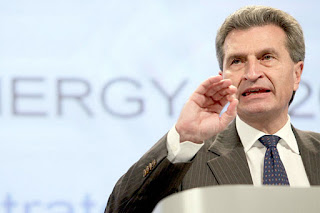
Günther Oettinger wants a pan-European energy market
Günther Oettinger believes lack of consistency and cooperation across Europe is the problem, and that more power in Brussels is the solution


European Energy Commissioner Günther Oettinger called yesterday for decisions on energy markets, security and renewable energy to be taken away from national governments and made in Brussels, as he admitted that Europe did not meet its 2010 renewable energy targets.

“These are strong arguments for giving [the EC] those powers,” Oettinger said in a speech to European policymakers. “In the next decade you would give greater value, or decide on a higher value for renewable energy in the [EU] energy mix.”

His call was supported by the President of the European Parliament, Martin Schulz, who said that European security and autonomy could only be achieved through more integration.

Under Article 194 of the Lisbon Treaty, individual EU member states have authority over their choice, use and structuring of energy resources.

In many countries this authority is jealously guarded because it is seen in terms of national security or as being politically useful during elections.

Several of them have still not transposed, or have only partly transposed, the the European Unions third energy package, intended to harmonise European markets into national. Furthermore, the energy mix of every state is qualitatively different.

Mr. Schulz acknowledged, however, that in the short term there would be no changes to Article 194. “The [energy] choice is made by member states and they are right to choose and we cannot get rid of that. But the right to choose your energy mix is a problem and we're going to have to talk about it a lot,” he said.

Renewable energy targets missed


Part of the reasoning behind the call is concern that the "20% by 2020" renewable energy policy goals will not be met.

Member states have just submitted their first reports to the European Commission outlining their progress towards meeting the targets, and most, including the U.K., missed them for 2010, as did the EU as a whole.

Only Denmark, Germany, Hungary, Ireland, Lithuania, Poland and Portugal expect to achieve their 2010 targets for renewable energy in electricity generation; and, only Austria, Finland, Germany, Malta, Netherlands, Poland, Romania, Spain and Sweden expect to achieve their targets for renewable energy in transport.

The European Commission said yesterday that it believes 2020 targets will only be achieved if member states fully implement their national renewable energy plans and more finance is available, which is not happening fast enough.

Oettinger believes lack of consistency and cooperation across Europe is the problem, and that more power in Brussels is the solution.

But Commissioner Oettinger's ambition doesn't stop there.

He also said yesterday that he wants to open talks on energy with Turkey in the current accession talks, and to enlarge Europe’s energy community to take in countries around its borders including Ukraine, Moldova, Georgia, Norway, Switzerland, Albania, Serbia, Montenegro and the Maghreb.

“Energy does not stop at the borders of the EU,” he stated.

Greater cooperation


Oettinger explained in his speech that he wants to see improved cooperation between member states and better integration of renewable energy into the single European market.

"We have to invest much more in renewable energy and we need smart, cost-effective financing. If Member States work together and produce renewable energy where it costs less, companies and consumers and the tax payer will benefit from this," he said.

To meet the renewable energy target, a doubling of annual capital investments in renewable energy is required throughout the continent, from €35bn per year to €70bn; this amounts to over one trillion euros between today and 2020.

Oettinger's Department says this will require "a substantial use of national support schemes", which "ought to be as cost-effective as possible".

A study released yesterday by the Department shows that, while different financial instruments are used in all Member States to develop renewable energy (grants, loans, feed in tariffs, certificate regimes etc.), "their management needs to be improved".

In an apparent jibe at the UK's recent policy about-turns it says: ″Retroactive changes to support schemes in particular must be avoided given the negative effect such changes have on investor confidence".

Once again it reiterates that investors need “greater coherence, clarity and certainty".

There are already three existing mechanisms which favour cooperation on energy between states:
  • "Statistical transfers" whereby one Member State with a surplus of renewable energy can "sell" it statistically to another Member State, whose renewable energy sources may be more expensive
  • "Joint projects" whereby a new renewable energy project in one Member State can be co-financed by another Member State and the production shared statistically between the two
  • "Joint support schemes" whereby two or more Member States agree to harmonise all or part of their support schemes.
The Commission says it will assess in 2014 the effective functioning of the cooperation mechanisms.

UK progress


The UK has so far not taken advantage of these cooperation mechanisms.

Its own Renewable Energy Directive Progress Report, submitted in December, shows that at the end of 2010 (the latest data available) 3.3% of its energy came from renewable sources.

Greg Barker, Minister for Climate Change, said yesterday he believed that this meant the UK is "currently on track to meet our first interim target of 4% over 2011-12".

The report adds: "we know the rate of deployment will need to be further increased to ensure we the meet the interim targets towards the end of the decade".

It is transport which is the particularly difficult area. 83% of the U.K.'s renewable fuel for transport is imported biodiesel, contributing to 3.3% of all the U.K.'s road fuels being renewable. The target is 5% by 2014.

In the latest example of action by individual states towards meeting the Directive's targets, Poland, notorious for its reliance on coal for electricity, announced yesterday that it will adopt a target of 15.5% renewables in its energy mix by 2020.

It said it is to switch support for investment in biomass, old hydropower plants and on-shore wind farms to solar energy, biogas plants, offshore wind generation and small hydropower units.

Deputy Economy Minister Mieczyslaw Kasprzak said he wanted to simplify and improve the support mechanism for renewables.

Tuesday, January 31, 2012

Large scale carbon capture and storage gets closer with new appointments

Schematic diagram of how the CCS set-up will work which is based upon the former BP Peterhead concept
Schematic diagram of how the CCS set-up will work which is based upon the former BP Peterhead concept.

A crucial step has been taken in the development of what may be the U.K.'s first large scale Carbon Capture and Storage (CCS) project, with the appointment of Foster Wheeler Energy Limited (FWEL) as project management consultants of a £3 billion, 650MW (net) project at Hatfield.

The Don Valley Power Project, at Stainforth in South Yorkshire, expects to combine a coal gasification plant, with CO2 capture on all of the plant, with an integrated gas-fuelled combined cycle power station that is fired by a hydrogen-rich fuel.

It will potentially capture up to 97% of the carbon dioxide from its operation and its principal emission will be water vapour.

Planning permission for the power plant has already been granted, and main construction activities would start in 2013, provided the project wins financial support from the EU and UK government, for which it is currently competing. The plant would be commissioned in 2016.

This was the only UK project to win funding (€180 million) under the European Energy Programme for Recovery (EEPR) and is being assessed by the European Investment Bank (EIB) for further EU funding under the New Entrants Reserve (NER300) programme, which is itself to be financed by the European Commission's satisfactory sale of 300 million EU allowances (EUAs) by the end of this year.

The appointment of Swiss company Foster Wheeler, a global engineering and construction contractor and power equipment supplier, has been made by 2Co Power (Yorkshire) Ltd. which is to design and construct the power station with pre-combustion carbon capture facilities.

Foster Wheeler's role will last until the plant comes into operation in 2016 and begin by helping 2Co Power (Yorkshire) to prepare an Engineering, Procurement and Construction (EPC) contract for the project build over the next six months.

Jonathan Briggs, Managing Director, 2Co Power (Yorkshire) Ltd said: “I firmly believe that the Don Valley Power Project is the UK’s most advanced and economic carbon capture and storage project.

"Foster Wheeler’s appointment will ensure we deliver this ground-breaking project on time to help create jobs, supply low carbon electricity to the region and help the UK meet its ambitious energy security and national carbon reduction commitments."

2Co Energy has also boosted its management team to take on the project with the addition of two leading carbon capture and storage experts, Jonathan Briggs and Graeme Miller.

Jonathan led the Hydrogen Energy joint venture between BP and Rio Tinto in California, and was responsible for managing the $2.5 billion carbon capture and storage project that is now under development by SCS Energy.

Graeme also worked on the Hydrogen Energy CCS project and previously worked on BP’s original Peterhead CCS project, which provides the technical blueprint for this one.

It is reckoned that the power station will employ over 2,000 people during the peak of construction and about 200 during operation.

The offshore part of the project is the responsibility of National Grid Carbon (NGC), an independent subsidiary of National Grid created to develop carbon dioxide transportation infrastructure in the UK, who are designing, building and operating the carbon transportation system and identifying potential offshore carbon storage sites in Southern North Sea.

This part should employ 800 workers during construction and 300 during operation.

Enhanced oil recovery


The Don Valley Power Project's unique business model centres on the vast CO2 storage and additional oil recovery potential under the North Sea, known as Enhanced Oil Recovery (EOR).

2Co proposes to inject the CO2 into proven secure oil fields where it can tap reserves of oil that would otherwise be unrecoverable, and then store the CO2 permanently in the oil fields.

Three quarters of CCS projects throughout the world in operation or under construction are currently linked to EOR.

A major feasibility study is nearly completed on two North Sea oil fields that might be used for this purpose.

It is hoped that sale of the oil will not only substantially offset the costs of carbon capture but generate several billion pounds in Treasury revenue as well as extending the life of North Sea oil fields by up to 20 years and deferring substantial costs to UK government from its shared responsibility for decommissioning oil fields.

The Humber cluster effect


One of the key elements of why this project at Hatfield was selected by the EU for the EEPR funding is the potential for developing a pipeline to support a cluster of CCS plants in the Humber.

Such a cluster could potentially capture about 60 million tonnes of CO2 per year from this region.

The Humber area is one of five identified by National Grid Carbon for CCS because they contain the UK's highest CO2 emitting facilities. NGC thinks the Humber could become the largest CO2 capture volume region in Europe.

This is now the only project being taken forward by National Grid Carbon after the decision by the Department of Energy and Climate Change not to go ahead to the construction stage of the Longannet CCS demonstration project.

The Humber cluster includes a further 426MW oxy-fired carbon capture and storage project currently under development at the Drax power station in North Yorkshire with partners BOC and Alstom.

Both are applying for part of the £1bn funding from DECC's CCS Delivery Programme.

DECC held its first CCS Industry Day on 16 December 2011, which was attended by over 130 delegates; the next is to be on 22nd February, and the CCS Delivery Programme competition will launch in Spring 2012.

Monday, January 30, 2012

Shale gas in Europe at the crossroads: are the existing legal protections sufficient?

a web of wells drilling for tight shale gas across a landscape in America
A matrix of close surface wells for the production of 'tight' shale gas in the USA.

Opinions differ about whether existing environmental legislation is sufficient to regulate the current level of exploration of shale gas in the EU, with a new report prepared for the European Commission arguing that it is.

But this is at variance with another report submitted last summer to the EC, which called for "consideration to be given to developing a new directive at European level regulating all issues in this area comprehensively".

That report, Impacts of shale gas and shale oil extraction on the environment and human health also recommended that for fracking, "all chemicals to be used should be disclosed publicly, the number of allowed chemicals should be restricted and its use should be monitored.

"Statistics about the injected quantities and number of projects should be collected at European level," it added.

But, as there is no large-scale commercial exploitation of shale gas reserves in Europe there have, as yet, been no cases that suggest a requirement for new legislation, according to the new 'Final Report On Unconventional Gas In Europe' by law firm Philippe and Partners.

“It is a new technology and we do not have a specific legislation on shale gas, because it is so new," Maureen Holzner, the European Commission spokesperson on energy was quoted as saying.

She said that the new report confirms that, so far, Europe's existing laws can be satisfactorily applied. This may change if commercial exploitation takes off.

The current laws include the Water Framework Directive and the Groundwater Directive which would cover water protection issues. The Mining Waste Directive covers other pollution issues, and the use of chemicals is covered by REACH legislation, which applies to the use of chemical substances in any industrial process.

Shale gas in Europe


Exploitation of shale gas reserves in Europe is currently limited, partly because the economics of shale gas in the European Union are still highly uncertain, particularly in the current context of significantly depressed prices as a result of the gas glut.

Furthermore, Europe is more densely populated than the United States, which makes local opposition more likely. At the beginning of the year, thousands of Bulgarians protested against exploration for shale gas because of concerns that it could poison underground water, cause earthquakes and create serious health hazards.

The new study only applies to four countries: Poland, France, Sweden and Germany, and did not examine climate change legislation.

In Sweden, the Swedish Mining Inspectorate has granted one exploitation concession, but this has not led to any exploitation activities.

In France, there is a legal ban on hydraulic fracturing on the basis of the Prohibition Act.

In England, hydraulic fracturing was held responsible for earthquakes registering 2.3 on the Richter Scale in Blackpool last year.

In Germany, at least one company has performed hydraulic fracturing tests, and in North Rhine Westphalia, shale gas activities are suspended until the completion of environmental studies and analysis of their results.

Poland is the country most interested in exploiting shale gas because it wishes to free itself from dependence on Russian gas.

Hydraulic fracturing has taken place there already, and the country plans to begin commercial production in 2014.

A US Department of Energy survey last year said that the amount of gas trapped in shale in Poland could provide it with enough fuel to last for 300 years.

In all Member States, general mining or hydrocarbons legislation covers licensing/authorisation procedures for shale gas projects.

Other legislation related to property, spatial planning or commercial activities can also play a role.

Commercial secrecy and public confidence


Commercial secrecy prevents knowing exactly the constituent chemicals used in franking. This is the area of greatest concern.

It is known that toxic salts, mineral oil, ethylene glycol and glutaraldehyde, volatile organic compounds like benzene, xylene and phenols may be employed and could cause pollution.

In Europe, under REACH legislation, if operators prefer to keep their chemical use confidential, they are required to conduct their own assessment of chemicals used in hydraulic fracturing and report this to the European Chemicals Agency.

The Agency can then review the report and verify the suggested risk management.

But since the onus is on the mining company to do this accurately, it is open to accusations that it is not being transparent or completely honest. This severely impacts on public confidence.

Chemical accidents are also covered by the Seveso II Directive, under which operators need to notify and report on the substances at their disposal and being stored on their premises.

These obligations differ according to the quantity and characteristics of the chemicals.

The new report to the EC also acknowledges that in countries where different authorities regulate different aspects of the mining process, expertise levels and communication between them can be inadequate.

In particular, it can mean in some countries that the core permitting authority can give the go-ahead for a project where some environmental aspects of the operation may not be up to scratch.

Sweden is held up as an example where this is not the case, as applications are dealt with under the overall assessment of environmentally hazardous activities.

Ultimately, public confidence is seen as key to the future expansion of the industry in Europe.

This is certainly the case in the United States. “If action is not taken to reduce the environmental impact, there is real risk of serious environmental consequences causing a loss of public confidence that could delay or stop this activity," US energy secretary Steven Chu was told by advisers late last year.

There, environmental scientists are worried about illegal discharges. “You just know there's going to be still spillage and contamination," said Walter Schlesinger, President of New York's Cary Institute of Ecosystem Studies.

Last summer's EC report was firm about the need for more legislation to protect the environment. "The threshold for Environmental Impact Assessments to be carried out on hydraulic fracturing activities in hydrocarbon extraction is set far above any potential industrial activities of this kind, and thus should be lowered substantially," it concluded.

What is shale gas?


Shale gas is extracted from sedimentary rock formations that act as both the source and the reservoir for the natural gas.

For this reason it is characterised as a “diffuse” source of gas, i.e. stretching beneath a large area. Numerous wells therefore need to be drilled and analysed in order to sufficiently determine the potential of the shale formation.

If sufficient gas is determined to be present, many horizontal wells from a single pad are drilled.

At this pilot stage there will be hydraulic fracturing and micro-seismic surveys.

If sufficient reserves are found, then commercial exploitation may begin.

According to Mike Stephenson, head of energy science at the British Geological Survey in Keyworth, there is, as yet, no peer-reviewed evidence that frack fluid can leak into groundwater.

Much fracking occurs at depths below other layers of impermeable rock which would prevent contamination of groundwater, he says.

Badly managed fracking has been shown to be the cause of contamination in Wells in Wyoming, USA. This, however, involved a shallow sandstone reservoir rather than deeper shale reserves.

Never mind steel producers squealing. This is the real carbon leakage.

consumption emissions are increasing in the UK

The price of carbon permits continues to hover only slightly above its all time low point of seven euros, and there seems to be little interest from the EU to intervene in any way that would cause it to rise.

A good price for EU carbon allowances on the trading market is required in order to boost investment in the low carbon economy.

A leaked draft resolution on the subject that is to be put before the European Parliament merely concurs that "a robust allowance price" is required and that "the present ETS allowance prices provide substantially lower incentives than anticipated".

It does not recommend taking any action.

A cross-party EU environment committee last month argued for withholding carbon permits from an oversupplied market on order to stimulate the price, but this looks unlikely in the foreseeable future.

The UK Treasury, overriding Department of Energy and Climate Change policy, decided in 2011 that a carbon price floor of £16 per tonne of carbon should be introduced unilaterally by the UK in just over a year's time.

(And, as an aside, it is a carbon price floor not a carbon floor price, as many insist on calling it. We are not talking about the cost of linoleum. Even George Osborne gets it wrong - sometimes in the same speech as getting it right.)

This means it would be up to companies registered under the Climate Change Levy to stump up the difference between the price of carbon at the time and £16 in order to provide certainty and motivation for investors in low carbon infrastructure. At the current rate the difference would be over £8 per tonne.

Existing CCL exemptions relating to fossil fuels used in UK electricity generation would be removed, and the amount of fuel duty that can be reclaimed when oil is used to generate electricity would be reduced.

Fossil fuels supplied to all types of electricity generator, including CHP stations and auto-generators, would be subject to increased taxation. This tax would allegedly (according to the big carbon emitters) be passed on to consumers.

This is not an electorally popular suggestion. Desperate mandarins at the Treasury are looking for a way out.

They are supported by manufacturers. EEF, the Manufacturers' Organisation has repeated its call for the carbon price floor plan to be scrapped, arguing that a unilateral move such as this would harm the competitiveness of UK industry.

It warns darkly of “carbon leakage" caused by manufacturing and heavy energy using companies fleeing the country to climes where such onerous burdens are not faced.

However, a different picture is offered by MPs on the Energy and Climate Change Committee, who say in a report published this week: "we believe that the threat of leakage to countries outside the EU has sometimes been exaggerated in lobbying conducted by vested interests".

Having heard evidence from all quarters, they conclude: "We do not accept that it poses an imminent threat to EU industry, except in a small number of sub-sectors.

"The problem should be addressed rationally and compensation should not be hijacked by emotive special pleading."

The MPs point out that the Chancellor has already promised a package of support for emissions intensive industries.

High emitters should come clean


They charge that the large carbon emitting companies that want this compensation must give something in return; namely, complete disclosure of the volume of free EU Allowances from the Emissions Trading Scheme they will receive, as well as the benefits to them, and of the value of support measures, so that all these subsidies for are transparent and can be weighed against the real risks of carbon leakage.

This will either expose or guard against the huge profits some firms have been a le to make from being given free allowances, but passing their costs onto consumers.

They are absolutely right. These big polluters cannot be allowed to have their cake and eat it.

For the same reason, the MPs support the inclusion of aviation within the EU-ETS but say that the EU should move towards 100% auctioning of permits to pollute by 2013 at the very latest; the target of auctioning just 15% of permits by 2020 is “disappointingly unambitious".

The real carbon leakage


But there is another sort of carbon leakage going on, that is much more damaging to the climate than that posed by polluting companies potentially relocating to a more laxly regulated nation.

Where this genuine leakage occurs is in the outsourcing of goods and services consumed in the UK and Europe as a whole to companies outside Europe.

If these emissions are taken into account, then total UK emissions have not dropped by around 14% since 1990, as the official figures ostensibly show; they have actually risen by 20% according to official figures.

These emissions are called, in the jargon, 'consumption emissions'.

In the Scottish version of the Climate Change Act, there is an obligation on the Scottish Government at least to account for consumption emissions.

Would it not be properly ethical and honest for this be applied to the UK as a whole?

A consumption-based approach to the country's carbon emissions would give a better picture of the U.K.'s impact, as Sir Robert Smith, the Scottish Liberal Democrat Member of Parliament for West Aberdeenshire, said during an Energy and Climate Change Committee hearing recently.

Defra expects to be providing regular estimates of consumption emissions, with the first results (for 1990 to 2009) expected in March this year.

The Carbon Trust already use a model for calculating consumption emissions developed by the Norwegian Center for International Climate and Environmental Research (CICERO).

The CICERO model uses two methods: Emissions embodied in bilateral trade (EEBT) and the Multi-Region Input-Output (MRIO) model.

It is the latter that Defra is using for its reports.

The rising level of consumption emissions is a direct function of the increasing balance of trade deficit, and reflects the fact that the U.K.'s imports have more or less continuously risen compared to exports since the mid-'90s except for a brief lull during the 2009 recession when we couldn't afford to buy much.

On this reasoning, one of the best ways to improve the true carbon emission figures of the country as a whole is to consume more products that are produced at home, whether they be food and drink or manufactured goods.

Improving our balance of trade will also increase our resilience to external price volatility and the economy as a whole by providing greater employment.

Amongst the other recommendations of the MPs on the ECC Committee is for the EU to pursue sectoral agreements with important emitting countries like China, from whom we import many goods, in order to target emissions reduction efforts in key industries and deal with competitiveness concerns such as carbon leakage.

But as these countries, like China, take more action to reduce their own carbon emissions by investing in low carbon generation and energy efficiency, which the UK can certainly help them with, the prices of their imports to this country will correspondingly rise.

This gives the UK another reason to produce more of the goods it consumes “in-house".

Improving our balance of trade at the same time as extending carbon taxation to cover all carbon emissions, including consumption emissions based on imports, would be of lasting benefit to the whole economy; and certainly have a better impact on overall emission levels than the sick dog that is the European Emissions Trading Scheme.

Thursday, January 26, 2012

Next stop: the Supreme Court. Isn't this a waste of taxpayers' money?

Lord Justice Moses


DECC's decision to ask the Supreme Court to overrule yesterday's unsuccessful High Court appeal against its recent ruling on solar PV feed-in tariffs means continued uncertainty for the industry.

Lord Justice Moses at the Court of Appeal ruled that on the question of whether the Secretary of State "has power" to apply a tariff cut before a consultation period is over: "In my view, he plainly has no such power".

As campaigners celebrated their victory, Energy and Climate Change Secretary Chris Huhne said: “The Court of Appeal has upheld the High Court ruling on FITs, albeit on different grounds. We disagree and are seeking permission to appeal.

“We have already put before Parliament changes to the regulations that will bring a 21p rate into effect from April for solar PV installations from 3 March to help reduce the pressure on the budget and provide as much certainty as we can for consumers and industry.

“We want to maximise the number of installations that are possible within the available budget rather than use available money to pay a higher tariff to half the number of installations. Solar PV can have strong and vibrant future in UK and we want a lasting FITs scheme to support that future and jobs in the industry,” he said.

Industry reaction to the High Court decision is relief mixed with apprehension. Chris Hopkins – Managing Director of Ploughcroft and successful contestant on the BBC’s Dragons Den, called it "excellent news for homeowners".

But the Electrical Contractors’ Association (ECA) warned of a "wild ride" ahead for an industry that is "already reeling from Government announcements in the last few months".

Paul Reeve, its Head of Environment, cautioned: “Before anyone celebrates, we should remember that future funding for FITs is not unlimited. "Some of the available cash could now be used up in a second ‘rush to install’ before 3 March, when FITs will be halved to 21p/kWh,″ he said.

The first ‘rush to install’ took place up to 12 December to beat the Government’s initial deadline for halving FITs and resulted in far more PV installations than DECC had planned. These will now be receiving the high rate for 25 years.

"A second rush now could put even more pressure on future FITs,” observed Reeve.

Nathan Goode, Head of Energy, Environment and Sustainability at tax auditors Grant Thornton, agreed that the "judgement is prolonging the agony. Whatever the theoretical rights and wrongs of the case we need to get to a position of stability as quickly as possible to provide the solar industry and investors with the certainty needed to allow them to move forward".

The Renewable Energy Association (REA) called for an end to the "fiasco" so that "the UK solar industry can get back to business".

The Solar Trade Association and Friends of the Earth continue to warn ministers of risks to 29,000 jobs as a result of subsidy losses, arguing that the tariffs could be paid for from tax payments which the industry generates.

They put this figure at £330m per year minimum, from income taxes, corporation tax, and VAT.

But Energy and Climate Change Minister Greg Barker said in the Government's defence that the higher tariff will cost consumers £1.5bn over 25 years and sought to blame Ed Miliband for the chaos, as he introduced the system.

Howard Johns, of the Solar Trade Association, countered that it wasn't the cut, but the way Greg Barker's department had managed it which was the problem.

The coalition of campaigners also wants the Government to look again at what FoE calls "over-strict energy efficiency rules that will prevent 90 per cent of houses from claiming solar subsidies".

This refers to a new rule that, from April 1st 2012, properties must have an Energy Performance Certificate (EPC) rating of C or above, to be eligible for the feed-in tariff.

This will penalise many old, solid-walled properties which, even with double-glazing, low-energy lights, a condensing boiler, thermostatic radiator controls and loft insulation, can only score D or E on the EPC due to a lack of wall insulation.

Green electricity supplier Good Energy commented that, "it looks as if rather than encouraging greater energy efficiency, the EPC standard is just another way of discouraging FIT take-up".

Campaigners also want the Government to keep housing associations, schools, councils and other community projects on the higher tariff rate.

"Helping more people to plug into clean British energy will help protect cash-strapped households from soaring fuel bills," said Friends of the Earth’s Executive Director Andy Atkins.

Much of the industry laments the chaotic way the Government has managed the situation. Andy Boroughs, CEO of Organic Energy says he "understands that solar payments must be cut in line with falling costs, but the Government must now accept that its illegal actions were putting the industry and thousands of jobs at risk.

“The industry needs stability," he said, adding that "if the Government is serious about its commitment to the renewables, it should accept this ruling and get back down to the business of supporting a sector which is helping to grow the UK economy as well as creating sustainable jobs”.

DECC's consultation on feed-in tariffs closed on 23 December with over 2,000 responses.

Greg Barker has promised that the outcome will be announced by 9 February 2012, in time for any resulting legislative changes to come into effect from 1 April 2012.

"Our aim is that this announcement will be accompanied by a set of reform proposals for the next phase of the comprehensive review of the FITs scheme, which will be the subject of a further consultation," he added.

All of which means that the solar industry will soldier on through a fog of insecurity for some time yet.

Afterthought: Germany currently has the highest power prices within the EU (24.4 cents per kilowatt-hour), but a recent survey by Forse for the German Association of Municipal Utilities found that an overwhelming majority of Germans are willing to pay the price as long as they get green power in return.

Wednesday, January 25, 2012

New service to help with the Green Deal & the Renewable Heat Incentive

energy efficiency advice

In 2012, the Green Deal & the Renewable Heat Incentive kick in.

Don't miss out on this fantastic opportunity.

I have launched a new service to help people make the most of them.

All businesses already are, and all homes will be, eligible to have energy-efficiency makeovers free of charge.

They will be repaid by the value of the energy saving.

They can also install renewable energy and get paid for the heat and power they generate.

This independent site aims to help ensure no-one is ripped off and everyone gets the best green deal.

Green Deal Advice offers free information, cheap downloads, books and consultancy.

Renovate your property to high energy-efficiency standards with the help of government support, to cut heating and cooling bills.

Add renewable energy to your home or business, like underfloor heating fed by a heat pump, solar PV, solar water or biomass heating.

Enjoy greater comfort at no or low cost by super-insulating & draughtproofing your home, then adding renewable energy for heating and cooling.

Get independent advice on the most cost-effective ways to use the Green Deal, Feed-in Tariff & Renewable Heat Incentive schemes.

Visit Green Deal Advice now.

Personal carbon trading "could fill the Green Deal gap"


Personal carbon trading is at the heart of a new proposal from academics to reducing energy use in buildings and help meet the aims of the Green Deal.

It comes in the form of a strategy document, Achieving Zero, being launched today by Dr. Brenda Boardman of Oxford University's Environmental Change Institute, which she hopes will help transform the UK’s built environment in a fair and equitable way.

Clinching the Green Deal

Dr. Boardman claims her recommendations will "lift millions of people out of fuel poverty, and improve the UK’s energy security" in a way that is "considerably cheaper than providing new energy supply".

The report comes at a critical time, as DECC's mandarins are now mulling the responses to questions about the Energy Company Obligation (ECO) and Green Deal's implementation in the recent consultation process.

The Environmental Industries Commission’s Executive Chair, Adrian Wilkes, has pointed out that "its successful implementation will be no easy feat" since it must "have widespread appeal and take-up from all sectors and demographics if it is to be successful".

Not only does it need the "required skills for Green Deal Assessors", but a broad "list of qualifying measures, products and systems" to cope with "the disparate number of building sizes and uses".

Most importantly, "it is vital that the scheme is felt to be financially viable in the eyes of both the suppliers and the consumers," he said.

Dr. Boardman's low carbon diet plan

Dr Boardman, who has long been a passionate advocate of domestic energy efficiency as a way of curbing fuel poverty, takes the view that the Green Deal must be seen strategically as part of the move towards the 2050 zero carbon use target.

“The change in perspective is substantial," she said, launching her report at Salford University, "as in future the value of our homes and offices will be linked to their energy efficiency.

"Reducing our demand for energy becomes an investment for every property owner.”

Achieving zero describes a triple-win situation through jobs, improvements to infrastructure, and energy security.

“We already spend £35bn a year on improving and maintaining our buildings," she says. "We need to refocus 40% of this into energy-efficiency and spend less on expensive kitchens and conservatories.”

Her key recommendations include:
  • progressively more challenging, legally-binding standards of energy efficiency for properties, based on Energy Performance Certificates in homes and display energy certificates (DECs) for business properties
  • a network of Low Carbon Zones set up by local councils that target the worst performing homes, especially those occupied by the fuel poor, using the legal obligation to eradicate fuel poverty (where reasonably practicable) by 2016 under the Warm Homes and Energy Conservation Act 2000
  • remaining emissions in households being mopped up "through some other policy that covers all energy use, such as personal carbon allowances (PCA)".
  •  

Personal carbon allowances

PCAs have been promoted by Dr. Boardman before. They give individuals an annually reducing carbon budget and they are rewarded if they live within their budget by being able to trade surplus allowances.

DECC has previously rejected them as unnecessary, given the existence of the Emissions Trading Scheme.

However, the failure of this scheme to provide sufficient incentive to invest in large low carbon infrastructure due to the oversupply of credits and their consequent low price, has led to scepticism and the Treasury's crestfallen contemplation of the cost implications of its commitment to introducing a carbon price floor.

PCAs, because they promote fairness and personal lifestyle change, remain attractive and for this reason are the explored by a new book, "Sharing for Survival: Restoring the Climate, the Commons and Society" to be published next month, co-authored by a group of campaigners that includes the late Richard Douthwaite.

PCAs are being used in practice now by one pioneering firm to reward employees and stakeholders for making energy efficiency improvements.

Green consultancy WSP Environment and Energy's scheme has 2,200 individuals taking part on a voluntary basis from 15 different organisations, including National Grid, Ecclesiastical Insurance and the London Borough of Haringey.

Its director, David Symons, says the scheme helps "staff understand that sustainability is relevant to them".

One of the scheme's members, Inga Doak, Head of Environment at Invensys Rail praises the scheme, as it "demonstrates pro-active leadership... It was fascinating to see people's perceptions of their carbon footprint and it helped to blow some carbon myths out of the water."

The home refurbishment mountain

Dr. Boardman sees PCAs as complementary to actions which reduce the carbon emissions burden of things that are outside individuals' control, like the state of the buildings they use.

The rate of activity required to meet the Green Deal targets is staggering: for every hour over the next 39 years, 82 existing buildings should be retrofitted to the level of band A on the energy performance certificate, Dr. Boardman calculates.

This is a 25% faster than has been achieved over the last 40 years.

If this were to be done, by 2050, all of the UK’s 28 million properties would be so well-insulated that they would require no external energy for space heating.

Electricity use, per property, would be halved and supplied solely from renewable electricity on the grid as a result of policies on lights and appliances, the report says.

How would this be financed? The report envisages that building improvements will continue to be the responsibility of the property owner, with Government providing zero-interest loans to low-income owner occupiers.

Once minimum standards are attained, properties would become more valuable, and be an asset in which lenders may have an equity stake.

Other financial inducements could come in the form of reduced tax liability (stamp duty, council tax, VAT), but at a scale required to ensure popular support in conjunction with the regulatory framework.

The size of financial incentives is inversely proportional to the certainty of the regulatory environment, particularly on minimum standards, Dr. Boardman says.

Value for money

An emphasis on reducing energy demand would result in the most cost-effective cuts in the UK's carbon emissions, with the benefit of lower bills and greater comfort for consumers.

The alternative, being touted by some in the Coalition Government, of a higher level of new, expensive electricity-generating capacity, implies considerably higher bills for users, thus pushing more households into fuel poverty, without providing any improvement in the level of energy services or spreading wealth by improving building value, or raising public awareness of energy use.

It therefore represents greater value for money.

Crucially, it all rests on the level of the interest rate at which capital is lent to finance the work and the period over which it is to be repaid.

Dr. Boardman concludes, "The UK cannot meet its legal obligations on eradicating fuel poverty by 2016 and 80% reduction in greenhouse gases by 2050 without most, if not all, of the proposed initiatives".

Friday, January 20, 2012

Doubts over Green Investment Bank's future borrowing power


Serious doubts have arisen over whether the Treasury will allow the Green Investment Bank to begin borrowing money, as scheduled, in 2015/16.

The Department for Business, Investment and Skills, which is driving the setting up of the GIB, has told EaEM that the bank "will be given borrowing powers at this time subject to the targets for reduction in national debt being met and further state aid approval being granted".

The BIS spokesperson added that "GIB borrowing will score against the national debt".

The Aldersgate group, which represents big companies like BT, M&S and Microsoft, has been secretly lobbying for the government to remove this condition, which it says will curtail their ambitions.

She said: "We will need to ensure that the necessary controls are in place so that borrowing is transparent and liabilities can be managed effectively. The decision on the level of borrowing cannot be taken now.

"When considering it in the future, both investment requirements and wider fiscal affordability will be taken into account."

The question is: will the fiscal targets will be met, since the Chancellor George Osborne admitted last Autumn that it would take two years longer to pay off the country's debts than he had originally estimated when he set up the Bank?

The Treasury's target was, before the Autumn Statement, that by 2015-16, public sector net debt as a percentage of GDP must be falling.

The chances of this were then estimated by the independent Office of Budget Responsibility as only "greater than 50%".

Then, the Treasury said that by 2014-15 there would be additional reductions in current spending totals of £30 billion a year (these were fixed in the Chancellor's June 2010 Budget).

80% of the further reduction in the deficit at this time was already supposed to come from reductions in public spending.

Autumn Statement

But then came the Autumn Statement, and the OBR revised its fiscal portrait of the UK.

They said Britain has the highest structural budget deficit of any major economy in the world.

They forecast that the current structural deficit will fall from 4.6% of GDP this year to a current structural surplus of 0.5% in five years' time - not three years as previously thought.

The debt-to-GDP ratio – which is forecast to stand at 67% this year – would peak at 78% in 2014-15 and be falling by the end of the Parliament.

As a result, the Chancellor set revised expenditure totals for the two years following the end of the Spending Review period: 2015-16 and 2016-17, i.e., the point at which the Green Investment Bank is supposed to be able to borrow.

He said that Total Managed Expenditure would now fall during that period by 0.9% a year in real terms, but with a baseline that excludes all the additional investments in infrastructure he announced at the time; expenditure which excludes that of the GIB.

The consequence must be that there is now less than a 50% chance of the Treasury's target being met, of public sector net debt as a percentage of GDP falling by 2015-16.

In the same speech George Osborne infamously uttered the words "I am worried about the combined impact of the green policies adopted not just in Britain, but also by the European Union".

To borrow or not to borrow?

When the Green Investment Bank was set up, it was strongly advised that it be constituted as a proper bank, and there was even a call to permit anyone to invest in it, with ordinary people being able to buy Green Bonds in order to finance the green industrial revolution.

The Treasury decided this was too risky and unwieldy, and that it could not be seen to borrow more money at a time when the rest of Government borrowing was being cut.

Chris Huhne, the Secretary of State for Energy and Climate Change, fought, and lost, the battle for the Bank to be able to borrow from Day One and therefore to have more funds at its disposal.

Instead, the Treasury set the date at 2015/16, subject to the above target being met, which now seems increasingly unlikely.

£100 billion by 2020 is a conservative estimate of the cost of the required upgrading of the National Grid, new renewable energy generation like energy-from-waste, the Green Deal, FITs, the Renewable Heat Incentive, ECO, and other measures to decarbonise and future-proof the UK economy and energy sector from the risks of fossil fuel price volatility and climate change.

The Green Investment Bank and the carbon price floor are the Treasury's key means of meeting this bill.

BIS' spokesperson told EaEM that "Our key priority at present is to ensure the establishment of the bank for 2013 and we are on target to achieve this. The GIB is being capitalised to an extent that it will not need to borrow before 2015/16."

The capitalisation is coming partly from the sale of government assets.

£1 billion stems from standard departmental allocations, and £775 million has already been received from the net proceeds from the sale of the high speed rail link.

"The remaining £1.225 billion is expected to come from future asset sales," the spokesperson said, adding that "The Chancellor has said if these sales are not completed in time, this sum will be underwritten by the Treasury".

CBI slams Treasury interference

The Confederation of British Industry has long called for the Bank to be made effective, and today criticised the way the Green Deal and ECO are being set up, saying the Green Deal won't meet its targets as it is currently designed.

John Cridland, its Director-General, has warned that the Bank "certainly won't work if it needs the Treasury's permission to blow its nose.

"The bank needs to be able to get into the markets itself and do what it's intended to do."

If the date by which the Treasury is to permit it to do this is put off even further this will severely curtail its already reduced effectiveness.

Yet Mr Cridland has said it is crucial that the "Green Investment Bank deliver certainty for investors if it is to generate the scale and pace of investment needed to shift the UK to a low-carbon economy.

"I want it delivering growth - large-scale, mainstream economic growth. I want it delivering the low-carbon infrastructure, leveraging the £450bn we need by 2025, that'll bring jobs and opportunities to the UK," Mr Cridland added.

But unless it is released from the Treasury's tether, this can only happen later rather than sooner.

Monday, January 16, 2012

Community energy schemes receive funding but mixed messages from Government

Action for Sustainable Living in Manchester is one of the winning community groups.


The first 82 local energy projects run by communities throughout England have won funding from the Government's £10m Local Energy Assessment Fund (LEAF).

But at the same time, many community-led solar PV projects are still waiting to hear if they will receive enhanced support from feed-in-tariffs.

LEAF is managed by a consortium of community networks administered by the Energy Saving Trust.

The money given is intended to be used for understanding energy efficiency and renewable energy generation issues at a local level and to help communities to prepare for new opportunities in sustainable energy and climate change arising from the Green Deal, Renewable Heat Incentive and feed-in-tariffs.

There was a high volume of applications for the first round of awards. The second round is open until 20 January and the website above contains full details of how to apply.

Many of the winners are part of the Energyshare network.

£50,000 is the average size of the award for each successful bid, but it depends on the proposals put forward. Any work needs to be completed by end of March 2012.

Peter Lipman, Chair of Communities and Climate Action Alliance said: “Hundreds of communities responded fantastically to the opportunity afforded by LEAF with imaginative and innovative schemes. It’s wonderful to see that many of them will be funded and so will have a chance to show just what those communities can deliver.”

Feed-in-tariffs confusion


Government support for communities wanting to engage with the low carbon agenda has come under renewed criticised lately over the removal of their ability to claim high returning feed-in-tariffs for solar electricity.

"Why on earth have [the Government] not excluded housing associations, schools, council and other community projects from the damaging proposal to give multibuilding projects ever lower financial support?" asked Lord Judd during last Thursday's Lords debate on the Government's green record.

Lord Marland, speaking for the Government in reply, gave no sign that it would give way on the matter and revise its position on the tariffs.

On Friday, the judges at the Court of Appeals postponed their decision on the Government’s appeal against the High Court’s recent finding that its cuts to the photovoltaic feed-in tariff (FIT) rates were unlawful. A decision is expected later this week.

The Renewable Energy Association’s Gaynor Hartnell commented that no one has liked how the government has carried out the FIT review process, and that the judges should "ensure that the Government thinks twice about acting in such a cavalier manner again".

However, she added that "the majority of our members want to draw a line under this affair, look forwards, and get on with installing systems at the new tariff rates".

The Department of Energy and Climate Change has issued a statement saying that once the court arrives at a decision "we will consider our options and make an announcement on the way forward to provide clarity to consumers and industry".

Amongst the clarity required by communities is whether a much lower tariff will now be applied to schemes where an organisation receives payments from multiple installations on different sites, as happens in some cases (the proposed cut is of 80%), or, whether genuine community renewable energy projects will be given special levels of support in recognition of their enhanced efficiency and the spin-off benefits.

The benefits of community energy


These benefits include social cohesion, reduced crime, a better local environment and spreading awareness of renewable energy and energy efficiency, all aims of the LEAF scheme.

Many projects have been cancelled or put on hold as a result of the confusion over FITs.

The situation means that the community-scale schemes that are now proceeding are more likely to be privately owned.

E.ON is one utility giant that is pushing into this market. Its Sustainable Energy division specialises in district-level or 'distributed' energy, employs 500 people with a turnover of £100m, and is rapidly expanding.

The UK situation is in stark contrast to that in Germany, where most of its $100 billion of private investment in renewable energy is not owned by companies but by communities and individuals; a total of 51% according to Paul Gipe.

40% of this 51% of renewable energy generation is owned by individuals, and 11% is owned by farmers. Just 13% is owned by power utilities. The rest is owned by a combination of developers (14%), investment funds (11%), industrial ownership (9%), and “others” (1%).

"German farmers, community leaders and entrepreneurs are not only democratising electricity generation and renewable heat, but are also setting their sights on an equally ambitious prize, the transmission system itself," comments Gipe, an advocate of community wind power since the 1970s.

Though Britain has a long and proud history of community and co-operative ownership, it is perhaps hard for us to imagine how, if this pattern were to be repeated here, it would affect our attitude towards energy supply.

Communities everywhere clearly want to have more engagement with renewable energy, but for decades the Renewables Obligation financing system has unfortunately inhibited this natural inclination and meant that there is only a handful of community-owned windfarms.

One example of such a community is Sustainable Wallingford, established in 2003 by residents of this Oxfordshire town, and which is one of the LEAF winners announced today, for a project to use thermal imaging to show where energy is leaking from homes, and provide advice on energy efficiency and solar power.

The Government continues to send out mixed messages on community energy, but the message from LEAF is that communities do want to be empowered.