Showing posts with label Areva. Show all posts

Wednesday, October 03, 2012

Not much on the Horizon for UK's nuclear programme

Wylfa
Horizon's Wylfa site, Anglesey, with its mothballed old reactor.

Just two bidders have emerged for Horizon, the nuclear company seeking to build two new reactors in Britain, following the expiry of a deadline last Friday for expressions of interest in purchasing the option, which saw expected partners dropping out.

In both cases it is unsure where the hundreds of millions of pounds of investment will come from, that could eventually see a new nuclear power station built on either of the company's sites, in Oldbury, Gloucestershire and Wylfa, Anglesey.

Last week, three consortiums were expected to throw their hats into the ring: France's Areva, partnered with China's Guangdong Nuclear Power Group, both state-owned; one led by Japan's Hitachi; and Japan's Westinghouse Electric Co., partnered with China’s State Nuclear Power Technology Corp and Exelon, the US power generator.

Areva failed to submit a bid. Hitachi did, and Westinghouse did, but without its Chinese partner, who would have provided substantial experience of delivering nuclear power stations on time and within budget.

Areva's European Pressurised Reactor (EPR) design is further ahead than Westinghouse's in the UK's generic design assessment approval process. Westinghouse' put their process on hold last December.

Its AP1000 nuclear reactor design is, in turn, further on than Hitachi's Advanced Boiling Water Reactor, which has yet to be submitted to the Health and Safety Executive (HSE), although it is licensed in the US, Japan and Taiwan.

Four ABWRs are already operating in Japan, with a fifth 94% completed.

No AP1000 reactor has yet been completed, although four are under construction in China, and two proposals have been given approval in the US.

Two builds of Areva's EPR design, in France and Finland, have experienced massive hold-ups and budgetary excesses.

EDF has yet to decide whether to proceed with construction of an EPR plant at Hinkley Point.

The process of approval of the EPR design issues by the Health and Safety Executive can be followed online here, where it can be seen that the majority of issues have yet to be resolved.

The only other contender for new nuclear power station building in the UK is NuGen, which is owned by GDF SUEZ and IBERDROLA. Their plans to implement 3.6GW of electricity generation at the Moorside site adjacent to Sellafield are also on hold.

Any potential backers for building new nuclear power stations, which would undoubtedly include Chinese money, are waiting for clarity on the level of government support that will be available following the passing of the Energy Bill, currently winding its way through Parliament.

Wednesday, July 18, 2012

Areva/EDF's nuclear ambitions are in disarray

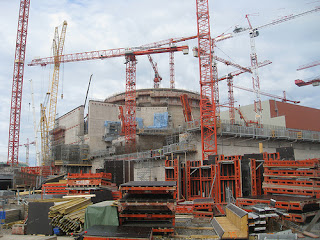
Areva's European Pressurised Reactor Olkiluoto 3
Areva's European Pressurised Reactor Olkiluoto 3 is now over five years behind schedule. Its design faces 28 unanswered questions from the UK regulator.

EDF and Areva are facing delays, high costs, and problems satisfying the regulator, over trying to get their flagship European Pressurised Reactor nuclear plant design approved for building in the UK, even as EDF seeks a £165/MWh price guarantee from the Government.

The two companies have resolved just three of the 31 problems blocking their proposed nuclear reactor from receiving environmental and safety approval from the Environment Agency and the Office of Nuclear Regulation (ONR).

They are greatly behind schedule and will not receive final approval this year, as they had hoped.

Their design for a new generation European Pressurised Reactor (EPR) has to pass through the generic design assessment (GDA) process before any reactors can be built.

EDF is hoping to use two of the reactors in a 3.2 gigawatt plant at Hinkley Point, Somerset.

Meanwhile, it is seeking a subsidy in the form of a guaranteed price of £165 per megawatt hour (MWh) for electricity from the plant from the Department for Energy and Climate Change (DECC) and the Treasury, according to the Times newspaper.

This expensive figure is more than the £150/MWh strike price estimated by Dr. David Toke, Senior Lecturer in Energy Policy at the University of Birmingham, and about the same as a £166/MWh estimate by Citi bank analyst, Peter Atherton.

The EPR design was given interim approval by the ONR and the Environment Agency last December but EDF has to come up with answers to 31 separate questions.

They cover issues such as security, reliability, strength of the inner containment wall, test results, and independent assessment of predictive calculations.

Significantly, the report says: “some of the deliverables have been late or did not provide the required quality of arguments or evidence".

It adds: "a number of the metrics are amber or red, indicating that, if no action is taken to improve matters, it is unlikely that the GDA [Generic Design Approval] Issues will be closed-out on the timescales indicated in the current resolution plans", in other words that the design will receive approval by November. EDF and Areva are reviewing their timescales and a new date will be announced shortly.

ONR takes a while to make its progress reports publicly available. Although published on July 5, the latest quarterly report actually covers the three months up to March 31. The reports are not easy to find on the website, especially because a link leading to them is broken.

The EPR is now the only reactor design being assessed following Westinghouse's withdrawal from the market with its AP1000 reactor design.

More EPR delays

To add to the two French companies' woes, the reactor being built by Areva in Finland, the 1,600 megawatt Olkiluoto 3, will now “not be ready for a normal level of electricity production in 2014" according to a statement issued on Monday by Areva's partner, the Finnish utility Teollisuuden Voima Oyj (TVO). TVO adds, dryly: “we are not pleased with the situation".

It was supposed to have been ready in 2009, and last year TVO said it would start in 2014. It is more than €2 billion over budget. TVO is locked in a bitter legal wrangle with Areva.

There are similar delays and cost overruns at Areva's EPR project in Flamanville, France.

The nuclear subsidy dilemma

Under the draft Energy Bill, the Government will introduce ‘contracts for difference’, a tariff system intended to subsidise renewables, nuclear, and carbon capture and storage. But it will not be in place until 2014, two years after EDF says it needs to make an investment decision on the Hinkley Point plant.

The EPR clearly is much more expensive than EDF had originally said publicly. The Government has repeatedly said it is committed to nuclear power.

Offshore wind power is currently subsidised at a price of £130 per MWh under the Renewables Obligation Commitment. The Secretary of State, Ed Davey told the House of Commons Select Committee on Energy and Climate Change yesterday that details of changes to the Renewables Obligation Commitment subsidy levels, which had been expected to include a reduction in this subsidy and were anticipated this week, have been delayed due to pressure of time impacting on his department’s discussions with the Treasury and other departments.

He said “there are over 4,000 responses to the consultation, and it is very complicated”. Pressed by MPs, he said an announcement will be made by the end of September. He also denied that there was any outside interference in the decision-making process.

Regarding the issue of a subsidy for nuclear power, Ed Davey, is on record as saying: “There will be no levy, direct payment or market support for electricity supplied or capacity provided by a private sector new nuclear operator, unless similar support is also made available more widely to other types of generation.

"I want to make clear … that this means that nuclear will not receive a higher price than comparable generation technologies whether they be renewables or indeed gas generation, once its emissions have been abated by carbon capture and storage.”

Tuesday, March 13, 2012

British consumers will pay dearly for French nuclear power, say environmental leaders

Flamanville-C in France, being built by EDF and Areva: over budget and overdue.
Today, four of the UK’s leading environmentalists have warned that the Government is about to hand over control of Britain’s future energy and climate security to the French government, leaving British taxpayers to pick up the bill.

Their claims are made in a letter and note sent to David Cameron, Nick Clegg, George Osborne, Edward Davey, Secretary of State for Energy and Climate Change, Vince Cable, the Business Secretary and Sir Jeremy Heywood, Cabinet Secretary.

The letter is signed by:
  • Jonathon Porritt, former chair of the Sustainable Development Commission and founder director of Forum for the Future
  • Tony Juniper, environmental advisor, campaigner and writer
  • Charles Secrett, co-founder of The Robertsbridge Group
  • Tom Burke, founder director of E3G.
Mr Cameron recently made an agreement with French President Nicolas Sarkozy to boost nuclear co-operation.

However, "our analysis shows that building new nukes will be a massive rip-off for the the British taxpayer," said Mr Secrett.

The letter-writers say the French will only build new nuclear reactors in the UK if the financial risks involved are transferred from France to British households and businesses – leaving UK taxpayers to pick up the bill to protect the French nuclear industry.

This is because without a strong price for carbon, which is not on the horizon unless the Treasury sets a high carbon price floor, and which British consumers will end up subsidising, new nuclear power's figures don't stack up.

Should the French subsequently decide not to proceed, the UK would be faced with a humiliating policy melt-down.

″This is an invitation to EDF to bargain very aggressively for an agreement that transfers the lion’s share of the financial risk of new nuclear to British taxpayers and consumers. EDF will have us over a barrel,″ they say.

They also claim that the nuclear plans proposed by the Department for Energy and Climate Change (DECC) and EDF, and approved by the Office for Nuclear Regulation, are based on a type of reactor that France has been advised to abandon.

EDF intends to construct four European Pressurised Reactors (EPRs) at Hinkley and Sizewell, yet the French National Audit Office has recommended abandonment of the EPR as too complex and expensive.

On his blog, Tom Burke writes: "The French National Audit Office recently recommended dropping the EPR as too expensive. This repeated a recommendation made to Sarkozy two years ago by the former head of EDF, Francois Roussely, who saw no future for it.

"In any case, the decision to extend the life of EDF’s existing fleet of reactors in France will put huge pressure on its capital budget over the next decade."

The construction of two EPRs in Finland and France under construction by Areva (designers of the European Pressurised Reactor) has been beset by problems: both are already four years late and costs are running twice as high as originally projected.

The four previous reactors they built took an average of 17.5 years from the start of construction to the delivery of the first electricity.

There is also a growing risk that Centrica (a British energy company with an option to take 20% of the new build at Hinkley and Sizewell) will not take up its 20% option leaving two French companies, Areva and EDF, as the primary beneficiaries of large subsidies from Britain’s householders and businesses.

Tom Burke said, “It is shocking that the government is willing to turn over control of our energy and climate security to France in pursuit of a nuclear mirage.

"British householders and businesses will be compelled to pay for a French nuclear loser. To do so we will turn an admired liberal electricity market back into the centrally planned nightmare that Mrs Thatcher rescued us from.”

Electricity Market Reform

Commenting on the letter, Jonathon Porritt said, “The fixation of the current political establishment with nuclear power beggars belief. The entire energy system in the UK is about to be rigged in order to support nuclear power, through the Electricity Market Reform, at great cost to UK consumers, UK businesses and the long-term interests of the entire nation.

"Given its historical opposition to nuclear power, the LibDems should be feeling particularly uncomfortable at the analysis surfaced in our note to the Prime Minister – and the Coalition Government’s continuing pledge that any new nuclear programme will not get any additional public subsidy is now palpably dishonest.”

Continuing with the present policy will seriously distort our electricity market for decades to come, reduce the competitiveness of British businesses, add to fuel poverty, and suppress innovation and investment in industries where Britain has real competitive advantage, they say.

Tony Juniper added, “Ministers have been well and truly led up the garden path by the nuclear lobby. Our analysis of nuclear energy provides a timely reminder as to the danger posed by campaigns against sustainable energy sources, such as wind power.

"If the not-in-my-backyard anti-anything-anywhere brigade prevail, and nuclear becomes the default option, then that could cost us a great deal of money. The Prime Minister needs to step in and make sure that energy policy is truly working in the public interest, rather than to the agenda of a massive vested interest.”

Charles Secrett concluded, "How on earth can the Prime Minister justify paying billions of pounds of subsidy to French power companies when the Chancellor is slashing welfare budgets for poor people in Britain and there are a million young people unemployed?"

EDF is 85% owned by the French state. It has been the most committed supporter of new nuclear build in Britain. Preparatory site clearance will begin shortly at its Hinkley Point C site. However, until EDF orders the major reactor components there is no guarantee that they will actually proceed to construction.

Environmentalists who support nuclear power argue that it is necessary to combat climate change. The letter writers plan to counter these arguments with a series of briefings to the Prime Minister over the next six weeks, covering:
  1. Market reform
  2. Investor issues
  3. Energy industry issues
  4. Wider economic issues
  5. Sustainability issues
  6. Political issues.
They argue that viable options are available to meet our energy and climate security needs at much lower economic and political risk and will create predominantly British jobs and growth.

The letter is fully supported by Friends of the Earth, whose executive director Andy Atkins said: "This report is spot on – Britain must meet its energy needs while keeping to its legally-binding climate targets, but gambling on a massive nuclear building programme to achieve it is far too risky.

"Investing in clean British energy by developing the UK’s huge wind, wave and solar potential and slashing energy waste will keep the lights on and create thousands of new jobs."

Saturday, February 18, 2012

Cameron & Sarkozy expose their nuclear hypocrisy

In a blaze of publicity, Prime Minister Cameron and President Sarkozy have signed a £400m deal on new nuclear reactors between Rolls Royce and Areva at the same time as agreeing a joint control and command centre for military operations and celebrating their "tough stance" against Iran's nuclear programme.

Cameron said: "One year on from the Libya uprising, we are working together to stand up to the murderous Syrian regime and to stop a nuclear weapon in the hands of Iran [sic]."

The two leaders agreed also to build a new generation of a controversial unmanned 'fighter drone' aircraft, which will allow targeted strikes, intended no doubt for use in the Middle East and elsewhere.

Anyone observing this from a Middle Eastern perspective might detect more than a whiff of hypocrisy here.

The £400m, which is as yet potential, would go to Rolls Royce to manufacture turbines for four possible reactors at a new factory in Rotherham, the first of which is the EPR reactor at Hinckley Point, Somerset.

Who gets the benefit?


DECC is claiming that the deal would support 1,200 new jobs across the nuclear supply chain in Britain.

However, as it covers four reactors, with each reactor costing £5bn upwards, the British contribution and benefit to the project would be less than 2%, (£100m per reactor).

This puts into perspective David Cameron's fine-sounding statement that "I want the vast majority of the content of our new nuclear plants to be constructed, manufactured and engineered by British companies".

He can want it as much as he likes, but it is not going to happen.

The actual size of the deal led Dr Tim Fox, Head of Energy at the Institution of Mechanical Engineers, to comment that “Although it is welcome news that the UK is pressing ahead with the development of new nuclear reactors, to secure affordable low-carbon electricity generation, this is not necessarily the best deal for securing UK jobs and skills".

Quite, but there is little that is affordable about it either.

Nuclear costs


Nuclear costs have a habit of ballooning well over predictions, as has happened at recent new builds in France and Finland.

Areva's Olkiluoto reactor in Finland is five years behind schedule and costs have increased from €3-billion to €5.3-billion, causing the Finnish utility TVO to fight Areva in court.

It is still uncertain where utilities will get the funding for new nuclear power, making Cameron's vision of £60 billion for the nuclear industry and 30,000 jobs in the UK presently no more than a hope.

Dr Doug Parr from Greenpeace commented: "No amount of talking up of the French nuclear industry by David Cameron and Nicholas Sarkozy will cover up the fact that the economics of new nuclear reactors don't stack up.

"The track record of EDF in building new nuclear power stations on time and to budget is appalling."

Recently, the independent risk agency Standard and Poor downgraded EDF’s creditworthiness on account of it being, like Areva, state-owned.

"All this came just a few months after a French judge sentenced a number of EDF senior executives to prison for unscrupulous acts of spying. French nuclear power is no longer popular even in France," said Dr. Parr.

Greenpeace accuses Cameron of using UK taxpayers' money to prop up failing French industries, and urges him instead to "follow the lead of Germany and concentrate on securing vast numbers of jobs and economic growth in the rapidly expanding clean energy industries such as wind and solar power".

Solar, wind power and other renewables can be up and running inside 18 months of permission being granted, whereas nuclear newbuild takes over a decade.

″A corruption of governance"


The source of Government enthusiasm for a new fleet of nuclear power stations can be traced to ministers having misled parliament over the need for them by distorting evidence and presenting to MPs a false summary of the analysis they had commissioned.

This is alleged by a group of MPs and experts in a a report published earlier this month by the Association for the Conservation of Energy and pressure group Unlock Democracy.

It shows that, on the basis of the Government’s own evidence, we do not need any more new nuclear power stations in order to ‘keep the lights on’ and reduce CO2 emissions by 80% by 2050.

And it shows that, again on the basis of the Government’s own evidence, electricity generated by nuclear power is the not the least expensive of all low-carbon technologies.

In everyday terms, the building of new nuclear power stations to provide electricity is likely to mean higher fuel bills.

If MPs had been presented with an accurate picture of the evidence for and against new reactors, they say, the government's plans might have been challenged.

Both the previous Labour government and the current coalition overstated the evidence that new nuclear power was needed.

The two bodies label this "nothing less than a corruption of governance" which can "only be rectified if Parliament re-opens this debate, and MPs vote on this issue having seen the correct information".

Areva's need


Behind the scenes, Areva is desperate to find new markets for the uranium it owns, following the purchase in 2007 of Canadian company UraMin's three African mines for $2.5 billion. The mines are Trekkopje in Namibia, Bakouma in the Central African Republic and Ryst Kuil in South Africa.

But the UraMin mines have yet to prove their money's worth at today's price of $52 a pound.

This has brought financial and political chaos to the company, and in December it wrote down almost the entire value of the mines.

This prompted speculation that the deal had been a scam and a report commissioned by Areva's security service even speculated that Chief Executive Anne Lauvergeon's husband had "illegally benefited" from the takeover.

No proof has been found, but an internal report two days ago has urged "reforms in governance" of the company and the French industry ministry and parliament are each investigating the UraMin acquisition.

SSE's exit


If new nuclear power is so attractive, then why is SSE pulling out? The utility company announced its intention to pull out of the nuclear sector in September last year in order to focus its efforts on renewable energy and carbon capture and storage (CCS) projects.

This week, it sold its stake in a nuclear joint venture NuGeneration (NuGen), for a cash consideration that could rise to £7m.

It has now completed the sale of its 25% stake in NuGen, which it jointly owned with partners GDF Suez and Iberdrola, parent company of ScottishPower.

Where the cash goes


The solar industry's reaction to the Cameron announcement, exemplified by Solar Century Jeremy Leggett's Twitter comment, is predictable: ″Cameron says nuclear deal with Sarkozy will create fully 1,500 jobs: And how many is he killing in solar?″

Although the mechanism is different, the broader truth is there: the cash for both nuclear and solar will come from increases in consumers' bills.

But who receives the income from the sale of that electricity? On the solar hand it is householders in the UK lucky enough to be able to afford the panels; on the nuclear hand it is a French utility, one of the Big Six we all love to hate.

Thank you Mr. Cameron, for supporting the export of British people's earnings to France.

Thursday, March 17, 2011

The curse of uranium mining

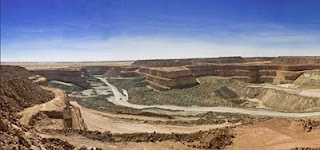
Uranium mine in Niger
“The people here don’t know about radioactivity, but there are still many people who do not drink the water in Arlit...They say they are sick when they drink it,” says Almoustapha Alhacen, who lives in a town built for nuclear mine workers in northern Niger, a parched desert area.
global supply lines for uranium

This is a glimpse of life at the other end of the uranium fuel supply route (right: where uranium originates and goes) for a plant like Fukushima.

Can nuclear-power ever be sustainable? Not unless it cleans up its act. It is just as criminally irresponsible in sourcing its raw materials as the fossil fuel industry. Read on...

Hell on earth


In a harsh environment in sub-Saharan Niger, French nuclear company AREVA has created a hell on earth amongst its indigenous population.

Here you would find great clouds of dust, caused by detonations and drilling in the mines, which cloud the air at the end of the day. Mountains of radioactive industrial waste and sludge sit in huge piles, exposed to the open air.

And the shifting of millions of tonnes of earth and rock have contaminated the groundwater source, which is quickly disappearing due to industrial overuse.

AREVA's majority shareholder is the French government. In 2009 Niger produced nearly 7% of the world’s uranium and is one of the four largest suppliers of uranium to the European Union. Northern Niger holds the world’s third-largest uranium deposit.

Foreign investors from China, Australia, South Africa, America, and Canada have flocked to the landlocked Saharan state recently. At least 139 research and exploitation permits have been sold in less than a year without any transparency or prior public discourse, says a local NGO.

Evidence has emerged that the permits corruptly enriched Mr. Tandja, the ousted president, and devastated the Touareg population.

Abject poverty


A landlocked-Saharan place in West Africa, Niger is a country where 60 percent of people are facing severe food shortages; it has the lowest human development index on the planet, despite the fact that Areva makes huge profits from its mining operations.

Arid desert, scarce arable land and intense poverty are hugely problematic - unemployment, minimal education, illiteracy, poor infrastructure and political instability are rife.

Mountains of tailings left from the uranium mine
AREVA established its mining efforts in northern Niger 40 years ago, creating what should have been an economic rescue for a depressed nation.

Yet, AREVA’s operations have been largely destructive, claims Greenpeace, whose experts visited the area at the beginning of last year together with experts from French independent laboratory CRIIRAD.

In 40 years of operation, a total of 270 billion litres of underground prehistoric water have been used, contaminating the water and draining the aquifer, which will take millions of years to be replaced. There have been consequent droughts and the death of farmers' cattle. No compensation has been provided.

Health and environmental findings


In collaboration with the French independent laboratory CRIIRAD and the Nigerien NGO network ROTAB Greenpeace have found the following:

• The concentration of uranium and other radioactive materials in a soil sample collected near the underground mine was found to be about 100 times higher than normal levels in the region, and higher than the international exemption limits.

• On the streets of Akokan, radiation dose rate levels were found to be up to almost 500 times higher than normal background levels. A person spending less than one hour a day at that location would be exposed to more than the maximum allowable annual dose.

• Although AREVA claims no contaminated material gets out of the mines anymore, Greenpeace found several pieces of radioactive scrap metal on the local market in Arlit, with radiation dose rate reaching up to 50 times more than the normal background levels. Locals use these materials to build their homes.

• In four of the five water samples that Greenpeace collected in the Arlit region, the uranium concentration was above the WHO recommended limit for drinking water. Historical data indicate a gradual increase in uranium concentration over the last 20 years, which can point at the influence of the mining operation.

• A radon measurement performed at the police station in Akokan showed a radon concentration in the air three to seven times higher than normal levels in the area.

• Fine (dust) fractions showed an increased radioactivity concentration reaching two or three times higher than the coarse fraction. Increased levels of uranium and decay products in small particles that easily spread as dust would point at increased risks of inhalation or ingestion.

• Death rates due to respiratory infection in the town of Arlit (16.19%) are twice that of the national average (8.54%).

AREVA, with its attempt to create a nuclear renaissance, brings to these communities the threat of losing the most basic elements necessary for life - poisoning their air, water and earth.
“We worked with our bare hands! ...The mining company never informed us about the risks... we relied on what God decided.” - Salifou Adinfo, a former driller for AREVA, Arlit, Niger, November 2009.
Women wash their clothes at a tap so generously provided by Areva
“We are already radiated. We are no more useful. We can only watch.” SOMAIR laundry worker Gigo Zaki, seen here at a tap so generously provided by AREVA.

“AREVA is coming to our country and making money, but we are the ones suffering and this must be addressed,” - Fatima Daoui.


Corruption and profits while locals are in poverty


Government spokesman Mahaman Laouali Dandah says there is ample evidence that corruption is an important part of doing business in Niger Production at COMINAK, located a few kilometres from the town of Akokan, commenced in 1978.

Unlike SOMAIR, COMINAK is an underground mine.

With a depth of 250 metres and over 250 kilometres of galleries, COMINAK is the largest underground mine in the world.

On average, the mines produce over 3,000 tonnes of uranium and net €200 million in sales each year.

A third mine, Imouraren, is planned to start production in 2013 and is projected to be the largest uranium mine in Africa and the second largest in the world, with an annual production capacity of 5,000 tonnes of uranium.

AREVA’s revenues for 2008 (most recently published) were €13.1 billion, with a profit of €589 million.

SOMAIR generated €161.7 million of that revenue by producing 1,743 metric tonnes of uranium.

COMINAK earned sales of €100.6 million for its supply of 1,289 metric tonnes of uranium concentrate.

Nuclear power sustainable? Don't make me laugh.

Wednesday, August 06, 2008

French nuclear cock-ups: not coming soon to a reactor near you

The collapse of the EdF takeover of British Energy is the right decision for the wrong reasons.

The private shareholders in British Energy, Invesco and M&G Investments who own 22%, greedily holding out for a higher share price, have shocked the pro-nuclear, pro-business BERR with their decision to reject EdF's £12 billion offer. The French state-owned EdF wasn't too pleased either. That sort of thing wouldn't happen in France.

The government sold all but 35% of its stake in British Energy last year. They probably rue the day now because they would love to have the £4bn in the Treasury coffers and the nuclear newbuild to go ahead. Conservative MP Peter Luff said the collapse was not necessarily a bad thing - if it had gone through, EdF would have "owned over a quarter of all electricity generation in the UK and the competition effect would've been very serious." I quite agree.

Business Secretary John Hutton has put a brave face on it: "We thought it was a good deal and were ready to accept." Like a pathetic salesman he tried to tout the land still available for anybody who wants to build a new nuclear power station: "Our commitment to nuclear power is clear.... BE still has potential sites and sites are available from the Nuclear Decommissioning Authority."

Meanwhile, British Energy is not exactly performing well. It announced in July that its Heysham and Hartlepool reactors, currently off-line due to faults, will now cost at least twice as much to repair - over £100m. Its chairman confessed that "output from our nuclear stations last year was disappointing." No kidding. And they say windfarms don't deliver.

French nuclear headaches to be exported to Britain

For those who think that new nuclear power is not a solution to either high energy prices, energy security or climate change, the EdF/BE news was positive, especially in view of the scandal rocking the French nuclear industry at the moment.

On July 7, Areva accidentally poured at least 18 cubic meters of liquid containing at least 75 kilograms of uranium onto the ground and into the river at the Tricastin nuclear site, prompting local authorities to launch an official enquiry and local people to be banned from drinking their own water. Environment Minister Jean-Louis Borloo has ordered an overhaul of France's nuclear supervision as well as groundwater checks around all nuclear plants.

President Sarkozy is keen to export French nuclear know-how around the world. Since his election, he has signed cooperation agreements on civilian nuclear energy with Algeria, America, Jordan, Libya, Morocco, Tunisia, and the United Arab Emirates, among others.

France has 59 reactors supplying 80% of its electricity. The Tricastin site is a major part of the French nuclear industry, with over 5,000 employees and many sub-contracting companies. It includes the military research facility of Pierrelatte, the EDF power plant, a factory for converting natural uranium (Comurhex), and a uranium enrichment factory (Eurodiff). The latter two are subsidiaries of Areva, which wants to build new nuclear power stations in Britain.

In June a consortium led by Areva won a 17 year contract to clean up Sellafield, worth at least £50m a year. Malcolm Wicks said in a parliamentary answer just before the summer recess that the contract specified no limit on the risk to the taxpayer in the event of an accident like that at Tricastin.

The Nuclear Decommissioning Authority (NDA) has given Areva indemnity if there were to be an incident, provided that it is insured against the first £140m of the damage costs.

NDA slammed for management failure as clean-up costs rise

We could have funded two London Olympics just from the rises in the estimated costs of cleaning up our nuclear waste over the past two years. The estimate is now around £73bn, according to the Nuclear Decommissioning Authority (NDA).

An audit of the NDA, published also in July, says there are "inherent risks" in the way the body operates, pointing out that half of its income is dependent on unreliable sources such as fuel reprocessing at Sellafield's Thorp plant (closed since a leak was discovered in 2005). It also highlights management and accounting failures; simple things like not taking notes at minutes has led to budgetary confusion.

The audit is by the government's Select Committee on Business and Enterprise. The NDA is funded by Government funding and from commercial income. The commercial slice is "volatile and over time will decline as sites progressively close and move into the decommissioning phase," says the report. "The grant-in-aid portion of the NDA's income already represents a very sizeable proportion of BERR's annual budget - 42% of the original total Departmental Expenditure Limit (DEL) for the 2007-08 financial year."

The nuclear dilemma

It is said that your position on nuclear power comes down in part to your response to this dilemma: which is worse, the local damage caused by nuclear leaks and processed fuel lying around for 4.5 billion years (which Is the half life of depleted uranium), or the global catastrophes caused by runaway climate change?

However Britain doesn’t need to build major new power stations to keep the lights on and maintain security, according to a report just released by independent consultants Pöyry.

It says that if the UK government can meet its EU renewable energy targets and its own action plan to reduce demand through energy efficiency, then major new power stations (either coal, nuclear or gas) would not be needed to meet the country's electricity requirements up to at least 2020.