A European Commission report released in draft form yesterday says that there are many potentially huge and expensive problems with the safety of the majority of nuclear plants operating in the European Union.
"On the basis of the stress test results practically all [nuclear plants] need to undergo safety improvements," says the leaked draft. "Hundreds of technical upgrade measures have already been identified."
This survey was produced in response to the Fukushima accident in Japan last year.
It puts the cost of the safety upgrades at a total of between €10 and €25 billion, or €30 million to €200 million for each reactor.
134 nuclear reactors are in operation in 14 EU countries, of which 111, at 47 plants, have over 100,000 people living within a radius of 30km.
Most worryingly, the report finds that four reactors, located in two different nations, have less than one hour available to restore safety functions if electrical power is lost.
At the other extreme, four countries operate additional safety systems fully independent from the normal safety measures and located in areas well-protected against external events. A fifth nation is considering that option.
The draft report notes that two member states have still not provided information, but does not identify them.
The UK government commissioned its own report on existing British reactors in the wake of the Fukushima disaster, which gave them the all clear.
However the EU report points out that most UK reactors do not have an alternative control room that could be used in the event that the main one became unsafe.
A DECC spokesperson commented that there was no evidence that British nuclear reactors were unsafe, adding that "the Government is committed to the principle of continuous improvement".
The final version of the European report is to be published later this month, and the Commission will make its recommendations shortly afterwards, including proposing laws on insurance and liability to "improve the situation of potential victims in the event of a nuclear accident".
Environmental campaigners pointed out that, although it is comprehensive and devastating, the report misses out further risks in crucial areas, such as ageing technology, terrorist attacks or human error.
"If this exercise was serious, the Commission should be recommending the closure of unsafe or ageing reactors," said Rebecca Harms, co-president of the Greens/European Free Alliance at the European Parliament.
Showing posts with label Fukushima. Show all posts
Showing posts with label Fukushima. Show all posts
Wednesday, October 03, 2012


Tuesday, September 04, 2012
Japanese consortium to invest £962 million in offshore wind power
 |
| This new wind turbine design could soon be seen off the coast of Japan. It is up to 3 times more efficient than conventional designs. |
As Japan abandons nuclear power, Toshiba, Hitachi and other partners have set up a consortium to invest £962 million in offshore wind power.
Toshiba Corp, Hitachi Zosen Corp, JFE Steel Corp, Sumitomo Electric Industries Ltd, Toa Corp and Toyo Construction Co. Ltd. together plan to invest 120 billion yen (£962 million) over ten years.
Japan faces a bill of at least 50 trillion yen (£401 billion) to install sufficient renewable energy infrastructure by 2030 if it decides to completely phase out nuclear power, the Japanese government estimated on Tuesday.
Potential sites for the wind farms are off the coast of the Kyushu region in southern Japan, where they could generate around 300 MW.
Pilot installations with a capacity of 7.5 MW will be constructed first, by 2016. The rest will be erected over the remaining six years.
The firms will raise the investment funds by setting up a special-purpose company and project financing.
Japan hopes to begin building commercial offshore wind farms, copying countries in Europe, especially Britain, following the post-Fukushima government decision to reduce reliance on nuclear power in favour of natural gas and renewable energy.
Its environment ministry has estimated the country can eventually build 1,600 gigawatts of offshore wind power capacity.
Currently, Japanese utilities are obliged to buy solar and wind powered electricity from generators at an especially generous feed-in tariff: 23.1 yen per kilowatt-hour for 20 years, almost double the market rate for industrial users.
New design
Japan's geography doesn't lend itself to onshore wind farms.There is speculation that the new wind farms may use exciting new wind turbine designs, such as the one illustrated above, which has been undergoing field tests at Kyushu University.
Its designers estimate that it could generate two or even three times more energy than existing turbines. They call it a ‘wind lens’, and it aims to solve two problems faced by existing wind turbines: noise and inefficiency.
Their design includes an inward curving green around the perimeter of the turbine blafes, which increases by a factor of up to three the speed of the air blowing through the blade zones. It also serves as a safety improvement and reduces noise levels.
The team at the University has also designed a hexagonal-shaped base for the turbines, that is comparatively cheap but still strong enough to endure marine conditions. This design makes it easier to link turbines together and enlarge the wind farm.
Currently, wind power accounts for less than 1% of all energy produced in Japan.
Monday, March 12, 2012
Protestors mark Fukushima anniversary by blockade of EDF nuclear site
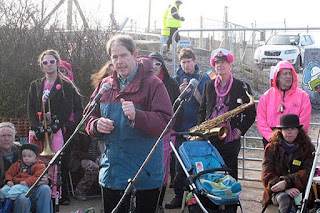 |
| Jonathan Porritt addressing the crowd at this weekend's Stop Hinkley anti-nuclear rally slammed the LibDems for their U-turn on nuclear newbuild. |
Following a demonstration by over 1000 people at Hinkley Point C on the Severn estuary in Somerset, which veteran campaigner Martyn Lowe described as the largest anti-nuclear action in this country since protests against the Torness power station in 1979, 100 people blocked the main entrance to the site, stopping all traffic from entering or leaving for over 24 hours.
The peaceful demonstration and blockade were organised by Stop New Nuclear, a coalition of anti-nuclear groups which includes the Somerset-based Stop Hinkley. Its spokesperson, Camilla Berens, called this a “double record" for nuclear protest in this country.
The blockade formally ended at 2pm on Sunday when Japanese Buddhist monks performed a prayer for the victims of the tsunami that precipitated the Fukushima disaster and urged the UK government to take a more enlightened view on energy provision.
Martyn Lowe added, “It is clear that the tide is turning against the government’s push for a ‘nuclear renaissance’. The British public is waking up to the fact that ‘new nuclear’ is dangerous, expensive and completely unnecessary.”
Among those who addressed the crowd were Green MP Caroline Lucas, environmental campaigner Jonathon Porritt, and Makoto and Akiko Ishiyama, a Japanese couple who were evacuated from the area around Fukushima, Japan.
“The government says it is now safe and they want local people to come back, but it’s a total lie,” Makoto Ishiyama told the crowd. “There is still a risk, it’s not safe and the accident isn’t over.”
Jonathon Porritt, who is launching a new book which provides a 'warts and all' overview of nuclear giant EDF Energy’s influence on Whitehall and Westminster, told the assembly that new nuclear power stations like Hinkley C could never operate without massive public subsidies towards their costs, including insurance and radioactive waste management.
Such potential subsidies are currently the subject of a legal complaint to the European Commission.
Jonathon Porritt said he found it “unbelievable" that nuclear energy was being put forward as a solution to climate change due to the expense and the timescale, as well as EDF's recent record in constructing plants which have been over budget and over schedule, and he called on the government reconsider its energy strategy.
He added: “It is clear we can do everything we need to do without nuclear power. The whole thing is being fixed to suit the nuclear industry. In Germany, they are working towards a nuclear-free future that affordable and realistic. Why is it we don’t think Germany is a really good model to follow?”
Porritt slammed the Liberal Democrats as they gathered for their annual conference. Referring to the U-turn on their previous anti-nuclear policy, he said: “It seems there is no betrayal to which they will not stoop to keep in power.”
Green Party MP, Caroline Lucas, echoed Porritt’s call for an end to nuclear power in the UK. She added, “The £60 billion the government wants invested in new nuclear is £60billion that should be channelled into developing renewable energy sources and making them fit for purpose in the 21st century”.
Stop Hinkley spokesman Crispin Aubrey said: “This has been one of the biggest protests ever held at Hinkley Point and shows the strength of feeling against EDF’s plans. The new reactors would be a constant drain on public funds and we don’t need nuclear power to keep the lights on.”
Plans for new nuclear
Currently, EDF has permission to carry out “preparatory works” on the 400 acre Hinkley C site but does not yet have safety approval for their new nuclear plant or planning consent to build the twin reactors.The Office for Nuclear Regulation, which overlooks the safety aspects of nuclear power in this country, has granted an interim Design Acceptance Confirmation (DAC) and interim Statement of Design Acceptability (SoDA) to two designs for new reactors in the UK: Westinghouse's AP100 and EDF / AREVA’s EPR (European Pressurised Reactor). All the reports supporting this are here.
However, Westinghouse has not found a customer in this country, leaving EDF / AREVA's design as the only one being progressed at the moment; the first instance of this design is intended to be Hinkley Point C.
These companies are this year to provide the ONR with further information in an attempt to achieve final Design Acceptance Confirmation (DAC) and a Statement of Design Acceptability (SoDA).
The ONR are says that EDF has missed deadlines due to "their resources being deployed on assessment of the impact of the Fukushima event".
The Environment Agency last month granted an environmental permit to EDF Energy's and Centrica's joint venture company, NNB Generation Company Limited (NNB GenCo), which will be constructing the power station, relating to discharges of waste water generated from site preparation and construction activities at the Hinkley site.
Clean-up costs
Luckily, no one has yet died of radiation poisoning after the Fukushima accident, but the Japan Centre for Economic Research has estimated the entire cost of compensation and decommissioning of the six Fukushima reactors at between £330bn and £415bn.The Japanese government has already agreed to provide nuclear operator TEPCO £9bn and the company has asked for an additional £7bn. This does not include government funds used to underwrite the cost of compensating the victims of the disaster.
This puts in perspective the public liability of just £1 billion accepted by EDF for any accident at one of their new nuclear power stations. The UK Government has agreed that it would foot the bill for any amount over this, were the worst to happen.
Back at Hinkley, Crispin Aubrey said that the weekend's action followed an occupation by protesters at the end of February of a barn in the middle of the building site for Hinkley C.
This barn was occupied by the group for two weeks. Aubrey said that EDF obtained an injunction to remove the protesters but tried to extend the ban to any action by Stop New Nuclear.
"This was opposed successfully in the High Court by the organisation and by Stop Hinkley, on the basis of the right to free speech," he said.
He added that EDF still lacked the finance to proceed and there were strong doubts that the power station would ever be completed.
Friday, September 09, 2011
It's six months since the Fukushima nuclear disaster and Japan is charting a renewable energy future

This Sunday will be the six month anniversary of the Fukushima disaster, which is now emerging as being far worse than officials originally admitted. But in many parts of the world, including the UK, it has already slipped into distant memory, even as we remember the terrible events of 9/11/2001.
While the mainstream media has moved on - even in Tokyo itself - and there has been little reportage of developments in the area around the disaster, it is apparent that secrecy and cover-up continues to be endemic in the industry, and anger is widespread among survivors of the March 11 quake and tsunami disaster.
Almost six months after the catastrophe, tens of thousands of people still live in crowded shelters and temporary homes, many mourning loved ones, fearful of radiation, lacking information they can trust, and without jobs, homes or a clear idea about their future. 100,000 Fukushima Prefecture residents are still not able to return to their homes.
Some locations near the nuclear power plant are estimated to be contaminated with accumulated radiation doses of over 500 millisieverts a year, meaning return for residents is not likely to be imminent.
Shinji Sakuma, a farmer whose cows were slaughtered due to fears of radioactive contamination, is furious with the politicians he sees as "distant and disconnected from the reality of the disaster zone".
There is a 20-30km "stay indoors" zone around the damaged Fukushima nuclear plant, and schoolchildren are not allowed to play outside.
Within 50km, in a school in Koriyama, students are monitoring levels of radiation in the grounds, and finding pockets of high radiation where contaminated surface soil on the school premises was removed and buried.
Readings in the wider affected area of the level of radioactivity in the soil and sea show that three times as much iodine-131 and cesium-137 - 4,720 terabecquerels - was emitted than that formerly estimated by Tokyo Electric Power Company (TEPCO), the plant operator.
Cesium-137 has a half-life of 30 years, meaning that its radioactive emissions will decline only by half after 30 years and will affect the environment over several generations.
A soil expert from Tokyo university estimates that cancer or illness from Fukushima radiation will begin to show in 5-10 years. “This is a disaster affecting all residents of Japan”, he says.
A group of researchers from the Japan Atomic Energy Agency, Kyoto University and other institutes say that a total of 15,000 terabecquerels of radioactive substances is estimated to have been released from the Daiichi nuclear plant into the sea, affecting fish and other sea-life.
Moreover the Japanese education ministry has released the first comprehensive survey of soil contamination within a 62-mile radius, showing that more than 30 locations spread over a wide area have been contaminated with cesium-137.
The survey of 2,200 locations - conducted in June and July - found that 33 had cesium-137 in excess of 1.48 million becquerels per square meter, the level set by the Soviet Union for forced resettlement after the 1986 Chernobyl disaster, Japanese authorities said.
This prompted Mamoru Fujiwara, assistant professor of nuclear physics at Osaka University, to say that residents from these locations "need to be relocated permanently", but no decision has yet been taken.
Meanwhile, technicians are still struggling to bring the crippled reactors to a state of cold shutdown by January.
Japan's clean energy future
In the light of all this, Japan is likely to have no nuclear plants in the future, Japanese Industry Minister Yoshio Hachiro said this week, basing his statement on Japan's new Prime Minister Yoshihiko Noda's policy of not building new nuclear power plants and decommissioning old ones.
Noda has just replaced Naoto Kan, who stepped down following criticism of the way he handled the aftermath of the March 11 earthquake, tsunami and nuclear disaster.
"Public opinion is generally united in reducing (nuclear plants), instead of increasing them," Noda said.
Prior to the Fukushima disaster, Japan had a target of meeting half of its electricity needs from nuclear power by 2030, up from one third. Only 12 of Japan's 54 commercial power plant reactors are now in operation.
Just before resigning, Kan also advocated a zero-nuclear future for Japan, and passed a feed-in tariff creating incentives for large-scale renewable energy projects. "When I think of safety not being outweighed by risk, the answer is not to rely on nuclear," he said in an interview a week ago.
Renewables, including hydropower, currently supply about 10 percent of Japan's energy mix but this will now rapidly increase.
With the indomitable spirit that allowed the country to rebuild itself after its defeat and the nuclear horror of the Second World War, the country is set to turn its worst crisis since Hiroshima and Nagasaki into an opportunity.
Its new foreign minister Koichiro Gemba, whose own constituency is Fukushima, has announced a national drive for clean energy that will focus not just on satisfying national demand but on exports to help fuel the country's economic recovery.
"We have bullet trains and water. From now on, there will be environmental technology," said Gemba on Monday. He said these would include state-of-the-art solar batteries.
"I'm sure it will be Japan's strong field. We will promote it through economic diplomacy," he said.
It's no immediate consolation for those innocent victims of Fukushima's own Ground Zero, but it should serve as a lesson and inspiration for the rest of the world.
Friday, July 01, 2011
Leaked post-Fukushima emails reveal UK Government's contempt for democracy
Unlike the immediate response by the governments in Germany and other countries to the Fukushima nuclear disaster on March 11 - to think about protecting their citizens - that of the UK Government was to think about protecting its plans for nuclear expansion.
Such is the only conclusion possible after reading the leaked e-mails obtained by the Guardian newspaper detailing correspondence between officials in the Department for Energy and Climate Change and employees of EDF, Westinghouse and Areva.
The e-mails, published in full on the newspaper's website, show an astonishing level of collusion between industry and the government.
They raise many questions, foremost of which is: why is it that these powerful officials are so determined to see more nuclear power built in this country that they would rather engage in a PR exercise than practice caution, or switch policies to alternatives that will do the job of keeping the lights on just as effectively without so much risk?
There is no doubt that such alternatives exist. Germany, the most energy-hungry, industrial nation in Europe, is committed to a nuclear-free path in the wake of the disaster, with a fraction of the natural resources for renewable energy that Britain has around its shores.
But the British government has, ever since around 2005, been hand in glove with the nuclear industry.
Immediately after the Fukushima disaster, I was bombarded with e-mails by representatives of the industry assuring me that the disaster was minor, that radiation would be contained easily, that there would not be a meltdown, there was no relation to Chernobyl or Three Mile Island, etc.
As the situation gradually worsened and its true reality came apparent, these e-mails changed their tone, instead trying to reassure me that there would be no comparison between what happened in Japan and what could happen in other nuclear-powered countries in the world.
Well, there are comparisons. And one of them is that before the disaster in Japan the nuclear industry and the government there had been accused of engaging in far too much secrecy and cover-up.
The same is now revealed to be true in this country. What these e-mails show is that we just simply can't trust the government and the nuclear industry.
After the disaster, we even had prominent environmentalists like Mark Lynas and George Monbiot doing the Government's job for them, to tell us how dumb we would be to go off the nuclear path.
When Italy voted overwhelmingly not to restart its nuclear programme, Mark Lynas wrote an article saying how stupid its citizens must be.
The truth is, Italy is an earthquake prone country, and the Fukushima disaster acted as a wake-up call to remind the public of the dangers of nuclear power, which they had forgotten in the years since they had originally abandoned their nuclear programme.
Lynas' article reveals an absolute contempt for democracy. How arrogant of him to imagine that he knows better than 95% of the Italian public!
It is this contempt and condescension towards the public which characterises the British Government's attitude as well.
The collusion revealed by the leaked e-mails reveals that the nuclear industry and the Government are far too close to each other.
It creates a conflict of interest which leads them to care more about the sanctity of their programme than what the British public really thinks.
This has nothing to do with democracy and accountability and everything to do with propaganda and steamrollering policies over our heads.
They do not deserve our trust and confidence on this matter.
Such is the only conclusion possible after reading the leaked e-mails obtained by the Guardian newspaper detailing correspondence between officials in the Department for Energy and Climate Change and employees of EDF, Westinghouse and Areva.
The e-mails, published in full on the newspaper's website, show an astonishing level of collusion between industry and the government.
They raise many questions, foremost of which is: why is it that these powerful officials are so determined to see more nuclear power built in this country that they would rather engage in a PR exercise than practice caution, or switch policies to alternatives that will do the job of keeping the lights on just as effectively without so much risk?
There is no doubt that such alternatives exist. Germany, the most energy-hungry, industrial nation in Europe, is committed to a nuclear-free path in the wake of the disaster, with a fraction of the natural resources for renewable energy that Britain has around its shores.
But the British government has, ever since around 2005, been hand in glove with the nuclear industry.
Immediately after the Fukushima disaster, I was bombarded with e-mails by representatives of the industry assuring me that the disaster was minor, that radiation would be contained easily, that there would not be a meltdown, there was no relation to Chernobyl or Three Mile Island, etc.
As the situation gradually worsened and its true reality came apparent, these e-mails changed their tone, instead trying to reassure me that there would be no comparison between what happened in Japan and what could happen in other nuclear-powered countries in the world.
Well, there are comparisons. And one of them is that before the disaster in Japan the nuclear industry and the government there had been accused of engaging in far too much secrecy and cover-up.
The same is now revealed to be true in this country. What these e-mails show is that we just simply can't trust the government and the nuclear industry.
After the disaster, we even had prominent environmentalists like Mark Lynas and George Monbiot doing the Government's job for them, to tell us how dumb we would be to go off the nuclear path.
When Italy voted overwhelmingly not to restart its nuclear programme, Mark Lynas wrote an article saying how stupid its citizens must be.
The truth is, Italy is an earthquake prone country, and the Fukushima disaster acted as a wake-up call to remind the public of the dangers of nuclear power, which they had forgotten in the years since they had originally abandoned their nuclear programme.
Lynas' article reveals an absolute contempt for democracy. How arrogant of him to imagine that he knows better than 95% of the Italian public!
It is this contempt and condescension towards the public which characterises the British Government's attitude as well.
The collusion revealed by the leaked e-mails reveals that the nuclear industry and the Government are far too close to each other.
It creates a conflict of interest which leads them to care more about the sanctity of their programme than what the British public really thinks.
This has nothing to do with democracy and accountability and everything to do with propaganda and steamrollering policies over our heads.
They do not deserve our trust and confidence on this matter.
Tuesday, April 12, 2011
Nuclear power is not the only energy fruit
As the level of the Fukushima accident is raised to the most severe (the "experts" said this would not happen at the start of the crisis), the truth begins to emerge about the radiation danger & awful treatment of workers at the nuclear plant in this excellent investigative piece in the New York Times.
Take this for example:
"Current and former workers said, radiation levels would be so high that workers would take turns approaching a valve just to open it, turning it for a few seconds before a supervisor with a stopwatch ordered the job to be handed off to the next person. Similar work would be required at the Fukushima Daiichi plant now, where the three reactors in operation at the time of the earthquake shut down automatically, workers say."
If radiation exposure was safe, as some are even now trying to claim, would this be happening?
The recent spat between George Monbiot and Helen Caldicott about the dangers of radiation is at a relatively trivial level: just because nuclear power has yielded fewer deaths than coal it does not follow that we should support nuclear.
If we burned live human bodies in incinerators as a biomass fuel - for the sake of argument - we could claim that coal was safer than this. It wouldn't entitle us to say that we should burn coal for power if there are safer alternatives!
The real question is: if a Fukushima or Chernobyl incident - however awful - is a local one, compared to global warming, which is by definition global in its effects, does this justify using nuclear power?
In other words is it right to accept a smaller harm to stave off a larger one?
The reason why this seems difficult to evaluate is the relative maturity of other, renewable, technologies, and the mental roadblock the political majority seems to accept over the true potential of energy efficiency.
I've tried to use my blog to illustrate some examples of these recently - there are many more.
At a climate change networking event last night I talked to Peter Davies, head of the Climate Change Commission for Wales. He pointed out that in 1992 the first wind farms appeared on Welsh hills. Now, twenty years later, the Chinese are churning out hundreds of turbines a week ten times their size.
It's taken 20 years for the technology to reach mass, mainstream, application. If there had been a real sense (wartime) of urgency, this time could have been halved.
Marine current turbines and other marine technologies, anaerobic digestion, short-rotation coppice biomass, algal biofuel production, dye-sensitised PV, solar thermal electric plants, mass rollout of energy efficient cars and products, hydrogen storage, phase change materials, smart meters and the smart grid, eco-retrofitting buildings, solar water heating, heat pumps, offshore wind and so on - the list is developing all the time - collectively can produce/save all the energy we need. Several studies have illustrated the appropriate scenarios.
Currently, official thinking says this can't happen till around 2060 - too late to save us from a minimum 3 degree rise without nuclear power and carbon capture and storage.
My belief - and I am far from being alone - is that both the new generation of nuclear power stations and CCS are currently technically and economically unproven at a mass scale - they're about at the same level of development as solar thermal electric plants and marine current turbines respectively.
If the R&D money that is/would be going into these technologies instead were to be channeled into the safer renewable technologies and into energy efficiency, we could accelerate development and bring forward the 2060 date by twenty years.
This world would be far safer - no oil and gas disasters, no coal and uranium mines, no more Fukushimas - and create far more employment - not to mention it could begin to reduce atmospheric concentrations of greenhouse gases.
Germany, Europe's most successful economy, has just announced it is going to do just this. Why can't every other nation on earth?
Take this for example:
"Current and former workers said, radiation levels would be so high that workers would take turns approaching a valve just to open it, turning it for a few seconds before a supervisor with a stopwatch ordered the job to be handed off to the next person. Similar work would be required at the Fukushima Daiichi plant now, where the three reactors in operation at the time of the earthquake shut down automatically, workers say."
If radiation exposure was safe, as some are even now trying to claim, would this be happening?
The recent spat between George Monbiot and Helen Caldicott about the dangers of radiation is at a relatively trivial level: just because nuclear power has yielded fewer deaths than coal it does not follow that we should support nuclear.
If we burned live human bodies in incinerators as a biomass fuel - for the sake of argument - we could claim that coal was safer than this. It wouldn't entitle us to say that we should burn coal for power if there are safer alternatives!
The real question is: if a Fukushima or Chernobyl incident - however awful - is a local one, compared to global warming, which is by definition global in its effects, does this justify using nuclear power?
In other words is it right to accept a smaller harm to stave off a larger one?
The reason why this seems difficult to evaluate is the relative maturity of other, renewable, technologies, and the mental roadblock the political majority seems to accept over the true potential of energy efficiency.
I've tried to use my blog to illustrate some examples of these recently - there are many more.
At a climate change networking event last night I talked to Peter Davies, head of the Climate Change Commission for Wales. He pointed out that in 1992 the first wind farms appeared on Welsh hills. Now, twenty years later, the Chinese are churning out hundreds of turbines a week ten times their size.
It's taken 20 years for the technology to reach mass, mainstream, application. If there had been a real sense (wartime) of urgency, this time could have been halved.
Marine current turbines and other marine technologies, anaerobic digestion, short-rotation coppice biomass, algal biofuel production, dye-sensitised PV, solar thermal electric plants, mass rollout of energy efficient cars and products, hydrogen storage, phase change materials, smart meters and the smart grid, eco-retrofitting buildings, solar water heating, heat pumps, offshore wind and so on - the list is developing all the time - collectively can produce/save all the energy we need. Several studies have illustrated the appropriate scenarios.
Currently, official thinking says this can't happen till around 2060 - too late to save us from a minimum 3 degree rise without nuclear power and carbon capture and storage.
My belief - and I am far from being alone - is that both the new generation of nuclear power stations and CCS are currently technically and economically unproven at a mass scale - they're about at the same level of development as solar thermal electric plants and marine current turbines respectively.
If the R&D money that is/would be going into these technologies instead were to be channeled into the safer renewable technologies and into energy efficiency, we could accelerate development and bring forward the 2060 date by twenty years.
This world would be far safer - no oil and gas disasters, no coal and uranium mines, no more Fukushimas - and create far more employment - not to mention it could begin to reduce atmospheric concentrations of greenhouse gases.
Germany, Europe's most successful economy, has just announced it is going to do just this. Why can't every other nation on earth?
Tuesday, March 15, 2011
How we can do without the nuclear renaissance

Japan, the only country to have experienced not one but two atomic weapon blasts which devastated two major cities, has now suffered what is probably going to become the third worst civil nuclear disaster in the world.
Many voices are lining up to say that this is the nail in the coffin for nuclear power. There have been anti-nuclear demonstrations in Germany and Greenpeace is calling for the phasing out of all existing power stations. They say nuclear power is simply too dangerous.
Those on the pro-nuclear side have in the last few days been consistently underestimating the way that events have actually unfolded. My inbox has been filled with nuclear pundits offering their prognoses which have been proved invariably wrong.
Nevertheless even some environmentalists such as Mark Lynas are arguing that we still need nuclear power and that it's worth the risk because the alternative - runaway climate change - is unavoidable without it.
Nuclear or renewable future?
Japan imports 90% of its oil and has used nuclear power to help fuel its economic success with a measure of energy independence. Up to now, the Japanese public have largely trusted the authorities.
The terrible consequences of the tsunami, the attendant economic collapse, the lack of services, electricity and food, and the terrifying prospect of an invisible enemy in the air or in the food around them has shattered this trust.
Hideki Ban, a Japanese antinuclear movement activist and leader of the Citizen's Nuclear Information Center (CNIC), commenting on the disaster, said at the weekend in an interview with an Italian newspaper "By an accident of this magnitude it is very likely (and is also our hope) that the close dependence of Japan on atomic energy will come to an end."
Yet would Japan be able to power all of its needs with renewable energy? And if it can, how long will it take to build the generation capacity? It would not do so with solar photovoltaic and wind power alone. However, it is an island and there is no shortage of marine energy or geothermal energy, whose effect could be magnified by the use of combined heat and power and heat pumps, or of food and crop waste for anaerobic digestion.
All new buildings to replace those lost could be constructed to become zero energy using the Passivhaus standard. If Japan can achieve energy security using renewables, then certainly so can the rest of the world.
And if it can't, then presumably the rest of the world cannot successfully tackle climate change either.
Mark Lynas argues that if we abandon nuclear power then in the immediate term coal will take up the slack. Without any proven (at scale) carbon capture and storage, this could well accelerate global warming.
The renewable vision
But it doesn't have to be like this. Large-scale deployment of anaerobic digestion, solar thermal power plants, marine energy and wind power linked by high-voltage supergrids can power economic revival.

The map right shows where it has been calculated that six large solar thermal plants situated in the hottest spots on the planet could power the whole world with such supergrids.


The European Desertec project is one such example of a project that could revolutionise North Africa and Europe and the Middle East.
The far east could have just such a super grid.
Is it feasible? Is it affordable?
What really brought nuclear power to a halt after the Three Mile Island disaster in America was the refusal of insurance companies to foot the bill for new construction given the potential damage to them were there to be another accident.
The same reaction is extremely likely again, in many countries of the world.
All renewable energy technologies carry far less inherent risk but more up front costs. If they are more expensive in capital terms, they are less expensive in terms of their running costs, security requirements and insurance requirements.
What the fulfillment of this dream requires is the political will and about the same amount of capital as it will take to build nuclear power stations and maintain their security and insure them against disaster in the future.
The health risk
Nuclear power is inherently dangerous. The whole supply chain including mining in countries like Niger promotes environmental desolation and conflict.
Mark Lynas argues that there have only been 50 deaths as a result of the Chernobyl disaster and this is an acceptable price.
But that is not the whole picture. There has been a great increase in thyroid cancers as a result of the ingestion of caesium-137, which can remain in the environment and food chain for 30 years.

Several of my friends around where I live have for many years received visitors from the Chernobyl area - children badly affected by radiation with terrible deformities. They come for holidays. It is awful to see them.
According to the World Health Organisation, an expert group from the US National Academy of Sciences has concluded that "there may be up to 4,000 additional cancer deaths among the three highest exposed groups over their lifetime". These groups contain 630,000 people.
Those who argue that all of this is an acceptable price to pay to tackle climate change have not seen the suffering themselves close to hand. If it was happening to them or their family, friends and neighbours they would not be so gung ho about it.
It's time to say no to the nuclear lobby. We don't trust you any more.
Monday, March 14, 2011
Fukushima accident triggers reappraisal of nuclear power
The unprecedented Fukushima nuclear power accident is the worst since Chernobyl and is causing a significant reappraisal of plans to develop nuclear power everywhere in the world.
The latest news is that a third reactor has lost its cooling system. A second explosion has injured 11 people, one of them seriously.
The authorities have so far categorised it as a level 4 event on the International Nuclear and Radiological Event Scale - an accident with local consequences, where there is a minor release of radioactive material, unlikely to result in implementation of planned countermeasures other than local food controls.
However, independent journalists from the Japan Visual Journalist Association (JVJA) and Ryuichi Hirokawa, editor-in-chief of DAYS JAPAN (magazine), went on Sunday to Futaba Town where the Fukushima Daiichi reactors are located to undertake independent monitoring.
Hirokawa said measurements taken near the high school at Futaba were higher than when he had taken measurements approximately 200 meters from unit 4 at Chernobyl shortly after that explosion.
He added, "At the front of the Futaba Town Hall, all our three radiation monitors went off scale and became inoperable (we could not take measurements). At the entrance of the hospital, stretchers were turned over, many things were scattered, a feeling that evacuation had been undertaken in a very rushed way."
Yet, a statement today by the International Atomic Energy Agency said "Radiation dose rate measurements observed at four locations around the plant's perimeter over a 16-hour period on 13 March were all normal."
These discrepancies in reports do not inspire confidence. Secrecy is a major issue in public confidence about nuclear power. In 2002 a scandal about widespread falsification of safety documentation lead to the shutting down of all of Tokyo Electric Power Company’s 17 nuclear reactors.
It will probably be some time before we find out exactly what has transpired, and there may be more explosions. However, the fact that there is now a 12 mile exclusion zone around the site gives some idea of its seriousness.
Masashi Goto, the designer of the containment vessel at the Fukushima plant, a former employee of Toshiba, held a press conference on 13 March with the Citizens' Nuclear Information Center in which he catalogued how the industry in Japan had been warned about the vulnerability of its reactors to earthquakes and ignored the warnings.
He said that the intensity of the quake in 2008 which cracked the reactor cooling towers at the Kurihara Nuclear Power Plant, spilling wastewater and damaging the reactor core, exceeded the design capability of the vessel to withstand it by almost three times, and that the only reason why a major disaster did not happen on that occasion was pure coincidence.
Reuters reports that even faithful workers have had their trust shaken. "The company has been saying such a thing would not happen and the plant was fine even after 40 years in operation...It only raised my distrust of TEPCO." said Mikiko Amano, a 55-year-old woman who had been recently evacuated from her home close to the quake-stricken Fukushima Daiichi nuclear complex.
Four plants have been shut down since the first Fukushima explosion, closing 20% of Japan’s nuclear capacity. 34% Japan's history comes from nuclear power. Even Tokyo Electric Power has called it "a considerably serious situation."
The Fukushima plant is a General Electric Mark I reactor. There are 23 of this type in the U.S. It is a Boiling Water Reactor (BWR) of which there are 192 in the world, some still under construction.
The design has been criticised by nuclear experts and even Nuclear Regulatory Commission staff for decades as being susceptible to explosion and containment failure.
As early as 1972, Dr. Stephen Hanuaer, an Atomic Energy Commission safety official, recommended that the pressure suppression system be discontinued and any further designs not be accepted for construction permits.
Shortly thereafter, three General Electric nuclear engineers publicly resigned their positions citing dangerous shortcomings in the GE design.
An NRC analysis of the potential failure of the Mark I under accident conditions concluded in a 1985 report that Mark I failure within the first few hours following core melt would appear rather likely.
In 1986, Harold Denton, then the NRC's top safety official, told an industry trade group that the "Mark I containment, especially being smaller with lower design pressure, in spite of the suppression pool, if you look at the WASH 1400 safety study, you'll find something like a 90% probability of that containment failing."
A statement issued by the Japanese Citizens' Nuclear Information Center expressed concern for the people living in the vicinity of Japan's nuclear power plants and called for a phasing out nuclear energy.
"Last December the Japanese government began a review of its nuclear energy policy," said Philip White its international liaison officer. "The review was commenced in the spirit of essentially confirming the existing policy. That approach is no longer viable. The direction of the policy review must be completely reversed."
The industry is countering that at least a major explosion of the containment vessel itself has been avoided. This is not 3 mile Island or Chernobyl, they say.
However, the accident is without precedent, and so were these others. The industry can only prepare within its economic constraints for probable accidents, and it is the improbable ones which are the most catastrophic.
Countries around the world are now commencing an evaluation of nuclear safety - India being one of the first to announce this move.
The latest news is that a third reactor has lost its cooling system. A second explosion has injured 11 people, one of them seriously.
The authorities have so far categorised it as a level 4 event on the International Nuclear and Radiological Event Scale - an accident with local consequences, where there is a minor release of radioactive material, unlikely to result in implementation of planned countermeasures other than local food controls.
Radiation levels and secrecy
However, independent journalists from the Japan Visual Journalist Association (JVJA) and Ryuichi Hirokawa, editor-in-chief of DAYS JAPAN (magazine), went on Sunday to Futaba Town where the Fukushima Daiichi reactors are located to undertake independent monitoring.
Hirokawa said measurements taken near the high school at Futaba were higher than when he had taken measurements approximately 200 meters from unit 4 at Chernobyl shortly after that explosion.
He added, "At the front of the Futaba Town Hall, all our three radiation monitors went off scale and became inoperable (we could not take measurements). At the entrance of the hospital, stretchers were turned over, many things were scattered, a feeling that evacuation had been undertaken in a very rushed way."
Yet, a statement today by the International Atomic Energy Agency said "Radiation dose rate measurements observed at four locations around the plant's perimeter over a 16-hour period on 13 March were all normal."
These discrepancies in reports do not inspire confidence. Secrecy is a major issue in public confidence about nuclear power. In 2002 a scandal about widespread falsification of safety documentation lead to the shutting down of all of Tokyo Electric Power Company’s 17 nuclear reactors.
It will probably be some time before we find out exactly what has transpired, and there may be more explosions. However, the fact that there is now a 12 mile exclusion zone around the site gives some idea of its seriousness.
Security against earthquakes
Masashi Goto, the designer of the containment vessel at the Fukushima plant, a former employee of Toshiba, held a press conference on 13 March with the Citizens' Nuclear Information Center in which he catalogued how the industry in Japan had been warned about the vulnerability of its reactors to earthquakes and ignored the warnings.
He said that the intensity of the quake in 2008 which cracked the reactor cooling towers at the Kurihara Nuclear Power Plant, spilling wastewater and damaging the reactor core, exceeded the design capability of the vessel to withstand it by almost three times, and that the only reason why a major disaster did not happen on that occasion was pure coincidence.
Reuters reports that even faithful workers have had their trust shaken. "The company has been saying such a thing would not happen and the plant was fine even after 40 years in operation...It only raised my distrust of TEPCO." said Mikiko Amano, a 55-year-old woman who had been recently evacuated from her home close to the quake-stricken Fukushima Daiichi nuclear complex.
Four plants have been shut down since the first Fukushima explosion, closing 20% of Japan’s nuclear capacity. 34% Japan's history comes from nuclear power. Even Tokyo Electric Power has called it "a considerably serious situation."
Doubts over the reactor type
The Fukushima plant is a General Electric Mark I reactor. There are 23 of this type in the U.S. It is a Boiling Water Reactor (BWR) of which there are 192 in the world, some still under construction.
The design has been criticised by nuclear experts and even Nuclear Regulatory Commission staff for decades as being susceptible to explosion and containment failure.
As early as 1972, Dr. Stephen Hanuaer, an Atomic Energy Commission safety official, recommended that the pressure suppression system be discontinued and any further designs not be accepted for construction permits.
Shortly thereafter, three General Electric nuclear engineers publicly resigned their positions citing dangerous shortcomings in the GE design.
An NRC analysis of the potential failure of the Mark I under accident conditions concluded in a 1985 report that Mark I failure within the first few hours following core melt would appear rather likely.
In 1986, Harold Denton, then the NRC's top safety official, told an industry trade group that the "Mark I containment, especially being smaller with lower design pressure, in spite of the suppression pool, if you look at the WASH 1400 safety study, you'll find something like a 90% probability of that containment failing."
A statement issued by the Japanese Citizens' Nuclear Information Center expressed concern for the people living in the vicinity of Japan's nuclear power plants and called for a phasing out nuclear energy.
"Last December the Japanese government began a review of its nuclear energy policy," said Philip White its international liaison officer. "The review was commenced in the spirit of essentially confirming the existing policy. That approach is no longer viable. The direction of the policy review must be completely reversed."
The industry is countering that at least a major explosion of the containment vessel itself has been avoided. This is not 3 mile Island or Chernobyl, they say.
However, the accident is without precedent, and so were these others. The industry can only prepare within its economic constraints for probable accidents, and it is the improbable ones which are the most catastrophic.
Countries around the world are now commencing an evaluation of nuclear safety - India being one of the first to announce this move.
Subscribe to:
Posts (Atom)