Showing posts with label insulation. Show all posts

Wednesday, September 20, 2017

British homes could cost-effectively halve energy demand by 2035

British homes could cost-effectively halve energy demand by 2035, according to a new report.


Man installing insulation on a roof.


A version of this article appeared on The Fifth Estate on 18 September.

In Britain, as a result of efficiency savings in products and efforts to make homes more efficient, homes now use 23 per cent less gas and 17 per cent less electricity than in 2008. Moreover, the average dual fuel household bill was £490 lower in 2015 than it was in 2004, according to the report from the UK Energy Research Council (UKERC).

The report says homes could save a further average of £270 a year at current energy prices, totalling about 140 terawatt-hours (TWh) – or the rough equivalent of the output of six Hinkley C-sized nuclear power stations – in heat and electricity.

This implies that the UK government would be much better off rekindling its home energy efficiency program – moribund for six years – than investing in new nuclear power stations – although much more electricity will be needed to charge the growing number of electric vehicles.

The report (using the government’s own guidance for policy appraisal) says that such investments would deliver net benefits worth £7.5 billion to the UK economy. This could rise to £47 billion if benefits such as health improvements and additional economic activity are counted.

The UKERC is therefore calling for the government to set a long-term target for energy efficiency – as it did on 26 July with a target to ban petrol and diesel cars by 2040 (a target beaten by eight years by the Scottish Government’s announcement to phase them out in 2032, made five days later).

The Committee on Climate Change believes that as much as 85 per cent of potential carbon emission savings in buildings are at risk of not being realised due to poor take-up of measures, implementation or standards enforcement.

The UKERC report makes an estimate of which of these savings are achievable under three scenarios of increasing ambition:

Table of home energy efficiency savings ranked by action, cost and achievability


This makes clear that more efficient appliances and boilers are easy wins – mostly thanks to EU policies (we won’t mention the ironies of Brexit here) driving greater efficiency in household appliances and boilers, and a new EU Regulation setting a framework for energy labelling, which simplifies and updates the energy efficiency labelling requirements for products sold in the EU.

The tough ones are help with insulation – particularly of walls and floors – and heat pumps. It is here where government support could therefore be most usefully targeted.

This graph shows where savings could be made over the next 18 years, and how much impact savings in different areas will make, compared with making no savings at all (the top dotted line):

Graph of home energy efficiency savings possible over the next 18 years

Source: CCC dataset

What is the cumulative value of this investment in the energy efficiency of the housing stock? The report analyses this in the “cost-effective” scenario. In the graph below, anything below the horizontal line is a cost compared to current levels, and anything above is a saving.

It shows that while the core savings come from energy use and a reduction in emissions and pollution, this has a knock-on benefit in health savings and GDP.

Graph of home energy efficiency savings and costs by method over 18 years


Source: produced from BEIS, 2016 using outputs from CCC dataset model

The headline takeaways are that “one quarter of the energy currently used in UK housing could be cost-effectively saved by 2035”, and that, “allowing for falling equipment costs and including the wider benefits of energy efficiency improvements, it should be possible to cost-effectively halve energy demand in UK homes.

“With innovation in technology and delivery, appropriately supported by government, it is likely we can go significantly further than this too.”

But to do so there needs to be significant policy change and public investment. The report points to the forthcoming opportunity in the expected (and delayed) Clean Growth Plan and National Infrastructure Assessment. Plus, to fill the current policy vacuum a new white paper on heat and energy efficiency is urgently required.

Two years after the government scrapped its Green Deal energy efficiency loan scheme, it has yet to announce a replacement. The company which bought the Green Deal Finance company (and some of the Green Investment Bank's investments from Macquarie) is also yet to announce a new scheme.

David Thorpe is the author of Energy Management in Building and Sustainable Home Refurbishment.

Tuesday, May 23, 2017

Innovative eco-social housing neighbourhood reaches completion in Wales


A version of this article was published on The Fifth Estate on 17 May.
 Glen Peters standing outside one of the  two-bedroomed semi-detached houses.
Glen Peters standing outside one of the two-bedroomed semi-detached houses.

The first tenants have moved into Pentre Solar, an eco-social housing neighbourhood being constructed in Glanrhyd, Wales. ('Pentre' means village in Welsh.)


Dr Glen Peters, chief executive of Western Solar, has an ambition for his company to supply 1000 homes and to work with housing associations and local authorities to provide social housing.


The South-facing front of a three bedroomed house with plenty of glazing to capture the sun's heat. Inside it falls onto a black, melamine-covered concrete floor to absorb the heat.

The North-facing rear of a three bedroomed eco-house. The homes are clad in local larch. This is projected to last at least 25 years before it needs replacing.
The North-facing rear of a three bedroomed house. The homes are clad in local larch. This is projected to last at least 25 years before it needs replacing. Much care in the detailing of the design should extend the cladding life well beyond this point.

Peters estimates the build cost is about £120 per square foot (AU$19 a square metre). This has led him to set a rental cost of the two-bedroom houses of £480 a month (AU$836), a level in line with the local 106 planning condition of no more than 80 per cent of local market rents. The three-bedroom houses are set at £620 a month (AU$1080). For the developer, this gives a 3.5-4 per cent return on investment.

A pair of two-bedroomed semi-detached houses. All the homes have solar roofs.

Local materials and labour

Costs have been kept low and as much as possible of the houses manufactured locally from local materials. In total 80 per cent of the building is manufactured locally out of local timber and 40 per cent – the airtight frames – are manufactured in a nearby factory – a converted cowshed – to be assembled on site.

Peters says the multiplier effect of the benefit to the local community for every £1000 invested is £2200, a factor of 2.2.


The timber frames are kept out of direct contact with the ground to prevent damp from rising:

The timber frame footing kept out of direct contact with the ground to prevent damp from rising.
A footing protected from damp on the patio.


The homes’ design builds upon the developer’s experience of a prototype house, Ty Solar:

The prototype Ty Solar (Ty is Welsh for House so the name means Solar House in English) in West Wales.
The prototype Ty Solar (Ty is Welsh for House so the name means Solar House in English) in West Wales. In the background can be seen the first solar farm in Wales which finance the building of Ty Solar.
Ty Solar was constructed in 2010 using the profit from Peters’ solar farm, the first in Wales. It cost about £75,000 (AU$130,640) to build with a £47,000 (AU$81,870) grant from the Sustainable Development Fund.

The unit costs of the Glanrhyd houses, built on the site of a now-demolished garage, were higher than normal, mainly because of the land reclamation, provision of services and unusual weather-related costs, as well as complying with planning conditions in an area of outstanding natural beauty.

The three-bedroom homes occupy 100 square metres, the two-bed ones slightly less, but still feel spacious.

The company is focused on providing social housing as Peters believes there is a reasonable business in creating good quality affordable housing, as none of the large developers seem to interested in doing so.

While it is economic and technically feasible to build these homes, politically Peters’ route has not been easy.

”Politicians have been unduly influenced by volume building companies, and while they love the houses it has been difficult to persuade local authorities and housing associations of the benefit of backing this design, despite the fact that occupants have virtually zero energy bills. The key performance indicators imposed on housing associations are unduly skewed towards capital costs rather than tenant and community welfare,” he says.

He is hoping that when he has occupancy data to back up his case, more housing associations and councils will be interested in the model.

Zero energy bills

The timber frame houses are built according to passive house principles, though are not validated as such due the cost of doing so, versus the benefits.

Each monopitch roof sports 8kW of integrated photovoltaic panels. Over a year these generate surplus energy, providing an income from a feed-in tariff, as well as giving the occupants free electricity. Total energy demand is about 12 per cent of a conventionally built home. Beneath the solar panels is a galvanised steel sheet that laps over the timber frame.

They sit on a concrete slab, unlike the prototype, which was constructed using the box beam method with a suspended timber floor. Peters says concrete is more durable, with more thermal mass and has a lower maintenance requirement, although with a greater carbon footprint.

The windows are double, not triple-glazed, to keep costs low as Peters believes that the incremental benefit of the extra pane of glazing is cancelled by the cost in the mild local climate.

The insulation is all 27cm of recycled newsprint pumped into the cavity. This type of eco-insulation is in general the most economic and ecological. The paint is clay-based – breathable and with no off-gassing. Although more expensive per litre, it requires fewer coats on bare plaster.

The houses all come fitted out with the most efficient washing machine, condenser drier, kitchen, water-saving bathroom with occupancy sensors in areas such as toilets, internet connection, Wi-Fi and an outside socket for charging an electric vehicle. There are LED lights throughout.

modern eco-kitchen

modern eco-bathroom

modern eco-utility room

modern eco-living room in passive solar house
All of these relatively spacious homes are provided with the most energy-efficient appliances and exceptional attention to detail.

Communal electric car


A Nissan Leaf electric car charging outside a solar eco-house.
The Nissan Leaf charging outside one of the houses.
The occupants of the estate have been given a Nissan Leaf to use collectively, charged by the solar panels on the roofs.

“It’s a way of getting neighbours to cooperate with each other and eliminate the need for a second car,” Peters says.

Energy storage

The South-facing homes are generous in their space, their form determined by the maximum depth allowed by the passive heating.

The rest of the heating is provided in a surprising manner, using the best of old technology with new: solar electricity and storage heaters.

A storage heater charged by solar electricity.
An installed storage heater; proven, old technology meeting the new.
Storage heaters contain thermally massive blocks that are heated up by an element. They then release that heat gradually over many subsequent hours.

This form of energy storage was introduced to British homes in the 1960s and ’70s on a special tariff called Economy 7. Since nuclear power stations could not be switched off, unlike other forms of electricity generation, these tariffs allowed people to use nuclear electricity at night – at a lower rate when national demand was low – to charge the storage heaters.

The problem was that by the time the heat was needed, the following evening, they were often too cool and many people subsequently removed them and installed central heating instead.

Here, the idea is to let the storage heaters be heated up during the day by the solar panels on the roof, meaning they are able to provide adequate heating through the evening and night provided that there has been average sunshine (50 per cent of a June summer’s day) during the day.

This may not be the case in the depths of winter and so the homes are also grid-connected. They export surplus energy when there is some – after the electric car and storage heaters have been topped up – and purchase it when not enough has been generated.

“Storage heaters are incredibly cheap,” Peters says, “and a well proven technology. Whereas the storage we had to start with in the prototype house – lithium-ion batteries – were designated a fire risk and we had them taken out. They are also much more expensive.”

A pair of two-bedroomed semi-detached passive solar houses.
The prototype house has been monitored and has well exceeded the predicted generation capacity, providing twice the electricity used over the year.

Peters says: “We have spent £2 million (AU$3.5m) researching and developing a sustainable timber building system that is 100 per cent British, powered by solar energy. We hope now to create 1000 homes across Wales and the UK, once the current political uncertainty is out of the way and we have won the argument on the efficacy of timber housing.”

David Thorpe is the author of a number of books on energy efficiency, sustainable building and renewable energy, including:
Find out more and buy the books here.

Tuesday, April 04, 2017

Why does the UK have lower energy bills but rising fuel poverty?

Note: A version of this piece first appeared last week on The Fifth Estate.
 
Average fuel bills have fallen and investing in energy efficiency does not need to push up energy bills according to new research from the UK’s Committee on Climate Change (CCC). Yet a recent debate in the Houses of Parliament on fuel poverty shows that ministers still lack the necessary political will to tackle its scale and are complacent about the effect of their efforts.

The UK ranks 14 out of 16 western European countries for fuel poverty, and ranks bottom for the proportion of people who cannot afford to adequately heat their home.

Yet household energy bills have fallen since the Climate Change Act was passed – despite fears expressed at the time that measures to tackle climate change would push bills up.

So why has fuel poverty slowly been creeping up? The fuel poverty gap, which is a measure of the difference between a household’s energy bill and what it can afford to pay, increased from £235 in 2003 to £371 in 2014, according to Rebecca Long-Bailey the Labour Party Shadow Secretary of State for Business, Energy and Industrial Strategy.

Real wages have fallen over the last decade since the banking crisis and the austerity politics era begin. That's part of the picture. But there is more.

Compared to Sweden. Britain’s winters are mild yet due to good insulation of homes levels of fuel poverty in Sweden are about half those of the UK. A typical Swedish wall is three times more energy efficient. So what is going on in the UK?

Why have fuel bills fallen?

Graph: Changes in annual energy bills from 2004 to 2008 and from then to 2016.
“Changes in annual energy bills from 2004 to 2008 and from then to 2016.” Source: CCC analysis. Estimates are for the average dual-fuel household with gas heating. 2016 estimates are based on consumption of 3,550 kWh for electricity and 13,500 kWh for gas. Note: 2004 is the first year for which comparable data is available to allow comparison over time.

Fuel bills in Britain have fallen not because of energy prices falling or homes being better insulated but because more energy efficient goods are on the market. This is in line with patterns found in Australian energy consumption.

Although the cost of measures to deliver a cleaner, low-carbon electricity system have added around £9 a month to the typical UK household energy bill in 2016, this was more than offset by a cut of over £20 per month due to reduced energy demand mainly from more efficient lights and appliances (according to the CCC’s fourth independent assessment of the impact of carbon budgets on energy bills).

This assessment finds that typical households which use gas for heating/hot water and electricity for everything else, paid (in real terms) £115 less per year for energy in 2016 than they did in 2008 when the Climate Change Act was passed. The total annual bill includes just over £100 to pay for decarbonisation measures.

Improvements in energy efficiency have saved the typical household around £290 a year since 2008.

This is largely due, as Green MP Caroline Lucas pointed out in the Parliamentary debate, not to the refurbishment of homes but to a European Union directive – the Ecodesign Directive – which, she said, is projected to produce average annual savings of £153 by 2020 – 20 per cent of the average annual energy bill.

This has been so successful that it has led to the virtual phasing out of all inefficient goods, including household appliances, boilers and windows, below the A rating since the energy rating label for goods was introduced 20 years ago.

It has encouraged the development of ever more energy efficient products. Consumer surveys show that about 85 per cent of European citizens look at energy efficiency labels when they purchase products.

The European Commission last week therefore decided to replace the current confusing A+++ to G labels for products by a clear and easier to use A to G labels to make energy labels more understandable.

Once this is approved by the European Parliament and the Council, product registration and public databases will be provided to make it easier for people to compare the energy efficiency of household appliances.

Fuel poverty and policy

But still fuel poverty is rising.

A household is said to be living in fuel poverty if its income is below the poverty line and it has higher-than-typical energy costs.

On 21 March, British MPs debated fuel poverty. The minister responsible for energy reminded everyone that in 2014 the Government adopted a target for England for improving the homes of all fuel-poor households to a band C energy efficiency rating by 2030. Along the way they are to be improved to a band E rating by 2020 and to a band D rating by 2025.

Only 7 per cent of fuel-poor households currently live in a band C rated property – most in much worse homes. Improving E, F or G-rated homes to band D can reduce energy costs by an average of £400 a year.

This is a lot more than the money saved by switching appliances to the most efficient, however much that helps. Besides, the poorest people cannot afford to buy new appliances.

A revised Act of Parliament that obliges energy companies to refurbish customers’ homes is about to see 500,000 homes improved over the coming 18 months. This is an extension of the Electricity and Gas (Energy Company Obligation) (Amendment) Order, which will prolong the Energy Company Obligation scheme from 1 April 2017 to 30 September 2018. It is well overdue and its tardiness has created uncertainty in the industry.

Seventy per cent of the support available under the Act will be directed at low-income homes. However there is currently no clear indication of what will happen to the obligation after 2018.

New private rented sector regulations will target the least efficient F and G-rated properties from 2018 by requiring landlords to improve those properties to at least a band E.

But is this enough?

The failure of policy

There has been an 88 per cent fall in the number of measures taken to retrofit homes since 2010 as a result of government policies, according to Long-Bailey.

Policies to date have failed to support the development of a large-scale sustainable market for energy efficiency investments.

The Association for the Conservation of Energy believes this is “because there has been a lack of a stable and long-term framework within which the energy efficiency supply chain can develop its market. Energy efficiency policies have proved susceptible to decisions driven by short-term political priorities”.

The Committee on Climate Change estimates that 4.5 million cavity walls remain un-insulated, 10 million easy-to-treat lofts could benefit from additional insulation and seven million solid walls are still without any insulation.

The case for further government intervention is clear, but the political will to spend money on this area is lacking.

The economic benefits of insulating homes

It’s not just about bills. It’s about human health and winter deaths, of which 8000 were said to occur last winter due to fuel poverty. But if that fails to persuade MPs to take action there are financial arguments too.

Analysis by consultants Frontier Economics suggests that the net present value of investing in insulating homes could be as valuable as the High Speed 2 rail link being backed by the government. It sees this type of investment as an infrastructure priority.

Opposition parties Labour and the Greens, Plaid Cymru and the Scottish Nationalists are united with the NEA that the National Infrastructure Commission and the UK Government must act on the strong case for domestic energy efficiency to be regarded as a hugely important infrastructure priority.

A further report by Cambridge Econometrics found that for each pound spent on insulating homes £1.12 is generated for the Treasury and £3 for the economy in GDP, and 42 pence is saved by the NHS.

The future effect of climate change targets on electricity bills

If it will not cost – but benefit – the taxpayer, will it cost the bill payer?

Graph: Central estimates for changes in annual household energy bill from 2016 to 2030.
“Central estimates for changes in annual household energy bill from 2016 to 2030.” Source: CCC analysis. Estimates are for the average dual-fuel household with gas heating.
The CCC calculates that the gradual shift towards low-carbon electricity could add a further £85-120 a year to a typical bill by 2030 if further policies to meet UK climate objectives are put in place, but that further improvements in energy efficiency have the potential to deliver even more savings for households in future (around £150, or more if wholesale costs continue to rise). That’s a net benefit to consumers of at least £30.

It points out that, “There is also a range of opportunities for business arising from the transition to a low-carbon economy. The UK low-carbon economy already makes up 2-3 per cent of GDP and employs hundreds of thousands of people.”

Jesse Norman, the Parliamentary Under-Secretary (Department for Business, Energy and Industrial Strategy), concluding the debate on fuel poverty for the Government, called their target to reduce fuel poverty “ambitious”.

But seen in this context it does not appear nearly as ambitious as it could be.

David Thorpe is the author of a number of books on energy, buildings and sustainability. See his website here.

Tuesday, March 13, 2012

THE GREENEST INSULATION : A huge opportunity to reduce atmospheric carbon may be about to be lost

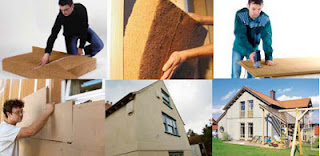
wood fibre board internal and external insulation with lime render
This is the most eco wall insulation: wood fibre board internal and external insulation with lime render. But it's the fossil fuel based polystyrene insulation that is getting the contracts.

A once-in-a-lifetime opportunity may about to be lost under the Green Deal to lock up a huge amount of atmospheric carbon in Britain's buildings to help combat climate change.

Later this year, the implementation of the Green Deal will kickstart the rollout of insulation of the nation's 29,000 homes.

Last Thursday's news, that the energy efficiency skills gap is being tackled with new funding to train installers and contractors in properly insulating properties throughout Britain up to the right standard, is to be welcomed.

But a huge question mark hangs over the choice of materials to be used for this job.

Not all insulation materials are equal; some are more environmentally sound than others.

There is a wide variety, ranging from the conventional; polystyrene and mineral wool; to the traditional and novel, such as sheep’s wool and hemp.

There is also a wave of new materials, derived from organic sources, by which I mean, ultimately, trees.

Principally these are woodfibre boards and batts, manufactured and sold in their most user-friendly form by companies such as Steico; and recycled cellulose, predominantly made and marketed by Excel Industries.

Any construction material derived from trees or other plants locks up in a building the carbon that it has absorbed from the atmosphere while growing, thereby helping to combat global warming.

It's a fantastic and cheap form of carbon sequestration.

By contrast, the current most commonly used insulation materials, such as phenolic foam board, expanded polystyrene boards and beads, and extruded polystyrene boards, are products of the petrochemical industry.

During their manufacture they emit carbon into the atmosphere, thereby increasing global warming.

Environmental impacts of insulation materials


The relative environmental impacts of insulation materials is a topic I examined thoroughly in chapter two of my standard textbook on the subject: Sustainable Home Refurbishment: the Earthscan Expert Guide to Retrofitting Homes for Efficiency.

Some people will tell you that recycled cellulose or wood fibre boards are more expensive. This is not necessarily so.

Last year I designed and built my own timber frame studio, which is super-insulated, and compared the cost of different insulation materials, from different suppliers. There is a huge variation, but I have to tell you that recycled cellulose made from old newsprint and treated against pests and fire is by far the cheapest.

It comes out at £12.49 per cubic metre when bought in 8 kg bags. Some “eco-" insulants are up to 25 times more expensive!

According to the most accurate figures available from the Carbon Trust, BSRIA and the University of Bath, in the Inventory of Carbon & Energy (ICE), expanded polystyrene has an embodied energy cost of at least 2.5kgCO2/kg.

Woodfibre board stores carbon at a quantity of 0.2 tonnes per cubic metre.

Doing a rough calculation, if one dwelling uses 20 cubic metres of this insulation, this represents a potential storage of 100 million tonnes of carbon throughout the country.

Is this significant? Yes. According to ICE's author, Craig Jones, the embodied carbon in buildings, taking account the projected future UK energy generation mix to 2050, is responsible for one third of their overall lifetime carbon cost.

Using organic insulation


Recycled newsprint works best when used in horizontal surfaces, like lofts; like most soft insulation it cannot be compressed, and must be covered up after installation if the space is to be used, because of the dust. Besides my loft I also used it underneath my floor.

It's the most environmentally sound insulation material you can possibly imagine. Apart from anything else, it is making use of a waste material.

The batts and boards made from wood fibre which I used are designed by the manufacturers for many different applications: between studs in walls, supporting concrete floors, or as tongue and groove cladding for the exterior insulation of a building.

The fibres for the latter are treated with wax to repel water, and when covered with a render (I used a very cheap proprietary lime render; all of this is part of the same complementary system) not only are weatherproof, but also allow the building structure to breathe.

This means that there is no condensation inside wet rooms and the building has an enhanced ability to withstand fluctuations in internal humidity.

By contrast, fossil fuel derived materials are not hygroscopic and do not allow the building to 'breathe'. Hence, when used for wall insulation, they can increase the risk of interior condensation.

There is one advantage which fossil fuel derived insulation has, and that is to achieve the same level of insulation using less depth of material. Typically you might need half the depth of phenolic or polystyrene foam than you would of wood fibreboard to achieve the same level of insulation.

This means that where space is a consideration, say to protect the internal dimensions of a room in internal wall insulation, or on the outside wall where the space beneath the eaves is limited for external wall insulation, then you would probably want to use, externally, mineral (rock & slag) wool batts and rolls such as Rockwool, which is relatively environmentally sound, certainly not as bad as foam. (Fibreglass mineral wool batts and rolls have a higher embodied energy than woodfibre.)

Lobbyists


Recently, Greg Barker said that his department had been inundated by lobbyists from insulation manufacturers wanting to get their products on the approved list for the Green Deal, which the Department is currently compiling.

My concern is that accredited installers are only going to be trained to install insulation containing fossil fuel derived insulation such as extruded polystyrene as manufactured by the likes of Kingspan and Knaupf, and a huge opportunity is going to be lost to save carbon.

I know these manufacturers have been lobbying furiously to make their products standard for the Green Deal, because if they are, it will be worth millions to them.

It's very important to bear in mind that each material has its own method of installation, and therefore a different skill needs to be learnt by installers.

Whatever has been learnt by the army of installers that, after this autumn, is likely to descend on the country's homes, will determine which insulation materials are used. Once installed, they will be there for decades.

Talking of long timescales, these foams also do not decompose at the end of their life, but instead will stay around for hundreds of years.

By contrast, surplus or used wood fibre board and cellulose composts to beautiful fertile soil within a year. So easy to dispose of! So environmentally sound. So easy to work with during construction.

Ignorance


In my experience there is almost complete ignorance of the organic materials I am talking about amongst your average builders, contractors and installers. Only the members of the Association of Environment Conscious Builders and their friends seem to be aware of them.

This is because they have only recently become available in this country in any quantity. Previously, they were quite hard to source.

I don't mind praising Burdens, under the brand EcoMerchant for being the only mass market supplier to stock thee fantastic materials, as far as I know.

So there is a massive skills and awareness gap to fill.

Preferentially specifying the use of these materials on a large scale will stimulate the supply chain, create demand and bring the price down even more.

The use of these materials is also recommended by the Centre for Alternative Technology and the related campaign Zero Carbon Britain, which last year consulted the industry on which materials to advocate.

CITB-ConstructionSkills, which is delivering the training, says it will do so "to evidence competence against the Minimum Technical Competence as specified by PAS 2030 and the Competent Persons Scheme Operators for the specific annexes covered by this initiative".

When I asked them about this, they said “CITB-ConstructionSkills has no remit or authority to prescribe what materials are accredited for the Green Deal.

"It is the organisations that are applying to be certification bodies of products acceptable to the Green Deal who will make the choice. At present we are not aware of which organisations or standards will be used."

Of course, it is up to the suppliers and manufacturers of these materials to lobby for their products and standards.

I sincerely hope they have the budget and the lobbyists available to compete with the insulation giants who currently dominate the building energy efficiency sector.

I've asked them, but so far received no reply.

Thursday, March 08, 2012

£3.5m for Green Deal apprenticeships

external insulation on a block of flats

The Coalition Government has announced a new fund of £3.5m to train Green Deal assessors and installers, and a further £10m to improve the energy efficiency of non-domestic buildings.

In the wake of complaints from the Green Deal Skills Alliance (GDSA) about a lack of awareness amongst contractors of energy efficiency measures and the Green Deal, a fund of £3.5million has been announced today by Energy and Climate Change Secretary Edward Davey to help train hundreds of people in key green skills ahead of its launch.

Nick Clegg, the Deputy Prime Minister, had promised a year ago to create 1,000 Green Deal apprenticeships, and this funding, offered together with CITB-ConstructionSkills, is intended to make good on this promise.

That organisation, a member of the Green Deal Skills Alliance, is contributing £500,000 towards training installers of insulation, while DECC itself is putting forward the remaining £3m.

As pointed out by Brian Smithers, business development director of Rexel UK, there is still a widespread lack of understanding and awareness of how green technologies can help people improve the energy efficiency of their homes and reduce bills.

This is despite the fact that since October 2010, the government has been running a "Cut the Carbon campaign in partnership with the Federation of Master Builders and National Specialist Contractors Council, to raise construction companies’ awareness of the Green Deal legislation.

"Rexel’s recent energy efficiency survey found that over a quarter of Brits would be motivated to save energy if they had access to financial subsidies, yet 90% hadn’t heard of schemes such as Carbon Trust Loans," Mr Smithers said today.

The news was welcomed by industry bodies, including the National Insulation Association, and even greeted enthusiastically by Andrew Warren, Director of the Association of the Conservation of Energy, normally a critic of the government's action on energy efficiency, who said: “Whilst the energy efficiency industry has a proud track record on training, it is excellent news that the enormous size of the task before us is being recognised by the Secretary of State in such an immensely practical way”.

Solid wall insulation will be central to the success of Green Deal and ECO. Mike Threadgold, Chairman of the INCA Training Committee said, “this funding will help to increase capacity within the industry to meet the surge in demand. SWI requires highly specialist skills and, by investing in the training and qualification of the workforce, the industry will be able to continue to deliver the highest quality standards.”

The Green Deal is the Government’s flagship energy efficiency scheme aimed at renovating millions of draughty, energy-inefficient homes and office buildings across the UK.

The scheme will begin in the autumn of this year and will support an estimated 65,000 jobs by 2015, but the financial details have yet to be announced.

Ed Davey said: “This money will help hundreds of people gear up for the Green Deal and ensure this scheme is a real success on the ground. We hope this will encourage businesses across the country to fully prepare their staff for the launch of the Green Deal later this year.”

CITB-ConstructionSkills CEO Mark Farrar called on employers and the supply chain to also invest in sustainable skills training for their workforce, so they too can capitalise on the Green Deal.

A Green Deal Competency Framework is being prepared, which will be an integrated portfolio of National Occupational Standards and qualifications to identify the standards of work and knowledge required to become an energy assessor, adviser or installer; these standards and qualifications will span a range of occupations.

The British Standards Institute (BSI) recently launched a new PAS2030 standard for all installers. Co-developed between DECC and industry representatives to ensure robust and deliverable standards as well as peace of mind and protection for consumers; details can be found on the BSI website.

To raise awareness of the Green Deal, the alliance is running events and other schemes to help employers, trade unions, learners and providers to identify opportunities for them; details of these are available on its website.

The new training will be administered by the Sector Skills Councils on behalf of the Green Deal Alliance. This group is made up of several existing skills groups - Construction Skills, Asset Skills, Summit Skills, whose members themselves are made up of representatives of the industries concerned.

£10 million competition

In addition, DECC is also funding a £10m competition to be launched in early May to support the incorporation of innovative technologies which can achieve significant energy savings in existing non-domestic buildings.

Non-domestic buildings, such as schools, shops, offices, hotels, are associated with 18% of the UK’s total carbon emissions so reducing energy demand in this sector will help the country meet its climate targets.

This programme will be delivered in partnership with the Technology Strategy Board. Details of how to apply will appear on DECC and TSB’s respective websites by early May. Innovative solutions will be encouraged from consortia of key supply chain players, including building owners and technology suppliers, to demonstrate the energy performance of innovative products or processes which could ultimately be accredited under the Green Deal.

Friday, August 26, 2011

Construction industry and public "not ready" for the Green Deal

Externally insulating a concrete, hard-to-heat house in Wales
The UK construction industry is largely unaware of - or unprepared for - the opportunities which the Green Deal represents, and the Government has a long way to go to convince the public to take part, according to two new pieces of research.

A survey by the Chartered Institute of Marketing Construction Industry Group has found that only 35% of product manufacturers believe that the Green Deal - due to be implemented in under 14 months - represents an “important opportunity", and only 31% have suitable products ready to meet the demand.

Organisations surveyed - 100 manufacturers and 15 installers, who will be required to renovate the nation's 29 million homes - appear unclear as to what opportunities the Green Deal represents for them and what they should be doing about it.

Yet the Government believes that by 2017 there will be a workforce of 100,000 qualified installers. Furthermore, the products and systems supplied to home owners will need to be approved by the UK Accreditation Service in just over a year.

Moreover, these products must not disappoint the home owner once installed but must work effectively. The British Standards Institute is developing a Publicly Available Specification (PAS 2030) for this purpose.

Installers must also be fully trained and home owners must know how to take advantage of their new products in a year's time.

What motivates the public?


When questioned, suppliers said they believe that home owners' reasons for installing energy-saving services are mostly driven by financial considerations: reducing energy costs (33%), for generating extra income (22%).

They see the principal benefits being reducing energy bills (55%) and generating renewable energy at home (45%).

This is backed up by a second report, The Green Gap, by YouGov for utility and environmental consultancy Gemserv, which found that 61% of homeowners would consider installing technology such as solar PV panels, hydro power or using biomass fuel to generate their own energy.

However, over half said the technology is too dear, a third didn't know how much cash they would get back, and over half - 54% - didn't know that the Green Deal is about energy efficiency in the home.

14% thought it was to do with protecting outdoor spaces like forests, and 9% thought it was about encouraging take-up of low carbon cars.

Chris Ashworth, author of the CIMCIG report, Taking Sustainability To The Consumer, said this was a wake-up call to installers and manufacturers who seem to be failing to grasp the enormous earning potential of the Green Deal.

He said: "The main challenge for manufacturers in this sector is to understand the motivations of the UK consumer.

"As a committee, (the institute) is dedicated to helping marketers in the construction industry develop best practices and capitalise on opportunities.

"In the current market conditions it takes initiative and imagination to create sales."

The need for the right marketing


The report found a disconnect between the sales and marketing departments of manufacturers, while marketing did not seem aware of initiatives being taken by the sales departments.

The Institute recommends that marketeers change the language they use in communicating with the public. “The language of low carbon is not seen as relevant to the choices people make in their everyday lives" says the report.

It is for this reason that the Zero Carbon Hub, which supports the building of new zero carbon homes, is recommending the use of the term “a new way of living".

The Institute has recognised that the Zero Carbon debate is actually impeding progress in motivating the public.

Currently, DECC's Behavioural Insights Team is researching how people can be influenced by incentives, joint action in their communities, and by behavioural feedback.

So far, it has found that homeowners need simple, clear and powerful information to help them make decisions.

The barriers for them include: a lack of understanding, lack of awareness, a conservative attitude to change, mistrust of installers, and cost.

The CIMCIG report breaks down the public into different segments who need to be approached in different ways: 'positive greens' make up 80% of the population; 'waste watchers' make up another 12%; ‘concern consumers’ make up 14%; ‘sideline supporters’ are 14%; ‘cautious participants’ are 14%; ‘stalled starters’ are 10%; and the ‘honestly disengaged' make up the last 18%.

The report concludes by saying the entire construction industry must work together - trade associations, manufacturers, contractors, wholesalers and installers - in an effective supply chain, in contrast with others such as energy companies and major retailers who have recognised the opportunity and are starting to act. Otherwise, traditional retailers risk being marginalised as the Green Deal becomes mainstream.

Installers of solar electricity systems for the Feed-In Tariffs have already shown how to take advantage of government support. For example, the Green Home Company has secured private finance to allow it to install free solar photovoltaic systems in the Kent area.

One positive initiative is where energy companies have been partnering with merchants to make it easier to buy insulation at subsidised prices, by creating online calculators so that homeowners can work out how many rolls of insulation to buy, and by offering free delivery.

The Energy Saving trust's website Think insulation is also a useful one-stop shop for consumers.

To help stakeholders DECC has set up four forums through which it is developing support for accreditation, capacity and innovation, and how to maximise energy efficiency.

Monday, February 14, 2011

Vital new tool sorts out the climate-friendly from climate-hostile materials

An important new tool that could help to drastically reduce buildings' climate impacts has been made freely available.


It is a revolutionary update of a “bible" on the embodied energy of hundreds of materials - anything from carpets and concrete to timber, insulation and plastics.

The widely used and authoritative ICE Database - 'Embodied Carbon: the Inventory of Carbon & Energy (ICE)' - is aimed at the manufacturing, construction and refurbishment industries, including designers, architects and policymakers.

It provides an invaluable means of telling specifiers what to avoid and what to use in the struggle to reduce the environmental impact of construction and other products.
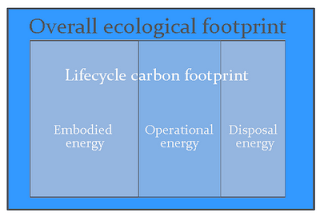
embodied energy and ecological footprint

What is embodied energy?


To reduce the level of climate change it is necessary to reduce emissions of global warming gases. These occur at every point in the life of a material or product, giving rise to the "life-cycle carbon footprint".

The “embodied energy" component of this overall figure is that used in the manufacturing process and is distinguished from the "operational energy" – that used in its lifetime. Then there is the environmental cost of its final disposal – whether it is landfilled or recycled etc.

If, for example, the product is concrete, it will take account of all the energy involved in quarrying, transportation and manufacture.

Usually, the impacts of other global warming gases like methane and HCFCs are converted into carbon-equivalent values for ease of comparison.

Why is it useful?


All products contain materials and in particular buildings can be with us for between 30 and 100 or more years. The building sector is responsible for 21% of global carbon dioxide-equivalent emissions: 8% through emissions from primary fuel types and 13% from the electricity demand for residential and commercial buildings.

As buildings become more energy efficient in operation, the embodied energy component of their overall footprint becomes proportionally more significant.

A recent report from the South West Regional Development Agency (SWRDA) on sustainable offices summarised that the embodied carbon impacts (construction, plus demolition) accounted for about a third of the whole life carbon impact.

Similarly, the RICS redefining zero report estimated the contribution of embodied carbon to be 20% for supermarkets, 30% for houses, 45% for offices and an incredible 60% for warehouses (usually unheated).

Last autumn the final report was published of the UK Low Carbon Construction Innovation and Growth Team (IGT), chaired by Paul Morrell (the UK Government Chief Construction Advisor). It had been asked by the government to consider how the construction sector could meet the low carbon agenda.

It made many recommendations, and on embodied carbon said that "as soon as a sufficiently rigorous assessment system is in place, the Treasury should introduce into the Green Book a requirement to conduct a whole-life (embodied + operational) carbon appraisal and that this is factored into feasibility studies on the basis of a realistic price for carbon".

Further, "that the industry should agree with Government a standard method of measuring embodied carbon for use as a design tool for the purposes of scheme appraisal".

A wealth of information


ICE is such a tool. It includes annexes on methodologies for metal recycling and explanations of how the values for carbon impacts have been calculated.

Summary sheets for each material expand into detailed fact sheets and graphs, giving a breakdown of the components of the impact, and how it has varied over the last 15 years.

For example, we learn that the impact of aggregates has been reduced by 1/5, because the UK energy mix has changed to include more natural gas.

In the important area of insulation, we learn that cellulose, typically made from recycled newsprint, has by far the lowest embodied energy (a maximum of 3.3MJ/Kg) even compared to other natural materials.

Rockwool is at 16.8, but polystyrene and other plastic insulation boards and foams, widely used in industry, are in the range of 99-109MJ/Kg. That is 30 times more than cellulose.

This means that cellulose should really be used universally by builders and refurbishment programmes in preference, despite the fact that it might take up more room.

It's important to realise that the global warming effects of the manufacture of products happens from the moment they are made, whereas the energy-saving benefit of insulation is only in the future.

Natural materials also contain carbon that has been locked up from the atmosphere during their growth (although ICE gives an average figure for the embodied energy of timber of 9.43 MJ/Kg).

So if there is a choice between timber and uPVC windows or doors, for example, uPVC has an embodied energy 10 times greater, of 94.7MJ/Kg.

The spreadsheets also include CIBSE data on material properties.

ICE is a major achievement, and is produced with the non-profit Building Services Research & Information Association (BSRIA). It is available to purchase and free to members.

The University of Bath, where project lead Craig Jones is employed, has charitably made a free Excel file version available.

Also for those with an interest in whole life carbon in buildings is this Sustain report on operational versus embodied energy.

Other sources of information


There are are other sources of comparable information:

• The Institute of Civil Engineers (ICE) Civil Engineering Standard Method of Measurement 3 (CESMM3) which includes carbon and prices for every material and unit of work, enabling users to calculate not just the economic, but also the embodied carbon of projects.
• The Hutchins 2010 UK Building Blackbook (The Capital Cost and Embodied CO2 Guide, Volume two: major works) which now includes both cost and embodied carbon for construction works.
• The Royal Institution of Chartered Surveyors (RICS) working group examining embodied carbon.
• The Institution of Structural Engineers (IStructE) soon-to-be published short guide on embodied carbon.
• BS 8903:2010 Principles and Framework for Procuring Sustainably
• PAS 2060:2010 Specification for the Demonstration of Carbon Neutrality.