Showing posts with label uranium. Show all posts

Thursday, March 17, 2011

The curse of uranium mining

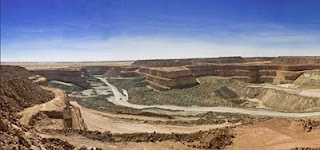
Uranium mine in Niger
“The people here don’t know about radioactivity, but there are still many people who do not drink the water in Arlit...They say they are sick when they drink it,” says Almoustapha Alhacen, who lives in a town built for nuclear mine workers in northern Niger, a parched desert area.
global supply lines for uranium

This is a glimpse of life at the other end of the uranium fuel supply route (right: where uranium originates and goes) for a plant like Fukushima.

Can nuclear-power ever be sustainable? Not unless it cleans up its act. It is just as criminally irresponsible in sourcing its raw materials as the fossil fuel industry. Read on...

Hell on earth


In a harsh environment in sub-Saharan Niger, French nuclear company AREVA has created a hell on earth amongst its indigenous population.

Here you would find great clouds of dust, caused by detonations and drilling in the mines, which cloud the air at the end of the day. Mountains of radioactive industrial waste and sludge sit in huge piles, exposed to the open air.

And the shifting of millions of tonnes of earth and rock have contaminated the groundwater source, which is quickly disappearing due to industrial overuse.

AREVA's majority shareholder is the French government. In 2009 Niger produced nearly 7% of the world’s uranium and is one of the four largest suppliers of uranium to the European Union. Northern Niger holds the world’s third-largest uranium deposit.

Foreign investors from China, Australia, South Africa, America, and Canada have flocked to the landlocked Saharan state recently. At least 139 research and exploitation permits have been sold in less than a year without any transparency or prior public discourse, says a local NGO.

Evidence has emerged that the permits corruptly enriched Mr. Tandja, the ousted president, and devastated the Touareg population.

Abject poverty


A landlocked-Saharan place in West Africa, Niger is a country where 60 percent of people are facing severe food shortages; it has the lowest human development index on the planet, despite the fact that Areva makes huge profits from its mining operations.

Arid desert, scarce arable land and intense poverty are hugely problematic - unemployment, minimal education, illiteracy, poor infrastructure and political instability are rife.

Mountains of tailings left from the uranium mine
AREVA established its mining efforts in northern Niger 40 years ago, creating what should have been an economic rescue for a depressed nation.

Yet, AREVA’s operations have been largely destructive, claims Greenpeace, whose experts visited the area at the beginning of last year together with experts from French independent laboratory CRIIRAD.

In 40 years of operation, a total of 270 billion litres of underground prehistoric water have been used, contaminating the water and draining the aquifer, which will take millions of years to be replaced. There have been consequent droughts and the death of farmers' cattle. No compensation has been provided.

Health and environmental findings


In collaboration with the French independent laboratory CRIIRAD and the Nigerien NGO network ROTAB Greenpeace have found the following:

• The concentration of uranium and other radioactive materials in a soil sample collected near the underground mine was found to be about 100 times higher than normal levels in the region, and higher than the international exemption limits.

• On the streets of Akokan, radiation dose rate levels were found to be up to almost 500 times higher than normal background levels. A person spending less than one hour a day at that location would be exposed to more than the maximum allowable annual dose.

• Although AREVA claims no contaminated material gets out of the mines anymore, Greenpeace found several pieces of radioactive scrap metal on the local market in Arlit, with radiation dose rate reaching up to 50 times more than the normal background levels. Locals use these materials to build their homes.

• In four of the five water samples that Greenpeace collected in the Arlit region, the uranium concentration was above the WHO recommended limit for drinking water. Historical data indicate a gradual increase in uranium concentration over the last 20 years, which can point at the influence of the mining operation.

• A radon measurement performed at the police station in Akokan showed a radon concentration in the air three to seven times higher than normal levels in the area.

• Fine (dust) fractions showed an increased radioactivity concentration reaching two or three times higher than the coarse fraction. Increased levels of uranium and decay products in small particles that easily spread as dust would point at increased risks of inhalation or ingestion.

• Death rates due to respiratory infection in the town of Arlit (16.19%) are twice that of the national average (8.54%).

AREVA, with its attempt to create a nuclear renaissance, brings to these communities the threat of losing the most basic elements necessary for life - poisoning their air, water and earth.
“We worked with our bare hands! ...The mining company never informed us about the risks... we relied on what God decided.” - Salifou Adinfo, a former driller for AREVA, Arlit, Niger, November 2009.
Women wash their clothes at a tap so generously provided by Areva
“We are already radiated. We are no more useful. We can only watch.” SOMAIR laundry worker Gigo Zaki, seen here at a tap so generously provided by AREVA.

“AREVA is coming to our country and making money, but we are the ones suffering and this must be addressed,” - Fatima Daoui.


Corruption and profits while locals are in poverty


Government spokesman Mahaman Laouali Dandah says there is ample evidence that corruption is an important part of doing business in Niger Production at COMINAK, located a few kilometres from the town of Akokan, commenced in 1978.

Unlike SOMAIR, COMINAK is an underground mine.

With a depth of 250 metres and over 250 kilometres of galleries, COMINAK is the largest underground mine in the world.

On average, the mines produce over 3,000 tonnes of uranium and net €200 million in sales each year.

A third mine, Imouraren, is planned to start production in 2013 and is projected to be the largest uranium mine in Africa and the second largest in the world, with an annual production capacity of 5,000 tonnes of uranium.

AREVA’s revenues for 2008 (most recently published) were €13.1 billion, with a profit of €589 million.

SOMAIR generated €161.7 million of that revenue by producing 1,743 metric tonnes of uranium.

COMINAK earned sales of €100.6 million for its supply of 1,289 metric tonnes of uranium concentrate.

Nuclear power sustainable? Don't make me laugh.

Wednesday, March 16, 2011

11 reasons to oppose nuclear power

I'm going to attempt to summarise the reasons why we should abandon nuclear power. I'll give a summary and then try and go into more depth.

1. The sourcing of uranium leaves a terrible legacy and can never be sustainable or carbon neutral. This is the elephant in the room that no one ever discusses.
2. Nuclear power stations can never be totally safe. Even though designers cater for every foreseeable event, it is the unforeseeable ones which have created the disasters of the last 50 years in Chernobyl, Fukushima and Three Mile Island and many other smaller ones
3. Nuclear waste remains radioactive for tens of thousands of years. It already costs in the UK £3 billion or £1000 per person per year to look after the existing legacy. How can it be safe, responsible or cost-effective to bequeath this to a distant and unknown future population?
4. It is not carbon neutral, or low carbon, but emits in its life-cycle about 30% of the carbon of gas generation, not including mining and looking after the radioactive tailings that results
5. It is highly centralised and so more vulnerable than a decentralised system
6. The nuclear industry has a reputation for secrecy and dissembling of the truth. This includes information about safety and costs which invariably rise. We need a power supply from sources we can trust.
7. We can satisfy our power needs from a mixture of existing and almost market ready renewable technologies, implementing the smart grid, low- and zero-carbon building design and refurbishment, better planning, more efficient transportation and other energy and resource efficiency.
8. New reactor designs are commercially unproven and improperly costed.
9. Uranium supplies will run out within 70 years - sooner as more plants are built. Why not invest instead in developing the renewable technologies whose fuel we will be able to use for much longer into the future?
10. Many power stations are on the coast. They will not be safe in 50 or 100 or more years' time when the sea level has risen as the Antarctic ice cap and glaciers melt.
11. Renewable energy (the source of it, i.e. the fuel) is free, and there is plenty of solar power - which fuels the wind, the waves, the tides and biomass growth - to supply the energy needs of the planet many times over. This means operating costs are in general lower as there is no fuel requirement. If only resources and subsidies currently channeled into nuclear and fossil fuels were channeled into renewable energy technologies, we could easily meet our needs this way.

Below, find some notes supporting some of the above statements. I will hopefully add to these in future posts.

Safety


None of the four Generation III designs submitted to the UK regulators for pre-licensing assessment have been proven commercially; they are design concepts without working prototypes to test their safety.

Nuclear waste


Are we expected to believe our energy companies will be around in any time over a few decades hence, for thousands of years, to pay for the full cost of management of the new radioactive waste produced?

How many companies are here now that were here 500 years ago let alone tens of thousands? None.

Existing nuclear waste is currently managed by the Nuclear Decommissioning Authority. Its 2010-11 budget is £2.8bn, of which £1.69 billion comes from the taxpayer via DECC. DECC's overall budget in this year is £2.9bn. This means that the cost of managing existing radioactive waste is a staggering 58% of the Department's total expenditure.

The cost of looking after the waste for each new power station is estimated to be about £1 billion.

Uranium mining


The World Nuclear Authority admits that in "emerging uranium producing countries" there is frequently no adequate environmental health and safety legislation, let alone monitoring.

It is considerately proposing a Charter of Ethics containing Principles of Uranium Stewardship for its members to follow. But this is a self-policing voluntary arrangement. Similarly, the International Atomic Energy Agency's Safety Guide to the Management of Radioactive Waste from the Mining and Milling of Ores are not legally binding on operators.

To produce enough uranium fuel - about 25 tonnes - to keep your average (1300 MW) reactor going for a year entails the extraction of half a million tonnes of waste rock and over 100,000 tonnes of mill tailings. These are toxic for hundreds of thousands of years.

The conversion plant will generate a further 144 tonnes of solid waste and 1343 cubic metres of liquid waste. To supply the number of power stations worldwide expected to be online in 2020 would mean generating 50 million tonnes of toxic radioactive residue every single year.

Uranium mining has often been a disaster for indigenous peoples. this includes as just one example the people in Niger around Areva's mines. The area has suffered conflict for ownership due to the huge profits involved, and the water table has dried up leaving cattle dead and farmers destitute. Radioactive contaminated goods have been found in street markets in villages.

British Energy is responsible for purchasing uranium in the UK.

Costs


Insurance: Nuclear plant operators have limited liability in the case of an accident. Any cost over £700m is covered by the taxpayer. Are taxpayers prepared to take on board the full insurance liabilities, which in the case of Chernobyl have already run to several tens of billions?

The cost of the new generation plant being constructed in Finland, which was alleged to be cost-effective and show what could be done by the new generation designs, has soared during the construction phase.

The same is true of its sister plant in Flamanville in France, now under construction.

Nuclear is not low carbon


Nuclear power produces roughly one quarter to one third of the carbon dioxide as the delivery of the same quantity of electricity from natural gas.

This is according to the Integrated Sustainability Analysis (ISA) by The University of Sydney, which concludes that the greenhouse gas (GHG) intensity of nuclear power varies within the range 130-160 g/kWh.

A second estimate (below) by Storm van Leeuwen and Smith (SLS) is higher because it reflects best practice, especially for waste treatment and disposal, and because the reality of errors and problems in the nuclear cycle typically raises the energy cost well beyond the planned level. ISA’s estimate includes all GHG emissions from the nuclear cycle.

Breakdown:
Construction: 12-35 CO2 g/kWh
Front end: 36 CO2 g/kWh
Back end: 17 CO2 g/kWh
Dismantling: 23-46 CO2 g/kWh
Total: 88-134 CO2 g/kWh

To compare: GHG emissions from gas-fired electricity generation are about 450 g/kWh.

By contrast, the U.K. Government’s 2007 Nuclear Power Consultation accepts industry estimates that, across its whole life-cycle, nuclear power emits 7 - 22 g/kWh.

Additionally, no one can convince me that the mining and the care of the huge piles of tailings at uranium mines is carbon-free. It takes a lot of – almost certainly fossil-fuelled - energy to move that amount of rock and process the ore. But the carbon cost is often not in the country where the fuel is consumed - certainly in the case of the UK. So that's why it's called ‘carbon free’.

The threat of rising sea levels


The Met Office has said that rising sea-levels, increased wave height and increased storm surge height must all be considered in the planning of the UK's future nuclear stations.

Their report was commissioned by British Energy. It concludes future power plants will need to be further inland and may need added protection.

At Sizewell in Suffolk, for example, site of Britain's most modern reactor, the prediction is for the most severe storm surges to be 1.7 metres higher in 2080 than at present. But that's only if the Greenland ice sheet doesn't melt. If it does, much of it will be underwater.

At Dungeness in Kent, the storm surge increase could be up to 0.9 metres. Already this plant, which is sited on land only two metres above sea-level, is protected by a massive wall of shingle which needs constant maintenance in the winter. Waves erode so much of it that it needs to be topped up constantly with 600 tons of shingle every day.

Renewable alternatives


Britain doesn’t need to build major new power stations to keep the lights on and maintain security, according to, for example, this report by independent consultants Pöyry.

Space and water heating counts for 83% of domestic energy use and about the same for office use. Together, offices and homes account for around 35% of UK energy use. Ie, 28% of total UK energy use.

Providing 40% of this by passive solar, solar water heating, heat pumps, domestic CHP, and woodchip/pellet boilers, would account for a significant proportion of the amount of power requirement as that required to compensate for the loss of old nuclear power stations.

It would have almost as great an impact in a shorter time scale and far cheaper but with little environmental impact than building new nuclear power stations, as well as creating more, sustainable jobs.

Monday, December 08, 2008

The undiscussed supply chain

Below is the original, longer version of my latest Guardian Comment is Free piece,
Extracting a disaster
.

The extraction of uranium is dangerous, leaves a toxic legacy for millions of years in vulnerable parts of the world, and is hardly conducted in an ethical fashion, yet British ministers - while sourcing FSC timber - are complacent about the supply-chain consequences of their enthusiasm for nuclear new build.

The Government is in a hurry to get eight new nuclear plants built around the country. It is even manipulating the planning laws to achieve this end: the Planning Act, Climate Change Act and Energy Act became law this week, all of which pave the way for a new generation of nuclear power stations. Nuclear power is the Government's magic ticket not only to meet its 2020 carbon emission goals and "stop the lights going out" but to export British nuclear know-how around the globe.

One can condemn ministers' gung-ho enthusiasm for this technology from any number of angles: the threat of terrorist attack; nuclear proliferation; global insecurity; the waste legacy, and so on.

I want to discuss one that is rarely raised: the fuel supply chain.

The UK Government has in place guidelines for the ethical and sustainable sourcing of many raw materials. The Government promotes Corporate Social Responsibility, and in this context Tony Blair launched something called the Extractive Industries Transparency Initiative [http://eitransparency.org/ ] t the World Summit for Sustainable Business Development in 2001. The Government's Sustainable Procurement Action Plan includes purchasing advice for its departments and agencies in order to reduce waste production, energy and water use, and reduce impact upon biodiversity. The most obvious example is timber; Government departments and agencies are supposed to source timber using the internationally recognised auditing trails.

But you won't find anything about uranium sourcing in that document, because the government itself does not buy uranium: British Energy does that. And yet the increased sourcing of raw uranium that will arise from nuclear new build is directly due to the U-turn in government policy on nuclear power that has come in the last three years.

The World Nuclear Association (WNA), the trade body for the ten companies that make up 90% of the industry, has convinced politicians that "Nuclear energy is one of the very few available large-scale sources of clean energy (CO2 free)" [http://www.iaea.org/OurWork/ST/NE/NEFW/documents/RawMaterials/CD_TM_IBPinUM&P%20200810/02WNA%20pres%20-%20IAEA-WNA%20TM%20-%20u%20mining%20EH&S%20-%2015oct08.pdf].

The WNA admits that in "emerging uranium producing countries" there is frequently no adequate environmental health and safety legislation, let alone monitoring. It is considerately proposing a Charter of Ethics containing Principles of Uranium Stewardship for its members to follow. But this is a self-policing voluntary arrangement. Similarly, the International Atomic Energy Agency's Safety Guide to the Management of Radioactive Waste from the Mining and Milling of Ores are not legally binding on operators.

The problem is that transparency is not a value enshrined in the extractive or the nuclear industries. Put the two together and you have a major quality of information problem. Access to the truth is, to say the least, uncertain. Journalists and others trying to obtain reliable information find themselves blocked. Recently, to tackle this issue, Panos Institute West Africa (IPAO) held a training seminar for journalists in Senegal which highlighted that only persistent investigation - or, in the case of the Tuareg, violent rebellion - has a chance of uncovering the truth.

The co-editor of The Republican in Niger, Ousseini Issa, said that only due to local media campaigns was there a revision of the contract linking Niger to the French company Areva. "We realized then that the country drew little benefit from uranium. As a result of our efforts, the price of a kilogram of uranium increased from 25,000 to 40,000 CFA francs," he said. This means that the local community receives a decent income from the extraction of their resources.

IPAO has plenty of evidence that in Africa the legacy of mining is often terrible health, water contamination and other pollution problems. The health and safety of workers and local communities is frequently a low priority. IPAO would laugh at the Extractive Industries Transparency Initiative – an Orwellian creation.

What is the effect of uranium mining specifically? Under current world market conditions, nuclear fuel from fresh uranium is cheaper than from recycled uranium or recycled plutonium (MOX), which is why there is a uranium rush going on worldwide.

To produce enough uranium fuel - about 25 tonnes - to keep your average (1300 MW) reactor going for a year entails the extraction of half a million tonnes of waste rock and over 100,000 tonnes of mill tailings. These are toxic for hundreds of thousands of years. The conversion plant will generate a further 144 tonnes of solid waste and 1343 cubic metres of liquid waste.

Contamination of local water supplies around uranium mines and processing plants has been documented in Brazil, Colorado, Texas, Australia, Namibia and many other sites. To supply the number of power stations worldwide expected to be online in 2020 would mean generating 50 million tonnes of toxic radioactive residue every single year.

The milling process recovers about 95% of the uranium. The residues, or tailings, contain naturally-occurring radioactive elements, including uranium, thorium, radium, polonium, and radon-222 emissions. In countries like the US, the Environmental Protection Agency sets limits of emissions from the dumps and monitors them. This does not happen in many less developed areas.

The current market prices of nuclear fuel do not include all of the costs incurred. For uranium mill tailings, the long-term management cost that is not covered by the uranium price may be as high as the uranium cost itself. The situation for the depleted uranium waste arising during enrichment even may be worse, says the World Information Service on Energy.

No one can convince me that the above process is carbon-free. It takes a lot of – almost certainly fossil-fuelled - energy to move that amount of rock and process the ore. But the carbon cost is often not in the country where the fuel is consumed - certainly in the case of the UK. So that's why it's ‘carbon free’.

And what of the other costs? Over half of the world’s uranium is in Australia and Canada. In Australia the Government is relishing the idea of making money from the nuclear renaissance being predicted, and uranium mining is expanding all over the place. Australian greens are fast losing the optimism they felt when the Labor Party won the last election. The temptation to cash in the expense of the environment and traditional peoples under the pretense of it being 'low carbon' is too much.

Uranium mining has often been a disaster for indigenous peoples. In the Northern Territory plans to expand a nuclear dump at Muckaty station are being pushed forward with no regard for the land's Aboriginal owners. The supposedly greener new Australian government Minister Martin Ferguson has failed to deliver an election promise to overturn the Howard Government's Commonwealth Radioactive Waste Management Act, which earmarks a series of sites for nuclear waste dumps. Senator Ludlam asked him last week at a senate hearing: "How can Martin Ferguson wash his hands of this issue and allow small Aboriginal communities in the Northern Territory to cop this waste in a repeat of the worst nuclear colonialism of the past?"

In South Australia, in August the Australian Government approved the expansion of a controversial uranium mine, Beverley ISL. This was dubbed a “blank cheque licence for pollution”. Groundwater specialist Dr Gavin Mudd, a lecturer in environmental engineering at Monash University, has examined the data from the Commonwealth Scientific and Industrial Research Organisation (CSIRO) and called for it to be “independently verified by people not subservient to the mining industry” (The Epoch Times Sept. 2, 2008).

Elsewhere in the Northern Territory, on Oct. 31 BHP Billiton said it plans to have the first of five planned stages of expansion at its Olympic Dam mine in production by 2013. This will increase production capacity to 200,000 tonnes of copper, 4500 tonnes of uranium and 120,000 ounces of gold. This is a vast open cast mine, from which the wind can carry away radioactive dust.

Not far away locals are fighting a new uranium mine 25 kilometres south of Alice Springs. Elsewhere, at the Ranger mines, on November 17, Energy Resources of Australia - 68.4% owned by Rio Tinto - said it expects to find 30,000 to 40,000 tonnes of ore in the Ranger 3 Deeps area. In October the company signed an agreement to supply uranium oxide to a Chinese utility. At the same time they signed a safety accord. This is how safe the mine in fact is - and you won't find such records at African mines: almost 15,000 litres of acid uranium solution leaked in a 2002 incident, and since then further leaks ranging from 50 to over 23,000 litres have been reported on the South Australian Government's Primary Industries website. The most recent was on April 22, 2006 when 14,400 litres of solution containing approx. 0.5% uranium leaked out.

The list goes on.

The bottom line is this: UK ministers are blind to the consequences of their pro-nuclear evangelism. Their hypocrisy is breath-taking. Carbon credits under the Kyoto mechanism have to be independently audited by a global body to ensure that new renewable energy is unique, additional and lives up to its claims. At the very least there should be an independent, global body verifying the ethics, health and long-term safety of the nuclear supply chain.

Better, just leave it in the ground.


© David Thorpe

Thursday, November 20, 2008

Australia is rubbing its hands due to nuclear new build

Uranium mining is expanding all over Australia. The Government is relishing the idea of making lots of money from the nuclear renaissance being predicted (but not yet proven).

Australian greens are fast losing the optimism they felt when the Labor Party won the last election. It's clear that the temptation to make money at the expense of the environment and traditional peoples under the pretense of it being 'low carbon' is too much for them.

Western Australia


In Western Australia BHP Billiton Ltd is to develop one of Australia's largest untapped uranium deposits, after the state government where the deposit is located lifted a ban on mining the nuclear power feedstock.

The 10-kilometre-long (6 miles) Yeelirrie deposit, located about 1,000 km north of Perth in west Australia, is estimated to contain about 52,000 tonnes of uranium.

Elsewhere in Australia and Canada uranium mining has been a disaster for indigenous peoples (as it is most everywhere in the world, ironically). Over half of the world’s uranium is in Australia and Canada.

South Australia

In South Australia, in August the Australian Government approved the expansion of a controversial uranium mine, Beverley ISL. This was dubbed a “blank cheque licence for pollution”.

“Fundamentally, they have allowed the area of pollution from the Beverly mine to be expanded quite significantly,” ground water specialist Dr Gavin Mudd told The Epoch Times. Dr Mudd, a lecturer in environmental engineering at Monash University, says he has looked at the data from the Commonwealth Scientific and Industrial Research Organisation (CSIRO) and it is not convincing.

“Until they have got that data on the public record that has been independently verified by people not subservient to the mining industry I think they really have been given a blank cheque to leave groundwater in a much worse state than before.” (The Epoch Times Sep. 2, 2008)

Elsewhere in the Territory, on Oct. 31 BHP Billiton said it plans to have the first of five planned stages of expansion at its Olympic Dam mine in production by 2013. The first phase of expansion is to optimise the existing underground operation and increase its production capacity to 200,000 tonnes of copper, 4500 tonnes of uranium and 120,000 ounces of gold. This is an open pit.

Northern Territory

At the Ranger mines (Northern Territory), on Nov. 17 Energy Resources of Australia, which is 68.4 per cent-owned by Rio Tinto, announced that it expects to find 30,000 to 40,000 t U3O8 in the Ranger 3 Deeps area east to the current Ranger 3 operating pit. ERA has performed extensive exploration in the area over the last two years.

In October the company signed an agreement to supply uranium oxide to an electric utility in China. They also signed "a safety accord." Here is a record of how safe it is:

Almost 15,000 litres of acid uranium solution leaked in a 2002 incident, and since then a further nine leaks ranging from 50 litres to more than 6,000 have been reported on the South Australian Government's Primary Industries website. Spills of 1000+ litres:

* Apr. 22, 2006: spill of 14,400 litres of solution containing approx. 0.5% uranium
* Oct. 31, 2005: spill of 23,700 litres of mining solution, containing approx. 0.06% uranium
* Aug. 8, 2005: spill of 13,500 litres of extraction fluid containing approx. 0.01% uranium
* Mar. 7, 2005: spill of 50,000 - 60,000 litres of injection fluid
* Dec. 8, 2004: spill of approx. 2,300 litres of mining solution, containing 0.028% uranium
* June 13, 2002: spill of 1,750 litres of brine solution
* June 7, 2002: spill of 1,500 litres of injection fluid in the well field
* May 5, 2002: spill of 14,900 litres of water containing 0.0018% uranium (Australian May 7, 2002)
* May 1, 2002: spill of almost 7,000 litres of brine solution containing some uranium (ABC May 2, 2002)
* January 11, 2002: spill of 60,000 liters of groundwater containing acid and uranium, after pipe rupture (ABC, The Age, Jan. 12, 2002)

Plans to expand a nuclear dump at Muckaty station north of Tennant Creek, are being pushed forward with no regard for the indigenous Aborigines who own the land. The new, supposedly greener, Australian government Minister Martin Ferguson has failed to deliver a Labor election promise to overturn the Howard Government's Commonwealth Radioactive Waste Management Act, which earmarks a series of sites for nuclear waste dumps.

Senator Ludlam asked him on Tuesday at a senate hearing on the matter: "How can Martin Ferguson wash his hands of this issue and allow small Aboriginal communities in the Northern Territory to cop this waste in a repeat of the worst nuclear colonialism of the past?"

Thursday, February 28, 2008

Don't let them relax uranium transport rules!

About 20 million packages of all sizes containing radioactive materials are transported around the world annually on public road, railways and ships.

With the comeback of nuclear power, there is an increasing demand for transportation of radioactive materials.

Wisely, regulations have been in place to strictly control their movement. But the industry is now complaining of bottlenecks and delays.

This is compounded by the fact that, sensibly, fewer and fewer transporters want to deal with the hazardous materials. Moeller Maersk, the world's largest container shipping line measured on vessel capacity, adopted a policy of not shipping radioactive materials in April 2007.

"It is a very complex problem," said Bernard Monot, external relations vice president at the logistics department of the world's biggest maker of nuclear reactors, Areva.

"The shippers complain about the port authorities, who in turn hold the shipping lines responsible and everybody accuses heavy regulations," he says.

So they want the rules cut.

For example in Holland, "It takes around six weeks to receive a permit," according to Pyter Hiemstra, spokesman for SenterNovem, the agency handling permits on behalf of the Dutch Department of Spatial Planning, Housing and Environment.

He said the International Atomic Energy Agency (IAEA) had asked countries to speed this up.

"What we would be looking for is for radioactive to be accepted for transit permission normally with 24 to 48 hours notice," said John Leach, General Manager for Dangerous Cargo, Special Cargo Management at Moeller Maersk.

The Low Carbon Kid argues hat the last thing we need is a relaxing of rule around the transport of radioactive materials. The world is a dangerous enough place as it is.

It is governments and local authorities and port authorities who control these rules. Write to your MP and ask them not to let these rules be relaxed.

Wednesday, January 16, 2008

Congratulations to Australia

Hats off to Australia's new Foreign Minister Stephen Smith who had the guts to tell India's nuclear envoy Shyam Saran on Tuesday that Oz would not sell uranium to New Delhi unless it signs the Non-Proliferation Treaty (NPT)

This reverses a decision by the previous government.

India's Saran had brokered a deal with the I-don't-give-a-damn United States to provide nuclear power aid to India while allowing it to continue nuclear weapons production

He'd then got the old OZ government to agree to supply the yellow stuff, overturning a policy of selling the fuel only to NPT signatories.

Fortunately Australia's now seen sense and the world is, in theory at least, a safer place.

Monday, January 14, 2008

Uranium Blues

Building new nuclear power stations will have an impact that reaches far beyond our borders - to the places where the fuel for them is mined.

> Comment is Free article

Friday, October 26, 2007

How long is a long time?

Current government policy on energy technology is based on a curious mismatch of ideas about time


Ideas of 'a long time' vary according to context in the Low Carbon Kid's analysis of the government's Energy Market Outlook published two days ago.

There is enough uranium ore in the world to meet currently projected demand for up to 85 years, according to current estimates from the Euratom Supply Agency.
Where our nuclear fuel will come from
Renewable energy will, by contrast and by definition, last forever. Oh yes, and it's free.

Technologies which use renewable energies as a fuel source will therefore have application forever.

In other words, investing now in developing new renewable energy technologies would produce expertise that would provide a strong foundation for industries that could last for centuries, rather than, by contrast with nuclear technology, one century.

Technologies' lifetimes


Technologies have their lifetimes.

Steam power has lasted roughly 250 years. The internal combustion engine may last (it first appeared in 1850) 200 years.

Nuclear power looks set to last for 150 years at the most.

Water power (mechanical) has been around for at least 2000 years and will probably never go away.

Electricity as a clean means of conducting energy may also be around now as long as we are.

Renewable technologies generating electricity and heat will obviously improve and change with innovation, but they will be around also as long as we are, it's safe to assume.

What the government says


In the long-run we believe increased prices and global demand will help maintain reliable uranium supplies, thus not representing a constraint on any new nuclear build in the UK.
This is not a long run in my books. It is a medium term run as it is looking not 85 years but 15 years into the future.

The report begins by saying
In the short term, the main concern is the extent to which
we can be confident that energy can be delivered when and
where it is needed, i.e. reliability.

In the medium term, the focus is on the availability of
infrastructure, the planning process and supply chain issues
such as the availability, both within the UK and
internationally, of raw materials, machine components and
project management and engineering skills.

In the longer term, there is a wider range of options open to market participants, including significant capital investment and the development of new technology. Given this, the key concern in this time-frame is likely to be the availability of primary sources of energy.
In this discussion, short term is therefore about up to 12 years (2020); medium term seems to be the same actually, as over the same period the same concerns apply, but might extend a further 10 years as the Grid infrastructure is updated; and long term is any time beyond this.

Governments usually can't see beyond the electoral term of office. They are therefore bound by the need to balance the books - they can't spend too much public money.

Nuclear power stations in general take twice as long to build as coal power stations - ten as opposed to five years.

It's therefore curious that nuclear stations are being backed by ministers as they neither address the short term issues or the very long term issues.

New build nuclear power stations will be up and running around 2020. They would last until around 2095, then the fuel runs out. And anyway they will be worn out.

Before then, there is plenty of time to implement 15% of our generating needs from renewables that are currently proven - wind power, ground source heat pumps, solar thermal, and solar electric.

In the medium term government policy should signal to the markets that they should invest In the newer technologies - marine current turbines, wave power, tidal power and more advanced solar photovoltaic generation.

In particular the more predicatable sources - marine currents, tides, geothermal, heat pumps - should be prioritised.

So that after 2020 these are increasingly phased in.

in the medium
term the electricity generating industry faces a substantial
challenge in ensuring delivery of the new generating
capacity that will be needed if demand continues to rise. [p 37]


All the more reason for speeding up the planning process.

[And we haven't even mentioned the very very very very long time that nuclear waste poses a threat for]. If Stonehenge had nen a nuclear reactor it would be well glowing still.
> Energy Market Outlook