Showing posts with label European Union. Show all posts

Tuesday, December 12, 2017

Europe inches closer to strong energy efficiency target

Members of the European Parliament’s industry and energy committee have voted by a narrow margin for a legally binding 40 per cent energy efficiency goal and a 35 per cent renewable energy target for 2030.

{Note: a version of this article appeared one week ago on The Fifth Estate]

Markus Pieper

The energy efficiency vote was won by only one vote (33 in favour and 32 against). German conservative Markus Pieper (above) sided with the ECR Group, a 74-strong Eurosceptic alliance of European conservatives and reformists, and the far-right Europe of Nations and Freedom group, which includes France’s National Front and the coal-favouring Visegrad Group.

Pieper’s compatriot, Socialists and Democrats Group member Martina Werner, siding with the committee’s rapporteur Adam Gierek, hailed the vote as “a great political victory after a fierce battle between the political groups”.

“We had to face serious attempts to water down the Energy Efficiency Directive. Even the Commission acknowledged that their amendments, for example on the annual savings rate, would amount to 0 per cent, for the period 2021-2030. This is not acceptable.”

With the European Council having already agreed on its approach on the Energy Efficiency Directive, the three European institutions must now agree on one joint position under the Bulgarian presidency next January, after the adopted report has been passed by a full plenary session.

Renewable energy sails through

By contrast, the Renewable Energy Directive vote was backed by 43 in favour and only 14 against. However, this motion already contained compromises. Although Members of the European Parliament (MEPs) wanted to increase the Commission’s 27 per cent target to 35 per cent, many, including the Greens, believe that 35 per cent is “the strict minimum” needed to let the EU meet its commitments under the Paris Agreement.

WWF Europe renewable energy expert Alex Mason slammed the proposal as “toothless” and claimed that the inclusion of a 10 per cent “flexibility margin” sent a signal to investors that “the EU is scaling back on renewable energy”.

Adair Turner, chair of the Energy Transitions Commission (ETC), a coalition of leading organisations from the worlds of business, energy and finance, said the ETC had come to the conclusion that a 100 per cent renewable energy system was now clearly within reach – probably sooner than we think.

“We are pretty confident that in 10 or 15 years you would be able to do a near total renewable system – 85 or 90 per cent – based on intermittent renewables. We said 2035 but this is probably ludicrously conservative.”

Energy efficiency remains controversial

But opponents of the target vowed to fight on to prevent it from becoming law. Opposition to the target is based on the belief that energy efficiency is not cost-effective.

Van Bossuyt, chair of the European Parliament’s internal market committee and member of the ECR Group, after the vote said: “We all want to see an ambitious strategy for improving efficiency, but there is no point introducing targets and policies if countries and companies are unable to implement them.

“A policy that is affordable and works in one country may be completely inappropriate and expensive in another. Governments and local authorities need to step up efforts to renovate their building stocks but this is expensive and places huge pressure on budgets that are already stretched.”

But this belief is not shared by industry. Philippe Dumas, secretary general of geothermal heating association EGEC, said: “The vote … puts the heating and cooling sector on track to be freed from fossil fuels. Decarbonising the heating and cooling sector can only be done by exploiting synergies between energy efficiency and renewable policies in terms of actions, technologies and ambitious policies.”

French energy group Engie’s CEO, Isabelle Kocher, said she supported the 40 per cent target: “We are very supportive of setting energy efficiency targets that are both very high and which are binding.”

So did members of the European Alliance to Save Energy, who include Veolia, Siemens, Philips Lighting and Danfoss, who had said that any target below 40 per cent energy savings “would set policy goals below the business-as-usual energy efficiency improvement trajectory and will have no impact on the ground”.

And the CEO of the Institutional Investors Group on Climate Change, Stephanie Pfeifer, said the 40 per cent target would “send a clear and positive signal to investors swiftly enough to ensure a smooth transition to a low carbon economy”.

The Coalition for Energy Savings welcomed the energy efficiency vote. Its secretary general Stefan Scheuer said: “Energy efficiency policies have been the bedrock of the EU’s common energy policy, and a major tool to address environmental, competitiveness, social and geopolitical challenges.

“MEPs across the political spectrum who acknowledge these benefits should overcome their divisions and agree on a solid common energy efficiency policy post 2020 in view of the negotiations with the Council.”

He said the EU could achieve this energy efficiency target cost-effectively, according to research findings presented in the impact assessment for the Energy Efficiency Directive revision proposal.

The need for investment

Seventy-five per cent of the EU’s building stock is inefficient and buildings account for 40 per cent of the EU’s primary energy demand. Even if the target becomes law, a major obstacle to increasing the rate of renovation is access to finance, an issue for both businesses and households.

The Energy Efficiency Financial Institutions Group (established by the European Commission Directorate-General for Energy and United Nations Environment Program Finance Initiative) says that to reach the EU 2030 energy and climate targets about €379 billion (AU$591.7b) is needed each year between 2021 and 2030.

Where could such a massive amount come from? Part of the answer might be from energy companies themselves, who stand to save hundreds of billions of dollars from the easing of network constraints and of the need for new infrastructure that is being caused by the ongoing digitalisation of the energy sector.

Those savings are highlighted in a recent report from the International Energy Agency, which puts the savings to be achieved from a more connected, intelligent, efficient and reliable energy system at around US$80 billion (AU$105b) – approximately five per cent of total annual generation costs worldwide.

Furthermore, it says that as much as US$270 billion (AU$355b) in necessary infrastructure costs could be saved by realising up to 185GW of worldwide flexibility via smart demand response.

These savings could usefully be translated into investments in energy efficiency programs, which would achieve a return on investment over similar long time frames.

Another, admittedly much smaller, type of solution is to be found in places like Bucharest, where EU investment programs have contributed to the renovation of around 1200 flats. The Dutch approach of “Energiesprong” undertakes housing retrofits and installing photovoltaic panels and boilers in order to create Net Zero Energy houses, focusing on the social housing sector. In the Netherlands there have so far been about 1800 refurbishments with a further 15,000 in the pipeline.

If the European Union does finally succeed in setting the 40 per cent energy efficiency goal in law next year, that will only be the beginning. It will be up to the market to step up to the challenge of meeting the requirements.

David Thorpe is author of Passive Solar Architecture Pocket Reference and Solar Energy Pocket Reference.

Wednesday, February 01, 2012

E.C. seeks more power over member-states' energy policy as Europe misses renewables targets

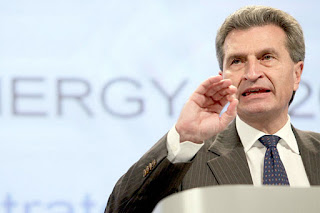
Günther Oettinger wants a pan-European energy market
Günther Oettinger believes lack of consistency and cooperation across Europe is the problem, and that more power in Brussels is the solution


European Energy Commissioner Günther Oettinger called yesterday for decisions on energy markets, security and renewable energy to be taken away from national governments and made in Brussels, as he admitted that Europe did not meet its 2010 renewable energy targets.

“These are strong arguments for giving [the EC] those powers,” Oettinger said in a speech to European policymakers. “In the next decade you would give greater value, or decide on a higher value for renewable energy in the [EU] energy mix.”

His call was supported by the President of the European Parliament, Martin Schulz, who said that European security and autonomy could only be achieved through more integration.

Under Article 194 of the Lisbon Treaty, individual EU member states have authority over their choice, use and structuring of energy resources.

In many countries this authority is jealously guarded because it is seen in terms of national security or as being politically useful during elections.

Several of them have still not transposed, or have only partly transposed, the the European Unions third energy package, intended to harmonise European markets into national. Furthermore, the energy mix of every state is qualitatively different.

Mr. Schulz acknowledged, however, that in the short term there would be no changes to Article 194. “The [energy] choice is made by member states and they are right to choose and we cannot get rid of that. But the right to choose your energy mix is a problem and we're going to have to talk about it a lot,” he said.

Renewable energy targets missed


Part of the reasoning behind the call is concern that the "20% by 2020" renewable energy policy goals will not be met.

Member states have just submitted their first reports to the European Commission outlining their progress towards meeting the targets, and most, including the U.K., missed them for 2010, as did the EU as a whole.

Only Denmark, Germany, Hungary, Ireland, Lithuania, Poland and Portugal expect to achieve their 2010 targets for renewable energy in electricity generation; and, only Austria, Finland, Germany, Malta, Netherlands, Poland, Romania, Spain and Sweden expect to achieve their targets for renewable energy in transport.

The European Commission said yesterday that it believes 2020 targets will only be achieved if member states fully implement their national renewable energy plans and more finance is available, which is not happening fast enough.

Oettinger believes lack of consistency and cooperation across Europe is the problem, and that more power in Brussels is the solution.

But Commissioner Oettinger's ambition doesn't stop there.

He also said yesterday that he wants to open talks on energy with Turkey in the current accession talks, and to enlarge Europe’s energy community to take in countries around its borders including Ukraine, Moldova, Georgia, Norway, Switzerland, Albania, Serbia, Montenegro and the Maghreb.

“Energy does not stop at the borders of the EU,” he stated.

Greater cooperation


Oettinger explained in his speech that he wants to see improved cooperation between member states and better integration of renewable energy into the single European market.

"We have to invest much more in renewable energy and we need smart, cost-effective financing. If Member States work together and produce renewable energy where it costs less, companies and consumers and the tax payer will benefit from this," he said.

To meet the renewable energy target, a doubling of annual capital investments in renewable energy is required throughout the continent, from €35bn per year to €70bn; this amounts to over one trillion euros between today and 2020.

Oettinger's Department says this will require "a substantial use of national support schemes", which "ought to be as cost-effective as possible".

A study released yesterday by the Department shows that, while different financial instruments are used in all Member States to develop renewable energy (grants, loans, feed in tariffs, certificate regimes etc.), "their management needs to be improved".

In an apparent jibe at the UK's recent policy about-turns it says: ″Retroactive changes to support schemes in particular must be avoided given the negative effect such changes have on investor confidence".

Once again it reiterates that investors need “greater coherence, clarity and certainty".

There are already three existing mechanisms which favour cooperation on energy between states:
  • "Statistical transfers" whereby one Member State with a surplus of renewable energy can "sell" it statistically to another Member State, whose renewable energy sources may be more expensive
  • "Joint projects" whereby a new renewable energy project in one Member State can be co-financed by another Member State and the production shared statistically between the two
  • "Joint support schemes" whereby two or more Member States agree to harmonise all or part of their support schemes.
The Commission says it will assess in 2014 the effective functioning of the cooperation mechanisms.

UK progress


The UK has so far not taken advantage of these cooperation mechanisms.

Its own Renewable Energy Directive Progress Report, submitted in December, shows that at the end of 2010 (the latest data available) 3.3% of its energy came from renewable sources.

Greg Barker, Minister for Climate Change, said yesterday he believed that this meant the UK is "currently on track to meet our first interim target of 4% over 2011-12".

The report adds: "we know the rate of deployment will need to be further increased to ensure we the meet the interim targets towards the end of the decade".

It is transport which is the particularly difficult area. 83% of the U.K.'s renewable fuel for transport is imported biodiesel, contributing to 3.3% of all the U.K.'s road fuels being renewable. The target is 5% by 2014.

In the latest example of action by individual states towards meeting the Directive's targets, Poland, notorious for its reliance on coal for electricity, announced yesterday that it will adopt a target of 15.5% renewables in its energy mix by 2020.

It said it is to switch support for investment in biomass, old hydropower plants and on-shore wind farms to solar energy, biogas plants, offshore wind generation and small hydropower units.

Deputy Economy Minister Mieczyslaw Kasprzak said he wanted to simplify and improve the support mechanism for renewables.

Tuesday, October 11, 2011

Energy efficiency and renewable energy to get EUR 75bn ERDF cash

ERDF funded project in Sheffield to make low-income homes more energy efficient
Energy efficiency and renewable energy are set to be one of the 11 investment priorities under a new EUR 346 billion European Regional Development Fund (ERDF) budget for 2014-2020 being discussed in Brussels this week.

They constitute two areas that have been neglected during the current 2007-2013 budget period.

The European Commission's ERDF budget proposals, which were presented by the European Commission last Thursday foresee a total budget of EUR 376 billion (one percent of Europe Gross National income) for economic, social and territorial cohesion for the period 2014-2020.

The ERDF is a vital part of funding many infrastructure projects and aims to correct imbalances between regions. It supports R&D and innovation in climate change and environment, business support to SMEs, energy and transport infrastructures and sustainable urban development amongst other things.

Amongst the 11 investment priorities defined, one aims to support the shift towards a low-carbon economy in all sectors, including energy efficiency in public infrastructures and the housing sector.

From 2014, the so-called 'transition regions' of Europe (in the UK this includes Merseyside and South Yorkshire) and the more developed regions will be required to focus the largest part of their allocation (except for the European Social Fund) on energy efficiency and renewable energy, competitiveness of SMEs, and innovation, with 20% of resources to be focused on energy efficiency and renewables.

This equates to EUR 75.2bn for these territories, although in the less developed regions this percentage drops to 6% or EUR 22.56bn.

For the first time, urban policy is acknowledged and endowed with significant financial resources under the budget.

The budget is being debated by regional presidents and mayors (the 'Committee of the Regions') Tuesday and Wednesday at a special conference in Brussels.

The budget includes EUR 50 billion for a 'Connecting Europe Facility' for transport, energy and information and communication technologies (ICT) infrastructure.

There will be an increased focus on sustainable urban development through the earmarking of a minimum of 5% of ERDF resources for sustainable urban development, the establishment of an urban development platform to promote capacity building and exchange of experience, and the adoption of a list of cities where integrated actions for sustainable urban development will be implemented.

Energy Cities, a European Association of local authorities in over 1,000 towns and cities in 30 countries, has campaigned for these developments, and is celebrating their success.

However, in a policy statement they argue that "the Commission’s proposals can still be improved", for instance, by making EU-funding eligibility conditional on "the existence of a local Sustainable Energy Action Plan geared towards the “3x20” objectives".

This is a reference to the three EU aims of reducing EU greenhouse gas emissions by at least 20% below 1990 levels, getting 20% of EU energy consumption from renewable resources, and reducing primary energy use by 20%, all by 2020.

They also call for "the continuation and refinement of the Intelligent Energy-Europe Programme (IEE)", which supports building efficiency, smart grids and sustainable energy.

The plans will be debated by Committee of the Regions members and EU Budget Commissioner Janusz Lewandowski on Tuesday evening, focussing in particular whether they are in line with the investment needs and industrial policies of regions and cities.

On Wednesday, for the first time in history, a minister from one of the BRIC (Brazil, Russia, India, China) countries, Kamal Nath, Indian Minister for Urban Development, will present to the conference the challenges that India is facing on the road to sustainable urban development as part of the 5th EuroIndia Summit on 'Smart, Sustainable and Innovative Cities'.

The Covenant of Mayors is also putting pressure on the European Parliament to take the proposals further by making sure their sustainability aspects become 'embedded' in all Community investments.

The budget was discussed Monday at an Covenant of Mayors Open Day event, and at a webinar on Wednesday (interested participants can sign up by emailing dion.wierts@eumayors.eu), and the topic will be on the agenda at the 3rd Covenant of Mayors’ Ceremony to be held on 29 November at the European Parliament in Brussels.

Wednesday, July 06, 2011

Poles pole-axe Europe's emission cut ambitions

European parliamentarians voted yesterday against a proposition to raise the continent's target for reducing greenhouse gas emissions by 2020 to 30% from the current 20% based on 1990 levels.

Nicholas Stern, author of the Stern Report, called the result “a missed opportunity". He said it means that the “European Union risks falling behind in the economic growth story of the future."

The vote, postponed till yesterday from the end of last month, was 347-258 against the proposal with 62 abstentions.

Many Conservative MEPs voted against the proposal in defiance of David Cameron's wishes. Amendments had been tabled by the Conservative grouping that would have weakened the resolution and these were rejected by the Green MEP group.

Martin Callanan MEP had earlier issued a statement giving reasons why the Conservatives would not vote for the higher target. "I am in favour of increasing the EU target to 30%, or even higher, in the context of a global agreement where our competitor countries take similar action," he said. "Increasing our own targets while the rest of the world does nothing will have virtually no measurable affect on global emissions because it will force large EU emitters to relocate to other countries outside the EU where they will continue to emit at a much lower cost."

He also said that it would mean that the bloc would leak jobs in energy intensive industries and suffer higher energy prices for consumers.

This was disputed by supporters of the increased target, who pointed to the European Commission's recent Roadmap to 2050 report which says that, to the contrary, the €270bn of investment needed to meet the more ambitious goal would be more than offset by €320bn savings in fuel costs and air quality benefits worth up to €88bn a year by 2050.

Other opponents of the move include Energy Commissioner Günther Oettinger and Poland, which has just taken over the European Union presidency.

Poland relies on coal for 95% of its electricity supply, and Prime Minister Donald Tusk had earlier insisted that Poland would resist the imposition of the emissions reduction targets. "When it comes to the Polish economy we simply can't afford it," he was quoted as saying.

Polish Budget Commissioner Janusz Lewandowski has even expressed scepticism that climate change is happening.

Environmentalists have accused Poland of bending the law "in breach of both Polish law, including the Polish Emissions Trading Scheme (ETS) Act and the EU ETS Directive" to get free greenhouse gas emissions permits for 11,700MW of coal-burning plants it wants to build on the day before it took over the presidency.

These free emissions allowances are effectively an incentive to pollute. Client Earth, an environmental NGO, is to ask the European Commission to reject the application when Poland applies for approval by the end of September.

"We're looking at legal action in Poland," said Karla Hill, Client Earth's director of programmes.

If Poland is allocated the free emissions allowances, it will add to a predicted glut of carbon permits in the EU's emissions trading scheme (ETS) between now and 2020.

This oversupply could total 1.9 billion tonnes according to environmental NGO Sandbag, which estimates that in Phase 2 of the ETS between 2008-2012, around 672 Mt (million tonnes) of carbon will be banked, from an excess of 855 Mt, and carried over into Phase 3.

"The recent freefall in the price of carbon has a simple, underlying cause - a huge oversupply of permits," Damien Morris, said the author of the study Buckle up! Tighten the cap and avoid the carbon crash. He added that at least 1.7 billion permits now need to be removed from the market to prevent a crash.

"If Brussels fails to reform the ETS then it is setting up Europe to fail when it could so easily be leading the world," added Sandbag's founding director, Baroness Bryony Worthington.

Meanwhile, the issue of trying to get Europe's greenhouse gas emissions target raised to 30% will continue to be debated, but is unlikely to get anywhere unless it can be shown that other countries, in particular China and the United States will sign up to similar targets.

Wednesday, May 26, 2010

European Union is NOT increasing its emissions cut targets!

A number of newspapers and other sources, including The Times, are claiming this week that the European Union plans to increase the target for greenhouse gas emission cuts.

They report that a new target of cutting emissions by 30 per cent on 1990 levels by 2020, would be set and that this "would cost the EU an extra £33 billion a year by 2020".

Unfortunately, there is no truth in the story.

It is true that the European Commission has released a discussion document on the subject. But it is not, as The Times describes, a draft of a communication.

In fact, it explicitly says, "The purpose of this Communication is not to decide now to move to a 30% target: the conditions set are clearly not met."

The conditions remain the same as they were during the Copenhagen discussions in December. At that point the Commission said that it would move from the current target of 20% to 30% if everybody else committed to legally binding targets.

A spokesperson for the European Commission told us unequivocally that there are no plans to increase the target to 30%.

And currently the expectation is that a legally binding global agreement on reducing greenhouse gas emissions that would be a successor to the Kyoto Protocol will not happen, if it ever will, until mid-2011 at the earliest.

One might wonder why The Times is publishing so prominently - it was on the front page - a story like this. It contains the following paragraph:

"Business leaders fear that thousands of jobs could be lost and energy bills could soar. Carbon taxes on road fuel, heating and other sources of emissions could be introduced, with proceeds reinvested in renewable energy products."

Those who hold conspiracy theories about sceptics of climate change or the European Union might draw their own conclusions.

Saturday, December 13, 2008

Poznan and Brussels: Failure

The news from Poznan and from the European Union is deeply depressing.

In Europe what we are seeing is a last ditch attempt by the dinosaurs of the old industrial system to hang on to what they once had.

The transition to a low carbon economy to cope with the pressures of climate change was always going to be either chaotic and disruptive, or managed and planned well. It looks like it is more the first than the last.

Governments pay far too much attention to the demands of the old industries. At the very least they should be giving concessions to them only in exchange for targeted, rapid evolution to reliance on post-carbon technology.

At Poznan it is the developed countries who have blocked the establishment of rigorous targets. At Brussels, it was Germany s trying to protect its heavy industry in a bizarre alliance with Poland and Berlusconi.

Poznan also saw little progress in helping the developing world make the necessary transition -- the developed world is now too caught up in a financial crisis of its own making.

Is this the worst possible outcome? Not quite. There are still more negotiations to come in the post-Kyodo process. But one thing we don't have is time.

Representatives of the Cap and Share group of which the Low Carbon Kid is a member who went to Poznan reported back on the almost futility of their visit. Thousands of campaigners, each with their own particular message actually locked out of the area where the real decision-making was taking place.

Our own strategy will now be to target decision-makers here. Beginning with the policymakers at DECC and the new Climate Change Committee led by Lord Turner who put out their own sadly inadequate report two weeks ago. Why inadequate? Because the climate is changing more rapidly than predicted two years ago by the IPCC.

In case anybody doubts that the hour is not late, do read the evidence amassed in this report by my colleagues at the Public Information Research Centre.