Showing posts with label electricity market reform. Show all posts

Friday, July 19, 2013

DECC tables plan to support independent renewable energy suppliers

Energy Minister Greg Barker.
Energy Minister Greg Barker said: “Our new reforms will create the framework for a far more dynamic and entrepreneurial market”.
The Department for Energy and Climate Change (DECC) has published plans to help independent renewable generators gain entry to the electricity market, in order to promote competition and innovation.

Energy Minister Greg Barker has tabled an amendment to the Energy Bill that will make it easier for independent generators of renewable electricity to sell their power to suppliers via Power Purchase Agreements, thereby improving their access to market.

Energy Minister Greg Barker said: “The Coalition is committed to driving much greater plurality, innovation and competition in the electricity market.

“Our new reforms will create the framework for a far more dynamic and entrepreneurial market, while still ensuring that we get the large scale investment that industry needs. Opening up the electricity market to more competition is a fundamental part of the reforms we are introducing through the Energy Bill.

“It will also allow new smaller players to gain a greater share of the exciting renewable electricity market.”

The amendment allows for the creation of an off-taker of last resort to be enabled, providing ‘back-stop’ power, providing greater certainty for renewable generators and investors.

Independent generators do not usually have a strong supply arm that sells electricity direct to consumers and have been finding it hard to enter the market, which is dominated by the ‘Big Six’ vertically integrated energy companies.

DECC says such companies "play an important role in helping to meet the country’s renewable energy targets, account for a significant chunk of the new energy infrastructure projects that are awaiting final investment decisions", and also introduce innovation and competition into the market.

The amendment would enable the Government to establish a scheme obliging suppliers to buy electricity from renewable generators under specified conditions if they were unable to agree a commercial contract. It would be used as a last resort, to strengthen routes to market and stimulate competition.

Detailed proposals will be developed and consulted on later this year.

Independent generators often sell their power to suppliers via power purchase agreements, and this is how they gain a route to market. The definition can cover a range of technologies and sizes.

Earlier this week DECC also published a draft delivery plan for Contract for Differences (CfDs) and the reliability standard of the future Capacity Market to guide how much capacity is auctioned in 2014 for delivery in 2018 to 2019.

Unveiling the plan, Secretary of State Ed Davey said it should "provide investors with further certainty of government's intent" to help incentivise up to £110 billion of funding for new electricity infrastructure by 2020.


Woodfuel conditions


DECC also issued a condition that new standalone biomass power plants will not be eligible for some subsidies unless they also generate heat, meaning many new plants could be cancelled, according to the Renewable Energy Association (REA), which represents large biomass generators. Gaynor Hartnell, its chief executive, said that combined heat and power (CHP) could not easily be retrofitted onto projects that had already been approved.

The move was welcomed by the Combined Heat and Power Association, which has lobbied in its favour. CHP is seen as much more efficient, as otherwise the heat goes to waste.

DECC also plans to restrict subsidies for biomass to 400MW per plant under the Renewables Obligation, which will operate until 2018.

The restriction does not apply to plants converting from coal-fired power, such as Drax, Britain's biggest power station. This means that large scale, controversial imports of wood pellets to Britain will continue, at least until the subsidies phase out in 2027.

On Wednesday, Mr Davey said that importing wood and burning it as biomass was not a long-term answer to the country's energy needs, leading to expectations that the government would reverse its support policy, but this has not materialised.

"This is something we already knew and does not mark a change in government policy," a Drax spokeswoman said.

DECC does believe that biomass is a transitional technology, "to be replaced by other, lower carbon forms of renewable energy in the medium to long term", it said in a statement.

Environmental groups are concerned that growth in Britain's bioenergy industry will mean the felling of virgin forests for fuel, a practice that was commonplace in Europe and North America before coal was used to power the industrial revolution. They are also worried that it takes 50 years to absorb from the atmosphere the carbon dioxide that is emitted during the burning of a tree.

Drax asserts that the woodfuel it imports has cut emissions in converted units by 80% compared with burning seaborne coal, and that it is certified as sustainable.

Last week, RWE npower said it would close a newly converted 750-megawatt biomass plant at Tilbury by July 21 because of a forecast drop in UK power prices and lack of capital from the Germany-based parent RWE.

Last year Drax also scrapped plans to build a new dedicated biomass plant on its site in North Yorkshire, due, it said, to insufficient government support.

Energy Minister Greg Barker said: “Our new reforms will create the framework for a far more dynamic and entrepreneurial market”.

Saturday, June 29, 2013

Strike prices for renewable energy revealed

Viridor's waste-to-energy plant in Cardiff, to be completed next year: it will receive a £90 per megawatt hour strike price.
The prices to be paid over and above the estimated market price for energy from waste, offshore and onshore wind, PV and other renewables were laid out yesterday as part of the government's electricity market reforms, designed to let renewable supply 30% of Britain's electricity by 2020.

The figures cover each year from 2014 until 2019. Some technologies will receive the same price for the whole period, while others will see the price reduce, as their costs are expected to fall.

For projects with a potential deployment capacity over 1 GW:
  • Offshore wind will receive £155/MWh, falling to £135 in 2019
  • Onshore wind will receive £100, dropping to £95 in 2019
  • Large solar PV will receive £125, falling to £110 in 2019
  • Hydro will receive £95 throughout
  • Biomass conversion will receive £105 throughout.
There are also prices for:
  • gasification and pyrolysis (£155-£135)
  • anaerobic digestion (£145-£135)
  • waste to energy (£90)
  • dedicated biomass with CHP (£120)
  • geothermal (£125-£120)
  • landfill gas (£65)
  • sewage gas (£85), and 
  • marine energy technologies (£305).

These prices are broadly comparable to the support levels available under the Renewables Obligation, with a number of adjustments to account for the benefits of Contracts-for-Difference (CfDs).

Under the Levy Control Framework there will be a cap, starting in 2015/16 at £4.3 billion in real terms, to limit the costs passed on to consumers.

The application process is now open for developers of renewable electricity projects to apply for Investment Contracts ahead of when the long-term EMR contracts (CfDs) are finalised.

DECC also confirmed that the Government will allow renewable electricity to be imported and exported from the UK to elsewhere to help meet renewable energy targets, boost energy security and investment.

Renewable energy projects on the Scottish islands will receive additional support to connect them to the mainland.

Energy Secretary Ed Davey said the strike prices would “make the UK market one of the most attractive for developers of wind, wave, tidal, solar and other renewables technologies. This will help boost home-grown sources of clean secure energy and enable us to decarbonise the power sector."

He predicted that renewables would contribute "more than 30% to our mix by the end of this decade".

The Government also revealed details of the capacity market, which will be launched next year, in which participants will include existing generators and investors in new plant. They will bid at auctions to offer to provide the total amount of electricity that the UK is expected to need for 2018-2019.

Bidders who are successful will receive a steady price from the year in which they agree to make the capacity available. In return they must deliver electricity as required, or face financial penalties.

The announcements coincided with a report from watchdog Ofgem warning that “without action" electricity margins could tighten in 2015-2016 to 2%-5% depending on demand.

Ofgem’s chief executive Andrew Wright said this “highlights the need for reform to encourage investment in generation”.

£75 million of capital for investment in innovative energy projects was also announced, with the aim of lowering the cost of deployment of offshore wind, renewable heat, carbon capture and storage.

Reactions to the strike prices have been mixed.

Gaynor Hartnell, chief executive of the UK’s Renewable Energy Association, said she was struck by what was left out. “The notable omission is dedicated biomass. We will be pushing for clarification of these as soon as possible.”

She observed that there are “hundreds of megawatts of biomass projects looking to commission under the new support regime and their contribution of clean, baseload electricity will help keep the lights on when the capacity crunch comes”.

The Solar Trade Association's Head of External Affairs, Leonie Greene, criticised the contracts for difference model for mitigating against independent renewable energy suppliers because it depends on generators securing a market 'reference' price for their power, which is then topped up by Government to meet the 'strike price'.

She said that there is then a relatively high risk for independent generators of failing to meet this price, meaning that purchasers of renewable power are likely to offer less attractive terms to independent generators in their long-term Power Purchase Agreements for their output.

“Because of the additional risk the CfD model presents to independent generators like solar power, we would expect to see the additional cost of risk factored into the strike price," she said.

Maria McCaffery, CEO of RenewableUK, representing marine and wind energy sectors, was more enthusiastic: "The levels of the strike prices are challenging but possible considering the reduced time periods that renewables will be supported for under the contract for difference system compared to the Renewable Obligation”.

She did call for more details to be set out for the sake of investors’ confidence. "The secret is consistent, long-term support and investors seeing that Government is behind renewables and low carbon generation for the long term.”

Utility firm RWE's CEO Paul Massara also called for more detail. “This, along with the overall complexity of the proposals and the need to gain EU state aid approval, means significant uncertainty remains. Only once the final detail on contract terms and conditions is clear will a full understanding of the impact these proposals will have on potential investment into the UK and on Britain’s energy consumers be possible,” he said.

The CBI's chief policy director, Katja Hall also welcomed the figures but added: “The Energy Bill’s passage has dragged on long enough — the big task now is to get it on the statute book as soon as possible.”

She added: "giving the Green Investment Bank borrowing powers will give it real teeth to support investments in low-carbon technologies”.

The Government also announced plans to support nuclear power and shale gas.

This includes £100,000 for communities situated near each exploratory (hydraulically fracked) well, and 1% of revenues from every production site.

The Treasury will pre-qualify EDF’s Hinkley Point C new nuclear power project for a Government Infrastructure Loan Guarantee, which is available to any large infrastructure project. Negotiations remain ongoing between Government and NNB Genco (a subsidiary of EDF) on the potential terms.

This support was lamented as being bad for Scotland by Lang Banks, director of WWF Scotland, who commented that: "the negative impacts of the UK Government's obsession with supporting nuclear and fossil fuels appear to outweigh the positive moves made on renewables.

“It would be a great shame indeed if Scotland's sensible ambition to create jobs and cut climate emissions through increased use of renewable energy was undermined by these measures," she continued.

"In environmental terms, plans to offer tax breaks and compensation for communities for shale gas extraction, and billions of pounds to underwrite new nuclear power is just plain foolish," she added. "Worse still, every pound wasted on polluting gas or nuclear means a pound less on encouraging energy saving and supporting more clean renewables."

Will Straw, the IPPR’s associate director, warned that shale gas "won’t do anything to keep energy bills down in the short term. We must ramp up our ambition on energy efficiency through innovative funding mechanisms like the UK guarantee scheme and the Green Investment Bank".

Caroline Lucas, Green MP for Brighton and Hove, said in Parliament yesterday that ministers should be "spending more time working out how to keep fossil fuels in the ground and less time squandering taxpayers’ money on tax breaks for shale gas that scientists say we simply cannot afford to burn if the Government are to keep to their commitment to limit global warming to below 2°".

This was a reference to a report from watchdog the Committee on Climate Change published this week which warned that the country risked missing its carbon emission reduction targets.

David Kennedy, Chief Executive of the CCC, cautioned: “There remains a very significant challenge delivering the 3% annual emissions reduction required to meet the third and fourth carbon budgets, particularly as the economy returns to growth.

"Government action is required over the next two years to develop and implement new policies. A failure to do this would raise the costs and risks associated with moving to a low-carbon economy,” he said.

Monday, September 03, 2012

Emissions from coal burning are rising. The Energy Bill must stop this.


Electricity Market Reform must address the continuing problem that the poor price of carbon is incentivising the burning of coal to generate electricity.

More bad news: burning coal to generate electricity in the UK increased by over a third in the first half of 2012, compared with a year earlier, as doing so became more profitable.

This has caused analysts at Thomson Reuters Point Carbon to forecast that the country's greenhouse gas emissions from the energy sector will hit 158.7 million tonnes in 2012, up a staggering 14% on the previous year.

The news comes in figures released last Thursday by the Department of Energy and Climate Change, which show that coal-fired plants produced 67.2 terawatt-hours (TWh), compared to 49.56 TWh the year before in the same period.

This trend was helped by a drop of 50% in the price of carbon permits over the year, which meant that it became, and continues to be at times, cheaper to burn coal than gas. Coal is more than twice polluting as natural gas in greenhouse gas emission terms.

At the same time, the output of nuclear power fell by 5%, or 2.6TWh, due partly to the retirement of plants at Oldbury and Wylfa, Anglesey.

On the positive side, output from renewable sources increased over this period, with wind power rising 28.3% to 7.17TWh.

Even so, the whole of the UK's energy sector emitted 139.8 million tonnes of CO2 in 2011, according to EU data, causing it to leap 28 million tonnes above its permitted cap in the EU Emissions Trading Scheme, which translates to the expensive purchase of emission credits.

The high profitability of coal means the UK is becoming more reliant on the dirtiest form of energy production, a trend that has been ongoing for the last few years, as I have warned before, both last December and in June this year.

The UK's greenhouse gas emissions increased in 2010 by 3.5%, more than double the 1.3% growth in the economy, and the previous years' statistics also show an increase in net carbon dioxide emissions of 3.8%.

Coal use hasn't been this high since the winter of 2007, and is attractive to generators due to the record low CO2 prices in the EU-ETS, which now stand at €7.65. These are prices which the European Commission seems unable to do anything about.

Hopes this week, that a linkup with the Australian carbon market would boost prices, were short lived.

U.N.-issued CERs also fell, even further, to a new record low of €2.5 last week, after a U.N. website showed that chemical companies were issued with almost 4 million offsets for destroying the potent greenhouse HFC 23, confounding expectations that the credits wouldn't be released for at least another few weeks.

Clearly the carbon market is failing abjectly, and having the opposite effect to what was intended.

If the European Commission and the United Nations cannot do anything about this, then there is a chance for the British government to show leadership, through its reform of the electricity market, the details of which are currently being finalised.

The bottom line is that the price of polluting must be higher than the price of buying renewable energy. This is the only way to reverse this trend.

If the combined weight of the Carbon Reduction Commitment and the European Emissions Trading Scheme is still failing to have the desired effect, the Energy Bill must rectify this.

As it stands, text of the draft Bill actually removes the obligation on the part of utilities to purchase renewable energy. This obligation must be kept.

Secondly, the Feed-in Tariffs with Contract for Difference (CfD) must be weighted so that the system rewards the purchase of renewable energy, and the carbon price floor should be set so that the relative cost of purchasing the most polluting forms of energy, i.e. coal, is always significantly more expensive.

This is more or less what was recommended by the Select Committee on Energy and Climate Change, in July, when it sent the Government's plans back to the drawing board.

The Treasury should welcome such a move, since taxing coal-generation would raise further finance which could be directed into subsidising new renewable generation infrastructure, or paying off government debt.

The move would also guarantee that the country's emissions fall within those permitted by the Emissions Trading Scheme and that the UK remains on course to meet its 2020 reduction targets.

The International Energy Agency warned earlier this year that we are in the last moments in history for us to take action to avoid heading towards a 5°C increase in average global temperature and the most catastrophic of those scenarios predicted by the last Intergovernmental Panel on Climate Change (IPPC) report.

In the last two weeks we have heard warnings from other impeccable sources. Richard C.J. Somerville, Distinguished Professor Emeritus and Research Professor at the Scripps Institution of Oceanography issued his warning last week, saying that "if the world as a whole continues to procrastinate throughout the current decade, allowing emissions to continue to increase year after year, then it will almost certainly have lost the opportunity to limit warming to 2 degrees Celsius."

But Defra's scientific adviser, Prof. Sir Bob Watson, a former chair of the IPCC, went even further on 23 August by saying that any hope of restricting the average temperature rise to 2°C was already "out the window".

"If we carry on the way we are there is a 50-50 chance that we will get to a three-degree rise," he said, and he called upon the Chancellor, George Osborne, to reconsider his opposition to tough measures to reduce carbon dioxide emissions. He said that we should instead “demonstrate to the rest of the world that we can make significant progress here".

“We need more political will that we currently have," he concluded.

Well, Coalition Government, as you put the final touches to the Energy Bill, there is still time for you to demonstrate that leadership.

Wednesday, June 13, 2012

Energy bosses slam Government's energy reforms

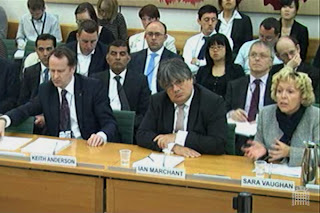
Keith Anderson of ScottishPower, Ian Marchant of SSE and E.ON's Sara Vaughan telling MPs the Government is bungling energy policy.

The bosses of the Big Six energy companies have slammed the complexity and pace of energy reforms being proposed by the Government for slowing the rate of investment in new plant which the country so desperately needs.

You thought that it was the Big Six energy bosses who, following extensive lobbying, were getting the proposals for reform they wanted in the new Energy Bill. It turns out that instead, they think that there has been too much ideological and political interference, and far too much delay.

The bosses were speaking to MPs in the Energy and Climate Change Committee during its first evidence session on the Draft Energy Bill, which contains the Government's proposals for electricity market reform and Contracts for Difference (CFDs). MPs want to know if these financial tools are effective particularly in supporting renewable energy and carbon capture and storage (CCS).

Keith Anderson, CEO of ScottishPower, told MPs that “this country used to be a fantastic place to invest in for energy because everyone had faith and trust that it was done in an evidence-based way". But this is no longer the case, and it is causing uncertainty and a hiatus in investment.

He spoke of the “massive amount of work" that was done in providing evidence during the lengthy consultation on the banding review for the Renewables Obligation last year, that came up with a lot of recommendations for the future.

“But then, since October, what we've seen is an awful lot of noise from politicians and in the media, and speculation about arguments between government departments that there will be political influence over the outcome of that consultation that it is not evidence-based, and this damages investor confidence."

Anderson called for more clarity, speed and confidence to be given by the Government. “There's a huge opportunity now for the UK to go out and grab a huge proportion of investment for renewable energy. Given the slowdown in our economy and in other countries I think right now is the time for the UK to put in place a very clear, long-term and robust framework," which should be “used to regenerate the economy".

However, he said that there is still a lot more detail required in the Bill, particularly on Contracts for Difference, and this was prolonging uncertainty amongst investors.

John McElroy, director of policy and public affairs at RWE Npower, agreed that as it stands, the Bill will not provide the confidence that investors need and requires a lot more work. "At the very least investors need to know how the capacity mechanism will work and when it will be triggered," he said.

“What we really want to see is the timetable moving forward and the government getting on with it," added Sara Vaughan, Director of Regulation and Energy Policy at E.ON. "There is already some slippage because we expected the bill to be introduced in May and it is now not going to be introduced till probably the end of the year," which will delay the secondary legislation as well “and that causes concern".

Carbon capture and storage

On CCS, Ian Marchant, CEO of SSE, said, frankly: “We do not know that this technology will work" and so developers "crucially need capital support at this stage to move beyond the demonstration phase".

He said that Government energy policy is predicated on assuming that it will work, but this is currently unknown.

Support for wind power

Anderson said finding investment for wind farms was more difficult in the UK than abroad because planning permission takes longer, land rental is more expensive and development costs are higher than elsewhere.

On the level of support for onshore wind, Marchant agreed that this should come down as costs reduce, and said that he doesn't get involved in bilateral discussions about the level of support. He said that he didn't like the way that discussions on nuclear and renewables were being conflated. “I do not believe that the returns being made on renewables are excessive" he added.

Call for more evidence

The Energy and Climate Change Committee, which today is on a fact-finding mission to the London Array and Gunfleet Sands Windfarms, has issued a call for evidence from the public on the economics of wind power, to be submitted by 27 June; there is to be a hearing on 10 July.

Tim Yeo MP, Chair of the Committee, said: “Government policy on wind power should be based on sound economics and engineering, not political pressure from a small vocal minority – whether that be green campaigners or anti-wind protestors.

“In this session we want to cut through all the hot air talked about wind power and examine whether the economics really add up. Wind farms are over forty times less polluting than gas burning power stations - per unit of energy produced - but there are concerns about the costs to consumers.”

Contracts for Difference

All the energy bosses agreed that they were in favour of Contracts for Difference because, unlike the Renewables Obligation, although it had many advantages, they will be able to support the massive increase in investment in renewable energy that is required in the coming years.

John McElroy agreed the Electricity Market Reform was too complex, and was taking too long to understand and finalise.

Sarwjit Sambhi, Director, Finance and Strategy at Centrica, owners of British Gas, said that the capacity payment was good for gas-fired generation, which was required in the medium-term.

Government “dishonest” on nuclear power

Marchant criticised the Government for trying to disguise their support for nuclear power, in doing so coming up against state aid rules, and called for “an honest and open discussion about whether the country needs it and what is the cheapest way of doing it as opposed to disguising it in a very complex set of proposals, so it actually doesn't have negative connotations."

Marchant described investment in wind power as much more manageable than in nuclear power, and preferable because it has a period of clean construction of two or three years. “Nuclear is a completely different animal. You have billions of pounds of investment and a build time of seven to ten years."

The MPs were also questioning whether there was enough provision for reducing demand for electricity in the Bill and the level of and exemptions to the proposed Emissions Performance Standard.

Thursday, May 03, 2012

Government energy policy splits laid wide open


Tim Yeo, MP

Veteran environmentalist MP Tim Yeo has called the energy minister Ed Davey and his department "weak",  and slammed tjhe Treasury,  and other departments for interfering in the UK's carbon-reduction and energy policies.

Speaking at today's UK Energy conference organised by The Economist magazine, Tim Yeo, Chair of the Commons Energy and Climate Change Select Committee, slammed the Treasury for constantly interfering with DECC's activities and policy development, confirming (which is news to no one who has been following environmental issues for 30 years) that the Treasury is not at all green.

He didn't stop there, but also laid into the Department for Communities and Local Governments, and the Department for Transport.

He labelled DECC a “weak department" for letting its policies be "crawled all over" by these three other departments and called Ed Davey a “junior partner" in any negotiations.

Referring to the carbon price floor as “the Treasury's latest wheeze" and “simply a way of getting more tax", he said that “the UK needs a carbon price signal not a carbon price floor, which is having the opposite effect to what George Osborne claims".

This is the first time there has been such open admission by an MP at a major energy conference of the existence of such high conflict between these government departments.

Yeo said that if Britain wants to be in the “premier division" internationally in 15 years' time, then energy needs to be higher up the priorities for the Government.

Despite this, he said that the required level of investment in UK energy infrastructure, of £200 billion by 2020 is “achievable", although he said there is no 'plan B' if we fail.

He said that the technology is already to hand to solve our energy crisis but that we don't yet have the right policies and price signals. He expressed alarm that firms like E.ON are pulling out of nuclear power in the UK.

While saying that the UK cannot rely on fossil fuels, whose price will rise due to rising demand, Yeo, a veteran Tory environmentalist, advocated that “we should exploit the shale gas resources we have in this country".

Yet in the same breath he said that replacing coal with gas “doesn't get us anywhere near the Committee on Climate Change 2030 decarbonisation target".

On fuel poverty, he said that it can't just be solved by changes to energy policy because it is also a Social Security issue.

Tony Cocker, Chief Executive Officer, E.ON UK, blamed a pause in investment on last year's review of the Renewables Obligation banding levels, and its (in investment terms) imminent demise in 2017.

Electricity market reform delay


Cocker, said that the UK needs the electricity market reform to happen speedily and not just be a “make do and mend" solution. "We are not asking for an extension of CERT and CESP we are pretty sure we can hit the targets" we have on fuel poverty, he added.

All the panel agreed that certainty was urgently needed on the planned reforms, especially in the light of alarming reports by the BBC last night that legislation on the topic would be postponed this summer to make room in the parliamentary timetable for reform on the House of Lords.

This was immediately denied by a Department for Energy and Climate Change spokeswoman, who said, “This is categorically untrue. We have said for some time that we intend to legislate for electricity market reform in the forthcoming session of Parliament”.

On the issue of energy pricing and investment, Cocker said of E.ON “We need the trust of our customers to create a sustainable energy system", somewhat ironically given the number of protesters outside the conference who were not permitted to enter.

He admitted that his company “needs more transparency on pricing and profits", and laid the gauntlet down by promising to put the extent of his bonus in the public domain.

The panel chairman, the BBC's Energy and Environment Analyst Roger Harrabin, earlier asked the organisers why protesters who had gathered outside the building, part of a Climate Justice day of action, were not being allowed in, and was told that the conference programme had been changed to reflect popular concerns about fuel poverty, and that they and grassroots organisations would be invited to next year's event.

Raising laughter, Mr. Harrabin summarised six months of energy policy in eight words as: “FiTs fiasco, nuclear no-show, wind whiplash and shale shivers".

Investment challenges


Speaking for the Carbon Trust, its CEO Tom Delay admitted that “sustainable solutions are difficult to invest in because they are capital intensive" and because of the uncertainty around costs.

He said that “light touch energy regulation" is deterring investment in “resilience, efficiency and an overhaul of the National Grid".

However, he advised that “it's dangerous to always focus on cost rather than investment"; it's the lifetime savings on bills that should be the chief criteria for investment decisions.

That is why the quick payback received from investing in energy efficiency makes it an “easier option" for large companies to be sustainable.

He slated UK building standards on energy efficiency for being too low, a decade or two behind those in Europe and North America.

Fuel poverty


The London School of Economics' Professor John Hill, author of last March's landmark Fuel Poverty Review, astonished the audience by explaining that under current definitions of fuel poverty, the Queen qualifies since over 10% of income is spent on fuel.

He said that a better criteria for fuel poverty is to measure the overlap between low incomes and high energy costs.

Friday, December 16, 2011

Low carbon electricity suppliers to get guaranteed fixed payments

Dinorwig pumped storage generator in north Wales

The Government's proposed reforms to the electricity market include guaranteed fixed payments to suppliers to ensure revenue continuity.

Measures were outlined yesterday by the Government to secure future low carbon electricity supplies.

They set out how new generating capacity (such as renewables, carbon capture and storage (CCS) and nuclear) and non-generation capacity (such as demand-side response and storage), could reduce the impact on customer bills, and create a secure mix of electricity sources to meet projected increased demand.

Energy and Climate Change Secretary Chris Huhne said: “The UK faces a huge energy investment challenge over the coming years, with a fifth of our generating capacity coming to the end of its working life and electricity demand set to double. We want to give certainty to investors to develop the mix of clean energy sources that will power the UK in the years to come.”

Measures outlined include:
  • next steps for the Electricity Market Reform programme;
  • a Capacity Market, designed to ensure reliable electricity supplies and avoid the higher prices that could result from tight capacity margins;
  • a proposal for a System Operator who would work with the National Grid to manage the Feed-in Tariff with Contracts for Difference (FiT CfD) and the capacity mechanism;
  • detail on work to enable investment decisions for early projects;
  • detail on how Renewable Obligation Certificates will work after 2027.
Reform of the electricity market will begin around May 2013, with the first low carbon projects resulting from it beginning the following year.
The New Year will see more information about how Emissions Performance Standards and FiT CfD will work.

The job of the System Operator, sitting within National Grid, will be to advise the Government on key rules and parameters and administer the FiT CfD and Capacity Market. A settlement agent will manage payments. Ofgem will continue to regulate the new system.

What is a Capacity Market?

The proposed Capacity Market is intended to ensure that sufficient reliable capacity is available by providing incentives to invest not only in generation but also non-generation approaches such as demand side response, or, interestingly, for existing capacity to remain operational beyond its previously estimated life.

Approaches that do not involve generation, such as storage and demand management, are, significantly, acknowledged as potentially being cheaper and helping to cut carbon emissions.

The technological options for electricity storage are increasing, with a number of interesting solutions coming forward such as chemical and flywheel storage as well as pumped storage (pictured above at Dinorwig, North Wales).

The government is also looking at further ways to incentivise efficiency in the use of electricity, including the smart grid.

The detailed design of the Capacity Market, including the payment model, will continue throughout 2012 and into 2013 leading to secondary legislation, with the first delivery plan published in 2013.

It represents a state intervention in the market that begins by estimating the total volume of reliable capacity required a number of years ahead, contracting for the required volume of reliable capacity from providers through a central auction process; and then placing incentives on those providers to ensure they are available when needed.

The additional capacity that results from the Capacity Market is expected to have a dampening effect on electricity market prices.

The 'availability payment'

Responding to criticism that there have been too many changes in government policy on feed-in tariffs and other support measures, which have affected revenue flows in the industry, the Government says that it will establish a “robust legal framework to protect investors against unilateral changes to the FiT CfD" to ensure the predictability of revenue flows.

This will include an 'availability payment', which would compensate providers of capacity for lower electricity market revenues. The level of this guaranteed regular payment is yet to be decided.

Capacity Market have been implemented elsewhere, for example in the United States and Colombia. France and Italy, are in the process of introducing similar mechanisms.

The theory is that a Capacity Market provides an ‘insurance policy’ against a tight future electricity generation market resulting in higher levels of blackouts. Of all the models looked at, it is expected to have the least impact on average electricity bills.

It could lead to new entrants in the market in the form of Energy Service Companies and will also provide further incentives to roll out the smart grid.

More detail on the functions of the System Operator and the role of Devolved Administrations will be set out in the Electricity Market Reform policy document that will be published alongside the introduction of primary legislation next year.

Bridging the investment gap

The government has also outlined measures to ensure there is no gap in investment until the new system is established.

DECC is inviting discussions with developers about significant projects which can benefit from the proposed FiT CfD. Such projects might not be eligible for the Renewables Obligation or able to receive ROCs before the end of March 2017.

In order to supply this “comfort", as the technical note quaintly describes grant aid for any projects selected, legislation will have to be passed by Spring 2013; this is not guaranteed.

Reactions

Renewable Energy Association (REA), chief executive Gaynor Hartnell welcomed the announcements, but said that developers of energy-from-waste plants still lacked clarity on whether the proposed Emissions Performance Standards would affect them. "We're at a loss to know why this can't be settled straightaway," she said. Details are, however, promised early in the New Year.

Richard Lloyd, executive director at Which?, commented that since National Grid "will now have a vital role to play in dictating consumers’ future energy bills, the Government must guarantee it will be held accountable.

“With new analysis from the Committee on Climate Change predicting that investment in low-carbon power will add £100 a year to bills by 2020, it’s more important than ever that the Government does everything possible to help people manage their energy use and save money,” he added.

Steve Radley, Director of Policy at EEF, the manufacturers’ organisation, cautioned that the government reforms should "not damage the competitiveness of energy-intensive industries".

Saturday, October 01, 2011

Open letter to Ed Miliband: Don't be shy. You can do it!

Ed Miliband at the Labour Party Conference 2011
Dear Mr. Miliband

In the small amount of your speech to the Labour Party Conference that you devoted to energy, you observed that "we need investment" - with which no one would argue – and added that Labour would "build our economy not on low wages and high finance, but low carbon and high tech".

And in the following Q&A session, you said you "want my children to remember me above all for tackling climate change".

Fine words. But what exactly are the policies that might achieve this for Labour? You did not say.

Nor was there any hint from your Shadow Energy Secretary Meg Hillier in her speech, although she made a good job of lambasting the Government's record.

She reminded a fringe meeting that DECC is lampooned at Westminster for being the Treasury's poodle and listed the broken promises of the "greenest government ever":
  • "The Green Investment Bank - promised in Labour's manifesto, but hobbled under the Coalition. Delayed, and unable to borrow capital.

  • Research into bio-fuels - scrapped.

  • Zero Carbon homes - scrapped.

  • Charging points for electric cars - scrapped.

  • Low carbon businesses watching their orders disappear abroad.

  • A 'green deal' for home insulation which promises the earth, but few have even heard of."


My abiding memory of you, Miliband Junior, is from when you were Labour's Energy and Climate Change Secretary, at the COP15 Copenhagen climate summit, being interviewed by the disarming The Age of Stupid director Franny Armstrong - while standing on her head.

You were very relaxed and spoke with conviction about having ambitious goals for the climate change talks.

Around that time, you called upon anyone who cared about climate change to put pressure on the Government, because it was only when doing so that it felt it had a mandate to push for demanding more at top level negotiations such as Copenhagen.

It was a surreal moment. It was if the world – rather than Ms. Armstrong herself – had been turned upside down.

One felt that when politicians ask the people to protest - and even join them on a demonstration - it is an admission of how little power they honestly feel that they have.

It made you seem human, and indeed you were an approachable and enthusiastic Energy Secretary.

But is this what we want from prime ministers? Don't we want them actually to be superhuman - strong leaders who intuitively know what is the right thing to do, get on with it, and show us the way?

Instead, as you know, we live in an age of focus-group politics that gives the illusion of democracy but is still dominated by vested business interests.

So perhaps this is why you chose to attack "the dominance of the big energy companies" in your keynote speech.

Yet what, people listening asked themselves, would you do in government that is different either from what the Coalition is doing now or what you yourself did when in power?

Did you do anything to challenge what you called the Big Six "rigged market" then?

Actually, you did.

Remember 2009's Climate Camp at Kingsnorth power station, which campaigned against the threat of a new coal-burning plant which E.ON, one of the Big Six, wanted to build?

Just prior to this, you attended The Age of Stupid film premiere where actor Pete Postlethwaite ambushed you and threatened to return his OBE unless you refused permission for this plant.

One month later you announced that no new coal-fired power station would get government consent unless it can capture and bury 25% of the emissions it produces immediately – and 100% of emissions by 2025.

This, a DECC source told the Guardian, represented “a complete rewrite of UK energy policy” - one which has continued to this day, surviving a change of government.

That's an impressive achievement, because it was the right thing to do.

Why didn't you remind the conference of this in your speech. You might have said, "I've taken on an energy giant before, I can do it again".

The source of energy policies


Admittedly, your party is three years from a general election, and it doesn't need to have specific policies yet.

But if Labour wants to really break from the past, as well as break the dominance of the energy companies, you could do far worse than to get down to basics, throw away the rulebook, and take a long, hard, and fresh look at the evidence base upon which governments have built their energy and environment policies for the last ten years.

Only then will you be able to reconstruct a legitimate yet radical new policy that has credible foundations.

This evidence base, as it is now, rests to far too great an extent on the commissioned research of external consultants.

These well-paid and influential firms toil in the relative shadows of government and produce reports full of cost-estimates and scenarios that 'prove' the relative worth of different policy choices - for example alternative energy mixes - which subtly nudge officials and ministers into weighing down on one policy side rather than another.

I'm talking about firms like Redpoint and Trilemma, who have produced and are continuing to produce reports for DECC on topics like the reform of the Renewables Obligation and other renewables and nuclear power support schemes.

The actual bases for their figures are often shrouded in mystery, and quite possibly pulled out of thin air, as they try to guess what energy prices will be in five, ten, fifteen years time. Who really knows?

Yet the reports which are based on them are given the aura of great authority by subsequently becoming embedded in the superstructure of the Government's energy policy.

But who are these firms? They consist of a few self-selected individuals who have set themselves up as 'experts'.

If you look at the credentials and CVs of the firms' directors, you will see that their backgrounds are almost exclusively in either the fossil fuel industries or asset management or both.

And, for example, Redpoint's other clients include EDF Energy, Centrica, ESB, GE, Statoil, Vattenfall, and Shell. Are these names familiar? Remember the "rigged market"?

What a different set of energy policies do you think Labour might generate if it asked for figures and evidence from other types of experts? From independent academics, for example, from scientists or from 'the wisdom of crowds'?

Since, Mr. Miliband, you like campaigners, you might choose to study the research of NGOs such as WWF, Greenpeace, Forum for the Future and the Centre for Alternative Technology, who have all developed detailed scenarios for moving towards a zero carbon sustainable future, have no vested business interests, but instead memberships of hundreds of thousands of ordinary people.

The people who might vote for you.

Failing that, you might want to listen to the voice of Parliament's own Select Committee on Energy and Climate Change, which has taken evidence from hundreds of expert witnesses over the years.

In my opinion, this cross-party group has consistently come out with the sanest of policy advice, only to have it largely and politely ignored by the Lower House.

So, which 'expert evidence', Mr. Miliband, will form the basis for your policies? You pay your money, you take your choice.

By the way, Ed, you said in your speech that energy prices always seem to go up, not down.

In fact this isn't true.

The Department for Energy and Climate Change records average energy bills, and although these have risen in real terms over recent years, there was actually a fall between 2009 and 2010.

And who was Secretary of State for Energy and Climate Change then?

Step forward, Ed Miliband. Don't be shy.

Either you have a short memory, or you are far too modest ever to stand a chance of being Prime Minister.

You need to do more to remind people of your successes, and have the courage of your convictions.

Tuesday, July 12, 2011

Electricity market reform unlikely to stimulate sufficient investment

The Electricity Market Reform White Paper is scheduled to be published today, the most radical change to the industry since it was privatised 20 years ago, but business is worried that it still won't provide sufficient certainty to permit the required levels of investment.

The paper is designed to shake up the way the supply industry operates and allow the construction of sufficient renewable energy to help the UK generate 15% of its electricity from renewable sources by 2020, compared with just 3.3% last year. (Only Cyprus and Malta generate a lower proportion of renewable electricity than the UK in Europe.)

The projected £200bn of investment needed by 2020, according to industry regulator Ofgem, is supposed to be sparked off by a guaranteed price for low carbon electricity, including nuclear, which will be passed on to businesses and households through higher bills.

After British Gas' price hikes - gas up 18% and electricity up 16% - announced last Friday, this announcement is particularly sensitive. But such hikes “demonstrate the problems caused for the UK by our over-reliance on energy from overseas", commented Juliet Davenport, CEO of 100% renewable electricity supplier Good Energy.

Almost 60% of the energy we use is imported and the latest rises in wholesale prices are largely due to events overseas out of our control. The proposed market reforms will help to increase energy and price security, and Chris Huhne insists that they will mean a long-term reduction in bills, also because of other Government measures to reduce household energy consumption.

“Once you take the effect on bills you actually find that we're getting overall bill down in the long-run,” he told the BBC, claiming that the UK has "the lowest energy prices in Europe".

Contracts for Difference


Under the white paper's proposals, a new scheme will come in from 2014, replacing and simplifying the current Renewable Obligation Certificate, where generators of renewable power earn tradable certificates which they then sell to utilities.

This system, called Feed-in-Tariffs with Contracts for Difference, will cut support for onshore wind and favour offshore wind and is intended to provide better value for money.

An agency - yet to be decided if it is a new institution, Ofgem or a government department - will pay a top-up premium for green power above the wholesale electricity price, up to an agreed fixed, or "floor," price.

If the wholesale price were to exceed the floor price, the renewable energy supplier would have to pay back the difference to the agency, under long-term contracts designed to promote certainty for investors.

The exact price, plus the amount of low carbon electricity the agency would buy, will be set nearer the time, but may be set by auction for "mature" technologies if there are enough bidders, as with nuclear power.

Business has warned, however, that too much delay on these crucial details could seriously put off vital decisions on investment.

Existing ROC contracts will be protected from the change. Developers will be able to choose between the ROC and the new scheme from 2014-2017.

There will not be an explicit target for utilities on how much of their electricity must be from renewable sources.

HMRC has worked out that electricity bills for an average energy-intensive business are estimated to increase by 2% and 6% in 2013 and 2016 respectively as a result of the carbon price floor, but by the late 2020s bills will be between 2% and 5% lower than would otherwise have been the case.

Reducing the monopoly of the Big Six


The established energy utility companies supply 97% of the energy consumed in households, and part of the purpose of the market reforms is to reduce their stranglehold.

Tim Yeo, Chair of the ECC Committee, has said that "radical reform" of the wholesale energy market is needed to "stop the Big Six from stitching it up".

Last week, Chris Huhne, who told the BBC, “we have to break the dominance of the big six”, met representatives of small energy supply companies who want to become the big companies of tomorrow. They told him that he had to do more to encourage independent energy generators so that smaller suppliers actually have someone to buy energy from.

They asked him to force the large companies to sell a minimum proportion of their electricity on the wholesale market, which would allow independents to undercut their prices.

Good Energy's Juliet Davenport, fresh from being honoured at the 2011 First Women Awards for the Retail and Consumer sector, told Huhne that the Government "has to balance its aim of simplifying energy tariffs with allowing smaller suppliers to innovate".

She also said there must be "complete transparency around the way Big Six generate and sell energy" to "buffer households and businesses from price hikes".

Mike Benson, of Carlton Power, said that allowing small companies to compete is crucial, because the balance sheets of the large utilities "are not strong enough”. “This really is the last chance,” he said. “If the big six are given a soft run this time round, they will lock themselves in for the next 20 years as the only ones able to play in this market.”

In another effort to support community renewable energy schemes, amongst other things, the Treasury had opened a consultation on the provision of finance for them - Tax-advantaged venture capital schemes - which Chris Huhne says will ensure that "enterprise investment schemes and venture capital trusts that invest in Feed-In-Tariff schemes through community-interest companies, co-ops and community benefit societies, will continue to qualify for improved support, as will those generating electricity from micro-hydro schemes".

Support for nuclear


The Select Committee on Energy and Climate Change warned the Government on 16 May that the long term contracts envisaged by the proposed bill at that point will work for supporting nuclear power, but that "different types of contract are needed for renewables and other clean technologies".

The white paper will reveal whether the Government has listened to this advice.

The proposed market reforms could end up giving a £1 billion windfall to nuclear power developers, who are among the Big Six, helping to consolidate their position.

This is why the ECC Committee warned in its report on the proposed bill that the Government "risks distorting its reform of the electricity market merely to save political face over implicit subsidies for nuclear power, through the use of a Carbon Price Floor Support system". It "will increase costs for consumers", they said.

LibDem MPs have also criticised the subsidy and are likely to vote against it.

The ECC Committee's report said the starting point for market reform should be a "clearly defined objective to reduce the carbon intensity of electricity generation in the UK to 50g of CO2 per kilowatt hour (KWh) by 2030".

Demand management


The report also warned that "it is too early for the Government to design a capacity mechanism given the rapid development of smart meters, interconnectors and storage systems that could remove the need for 'peaking plant'".

Reducing peak demand will reduce the amount of overall generation capacity required. Traditionally, energy planning has been done on the basis of meeting peak demand. But the roll-out of smart meters, the Green Deal and other policies will help reduce these peaks.

Greg Barker told Zac Goldsmith in the House last week that "demand reduction is not like alternative forms of energy generation. We are creating a new model, and different types of indices and accounting will be necessary. We will need a robust system of measurement as well as the market mechanism."

Goodbye to coal


Another effect of the market reforms will be to stop British power stations burning coal to generate power within the next three years, which Chris Huhne insists is also vital to bring stability to household bills.

"We've got to move to low carbon sources," Mr Huhne said. "We've got to get off that oil and gas fuel hook."

Carbon emissions from new coal plants will be limited to 450 grams of carbon dioxide (CO2) per kilowatt hour of power production, meaning they must have carbon capture and storage equipment installed.

Tuesday, May 17, 2011

Government's electricity market reforms are 'half baked'

The Government's proposals for reforming the electricity market have come under a hail of attack for being short on detail and plain wrong in other areas, as well as opening a back door for subsidising nuclear power.

According to a committee of MPs, there is a gaping hole in the Government ambitions to reform the electricity market - set out in a consultation which closed on March 10 and which is awaiting Government response - and that is an absence of a plan for the wholesale market.

The wholesale market ″would not be changed by the measures proposed", says the Select Committee on Energy and Climate Change in their review of the Government's proposals.

“The consultation document proposes a number of "bolt on" measures that reform the subsidies and structures around the market, not the market itself", they continue.

The market dominance of the Big Six energy companies must be broken up they say, "in order to allow new entrants to invest in the UK's low-carbon future". Currently, they are almost unchallenged in the sector as they control both generation and supply, therefore there is little room for independent or decentralised generation.

“This lack of liquidity in the market makes it hard for potential investors" and new entrants, says the review.

The MPs also say that "the Government's 'one size fits all' approach will fail to bring forward the low-carbon investment we need".

Some generators such as nuclear and biomass which can provide continuous power will benefit from the kind of contracts proposed, but for intermittent generators such as wind and solar, and technologies like carbon capture and storage and electricity storage itself, the contracts are inappropriate.

Support for nuclear power


It says that the proposed Feed-in Tariff with Contract for Difference is fine to expedite an extremely rapid rollout of nuclear power, "if that is the option the Government wishes to pursue," but MPs suggest other kinds of long term contract should be designed as well for other kinds of low carbon generation.

These contracts give a guaranteed price for generating electricity from nuclear power over the long-term in order to help finance the construction of the plans. However, this effectively amounts to a subsidy which is given to nuclear, whereas the Government is ostensibly opposed to such subsidy.

"Ministers ... don't want to own up to supporting [nuclear power]," said Committee chairman Tim Yeo. "This is understandable given the promise they made not to subsidise nuclear, but it would be deeply irresponsible to skew the whole process of electricity market reform simply to save face."

As a result, the government should immediately put together an independent team of experts to develop alternative financial incentives for all low carbon energy generators.

Juliet Davenport, CEO of Good Energy, a generator and supplier of renewable energy, welcomed this recommendation. "It is important that the Government creates a truly level playing field so that renewable energy doesn't miss out because of hidden subsidies for other technologies," she said.

Energy efficiency is overlooked


The committee has other criticisms of the proposals.

There is not enough focus on energy efficiency in the review. "Demand reduction ought to be a primary focus of the Government's decarbonisation agenda, as the most cost-effective and environmentally effective method of climate change mitigation."

It "should be placed at the heart of EMR and the Government's climate change policy".

DECC proposes a carbon intensity of 100g CO2/kWh for electricity generation by 2030, compared to the present 490g CO2/kWh. But MPs say instead they should accept the recommendations of the Committee on Climate Change and let the electricity market review aim to achieve 40-60gCO2/kWh by 2030.

The level of the Carbon Price Floor is crucial to the success of the reforms. MPs criticise the Treasury for introducing the price in this year's Budget ahead of the review of market reform. The floor will start at around 」16 per tonne of carbon dioxide in 2009 prices (equivalent to 」19.16 in 2013-14 estimated prices) and follow a linear path to 」30 per tonne in 2020 (in 2009 prices).

"We would have preferred the government to establish a nominal Carbon Price Support level until 2018 and then set a long-term trajectory based on advice from the Committee on Climate Change," the report says. "Until then, the Carbon Price Support represents little more than an additional energy tax, which will be passed on to consumers."

Furthermore, proposals for an Emissions Performance Standard (EPS) are ″half baked" say the MPs. "The EPS proposed in the consultation document would have no material impact and is therefore pointless. The prospect that the EPS will be tightened by unannounced amounts later on introduces additional political risk."

The caveat that the EPS could be changed later if it is not working just introduces more uncertainty into an already highly uncertain investment world, they say.

The Government also has a duty to explain to the public what the costs of decarbonisation are and how they will be met. To be sustainable the reforms must have public support.

More detail is also called for in other areas, such as interconnection, carbon price trajectories, the contribution of decentralised generation, technological improvements, the pace of electrification in the domestic heating and transport sectors, and what happens if the price of gas falls.

A target timetable for implementation must be published as soon as possible, once the details are right, to reduce the uncertainty that is deterring investment.

Electricity market reform must also be coordinated with other developments, such as the Energy 2050 strategy in Europe and the transmission pricing review.

This topic is too important to get wrong, they conclude. Without the 」110 million of investment necessary in the electricity sector in less than 10 years, the UK will not meet its decarbonisation and energy security targets.