What is one planet living? Watch a video of my talk at the Centre for Agroecology, Water and Resilience!
Showing posts with label ecological footprinting. Show all posts
Showing posts with label ecological footprinting. Show all posts
Friday, February 02, 2018


Thursday, December 14, 2017
How can cities reduce their ecological footprint?
 |
| Is this the future of cities? |
The last post in this series looked at the vital role of ecological footprinting in ensuring that our individual actions are truly sustainable – i.e. within the limits of what the Earth's resources can provide. This is called 'one planet' development.
This post will begin to look at how communities of varying sizes might transition to one planet living, in other words, how towns and cities can reduce their consumption levels.
The challenge
The world's citizens must reduce their collective footprint to one planet equivalent or face various catastrophes: out-of-control climate change, mass extinctions, famine and the death of the oceans to name but four on the agenda.The global population is now 7.5 bn. and is predicted to peak at 11.2 bn by 2100 (UN). By this time up to 84% of us may be dwelling in cities. A frightening thought.
Yet all around the world, many different projects and initiatives to tackle their impact – both top-down and bottom-up – are evolving, especially in urban areas, as cities gain more confidence. They are supported by a plethora of pan-global organisations such as C40, ICLEI and the World Future Council.
These initiatives cover most fields from energy and water to transport, buildings and industry, with the latter being particularly tough to tackle.
Cities hoover up resources from the rest of the world. Unless those resources are both replenished in their place of origin and reclaimed for reuse in closed loop systems within cities, then cities cannot survive indefinitely.
So it is in cities where the battle for the future will be most harshly fought.
>Standards? What standards?!
To help us fight this battle effectively, we need assured processes. Enter the role of standards.Standards are essentially manuals containing a set of guidelines and metrics to be followed and met in pursuit of whatever goal you're setting yourself.
There is a new standard to measure the sustainability of cities: Indicators for City Services and Quality of Life (ISO 37120). It is being piloted as part of an integrated suite of standards for sustainable development in communities by such as Mexico City.
There are many other indicators and standards for measuring sustainability: for example the United Nations Sustainable Development Goals contain a goal specifically about cities, and there is the New Urban Agenda, not to mention the Global Footprint Network's Ecological Footprint Standards 2009
Which standards should we use?
Standards can be relative or absolute. In other words, they can set a target of, say, a (relative) 50% reduction from a certain baseline, or an (absolute) target of, say, zero waste to landfill.Absolute targets enable comparison and ranking between different cities or projects; we can compare the performance of communities by dividing their consumption by their population.
Absolute targets can also be linked to the (absolute) resources of the planet. In fact, standards must refer to planetary boundaries.
Standards should also be simple to communicate and implement – especially in relation to the gathering of the necessary data.
They might be designed to make it easy automate the gathering of data from existing data collection methods.
According to John Delaney of the British Standard Institute, "What option is chosen depends on what suits a city and/or what they are most comfortable with."
Mathis Wackernagel, president of the Global Footprint Network, says that, “Perhaps the driving question becomes – what do places need to know in order to operate safely in an ecologically ever more constrained world. Cities need to have the critical information.”
Back to Wales
Back in Wales, the home of One Planet Development, its Well-Being of Future Generations Act is its very own charter to make Wales sustainable within a generation or two. It uses various metrics and standards to measure this and some have yet to be decided at the local level. |
| The seven Well-Being Goals in the Well-Being of Future Generations Act |
It is essentially about spending. The Act means to ensure that the spending of public money is done in a sustainable way. That is to say, it does not jeopardise the ability of future generations both to live well and within planetary limits. The list of metrics includes:
- Economic output – Gross Value Added
- Social Justice - percentage of the population in relative low-income households
- Biodiversity conservation – status of priority species and habitats
- Ecological footprint – national EF against the UK and global average
- Wellbeing - a standard set of 36 health questions which ask respondents about their own perception of their physical and mental health.
- UN’s Sustainable Development Goals
- Carbon footprinting.
To try and ensure this is done, procurement strategies still need to be thrashed out.
And there is an independent Commissioner for Future Generations, who acts as a government watchdog.
(In England, the Tory Government abolished this role, which was held by Jonathan Porritt, in 2011).
The path towards One Planet Towns and Cities
So here is my deceptively simple six-step process for a town or city that decides it wants to reduce its ecological footprint to a fair and sustainable level:- Decide which standards to use
- Obtain buy-in from citizens and all branches of government and obtain feedback at all level
- Set the baseline – identify the current situation for each of the impacts (energy, water, food, minerals, biodiversity, carbon, pollution, health, income inequality, etc.)
- Decide the objectives to be set for each aspect of the footprint over realistic timescales. These should ratchet down consumption in stages over one or two generations.
- Set in place ways to measure them and to independently enforce them.
- Celebrate all your achievements!
This makes it sound easy. But the task ahead is momentous. Above all it requires skills, knowledge and leadership.
You know, anyone can become a leader. You just have to decide to do something.
If you doubt this, look for a moment at the enormous difference a small group of people in Todmorden have made. They started the 'Incredible edible' guerilla food-planting movement now copied all over the world.
One Planet Towns vs. Transition Towns
I believe that 'one planet' towns should be what 'transition towns' transition towards.Transition towns do not generally measure the efficacy of their actions. While they may very well be doing lots of good work, it may be that the efforts of some are only scratching the surface of what needs to be done, and at worst, wasting their time.
They would have to account for the whole picture of consumption of their community in order to be sure, and then check what difference their actions are making over time. This is hard for voluntary organisations to do, and indicates why it is crucial to work with the authorities.
But the authorities often do not want to know. In such cases they need to be trained to see the benefits that would accrue to their communities. Success depends on both top-down and bottom-up co-operation.
The need for training
In 2018 I am setting up a new body called The One Planet Institute that will contribute to this work. Contact me for more information or to get involved.Measurement and verification may be boring. It may be hard work. It might even seem a waste of time to some people. But I know from my experience in energy management and in the post-occupancy evaluation of buildings that were intended by architects to be low-carbon, that it is the only way to be absolutely sure we are NOT wasting our time.
In short, that we are targeting our efforts in the most worthwhile directions.
Next article
The next article in this series will look at the hardest component of the ecological footprint to reduce – food production and consumption.One Planet Living is about showing the way:
- To buy The One Planet Life, click here.
- To enquire about hosting a workshop or training in One Planet Living, or anything else, email David.
Friday, November 24, 2017
What is One Planet Development?
Something special is happening in Wales. The country is using legislation to shift itself into a very different direction from England. It wants to be more sustainable. It wants to reduce its ‘ecological footprint’ to a level that’s fair compared to the rest of the planet’s population and resources.
Spearheading this approach is the notion of One Planet Development.
However planning guidance exists currently only for OPD in the open countryside. The criteria include:

Meanwhile, I run courses on how to do this, based on my book, The One Planet Life, which is a kind of manual and ‘big book of everything’ for sustainable living.
The One Planet Council, of which I am a co-founder and patron, is also a great source of help, both on its website and Facebook page for anyone wanting to do this or find out more.
To prove their claim in Wales, applicants must submit a planning application containing a ‘management plan’ that sets out their plans to meet these criteria. This includes detailing the land-based businesses they will run to support themselves.
When you have secured planning permission you have five years to meet the criteria. You can also use the ‘one planet’ label on your products that has been developed for marketing purposes by the One Planet Council.

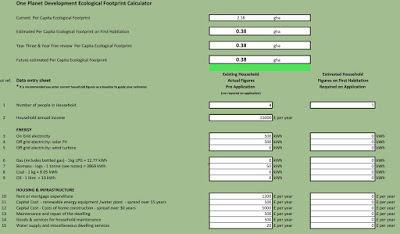
Above: a screenshot of the Excel-based calculator. It uses your expenditure as a way of working out your ecological footprint (click to enlarge).

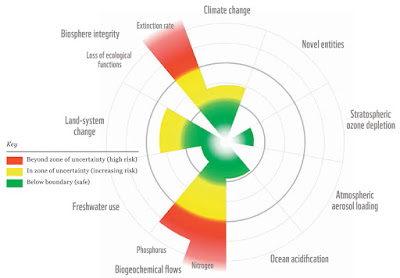
As defined by the environmental charity WWF, there are nine ‘planetary boundaries’. Every couple of years WWF produces a brilliant survey called a ‘Living Planet Report’. The last one, in 2016, said that of these nine limits to growth, four have passed safe levels: climate change, biosphere integrity, biogeochemical flows and land-system change.
WWF says that humanity now needs the regenerative capacity of 1.6 Earths to provide goods and services we collectively use. But the per capita ecological footprint of high-income nations dwarfs low- and middle-income countries. What will happen if 11.2bn people want North America’s standard of living?
Ecological footprint is measured in ‘global hectares’. It divides the ‘biocapacity’ of land (supply) by human consumption levels (demand). The biocapacity is a measure of the pollution land can absorb and the services and resources it can provide. The demand is the population level times the consumption level. The result is an average of hectares per person, if it were distributed equally between everyone alive. A hectare is 2.47 acres or 10,000 square metres or 0.01 square kilometers.
According to the last report, the fair level is 1.7 global hectares per person.
Not very much. It is the level of the world’s lowest consuming countries, in Africa and the Indian sub-continent.
So we in the UK must move from an average level of three times this (as if, if everyone were living this way, we had three planet Earths – if only!) to one.

One Planet Living is about showing the way. It is the start of an immense and difficult journey.
Spearheading this approach is the notion of One Planet Development.
What is One Planet Development?
Through its Technical Advice Note 6 (TAN 6) and Planning Policy Wales (PPW) the Welsh Government sets out land use planning policies to support sustainable communities. Planning Policy Wales (2016) says:4.5.11 Closely aligned to the commitments to tackling climate change is the Welsh Government’s approach to reducing the ecological footprint of Wales. Our Sustainable Development Scheme sets out an ambition for Wales to use its fair share of the Earth’s resources, where, within a generation, our ecological footprint is reduced to the global average availability of resources – 1.88 global hectares per person. The current footprint shows that, if everyone on the Earth lived as we do, we would use 2.7 planets worth of resources. Reducing Wales’ ecological footprint will require a large reduction in the total resources used to sustain our lifestyles. The policy and guidance set out here in PPW will make an important contribution to reducing our footprint, whilst delivering sustainable development and tackling climate change.Section 4 of TAN 6 defines One Planet Developments (OPD) as being exemplars of sustainable development:
4.15.2 One Planet Developments may take a number of forms. They can either be single homes, co-operative communities or larger settlements. They may be located within or adjacent to existing settlements, or be situated in the open countryside.In other words, anywhere.
However planning guidance exists currently only for OPD in the open countryside. The criteria include:
- An initial ecological footprint of 2.4 global hectares per person or less and clear potential to move towards 1.88 global hectare; the Welsh Government provides an Excel-based calculator on its website to help you work out your own footprint
- Buildings being zero carbon over their lifetime;
- Carbon analysis and improvement plan for the plot;
- Biodiversity and landscape improvement;
- A community impact improvement;
- Transport assessment and travel plan to minimise carbon impact of travel;
- Sustainable water supply;
- Zero waste (including biological waste – sewage treatment)
- 100% renewable energy.
- Over a reasonable length of time (no more than 5 years), to provide for the minimum needs of the inhabitants in terms of income, food, energy and waste assimilation from land-based employment.

Meanwhile, I run courses on how to do this, based on my book, The One Planet Life, which is a kind of manual and ‘big book of everything’ for sustainable living.
The One Planet Council, of which I am a co-founder and patron, is also a great source of help, both on its website and Facebook page for anyone wanting to do this or find out more.
How to do it
Anyone wanting to pursue this life in Wales, in the open countryside, where one is not normally permitted to build a home, must satisfy the above criteria. In England, sometimes a Local Development Plan can have similar criteria, or an authority can use a Section 106 agreement to permit it, as with Hockerton Housing Project.To prove their claim in Wales, applicants must submit a planning application containing a ‘management plan’ that sets out their plans to meet these criteria. This includes detailing the land-based businesses they will run to support themselves.
When you have secured planning permission you have five years to meet the criteria. You can also use the ‘one planet’ label on your products that has been developed for marketing purposes by the One Planet Council.

Measurable and provable
The great advantage of this approach, and its ‘unique selling point’, is that it is measurable and provable. There is no doubt that your life will be a little more sustainable. Many times you hear claims about the sustainability of lifestyles or products and developments, but there is no way of knowing how true they are.
Above: a screenshot of the Excel-based calculator. It uses your expenditure as a way of working out your ecological footprint (click to enlarge).
What is an ecological footprint?
The global population is now 7.5 bn. and is predicted to peak at 11.2 bn by 2100 (UN). But the ability of our lovely planet Earth to support life depends on us staying within a number of ‘planetary boundaries’. Humanity passed this ‘biocapacity’ limit way back in the early 1970s. Our collective footprint has been rising ever since:
As defined by the environmental charity WWF, there are nine ‘planetary boundaries’. Every couple of years WWF produces a brilliant survey called a ‘Living Planet Report’. The last one, in 2016, said that of these nine limits to growth, four have passed safe levels: climate change, biosphere integrity, biogeochemical flows and land-system change.

WWF says that humanity now needs the regenerative capacity of 1.6 Earths to provide goods and services we collectively use. But the per capita ecological footprint of high-income nations dwarfs low- and middle-income countries. What will happen if 11.2bn people want North America’s standard of living?
Ecological footprint is measured in ‘global hectares’. It divides the ‘biocapacity’ of land (supply) by human consumption levels (demand). The biocapacity is a measure of the pollution land can absorb and the services and resources it can provide. The demand is the population level times the consumption level. The result is an average of hectares per person, if it were distributed equally between everyone alive. A hectare is 2.47 acres or 10,000 square metres or 0.01 square kilometers.
According to the last report, the fair level is 1.7 global hectares per person.
Not very much. It is the level of the world’s lowest consuming countries, in Africa and the Indian sub-continent.
So we in the UK must move from an average level of three times this (as if, if everyone were living this way, we had three planet Earths – if only!) to one.
Back to Wales
To go back to Wales, the law there contains a goal to make this shift in one generation.One Planet Living is about showing the way. It is the start of an immense and difficult journey.
- To buy The One Planet Life, click here.
- To enquire about hosting a workshop or course in One Planet Living, email David.
- The next post in this series will be about moving from individual to collective one planet living, in other words show towns and cities can shift their consumption levels.
Tuesday, June 03, 2014
How to Solve the Housing Crisis Sustainably
Britain has a housing crisis. Politicians are calling for the building of garden cities and for permitting building on formerly protected greenbelt sites. Business Secretary Vince Cable has told the Daily Mail that "building on green belt land should be 'encouraged' provided it is done in a 'proper way'". This follows the publication by the Department for Communities and Local Government of a prospectus for "Locally Led Garden Cities" which invites local authorities to put forward their ideas for how they wish to develop garden cities.
This all sounds positive, since, in the abstract, we love the idea of garden cities, with pleasant wide tree-lined avenues and residents tilling their gardens to grow their own food whilst cycling to nearby shops. But we all know how nice-sounding government policies frequently end up being hijacked by developers who wish to turn a tidy and quick profit and the dream, eventually, turns sour.
So, how to guarantee that these proposed new types of development are genuinely sustainable?
The only way, as anybody involved in sustainability accounting or energy management will tell you, is through monitoring and measurement of pre-established metrics, backed up by the threat of planning permission being revoked should agreed benchmarks not be reached. In other words, we should permit building on green field sites only if they can establish that they are truly sustainable in a measurable way. This approach could just as easily be adapted to urban living, in several potential and already existing ways:
The success is also a personal one for a family that has just realised its dream. The Moodys are a family which lives on a smallholding between Caerphilly and Cardiff. Theirs has become the first One Planet Development in Wales - and the world - to receive permanent planning permission. Called Nant-y-Cwm farm, it is home to Dan and Sarah Moody (below) and their five children who had already been working their 16 acre plot for four years and were seeking retrospective planning permission from Caerphilly Council.

They decided to apply for planning permission under One Planet Development, a forward thinking policy by the Welsh Government which provides a way for people to live and work on the land with social, economic and environmental benefits. In addition to meeting planning regulations, applicants are required to produce a detailed management plan and ecological footprint analysis which demonstrates their commitment to sustainable living, including how they will provide for at least 65% of their basic household needs from land based activity within 5 years.
Dan and Sarah are overjoyed by their success, which they put down to hard work and their close links with the local community. Cllr Ken James, Caerphilly County Borough Council’s Cabinet Member for Regeneration, Planning and Sustainable Development, commented on the application by saying: “We were satisfied, following lengthy discussion with the applicants that their proposals complied with the One Planet Development policies, subject to a number of strict conditions”.
Jeff Cuthbert, the Minister for Communities and Tackling Poverty, has also visited the site, which is in his constituency, and expressed his pleasure at seeing what they have achieved.
This is important for a number of reasons. The policy is one of which the Welsh Government should be extremely proud. Wales has an objective, set out in its sustainable development scheme One Wales One Planet, that: "within the lifetime of a generation, Wales should use only its fair share of the earth’s resources, and our ecological footprint be reduced to the global average availability of resources - 1.88 global hectares per person in 2003".
One Planet Developments should, according to the Welsh Government guidance, initially "achieve an ecological footprint of 2.4 global hectares per person or less in terms of consumption and demonstrate clear potential to move towards 1.88 global hectare target over time".
So the practice offers a transition to a more sustainable way of life by providing a way for people to live and work on their own land with measurable social, economic and environmental benefits. By using a verifiable metric - ecological footprint accounting - it is setting a precedent for assessing planning applications and other developments. In this sense, it is far from being of minority interest only.
A body has been set up to support both those who want to make planning applications under this scheme, and those in planning departments who have to process them, often a job that proves to be outside their training and experience. Called The One Planet Council, it is an independent voluntary body that also sees itself as furthering understanding amongst the public and policymakers of how the tools and practices enabled by this policy can further Wales' overall sustainable development requirements and, by example, the rest of the UK. I am a founder member. The body aims to work together with all those with Local Planning Authorities, policy makers, academics, landowners, and those already living on and planning to live on One Planet Development sites.
Jane Davidson, previously the Welsh Minister responsible for the introduction of the One Planet Development policy and now Director of INSPIRE at the University of Wales Trinity St David's, helped to launch the Council at the Royal Welsh Showground Spring Fair on 17 May (below).

Standing alongside the Moodys she said: "I'm so delighted to hear about the Moodys’ success. Wales is unique in having a national commitment to support those who want to demonstrate that it is possible and desirable to live in a way that reduces their impact on the environment. I hope that the success of this application will pave the way for others who want to pioneer living lightly on the land and in doing so help others think about actions they could take to harness local resources better”.

At the launch of the One Planet Council, left to right: Dan and Sarah Moody, Stefan Cartwright, Samantha Minas, Jane Davidson, Eduardo Bracho, Mark Waghorn and Pete Linnnell.
The planning guidance behind the policy holds open the door for One Planet Developments to occur in an urban context, but remains unclear on how this could be achieved. Some architects believe that ribbon development, for example, where there is green field countryside behind housing on transport links, offers one opportunity for this to happen. So does the concept of garden cities.
The OPD policy supports other policy aims of both the Welsh and Westminster Governments, including provision for affordable housing, reduced subsidy for agriculture, promoting healthy living, promoting sustainable communities and carbon reduction.
For example, in addition to producing meat, eggs and a wide range of fruit and vegetables, some of which is sold to local residents, the Moodys' smallholding also supports different local causes such as Kaleidoscope, a Cardiff based charity supporting people recovering from drug and alcohol addiction.
So here are the 12 main advantages of One Planet Development
 1. Affordable housing
The UK housing market is currently one of the most inflated in Europe, and inequality between those who own a home and those who don’t is rising. For many, especially first time buyers and those who are on a low income, owning their own home is beyond reach. One Planet Development supports the construction of simple, well functioning dwellings tied into sustainable land management. These are intrinsically much less expensive to build than the average home, even when constructed to a conventionally accepted standard.
2. Sustainable, low impact homes
One Planet homes must be constructed from sustainable or recycled materials, locally sourced where possible for minimal environmental impact. Buildings must be energy efficient and generate all of their own electricity and heat renewably. Innovation and different styles of construction are encouraged as long as they comply with the stringent planning standards and meet building regulations. Dwellings should have a relatively low visual impact and be easy to take down at the end of their lives.
 3. A reduced burden on the public purse
The purchase of land and creation of a One Planet Development is self-funded from the beginning, unlike some types of agriculture which receive subsidies.
4. Creating genuine livelihoods
One Planet practitioners are required to meet 65% of their basic household needs from land based activity within a 5 year period. A robust management plan is required at planning application stage to show how these needs will be met. The result is a subsistence livelihood with the possibility to develop new streams of income from education and other related activities.
5. Increased land productivity
One Planet Developments promote a more sustainable level of food production. A study of organic smallholding-type food production found the level of produce per annum to be 3.5 kg per square metre, equating to 35 tonnes per hectare. This is over 4 to 5 times greater than average UK wheat yields of around 7-8 tonnes per hectare on the best soil.
6. Beneficial to wildlife and the land
One Planet practitioners have a duty to conserve and enhance the biodiversity, cultural heritage and landscape of a site. The existing ecology is carefully preserved and enhanced by planting hedgerows, orchards and wetlands. Produce is grown without the use of pesticides, herbicides or artificial fertilisers by using methods such as companion planting, soil care and encouraging natural predators of pests.
7. Beneficial to the local community
One Planet living encourages outreach and sharing. Surplus food and other land based produce and crafts are sold locally to generate income, which is beneficial for the community by reducing food miles and by offering affordable, fresh, healthy food. Educational courses and open days may be offered. Developing land based businesses may offer employment opportunities.
8. Beneficial for Wales
One Planet Development is open to people from all walks of life. The more developments that use different approaches to sustainable building, land management and living, the more exemplar models others will have to learn from. The Welsh Government has made a bold commitment to a sustainable future for current and future generations. This initiative can help Wales become an inspiration to people around the world.
9. An efficient use of natural resources
Energy is harvested using the latest renewable technologies. Water is sourced on site from springs, streams or rainwater collection, and wastewater is processed on site with the nutrients reused to encourage biodiversity and fertility. Composting of all biodegradable waste and non-biodegradable waste is minimised, re-used where possible and re-cycled off site as a last resort.
10. Promoting health and well-being
There are numerous documented benefits of daily contact with nature that would reduce the burden of those living in One Planet Developments upon the National Health Service. These include: improvements in self-esteem and mood, recovery from stress, blood pressure, heart rate, vitamin D deficiency, the benefit upon health of consuming fresh food, as well as others such as improved community building.
11. Supporting sustainable transport
One Planet Development supports living and working on the same site. Ideally, sites should be located within walking or cycling reach of public transport and local communities to reduce vehicle dependence. Electric vehicles can be charged from sources of renewable power.
12. Measurable sustainability
One Planet Development is quantified by ecological footprinting, which shows how much of the Earth’s resources people are consuming. When households reduce their own ecological footprints this helps their country reduce its overall footprint. Practitioners are required to log specific inputs and outputs so that data can be monitored for planning and research purposes.
As I said, ecological footprint analysis is not the only way to measure and verify sustainability, but it is one with a policy foothold in the UK. Sustainability needs measurement, it needs to be quantified, it needs to be monitored in order to guarantee that it is truly sustainable and not merely used as a greenwashing exercise. Even if you don't believe that we collectively need to bring down our ecological footprint, I hope I've made it clear that there are many other benefits to supporting this type of activity and approach.
This all sounds positive, since, in the abstract, we love the idea of garden cities, with pleasant wide tree-lined avenues and residents tilling their gardens to grow their own food whilst cycling to nearby shops. But we all know how nice-sounding government policies frequently end up being hijacked by developers who wish to turn a tidy and quick profit and the dream, eventually, turns sour.
So, how to guarantee that these proposed new types of development are genuinely sustainable?
The only way, as anybody involved in sustainability accounting or energy management will tell you, is through monitoring and measurement of pre-established metrics, backed up by the threat of planning permission being revoked should agreed benchmarks not be reached. In other words, we should permit building on green field sites only if they can establish that they are truly sustainable in a measurable way. This approach could just as easily be adapted to urban living, in several potential and already existing ways:
- by extending the parameters of the Building Regulations;
- by extending the Code for Sustainable Homes to include other metrics besides carbon emissions;
- by applying GEMIS Life Cycle Analysis to development;
- by applying ecological footprint analysis;
- by applying BREEAM;
- by applying GPI - the Genuine Progress Indicator;
- by using this ISO for life cycle analysis of the development in question.
The success is also a personal one for a family that has just realised its dream. The Moodys are a family which lives on a smallholding between Caerphilly and Cardiff. Theirs has become the first One Planet Development in Wales - and the world - to receive permanent planning permission. Called Nant-y-Cwm farm, it is home to Dan and Sarah Moody (below) and their five children who had already been working their 16 acre plot for four years and were seeking retrospective planning permission from Caerphilly Council.
They decided to apply for planning permission under One Planet Development, a forward thinking policy by the Welsh Government which provides a way for people to live and work on the land with social, economic and environmental benefits. In addition to meeting planning regulations, applicants are required to produce a detailed management plan and ecological footprint analysis which demonstrates their commitment to sustainable living, including how they will provide for at least 65% of their basic household needs from land based activity within 5 years.
Dan and Sarah are overjoyed by their success, which they put down to hard work and their close links with the local community. Cllr Ken James, Caerphilly County Borough Council’s Cabinet Member for Regeneration, Planning and Sustainable Development, commented on the application by saying: “We were satisfied, following lengthy discussion with the applicants that their proposals complied with the One Planet Development policies, subject to a number of strict conditions”.
Jeff Cuthbert, the Minister for Communities and Tackling Poverty, has also visited the site, which is in his constituency, and expressed his pleasure at seeing what they have achieved.
This is important for a number of reasons. The policy is one of which the Welsh Government should be extremely proud. Wales has an objective, set out in its sustainable development scheme One Wales One Planet, that: "within the lifetime of a generation, Wales should use only its fair share of the earth’s resources, and our ecological footprint be reduced to the global average availability of resources - 1.88 global hectares per person in 2003".
One Planet Developments should, according to the Welsh Government guidance, initially "achieve an ecological footprint of 2.4 global hectares per person or less in terms of consumption and demonstrate clear potential to move towards 1.88 global hectare target over time".
So the practice offers a transition to a more sustainable way of life by providing a way for people to live and work on their own land with measurable social, economic and environmental benefits. By using a verifiable metric - ecological footprint accounting - it is setting a precedent for assessing planning applications and other developments. In this sense, it is far from being of minority interest only.
A body has been set up to support both those who want to make planning applications under this scheme, and those in planning departments who have to process them, often a job that proves to be outside their training and experience. Called The One Planet Council, it is an independent voluntary body that also sees itself as furthering understanding amongst the public and policymakers of how the tools and practices enabled by this policy can further Wales' overall sustainable development requirements and, by example, the rest of the UK. I am a founder member. The body aims to work together with all those with Local Planning Authorities, policy makers, academics, landowners, and those already living on and planning to live on One Planet Development sites.
Jane Davidson, previously the Welsh Minister responsible for the introduction of the One Planet Development policy and now Director of INSPIRE at the University of Wales Trinity St David's, helped to launch the Council at the Royal Welsh Showground Spring Fair on 17 May (below).
Standing alongside the Moodys she said: "I'm so delighted to hear about the Moodys’ success. Wales is unique in having a national commitment to support those who want to demonstrate that it is possible and desirable to live in a way that reduces their impact on the environment. I hope that the success of this application will pave the way for others who want to pioneer living lightly on the land and in doing so help others think about actions they could take to harness local resources better”.
At the launch of the One Planet Council, left to right: Dan and Sarah Moody, Stefan Cartwright, Samantha Minas, Jane Davidson, Eduardo Bracho, Mark Waghorn and Pete Linnnell.
The planning guidance behind the policy holds open the door for One Planet Developments to occur in an urban context, but remains unclear on how this could be achieved. Some architects believe that ribbon development, for example, where there is green field countryside behind housing on transport links, offers one opportunity for this to happen. So does the concept of garden cities.
The OPD policy supports other policy aims of both the Welsh and Westminster Governments, including provision for affordable housing, reduced subsidy for agriculture, promoting healthy living, promoting sustainable communities and carbon reduction.
For example, in addition to producing meat, eggs and a wide range of fruit and vegetables, some of which is sold to local residents, the Moodys' smallholding also supports different local causes such as Kaleidoscope, a Cardiff based charity supporting people recovering from drug and alcohol addiction.
So here are the 12 main advantages of One Planet Development
1. Affordable housingThe UK housing market is currently one of the most inflated in Europe, and inequality between those who own a home and those who don’t is rising. For many, especially first time buyers and those who are on a low income, owning their own home is beyond reach. One Planet Development supports the construction of simple, well functioning dwellings tied into sustainable land management. These are intrinsically much less expensive to build than the average home, even when constructed to a conventionally accepted standard.
2. Sustainable, low impact homes
One Planet homes must be constructed from sustainable or recycled materials, locally sourced where possible for minimal environmental impact. Buildings must be energy efficient and generate all of their own electricity and heat renewably. Innovation and different styles of construction are encouraged as long as they comply with the stringent planning standards and meet building regulations. Dwellings should have a relatively low visual impact and be easy to take down at the end of their lives.
3. A reduced burden on the public purseThe purchase of land and creation of a One Planet Development is self-funded from the beginning, unlike some types of agriculture which receive subsidies.
4. Creating genuine livelihoods
One Planet practitioners are required to meet 65% of their basic household needs from land based activity within a 5 year period. A robust management plan is required at planning application stage to show how these needs will be met. The result is a subsistence livelihood with the possibility to develop new streams of income from education and other related activities.
5. Increased land productivity
One Planet Developments promote a more sustainable level of food production. A study of organic smallholding-type food production found the level of produce per annum to be 3.5 kg per square metre, equating to 35 tonnes per hectare. This is over 4 to 5 times greater than average UK wheat yields of around 7-8 tonnes per hectare on the best soil.
6. Beneficial to wildlife and the land
One Planet practitioners have a duty to conserve and enhance the biodiversity, cultural heritage and landscape of a site. The existing ecology is carefully preserved and enhanced by planting hedgerows, orchards and wetlands. Produce is grown without the use of pesticides, herbicides or artificial fertilisers by using methods such as companion planting, soil care and encouraging natural predators of pests.
7. Beneficial to the local community
One Planet living encourages outreach and sharing. Surplus food and other land based produce and crafts are sold locally to generate income, which is beneficial for the community by reducing food miles and by offering affordable, fresh, healthy food. Educational courses and open days may be offered. Developing land based businesses may offer employment opportunities.
8. Beneficial for Wales
One Planet Development is open to people from all walks of life. The more developments that use different approaches to sustainable building, land management and living, the more exemplar models others will have to learn from. The Welsh Government has made a bold commitment to a sustainable future for current and future generations. This initiative can help Wales become an inspiration to people around the world.
9. An efficient use of natural resources
Energy is harvested using the latest renewable technologies. Water is sourced on site from springs, streams or rainwater collection, and wastewater is processed on site with the nutrients reused to encourage biodiversity and fertility. Composting of all biodegradable waste and non-biodegradable waste is minimised, re-used where possible and re-cycled off site as a last resort.
10. Promoting health and well-being
There are numerous documented benefits of daily contact with nature that would reduce the burden of those living in One Planet Developments upon the National Health Service. These include: improvements in self-esteem and mood, recovery from stress, blood pressure, heart rate, vitamin D deficiency, the benefit upon health of consuming fresh food, as well as others such as improved community building.
11. Supporting sustainable transport
One Planet Development supports living and working on the same site. Ideally, sites should be located within walking or cycling reach of public transport and local communities to reduce vehicle dependence. Electric vehicles can be charged from sources of renewable power.
12. Measurable sustainability
One Planet Development is quantified by ecological footprinting, which shows how much of the Earth’s resources people are consuming. When households reduce their own ecological footprints this helps their country reduce its overall footprint. Practitioners are required to log specific inputs and outputs so that data can be monitored for planning and research purposes.
As I said, ecological footprint analysis is not the only way to measure and verify sustainability, but it is one with a policy foothold in the UK. Sustainability needs measurement, it needs to be quantified, it needs to be monitored in order to guarantee that it is truly sustainable and not merely used as a greenwashing exercise. Even if you don't believe that we collectively need to bring down our ecological footprint, I hope I've made it clear that there are many other benefits to supporting this type of activity and approach.
Subscribe to:
Posts (Atom)