Showing posts with label CCS. Show all posts

Wednesday, June 13, 2012

Energy bosses slam Government's energy reforms

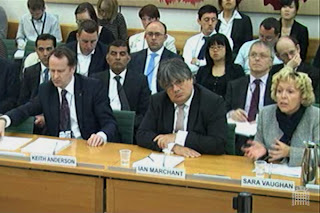
Keith Anderson of ScottishPower, Ian Marchant of SSE and E.ON's Sara Vaughan telling MPs the Government is bungling energy policy.

The bosses of the Big Six energy companies have slammed the complexity and pace of energy reforms being proposed by the Government for slowing the rate of investment in new plant which the country so desperately needs.

You thought that it was the Big Six energy bosses who, following extensive lobbying, were getting the proposals for reform they wanted in the new Energy Bill. It turns out that instead, they think that there has been too much ideological and political interference, and far too much delay.

The bosses were speaking to MPs in the Energy and Climate Change Committee during its first evidence session on the Draft Energy Bill, which contains the Government's proposals for electricity market reform and Contracts for Difference (CFDs). MPs want to know if these financial tools are effective particularly in supporting renewable energy and carbon capture and storage (CCS).

Keith Anderson, CEO of ScottishPower, told MPs that “this country used to be a fantastic place to invest in for energy because everyone had faith and trust that it was done in an evidence-based way". But this is no longer the case, and it is causing uncertainty and a hiatus in investment.

He spoke of the “massive amount of work" that was done in providing evidence during the lengthy consultation on the banding review for the Renewables Obligation last year, that came up with a lot of recommendations for the future.

“But then, since October, what we've seen is an awful lot of noise from politicians and in the media, and speculation about arguments between government departments that there will be political influence over the outcome of that consultation that it is not evidence-based, and this damages investor confidence."

Anderson called for more clarity, speed and confidence to be given by the Government. “There's a huge opportunity now for the UK to go out and grab a huge proportion of investment for renewable energy. Given the slowdown in our economy and in other countries I think right now is the time for the UK to put in place a very clear, long-term and robust framework," which should be “used to regenerate the economy".

However, he said that there is still a lot more detail required in the Bill, particularly on Contracts for Difference, and this was prolonging uncertainty amongst investors.

John McElroy, director of policy and public affairs at RWE Npower, agreed that as it stands, the Bill will not provide the confidence that investors need and requires a lot more work. "At the very least investors need to know how the capacity mechanism will work and when it will be triggered," he said.

“What we really want to see is the timetable moving forward and the government getting on with it," added Sara Vaughan, Director of Regulation and Energy Policy at E.ON. "There is already some slippage because we expected the bill to be introduced in May and it is now not going to be introduced till probably the end of the year," which will delay the secondary legislation as well “and that causes concern".

Carbon capture and storage

On CCS, Ian Marchant, CEO of SSE, said, frankly: “We do not know that this technology will work" and so developers "crucially need capital support at this stage to move beyond the demonstration phase".

He said that Government energy policy is predicated on assuming that it will work, but this is currently unknown.

Support for wind power

Anderson said finding investment for wind farms was more difficult in the UK than abroad because planning permission takes longer, land rental is more expensive and development costs are higher than elsewhere.

On the level of support for onshore wind, Marchant agreed that this should come down as costs reduce, and said that he doesn't get involved in bilateral discussions about the level of support. He said that he didn't like the way that discussions on nuclear and renewables were being conflated. “I do not believe that the returns being made on renewables are excessive" he added.

Call for more evidence

The Energy and Climate Change Committee, which today is on a fact-finding mission to the London Array and Gunfleet Sands Windfarms, has issued a call for evidence from the public on the economics of wind power, to be submitted by 27 June; there is to be a hearing on 10 July.

Tim Yeo MP, Chair of the Committee, said: “Government policy on wind power should be based on sound economics and engineering, not political pressure from a small vocal minority – whether that be green campaigners or anti-wind protestors.

“In this session we want to cut through all the hot air talked about wind power and examine whether the economics really add up. Wind farms are over forty times less polluting than gas burning power stations - per unit of energy produced - but there are concerns about the costs to consumers.”

Contracts for Difference

All the energy bosses agreed that they were in favour of Contracts for Difference because, unlike the Renewables Obligation, although it had many advantages, they will be able to support the massive increase in investment in renewable energy that is required in the coming years.

John McElroy agreed the Electricity Market Reform was too complex, and was taking too long to understand and finalise.

Sarwjit Sambhi, Director, Finance and Strategy at Centrica, owners of British Gas, said that the capacity payment was good for gas-fired generation, which was required in the medium-term.

Government “dishonest” on nuclear power

Marchant criticised the Government for trying to disguise their support for nuclear power, in doing so coming up against state aid rules, and called for “an honest and open discussion about whether the country needs it and what is the cheapest way of doing it as opposed to disguising it in a very complex set of proposals, so it actually doesn't have negative connotations."

Marchant described investment in wind power as much more manageable than in nuclear power, and preferable because it has a period of clean construction of two or three years. “Nuclear is a completely different animal. You have billions of pounds of investment and a build time of seven to ten years."

The MPs were also questioning whether there was enough provision for reducing demand for electricity in the Bill and the level of and exemptions to the proposed Emissions Performance Standard.

Friday, June 08, 2012

Deal with Norway guarantees future UK gas and oil dependency

Øyvind Eriksen, executive chairman of Aker
Solutions, Norwegian Prime Minister Jens Stoltenberg and David Cameron
discussing the deal in a side street in Oslo, Norway.
Øyvind Eriksen, executive chairman of Aker Solutions, Norwegian Prime Minister Jens Stoltenberg and David Cameron discussing the deal in a side street in Oslo, Norway.

The Norwegian and British Prime Ministers yesterday agreed several landmark energy partnerships between the two countries designed to secure long-term energy supplies.

The deals will further increase UK dependence on gas and oil for decades to come, including committing it to tapping reserves in the Arctic that are opposed by environmentalists. They will also support the development of offshore wind and, it is hoped, carbon capture and storage. Finally, they continue to support a grid interconnector between the two countries, allowing the UK to import geothermal power.

The deals were sealed at a breakfast meeting in Oslo with Prime Ministers David Cameron and Jens Stoltenberg that was attended by ten leading energy companies from both countries: Fred Olsen, Gassco, Aker Solutions, National Grid, NorthConnect, Shell, Statoil, Statnett, Statkraft and Centrica.

Billions of pounds of new investment are expected to result, with the potential to create thousands of new jobs. The agreements include the creation of:
  • 300 jobs from Statoil's £12 billion investment over the lifetime of oilfields in the UK's Mariner-Bressay North Sea
  • 1300 jobs in the oil services industry created by Norwegian firm Aker Solutions in Chiswick
  • continued cooperation on gas supply and exploration between Centrica and Statoil, sealed in a new Memorandum of Understanding
  • a promise to develop the 9GW Dogger Bank offshore wind farm off the East coast of Yorkshire by the Forewind Consortium
  • a deal to provide more Norwegian gas to Shell from Gassco
  • continued progress on installing two subsea electricity interconnectors to provide geothermal electricity between the UK and Norway.
Prime Minister David Cameron said of the Norway-UK Energy Partnership for Sustainable Growth: "The jobs and investments announced today highlight how vital the strong relationship between Norway and the United Kingdom is for our energy security and economic growth. We look forward to strengthening our partnership further, driving investment into a diverse, sustainable energy mix that delivers affordable long term supplies for consumers."

Norway is already an important supplier of oil and gas to the UK, providing over a quarter of the UK's primary energy demands: 42% of imported gas and 62% of imported oil in 2011. Charles Hendry, Energy Minister, added that: “The investments and jobs announced today by British and Norwegian companies are a clear signal of the benefits of this partnership.”

The agreement says that oil exploration on the Norwegian and the UK continental shelves “will continue to provide substantial energy supplies for the coming decades". Included in this is the ability to use new technology to improve recovery from mature fields and from the Arctic.

Carbon capture and storage

The statement continues: "The UK is currently developing a gas generation strategy, setting out the role for gas-fired power in delivering a secure and affordable route to a low-carbon economy. CCS will enable gas to provide substantial electricity consistent with our climate change agenda."

Norway is leading the world in this technology; it has been burying carbon dioxide there since 1996. Last month, Norway's Prime Minister, Jens Stoltenberg, opened the next stage of the world's largest prototype carbon capture and storage plant at an oil refinery and gas power plant at Mongstad, that is financed by the Norwegian government to the tune of $1bn.

The United Kingdom, however, like the rest of Europe, is lagging behind Norway and other countries such as America, Canada and Australia, all famous for the size of their carbon footprints in implementing CCS. The main reason is the low price fetched for a tonne of carbon released into the atmosphere under the European Emissions Trading Scheme, roughly one tenth of the cost of burying it back in the ground.

David Cameron hopes that we can learn a thing or two about CCS from the Norwegians to improve the prospects of the fledgling CCS projects here in the UK.

However, with the proposed emission limits of 450gCO2/kWh for Emissions Performance Certificates for new gas-fired power stations in the new Energy White Paper, it is hard to see that there will be any regulatory incentive to capture carbon from these power stations.

Arctic oil and gas


Because of the agreement, Britain will have no shortage of oil and gas in the years to come. Norway is ranked 13th amongst nations with gas reserves. Major new discoveries of oil and gas have been made recently in the Norwegian Continental Shelf, in the Skrugard and Havis fields in the Barents Sea, and the Johan Sverdrup in the North Sea. Aker Solutions has recently been awarded contracts by Statoil for exploring these. The Barents in particular is a harsh, Arctic environment.

But exploration in the Arctic faces severe opposition from environmentalists. Greenpeace calls it “a catastrophe waiting to happen" and is mounting a big campaign, fronted by Jarvis Cocker, who recently visited the Arctic Circle and was reportedly moved to tears at the region's majestic landscape.

David Cameron did not have time to do any sightseeing. In the joint statement is the claim that coming Electricity Market Reform will create a "framework for investment in the UK" worth "over £200bn in energy project opportunities. Similarly," it continues, “Norwegian policies are creating new commercial opportunities for companies, particularly in the High North," a reference to the Barents Sea discoveries. "The Norwegian-Swedish Green Certificate Scheme also offers incentives for British investors in renewable energy," it adds.

This scheme was launched on 1 January 2012 and is a market-based system to support the expansion of electricity production from renewable energy sources and peat. Since then 12,573 green certificates have been issued in Norway in relation to 26 plants.

In Norway, Statoil, which is 67% owned by the Norwegian government, is facing stiff opposition from the public, church leaders and 28 Norwegian organisations including WWF Norway and Greenpeace Norway, for having chosen to get involved with tar sands.

Wind farms


As for the renewable energy projects, the largest of these is the Dogger Bank one, which comprises up to four offshore wind farm projects, 156km off the coast of Teesside, which could provide over 10% of the UK's energy needs

The windfarms will be connected by onshore high voltage direct current (HVDC) underground cabling and up to four direct current (DC) to alternating current (AC) converter stations. A local consultation is currently underway.

The Forewind consortium managing the project is comprised of the Norwegian companies Statkraft and Statoil, German company RWE npower renewables, and Scottish company SSE.

Finally, the Norwegian-UK agreement says that "The UK and Norway will work together to build on outcomes of the Rio+20 Conference, including further development of the Energy+ Initiative to increase clean energy access for developing countries."

The next step is a conference to discuss the achievements and future priorities of the UK-Norway energy partnership, to be held at London’s Royal Geographical Society in September.

Monday, March 19, 2012

UK Government's green record comes under worst criticism yet

Tory anti-wind power propaganda
With friends like this, do the LibDems need enemies? Tory Aardvark campaign material.

Coalition Government claims to be the “greenest government ever" have been severely tarnished from five directions following developments over the weekend.

According to a YouGov survey, just 2% of the British population believe this claim, which will be further undermined by revelations in the Guardian on Saturday that restrictions on environmental pollution are about to be removed under the Government's “red tape challenge".

Furthermore, last Friday, Energy and Climate Change Secretary Ed Davey revised the Emissions Performance Standard requirements for a new generation of gas-fired electricity generating plants, which Greenpeace has calculated will lead to Britain missing its climate change targets.

This morning the Prime Minister also signalled his government would support new airport expansion in the South East, and heavily hinted Gatwick would be the focus of these plans.

The coalition agreement explicitly says: “We will refuse permission for additional runways at Gatwick and Stansted.”

But the Prime Minister said this morning: “I'm not blind to the need to increase airport capacity, particularly in the south-east. We are acting now to make the best use of existing capacity...... Gatwick is emerging as a business airport for London, under a new owner competing with Heathrow.”

Finally, the National Audit Office (NAO) has criticised the way in which the competition for the first UK demonstration carbon capture and storage project was run, saying valuable years have been lost in developing this new technology.

Not the greenest Government

On 27 May 2010, Secretaries of State Chris Huhne and Caroline Spelman repeated the new coalition Government’s pledge to be the greenest in UK history and outlined their legislative programme for the first term of government.

Chris Huhne said, "Making this Government the greenest ever...is not merely an aspiration; it is essential. The actions of this Government in this Parliament will define our ability to combat climate change in the decades to come.

“We are developing an integrated strategy across the public, private and third sectors, to tackle the loss of biodiversity, address the way that we use resources, adapt to climate change and grow a greener economy that provides the clean, green jobs and industries of the future."

Twenty two months later, where are we?

A YouGov poll, commissioned by Greenpeace, has found that only 2% of voters asked believe that the government is the “greenest government ever", with the majority, 53%, believing that it is “about average".

10% believe it is “greener than most other governments have been", with 9% believing it is “less green" and 7% believing it is the “least green". 18% didn't know.

The votes were split pretty equally by age and gender, but more Tories believe the claim (3%) than Labour (1%) with no LibDems agreeing with the statement.

People were asked whether they thought that current safeguards to protect Britain's wildlife and countryside were too strong, too weak, or about right.

Just 4% thought they were too strong, with 40% thinking they were too weak. 37% thought they were about right and 19% didn't know. Again, age and gender did not have a strong effect on the results, but voting intention did. Nearly half the number of Labour and LibDem voters thought that currently there was too little protection, whereas just 28% of Conservative voters did. 54% of Tories thought they were about right.

Red tape challenge

This being the case, the question of why the Government is slashing environmental protection for the countryside is being asked following revelations in the Guardian over the weekend that the Government will soon announce that 174 environmental regulations are to be relaxed.

These include laws concerning the dumping of asbestos, preventing the spread of invasive species, the protection of wildlife and common lands, curtailing noise nuisance, industrial air pollution and animal traps.

Ministers are expected to claim that the simplification of this legislation will save business £1 billion, yet apparently neither the Environment Secretary, Caroline Spelman, nor any other environment minister attended the ‘Star Chamber’ conducted by Cabinet Office Minister Oliver Letwin who is leading the “red tape challenge".

97% of the many thousands of public responses on the red tape challenge website asked for stronger protection or no change in the rules.

"The brazenness with which the government has sought to undermine the very principles of environmental protection is shocking enough," said Green Party MP Caroline Lucas. "But it's also astonishing that ministers have been so willing to waste taxpayers' money on such an ideologically driven vanity project."

A spokesperson for Defra merely said that “some of the rules we ask businesses to follow are either too complicated, ineffective or just obsolete".

The EU Habitats Directive, which protects rare and threatened wildlife, has been targeted by Osborne and will be "liberalised", according to the document. Other targets include regulations about:
  • persistent organic pollutants
  • cleaning up contaminated land, because this is a “burden for the housing industry"
  • development of common land
  • requirements for local authorities to investigate complaints about noise, dust and smell
  • waste management at construction sites
  • safe disposal of electrical goods and batteries by manufacturers
  • recycling targets for larger UK businesses.
Any environmental damage not paid for by business will have to be borne by the taxpayer.

New gas plants

Thirdly, on Friday Ed Davey announced measures to be included in the forthcoming Electricity Market Reform legislation that he says are intended to provide more certainty to those investing in new gas-powered generation.

He wants to maintain the 450 grams per kilowatt-hour level of emissions from such plants until 2045, so that they do not have to be fitted with emission-reducing technology or made more efficient, and adjust the Capacity Market in such a way that ensures such plants are built.

Greenpeace immediately slammed this as “the Liberal Democrats’ most craven submission yet to George Osborne’s bonfire of environmental protection".

Its senior energy campaigner Joss Garman said, “by stripping away the simple requirement that our power stations need to become more efficient and less polluting, Clegg and Davey are undoing whatever good work their party has done on the environment since entering government".

They have calculated that the effect of this measure "would make it impossible for the UK to meet its long-term carbon emission reduction goals".

The move could even be illegal and subject to challenge in the courts, since to comply with the recommendations of the Committee on Climate Change, Greenpeace notes that the level of emissions from these plants would need to fall to 50g per kwh at 2030.

According to DECC’s October 2011 Updated Emissions Projections, an additional 4.9 gigawatts (GW) of new gas-fired electricity generation capacity is projected to come online by 2020, with 4.1GW due by 2016.

However, new consented gas projects already amount to 16.2GW, and National Grid and New Power data shows that all of these projects could be online before 2020.

Garman called this "a major change of course from the one followed by Chris Huhne," and said it was “just about the worst thing Ed Davey could have done in his first weeks in office.”

Ed Davey said: “This is all part of our commitment to transforming the market, providing long-term certainty to investors, increased competition, and the best deal possible for consumers.”

Carbon capture and storage

Finally, the National Audit Office has issued an investigation into the competition launched in 2007 by the Department for Business, Enterprise and Regulatory Reform designed to stimulate innovation in carbon capture and storage and put the UK at the forefront of global attempts to develop this novel technology.

It was cancelled four years later by the Department of Energy and Climate Change on the grounds of protecting value for money and because the project could not be funded within the £1 billion budget agreed at the 2010 Spending Review.

The report concludes that it was launched with “insufficient planning and recognition of the commercial risks".

However, it does say that some good came of it: the results of engineering and design studies completed by bidders, upon which the Government spent £40 million (63 per cent of the £64 million it spent in total on the competition), may help to reduce the costs of future carbon capture and storage projects.

But during the competition, "DECC's decisions to continue were not informed by detailed consideration of the probability of reaching acceptable contract terms and the time lost should the competition not succeed.

"When a capital budget was decided in October 2010, there was no agreement on government funding for operational costs," it observes.

Amyas Morse, head of the National Audit Office, said: "Taking calculated risks is perfectly acceptable if those risks are managed effectively; but in this case DECC, and its predecessor, took too long to get to grips with the significant technical, commercial and regulatory risks involved.

"Four years down the road, commercial scale carbon capture and storage technology has still to be developed.

"The Department must learn the lessons of the failure of this project if further time is not to be lost, and value for money achieved on future projects."

Carbon capture and storage is a three-part process that involves capturing the carbon dioxide produced from burning fossil fuels, transporting it to a storage site, and permanently storing it under pressure, usually underground.

The individual elements of the technology exist but have yet to be linked and operated together at a commercial scale power station.

Wednesday, March 14, 2012

“Perfect storm" has arrived for efforts to reduce carbon emissions

Drax power station

Efforts to reduce carbon emissions in the UK and across Europe are facing a combination of factors strongly hindering investment in low carbon power generation and energy efficiency and promoting the burning of coal.

Now who do you believe? Today, one British tabloid newspaper is reporting that the construction of gas power plants is “twice government predictions", while another is reporting the exact opposite.

The Guardian reports Friends of the Earth analysis of the latest Government figures, from October, saying that while about 5GW of new gas-fired power generation will be needed to supply the UK in the coming decades, “power stations with more than 3GW of capacity are already now under construction and nearly 10GW of plants have received planning permission. In addition, nearly 10GW of capacity is in the earlier stages of planning".

Meanwhile, the Financial Times is warning that with 11GW of mainly coal-fired generation due to close by 2015 under the EU’s Large Combustion Plant Directive, we are burning more coal because it is currently cheaper than gas.

What is the truth?

Actually, both, at different time scales. Either way, however, it's not good news for the climate.

Coal is too cheap

Gas is today trading at just over 58p per therm, yielding baseload power for delivery today from gas generation of £45.20 per megawatt-hour. This does not leave much room for profit when electricity is trading at 45.50 £/MWh, and this is why coal generation is now favoured over gas.

The FT says “coal plants have been pumping at more than 75 per cent capacity, compared with 25 per cent a year ago".

This is a continuation of the trend of burning more coal over the last two years which is helping to push up the U.K.'s carbon emissions.

Partly as a result of increased demand, UK Coal moved from an interim loss of £93.2 million to a profit of £22.1 million in the six months to last June, following losses totalling £270 million over the previous three years. (However, this has not stopped it from announcing plans today to close the U.K.'s biggest coal mine, Daw Hill, near Coventry, by early 2014 when current seams are exhausted.)

The demand is driving strong imports of U.S. and Colombian coal into Europe, and prices have fallen to just over $100 (£64) a tonne.

This figure is wildly different from that predicted by the government just six months ago: $124 (£80).

(In fact, the price of coal wasn't even the price that DECC's report said it was at the time it was published; yet these now wildly inaccurate figures are those on which the Government bases its energy policy.)

The low price for coal is also partly the reason why Drax announced last month that it was scrapping plans for a new biomass power station, calling for more support for biomass generation from the Renewables Obligation to counter an increase in its fuel costs; although it put these fuel costs at just £33.3 per megawatt-hour, significantly less than that for gas.

Too many carbon credits


None of this is helping the UK, or Europe, meet its greenhouse gas emission targets.

The problem is that with coal prices low, a recession on, and an over-abundance of EU Emissions Allowances resulting in a low price of carbon, there is insufficient disincentive to burn coal, let alone gas, and consequently even less incentive to build renewable energy generation, nuclear power stations or develop carbon capture and storage.

Hence the need for DECC's
announcement this week of a £20 million competition to develop Carbon Capture and Storage technology, in the hope that it will reduce the price of this still unproven technology.

This combination of factors is the perfect storm for attempts to reduce carbon emissions this decade.

Carbon prices fell by over half during 2011 and are now still trading for under €8.

Despite rumblings from Brussels, the Commission is dragging its feet on moves to set aside allowances in order to restrict demand and stimulate the price.

Instead, it seems to be hoping that by the end of the year, when airlines begin being required to purchase carbon-emission allowances as part of their role in the Emissions Trading Scheme, this will stimulate a price rise. But that is still nine months away.

According to carbon market analyst Steven Knell, from IHS CERA, the ETS in no longer the main policy tool for reducing emissions ″because the supply and price of allowances are fixed and predetermined. The market is poorly equipped to deal with disruptions in demand levels," he says.

“This, plus the financial crisis, the consequent fall in emissions, and the fragile nature of the recovery, added to recent price decline due to the expectation that policy risks will deprive the market of demand, mean that action to fix the problem is urgently required".

The oversupply means that only 6.8% of all EUAs are trading; a poor proportion. This amounts to 550 million tonnes, which is equivalent to all the emissions of the non-power generation industry members of the market in Europe, i.e., the high energy users like steel and concrete; or, to put it another way, all of the U.K.'s allowances.

“This yields a long position and indicates what the price will be like in 2020: that it will not change sufficiently to stimulate the demand required for investment in energy efficiency and renewable energy lesser-known carbon capture and storage or nuclear power," says Knell.

The supply of carbon-emission allowances needs to decline more aggressively and prices need to be higher.

The policy overlap in Europe needs addressing, he says. “The latest agreements give the possibility to set aside some EU Allowances to promote energy efficiency in the draft of the Energy Efficiency Directive, but the amount set aside would need to be substantial," he says.

“Strong medicine is needed."

“Strong medicine is needed," concludes Knell. He points to an increase in European ambition for emission reduction cuts from 20% to 30% by 2020, which, he says is achievable due to the recession's effects.

However, Poland has just vetoed this target at last Friday's meeting of environment ministers because of its own addiction to coal-fired electricity generation. This vote is not binding on a Commission decision however, and it remains to be seen what will happen.

In the meantime, only two strategies are available to individual governments, because they can't control the price of oil, and these are to tax carbon and support the carbon price.

Therefore, any measure that favours the energy-intensive industries by reducing the impact of carbon-penalising policies in next week's Budget from the Chancellor, George Osborne, will send precisely the wrong signals to the market.

The setting of the carbon price floor, and reform of the energy market are urgently required to favour carbon-reduction investment and weather this storm.

But contrary to the impression given by the Financial Times article, whatever happens the lights will stay on in Britain, because of the number of gas-fired power stations that have received planning permission; they may not be built just yet, but they will be built when coal and nuclear generation comes off-line in the future, to meet any demand not met by offshore wind.

But whether it's coal or gas, it locks in more UK carbon emissions than desirable for the next 20 or so years. Chancellor: are you paying attention?

Wednesday, February 08, 2012

U.K. emissions rise for second year; CCS remains a pipe dream; new energy efficiency unit in government


UK 2012-11 carbon emissions chart

The U.K.'s net carbon dioxide emissions rose in 2010/11 by 3.8% on the 2009 figure of 477.8 Mt., even more than earlier provisional figures had suggested.

Much of this increase was due to the residential sector, which was 15.8% (11.8 Mt) up, while the energy supply sector was up 3.1% (5.8 Mt)

The blame is being put on the cold period at the beginning of last winter and the downtime of some nuclear plants, which caused "a rise in residential gas use", and the burning of more coal in power stations.

But in fact it is a new trend: the previous years' figures also show an increase in net carbon dioxide emissions of 3.8%, and follow a period when they were sharply falling.

In 2010 there were technical problems at some nuclear power stations. In particular, Sizewell B, the largest nuclear power station, was offline for six months, which DECC says contributed to an increase of around 4% in emissions from electricity generation between 2009 and 2010.

Emissions from international aviation fuel use are not included in these figures, but the report does estimate them for 2010, at 31.8 million tonnes carbon dioxide equivalent.

This is assessed to be 4.4% lower than the 2009 figure of 33.3 million tonnes, but is still more than double the 1990 level. High altitude aviation has a greenhouse effect over and above that of carbon dioxide alone, but this is not reflected in these estimates.

International shipping emissions, also kept out of the headline figure, were estimated at 8.8 million tonnes carbon dioxide equivalent, a 13.3% drop on the 2009 figure of 10.1 million tonnes.

They are now at the same level as in 1990. The figures are estimated from the state of UK shipping bunkers, but DECC observes that "UK operators purchase most of their fuel outside the UK". Therefore the figure cannot provide a true picture of emissions.

The next report on progress towards meeting the UK's carbon budgets, as required under section 16 of the Climate Change Act, will be made by the end of March and detail exactly how well the country is doing in trying to meet its reduction targets, but, DECC's current estimate is that UK greenhouse gas emissions were 23% lower in 2010 than in 1990, and that we are therefore on target.

However, once the official Defra "consumption emissions" are factored in (up 20% since 1990), then it reveals a drop of just 3% in the overall greenhouse gas emissions for which the UK is responsible since 1990 (and this does not include the above emissions from shipping and aviation).

€1 billion for carbon capture and storage


If burning coal, and to a lesser extent gas, is one principle reason for this, then a solution sought by some is carbon capture and storage (CCS).

The 2050 Energy Roadmap, adopted by the European Commission in December, expects CCS to be responsible for between 19% and 32% of total European Union emission cuts by 2050.

Further funding for the development of this presently unproven and uncommercial technology is expected to come from the European Union's energy infrastructure package, which is currently being drafted.

António Correia de Campos, a rapporteur whose job it is to steer the package through the European Parliament, said yesterday that about €1 billion, or “around 10%-15%” of the €9.1 billion funding in the legislation is likely to be allocated to pilot programmes for CCS.

The cash from the infrastructure fund “will be fundamental for it,” said de Campos.

Twelve demonstration plants were supposed to be running by 2015, but due to cancellations, “the programme will deliver four to six projects, tops, and some say that’s optimistic,” according to Eric Drosin, a spokesman for Zero Emissions Platform, a group of private and public partners lobbying for CCS.

Most European countries lack enthusiasm for CCS, because of its huge cost.

For example, a Spanish project, Ciuden, was given €180 million euros in 2009 to develop a means of collecting waste carbon dioxide from coal burning, cooling it to a liquid and pumping it for indefinite storage into underground rock formations.

It was meant to be completed by 2015, but is now "unofficially mothballed" due to a lack of match funding.

At this rate of development, Arthouros Zervos, president of the European Renewable Energy Council, believes "it won’t be commercially viable until 2030, and if you give the money to CCS you subtract it from other electricity infrastructure projects which Europe needs urgently”.

Zervas says that “even the people building CCS say this".

The draft report of the European Parliament on the energy infrastructure package is due on 28 February, just before publication of the ENTSO-E (European Network of Transmission System Operators for Electricity) 10-year network development plan, which will be the blueprint for Europe's interconnected grid.

And without that transmission grid, new renewable energy generation capacity will have no way of getting power to the homes and businesses that will need it.

Meanwhile, it seems, without more action on using energy more efficiently, we must keep on burning coal and letting the emissions rise.

New energy efficiency team

Therefore it is good news that Ed Davey, the new Energy and Climate Change Secretary has just announced details of a new 50-strong Energy Efficiency Deployment Office (EEDO) in DECC.

In his first speech as Secretary of State, Mr Davey he is “hugely enthusiastic about energy efficiency. It’s the cheapest way of cutting carbon – and cutting bills for consumers. It has to be right at the heart of what we do.

“EEDO will be a centre of expertise, challenging our work and making energy efficiency real and relevant to people’s everyday lives. Two out of three consumers think their home is wasting energy, but only one in three is going to do anything about it. That has to change. We need to get out there and show people what energy efficiency can really do for them.

“The Green Deal will play a huge part in this work and will also support jobs in the insulation and construction industries– as many as 65,000 right across the country by 2015. It can help us deliver a fairer, greener economy. And help us get young people back into work – or into work for the first time."

The team, which will be based at DECC’s headquarters in London, will pull together expertise from across the Department. EEDO staff will continue to support the delivery of the Green Deal, the rollout of smart meters and the increase in renewable heat as well as developing a new energy efficiency strategy to identify the potential for further energy efficiency across the economy.

As well as having its own expertise, EEDO will work with leading industry experts to ensure we have the best possible evidence, analysis and policy response to this challenging agenda.

Mr. Davey said that today DECC is launching a call for evidence to help underpin the energy efficiency strategy.

Tuesday, January 31, 2012

Large scale carbon capture and storage gets closer with new appointments

Schematic diagram of how the CCS set-up will work which is based upon the former BP Peterhead concept
Schematic diagram of how the CCS set-up will work which is based upon the former BP Peterhead concept.

A crucial step has been taken in the development of what may be the U.K.'s first large scale Carbon Capture and Storage (CCS) project, with the appointment of Foster Wheeler Energy Limited (FWEL) as project management consultants of a £3 billion, 650MW (net) project at Hatfield.

The Don Valley Power Project, at Stainforth in South Yorkshire, expects to combine a coal gasification plant, with CO2 capture on all of the plant, with an integrated gas-fuelled combined cycle power station that is fired by a hydrogen-rich fuel.

It will potentially capture up to 97% of the carbon dioxide from its operation and its principal emission will be water vapour.

Planning permission for the power plant has already been granted, and main construction activities would start in 2013, provided the project wins financial support from the EU and UK government, for which it is currently competing. The plant would be commissioned in 2016.

This was the only UK project to win funding (€180 million) under the European Energy Programme for Recovery (EEPR) and is being assessed by the European Investment Bank (EIB) for further EU funding under the New Entrants Reserve (NER300) programme, which is itself to be financed by the European Commission's satisfactory sale of 300 million EU allowances (EUAs) by the end of this year.

The appointment of Swiss company Foster Wheeler, a global engineering and construction contractor and power equipment supplier, has been made by 2Co Power (Yorkshire) Ltd. which is to design and construct the power station with pre-combustion carbon capture facilities.

Foster Wheeler's role will last until the plant comes into operation in 2016 and begin by helping 2Co Power (Yorkshire) to prepare an Engineering, Procurement and Construction (EPC) contract for the project build over the next six months.

Jonathan Briggs, Managing Director, 2Co Power (Yorkshire) Ltd said: “I firmly believe that the Don Valley Power Project is the UK’s most advanced and economic carbon capture and storage project.

"Foster Wheeler’s appointment will ensure we deliver this ground-breaking project on time to help create jobs, supply low carbon electricity to the region and help the UK meet its ambitious energy security and national carbon reduction commitments."

2Co Energy has also boosted its management team to take on the project with the addition of two leading carbon capture and storage experts, Jonathan Briggs and Graeme Miller.

Jonathan led the Hydrogen Energy joint venture between BP and Rio Tinto in California, and was responsible for managing the $2.5 billion carbon capture and storage project that is now under development by SCS Energy.

Graeme also worked on the Hydrogen Energy CCS project and previously worked on BP’s original Peterhead CCS project, which provides the technical blueprint for this one.

It is reckoned that the power station will employ over 2,000 people during the peak of construction and about 200 during operation.

The offshore part of the project is the responsibility of National Grid Carbon (NGC), an independent subsidiary of National Grid created to develop carbon dioxide transportation infrastructure in the UK, who are designing, building and operating the carbon transportation system and identifying potential offshore carbon storage sites in Southern North Sea.

This part should employ 800 workers during construction and 300 during operation.

Enhanced oil recovery


The Don Valley Power Project's unique business model centres on the vast CO2 storage and additional oil recovery potential under the North Sea, known as Enhanced Oil Recovery (EOR).

2Co proposes to inject the CO2 into proven secure oil fields where it can tap reserves of oil that would otherwise be unrecoverable, and then store the CO2 permanently in the oil fields.

Three quarters of CCS projects throughout the world in operation or under construction are currently linked to EOR.

A major feasibility study is nearly completed on two North Sea oil fields that might be used for this purpose.

It is hoped that sale of the oil will not only substantially offset the costs of carbon capture but generate several billion pounds in Treasury revenue as well as extending the life of North Sea oil fields by up to 20 years and deferring substantial costs to UK government from its shared responsibility for decommissioning oil fields.

The Humber cluster effect


One of the key elements of why this project at Hatfield was selected by the EU for the EEPR funding is the potential for developing a pipeline to support a cluster of CCS plants in the Humber.

Such a cluster could potentially capture about 60 million tonnes of CO2 per year from this region.

The Humber area is one of five identified by National Grid Carbon for CCS because they contain the UK's highest CO2 emitting facilities. NGC thinks the Humber could become the largest CO2 capture volume region in Europe.

This is now the only project being taken forward by National Grid Carbon after the decision by the Department of Energy and Climate Change not to go ahead to the construction stage of the Longannet CCS demonstration project.

The Humber cluster includes a further 426MW oxy-fired carbon capture and storage project currently under development at the Drax power station in North Yorkshire with partners BOC and Alstom.

Both are applying for part of the £1bn funding from DECC's CCS Delivery Programme.

DECC held its first CCS Industry Day on 16 December 2011, which was attended by over 130 delegates; the next is to be on 22nd February, and the CCS Delivery Programme competition will launch in Spring 2012.

Friday, October 07, 2011

Scottish Power to Treasury: give us £0.5bn or we'll ditch flagship CCS project

National Grid's explanation of carbon capture ad storage.
Electricity generator Scottish Power is threatening to withdraw from a project to build a flagship pilot carbon capture & storage (CCS) facility at Longannet coal-fired power station near Fife, Scotland, unless the Treasury gives it £0.5bn more funding.

If the Treasury can't produce the money, this will be a severe blow to the UK's hopes of becoming a world leader in the technology. Urgent talks are being held between Scottish Power, DECC and the Treasury.

Do you fancy their chances, especially after Osborne's anti-green speech at the Tory Conference? I don't.

The plant is the UK's second largest coal-fired power station and Europe's third largest. If CCS proved to be successful it could capture between seven million and eight million tonnes of carbon dioxide a year and make a serious contribution to tackling the UK's overall emissions.

George Osborne had earmarked £1 billion for the project, but Scottish Power, owned by the Spanish company Iberdrola, is now asking for half as much again. It is supposed to be up-and-running in three years.

A competition to find contenders to build pilot CCS projects was begun in 2007 by the previous Labour administration, and there had been five entrants.

Now the project at Longannet is the only one remaining in the running, since E.On pulled out of constructing a coal-burning power station at Kingsnorth in Kent earlier this year.

Last May, a study by Scottish Enterprise suggested more than 5,000 Scottish jobs could be created by three proposed CCS schemes, including the one at Longannet.

Jeff Chapman, chief executive of the Carbon Capture & Storage Association, remains upbeat, saying that even if this project were not to go ahead, “there are lots of others ready to take its place”.

DECC is still insisting that a way will be found for the project to proceed, and an announcement will be made before the year's end.

It is expected that some of the funding will come from the sale of CO2 permits by the European Investment Bank that are beginning in a month's time.

The Bank is being given 300 million EU carbon permits by the European Commission, which are reserved for new entrants into the EU's emissions trading scheme from 2013, and is being told to sell 20 million units per month through next year in order to raise funds for renewable energy and carbon capture and storage projects in all the member states.

CCS has always been touted by the conventional energy sector as being a vital weapon in the armoury to fight climate change, not least because if successful it would allow 'business-as-usual' to continue without the release of climate-warming gases to the atmosphere.

Critics of the technology have always argued that its cost would prove prohibitive, that it is unproven and would take too long to implement to make a significant dent on global emissions in time to curb dangerous climate change.

The loss of the scheme would also affect proposals for a £3bn CCS-enabled coal-fired power station in Ayrshire, by Ayrshire Power, a company owned by Peel Energy Ltd, to be situated near Hunterston B nuclear power plant.

A coalition of environmental groups that includes WWF, RSPB Scotland, Friends of the Earth, Oxfam, and the Scottish Wildlife Trust had mounted a legal challenge to the plans which a judicial review over-ruled on 4th October.

Developers of several other proposed power plants are also waiting to see if they can be constructed using CCS. Scottish Power itself is hoping to fit it to a new gas turbine power station at Cockenzie in East Lothian, which has also just received planning permission.

Only in June, ScottishPower, National Grid and Shell announced plans to create an onshore pipeline to carry up to two million tonnes of CO2 from Longannet to the North Sea.

Last month the Energy Technologies Institute (ETI) launched a £3m, two-and-a-half year project involving EDF Energy, E.ON, Rolls-Royce and Petrofac, to create a modelling tool-kit capable of simulating the operation of all aspects of the CCS chain, from capture and transport to storage.

ETI Chief Executive Dr David Clarke believes that “around a third of the UK’s electricity could be generated from coal, gas, biomass or hydrogen turbines fitted with CCS by 2050".

“CCS infrastructure is complex," he says, "and will need to be rolled out rapidly to meet those targets."

The ETI has already announced £29m worth of CCS projects, including a next generation capture demonstration project led by Costain and an appraisal of the UK’s potential storage sites led by Senergy. Scottish Power has had funding to scope out its own projects.

The ETI is also commissioning a project to develop and demonstrate cheaper carbon capture technologies specifically for gas fired power stations. An announcement on who will carry out the work on this project is expected in early 2012.

There are several different types of CCS technology, depending on whether it is retrofitted to an existing plant or intrinsic to a new-build, and depending on the fuel burnt.

Costs can be reduced if the gas is used to help extract more oil and gas from the North Sea fields into which it is pumped. The most optimistic studies put a figure of £150bn on the amount of fuel that could be obtained in this manner.

Wednesday, March 23, 2011

Osborne's pale green budget offers crumbs to the green sector

Chancellor George Osborne's first budget was billed as a “budget for growth", but the green shoots of recovery could have been stimulated to rise much faster. It offers crumbs to the green sector while doing nothing to tax pollution or wean the UK off oil.

Budget 2011 contains limited measures for funding investment in green technology, and for meeting the skills and enterprise gap perceived in not just the green sector but other sectors necessary to help Britain compete in a global economy.

These general measures include 21 new enterprise zones, new export credits, a technology and innovation centre, nine new university centres, doubling the number of university technical colleges to 24, an increase in work experience schemes and apprenticeships, as well as £100m of investment in new science facilities, income tax relief on enterprise investment schemes rising from 20% to 30%, and an increase in small companies' research and development tax credit to 200% in April and 225% in 2012.

On to the specific environmental measures.

Planning reform


In planning, there will be a new presumption in favour of sustainable development, so that the default answer to development is ‘yes’ to planning applications, although what this means in practice is yet to be defined.

Planning decisions will be localised about the use of previously developed land, removing nationally imposed targets while retaining existing controls on greenbelt land.

Surplus military land will be auctioned off for housing. This means that 20,000 new low carbon homes should be built by 2015, the budget says.

Mr Osborne announced a 12 month limit on considering planning applications, including appeals, as part otherwise yet-to-be-specified measures to “streamline the planning applications and related consents regimes removing bureaucracy from the system and speeding it up”. It's unsure what this means for local accountability.

Green Investment Bank


The Green Investment Bank is to operate from 2012-13. The UK devoted just £12.6bn towards green investment in 2009-10 according to an independent report from the Public Interest Research Centre (PIRC), released yesterday.

This is half the minimum of £20bn that must be invested in each of the next ten years, according to the Treasury, and is less than 1% of UK GDP - or less than what Britain spends on furniture each year.

This is why it is welcome that the Chancellor George Osborne announced £3 billion rather than the £1 billion previously announced to set up the Bank, with £2 billion to be funded from the sale of assets, which includes £775 million net proceeds already received from the sale of High Speed I.

Mr Osborne said that the Bank would “support low-carbon investment where the returns are too long-term or too risky for the market”.

However, he resisted calls that the bank be allowed to borrow and lend with immediate effect, saying instead that it will have to wait until 2016 to do so.

Andrew Raingold, executive director of the Aldersgate Group, was amongst critics of this, saying: "We welcome the additional finance for the Green Investment Bank but it must have the power to borrow from day one. This would put the bank at the heart of Chancellor's plan for growth and not wait until the UK is overtaken in key green industries by competitors."

Mr Osborne did argue that the £3 billion will allow a further £15bn to be raised privately for investment in green infrastructure by 2014-15.

Carbon price floor


Besides the GIB, the Government is to introduce a carbon price floor for electricity generation from 1 April 2013.

This will start at around £16 per tonne of carbon dioxide and follow a linear path to £30 per tonne in 2020 to drive investment in the low-carbon power sector. The Treasury says that the carbon price support rates for 2013-14 will be equivalent to £4.94 per tonne of carbon dioxide.

It means that signatories to the Emissions Trading Scheme (ETS) will make up the difference between the actual price of carbon permits under the ETS and the agreed floor price. It expects to raise £740 million in the first year, rising to £1.07bn in the second year and £1.4 billion in the third year.

Friends of the Earth complained that the floor price is too low to make much difference (it is currently only £1.30 less than that) and will provide a "windfall for existing nuclear power".

Meanwhile, income from the Climate Change Levy is projected to increase from £0.7 billion now to £2 billion in 2015-16.

Other environmental taxes


Reform to the Climate Change Agreements, which rewards businesses for energy efficiency, will cost the Treasury £140 million in 2013-16. These tax discounts will stay at 80% not reduce to 65% in 2013 as previously proposed, and the scheme will continue till 2023.

Adjustments to company car tax rates from 2013-14 are expected to bring in to the Treasury over the following three years an additional £390 million. A slight change to the Climate Change Levy exemptions in Northern Ireland will bring in an additional £15 million in the same period.

Negatively for the environment, the Aggregates Levy, which is intended to cut landfill from construction, is having its rate increase postponed this year, at a total cost to the Treasury of £90 million, but it will continue until 2021.

Similarly, the proposed increase in air passenger duty is to be deferred and this will cost the Treasury £145 million. However, wealthy owners of private jets will have to pay fuel duty for the first time.

The fuel duty escalator is also being cancelled, as long as oil prices remain high, and fuel duty is to be cut by 1p. Friends of the Earth wondered what this means for David Cameron's recent promise to "wean the UK off oil". Interestingly, the Treasury is predicting that oil prices will come down from today's highs of £69.3 per barrel to £66.2 in 2015-16.

As previously announced, there will be an increase in the standard rate of landfill tax by £8 per tonne to £56 per tonne on April 1 2011 and to £64 per tonne on 1 April 2012 but the lower rate of landfill tax will be frozen at £2.50 per tonne in 2012-13. The value of the Landfill Communities Fund will rise in line with inflation in 2011-12 to £78.1 million.

The proportion of the landfill tax liability paid by landfill operators into it will remain the same. Future decisions on the value of the fund will take into account the success of environmental bodies in reducing the level of unspent funds that they hold.

Despite previous promises to tax pollution more, there were no new initiatives here.

Carbon capture and storage


As predicted yesterday, carbon capture and storage is to get £1bn but there will be no special levy to support this technology, and any additional support will be funded from general spending.

Although Osbourne says that the government remains committed to providing public funding for four Carbon Capture and Storage (CCS) demonstration plants, there are concerns over whether the necessary development of this technology, seen as being crucial to reducing carbon emissions from existing and new fossil fuel plants, will go ahead on schedule.

Water shortages


To address the issue of water shortages, The Government is to consult shortly on making reforms to the existing WaterSure scheme, the approach to company social tariffs and options for additional government spending to provide further support for water affordability.

The Budget 2011 documents are available on the Treasury website.

Monday, August 11, 2008

Carbon capture and storage is an end-of-pipe dream

The Government is basing its enthusiasm for new coal-burning power stations on the notion of retrofitting CCS (carbon capture and storage) in the future once the technology is developed.

But is this feasible?

"Even the most optimistic proponent of CCS would not envisage any demonstration plant to be operational much before 2015, which would put wide-scale deployment as far away as 2020 or later after lessons from the pilot have been learned and digested," says a submission from The Royal Academy of Engineering to the House of Commons Environmental Audit Committee (EAC).

In July the EAC published its examination of CCS and found it to be a pipe dream. In fact, an end-of-pipe dream. It estimates that the cost of building the first CCS plant could be anything up to £500m, on top of the £1bn cost of a new coal-fired power station. Retrofitting CCS at a station like Kingsnorth is likely to cost over £1.1bn. This is a huge figure by any standard, and would have a massive impact on energy prices.

The EAC urges: "We cannot emphasise strongly enough that the possibility of CCS should not be used as a fig leaf to give unabated coal-fired power stations an appearance of environmental acceptability." Furthermore, "Replacing old coal-fired power stations with new ones, rather than using alternative energy sources, locks Britain in to a high level of emissions for many years to come."

Hutton has said that a high carbon price under the EU-ETS will mean that CCS-retrofitting so-called 'CCS-ready' new power stations becomes economical. The EAC slams this notion on three counts:

1. Lack of knowledge of the technology: since the eventual nature of CCS technology is currently unknown, how can a plant built now be designed to have the technology retro-fitted on?

2. Carbon emissions: "The EU ETS is a mechanism designed to reduce emissions; using it as a cover for choosing high emissions technology goes against the purpose of the scheme."

3. The price per tonne of CO2 for retrofitting CCS required to make it commercially viable is unfeasibly high: estimates of this vary from the rather optimistic €40 (E.ON UK) to €90-155 per tonne (Climate Change Capital) and €70-100 per tonne (UK Energy Research Centre). How much it will really be is anybody's guess, but the Government cites an EU estimate of a forward price of carbon of €39 for 2013-2020 (EU-ETS Phase 3). The UK Energy Research Centre predicts around €30. The EAC concludes from this: "the gap between the carbon price and the cost of CCS is enormous".

The EAC concludes: "Coal should be seen as the last resort, even with the promise of CCS."

[Sources available in the EAC report on CCS].