Saturday, March 05, 2011

Anti-tar sands activist convicted in US

Guest post by Sarah Laskow


This post provides a glimpse of the huge struggle taking place in N. America between environmentalists and the oil industry-financed Republican right.

Environmental activist Tim DeChristopher was convicted yesterday of two felony counts. DeChristopher was on trial for bidding on more than 22,000 acres of public land that he could not pay for: his two crimes are making false representations to the government and interfering with the land auction.

DeChristopher made the $1.79 million bid in order to "do something to try to resist the climate crisis," he told Tina Gerhardt, in an interview published by AlterNet. But, as Kate Sheppard explains at Mother Jones, the judge threw out "the defense that his actions were necessary to prevent environmental damage on this land and, more broadly, the exacerbation of climate change."

"They're hoping to make an example out of me."

DeChristoper now faces the possibility of a $75,000 fine and 10 years in prison. In an interview with YES! Magazine's Brooke Jarvis, before the trial started, DeChristopher said he had faced the possibility that he would be found guilty.

"There is still the possibility of acquittal, but I think the most likely scenario is probably that I will be convicted," he told Jarvis. "The prosecution has been very clear that they're hoping to make an example out of me, to convince other people not to fight the status quo."

Wild lands

What is the status quo? Bureau of Land Management land, like the parcel DeChristopher bid on, is owned by the government, which often leases out the rights to develop the natural resources, like gas and oil, to private companies.

Up until 2003, the Department of the Interior had the option of setting aside some of its lands for preservation, pending final Congressional approval. But during the Bush administration, the DOI gave up that option and only considered uses like recreation or development for its holdings.

Back in December, the current Interior Secretary, Ken Salazar, reversed that policy, again putting on the table the option of using public lands for conservation purposes. But as I write at TAPPED, Republicans are throwing a hissy fit about the change.

Truth or consequence?

The Republicans' argument goes something like: Using public lands for conservation will deprive Americans of jobs and hurt the bottom lines of states with large tracts of public lands. What they don't discuss is the potential damage that drilling for, say, natural gas could cause. The Mulch has been writing about the dangers of hydrofracking for awhile now, but over the past week The New York Times began weighing in on the issue with a long series on the dangers of hydrofracking.

The Times' series brings even more evidence of hydrofracking's dangers to light—in particular, about the radioactive waste materials being dumped into rivers where water quality is rarely monitored. As Christopher Mims reports at Grist, the series has already prompted calls for new testing from people like John Hanger, the former head of Pennsylvania's environmental protection department, which has not been among the staunchest opponents of new drilling protects. According to Mims, Hanger has written that:

The Pennsylvania Department of Environmental Protection should order today all public water systems in Pennsylvania to test immediately for radium or radioactive pollutants and report as soon as good testing allows the results to the public. Only testing of the drinking water for these pollutants can resolve the issue raised by the NYT.

Or, as Mims puts it, "No one has any idea if the radioactive material in the wastewater from fracking is appearing downstream, in drinking water supplies, in quantities in excess of EPA recommendations."

Tar and feather 'em

Fracking is not the only environmentally destructive practice that the energy industry is increasingly relying on. Earth Island Journal has two pieces looking into the tar sands industry in Canada. Jason Mark's piece is a great introduction to the history of the tar sands and takes a sharp look into the impact development has had on the community and the environment.

And Ron Johnson details the U.S.'s connection to the destruction: The federal government is considering approving a pipeline that would allow the oil from the tar sands to travel to Texas refineries. Johnson writes:

Green groups warn that the pipelines will keep North America and emerging economies hooked on oil from the Alberta tar sands for years to come. By greasing the crude’s path to market, the projects will encourage further reckless expansion of the tar sands. That would delay the transition to a renewable energy economy, while further degrading Canada’s boreal forests and spewing even more CO2 into the atmosphere.

A new regime

The decision to approve the pipeline lies with the executive branch. But all of Washington isn't a particularly friendly place to green groups and their causes these days.

For example, as Care2's Beth Buczynski reports, the newly empowered House Republicans have done away with one of the smallest green programs the Democrats put into place, an initiative to compost waste from House cafeterias. They've justified the cut by saying it was "too expensive," but as Buczynski writes, "Spending must be dramatically reduced, yes, but also strategically. It's interesting (and disheartening) to see which programs the new GOP House has targeted first."

It's a small thing, but it shows how committed Republicans are to the status quo: They're not even willing to mulch their leftover salad.

This post features links to the best independent, progressive reporting about the environment by members of The Media Consortium.

Wednesday, March 02, 2011

DECC minister Barker attacked over retrofit financing

DECC Minister Greg Barker came under attack yesterday for the confusion at the heart of Government attempts to improve energy efficiency in the domestic sector. He was being quizzed at the Ecobuild exhibition in the ExCel Centre, London.

The method of financing the Green Deal programme to retrofit the country's 28 million homes is still unclear and there are reports that potential backers are unsure about jumping on board.

In this context Kevin McCloud, presenter of TV's Grand Designs, and Robert Peto, president of the Royal Institution of Chartered Surveyors, suggested that another way to stimulate interest would be to reduce VAT on energy efficient products for refurbishment.

“The government should be focused on VAT if they want to engage with the public," said Mr Peto. "The knock-on effect of increasing work in the building industry would be £2.50 into the economy for every £1 spent on retrofit but all the conversations I have had with ministers are them saying we can't afford it.”

UKGBC chief executive Paul King said that the Energy Bill should be used to force people in the owner-occupier sector to retrofit.

Barker rejected both approaches, saying that the financial deficit couldn't support a VAT cut and that home owners would be "pissed off" if they were forced to improve their properties to a certain standard before they could be sold.

Peto therefore accused the government of an absence of long-term thinking when it came to green building policy, echoing the CBI, which warned recently that the scheme risked becoming a "lame duck" unless the Coalition improved the incentives.

The Green Deal is to be bolstered by two others policies in the Energy Bill. The first will compel landlords to use the Green Deal to improve their domestic and commercial properties.

Secondly, an Energy Company Obligation (ECO), to replace the current Carbon Emissions Reduction Target (CERT) from 2013-20, will compel gas and electricity suppliers to deliver set levels of CO2 savings and home energy efficiency improvements through grants to fuel poor households funded, like Feed-in-Tariffs, by a levy on all customers' bills.

Richard Baines, environmental consultant for the Black Country Housing Association, questioned Greg Barker over how much of the £1.3 billion which Baines expects to be raised from ECO (the Government hasn't admitted a figure yet) will be in addition to or included in the money accessible under the Green Deal.

Barker said that DECC was still working this out, but tentatively mentioned that it was at least above the 20% mark.

Baines, speaking at a later seminar on retrofitting for energy efficiency, expressed further concern that there won't be sufficient finance available for 'The Great British Refurb'.

He said that the social housing sector and local authorities were in a double bind. "They fear that if they accept Green Deal cash, they will not be able to access other sources of funding under state aid rules. Secondly, as the value of their properties is already used as guarantees for other loans, they cannot raise further cash for these improvements themselves."

He continued, "The Green Deal, worth perhaps £6,000, will take care of the 'low hanging fruit' - efficient boilers, cavity wall and loft insulation. The ECO scheme should be used to tackle those jobs with a longer payback that won't result in the quick returns on investment expected under the Green Deal, such as external wall insulation, airtightness and window or door replacement.

"However, I have calculated that to raise homes to the necessary 80% CO2-saving standard, which may be £20,000-£50,000 per home, using a cut of everyone's energy bills, the bills would have to rise by over 40%. Clearly this wouldn't be popular!"

The Government still envisages a wide range of companies and public bodies being involved in the Green Deal & DIY chains such as B&Q, retailers like Marks & Spencer, gas and electricity suppliers, banks, local councils, housing associations and builders, plumbers and gas installers.

DECC's own impact assessment forecasts that up to six million home packages could be installed by 2020 at a cost of £21bn. Benefits are put at £33bn from energy savings, reduced CO2 emissions, improved air quality and more comfort inside homes. The accumulated CO2 savings for 2013-20 are put at 5.9 million tonnes.

European action for energy efficiency


Meanwhile, at the European level yesterday, EU diplomats said that 20 states have so far submitted their energy efficiency National Reform Programmes ahead of an April deadline.

The chair of the European Parliament's Environment Committee also told the EU executive that the Committee will fight to make enforceable the 20% energy-efficiency improvement target by 2020. This is the only one of the EU's three 2020 targets that is not currently compulsory, and the only one not on track to be met. Instead, savings of just 9-11% are forecast based on the current levels. Even with the submitted national plans this rises only to 14% savings.

A published draft of the Commission's Energy Efficiency Action Plan says that for the next two years, the Commission will only monitor the implementation of voluntary national efficiency targets.

"If, nevertheless, the 2013 review shows that the overall EU target is unlikely to be achieved," the document states, "then as a second stage the Commission will consider whether to propose legally binding national targets".

Monday, February 28, 2011

UK earns Euros 1bn from emissions trading as prices rise - & the Treasury won't spend it on green tech

The United Kingdom is making huge profits from its emissions trading under the ETS, but not ploughing the revenue back into green investment.

It has earned more than one billion euros from the auction of EU Allowances since its first auction in Phase II of the EU Emissions Trading Scheme (EU ETS) in November 2008, according to a report by carbon offsetting company Carbon Retirement.

Only Germany earns more from these auctions.

The revenue goes straight into the Treasury's general pool, and despite European Commission proposals that at least half of auction revenues should be used to help reduce greenhouse gases, develop renewable energies and clean technologies, and shift to low-emission forms of transport, the UK has so far refused to do so.

An attempt by the European Parliament to force EU member states to comply when passing the Aviation EU ETS directive was rejected by the EU Council of Ministers.

Revenues raised through allowance auctioning are set to rise dramatically in Phase III, with aviation joining the scheme in 2012 and additional greenhouse gases and manufacturing processes being covered from 2013.

At a carbon price of €15 per tonne, the UK stands to generate €328.5 million this year. Using Carbon Trust estimates of a price of €28 per tonne in 2013 and €39 per tonne in 2020, the UK would earn €32-64 billion over the eight years of Phase III.

Earmarking this revenue for green projects works well elsewhere in the EU. Germany currently earmarks €400 million of auction revenues annually, with €280 million set aside for national projects and €120 million for international projects. The report says other EU countries also earmark environmental taxes for various related initiatives.

Energy companies pass on the cost of carbon to their customers in the form of price rises, as their own profits soar. Carbon Retirement comments that as a result the most vulnerable members of society are being tipped into fuel poverty, and the trend is likely to continue.

“Earmarking revenues from EU Allowance auctions for subsidised community energy generation or energy efficiency in social housing would be a very sensible way of balancing out the potential adverse effect of the EU ETS on this group.”

The money could also be used to help finance the Government's proposed Green Investment Bank.

Saturday, February 26, 2011

Unsexy renewable energy technology is turned on... and will one day beat solar and wind in the UK

Anaerobic digestion (AD) plant at BV Dairy

It's not as sexy as solar power or controversial and high profile like wind power. But a 'new' form of renewable technology is going to take off this year – the first of a series of plants was commissioned this week – and eventually it will be better value for money, more reliable and even contribute more energy to the UK's needs.

Its developers are now urging the Government to match the level of support offered to other renewable energy technologies such as wind and solar, through Feed-in Tariffs.

What is it? Well, unpleasant as it sounds, it's anaerobic digestion (AD) and it is a multiple-win technology that is set to revolutionise waste processing and energy generation.

AD also helps to divert waste from landfill, and reduce air and water pollution. Byproducts include transport fuel and renewable sources of soil nutrients and manures. These processes will all additionally create new employment.

The Coalition Government also believes AD can help the UK meet its climate change objectives by reducing greenhouse gases from waste and producing energy - including renewable heat - without significant land use changes.

AD makes power from the methane generated by composting organic food, sewage and crop waste without oxygen being present. As these materials are in abundant and continuous supply, it is more reliable than wind and solar power.

The National Grid has said that it believes that within 20 years, half the gas in the grid could come from this source. The gas can be burnt to make electricity and used to power vehicles too.

Pioneer plant opens


One of the first anaerobic digestion projects funded through the Government’s Environmental Transformation Fund was officially opened on Thursday.

The plant, at Staples Vegetables in Boston, Lincolnshire, one of the biggest producers of vegetables in the UK, will produce 11 million kilowatt hours of electricity per year by processing 40,000 tonnes of unusable vegetables and waste.

The digestate (what's left over after the composting) from the Staples plant will replace artificial inorganic fertiliser (which creates emissions) and be better for the soil (because of the organic matter it contains), the heat will be captured for office heating, innovative heat absorption coolers will chill the processing areas, and the electricity generated will power the plant.

Vernon Read, Managing Director at Staples says there is an additional benefit: “The project is giving us control not only over future pricing of power, but also over power security.”

There are three more Government-supported AD facilities opening this spring and over 30 in the planning stage. Some examples are highlighted towards the end of this article.

The National Grid has talked of the biogas from AD eventually replacing a significant proportion of fossil fuel gas in the mains in the future.

But before this can happen markets need to be created for the fertiliser, and for the gas as a fuel in transport. Different sectors, such as the water sector, need to be encouraged to process sewage this way. This was the subject of a Defra consultation last December, whose results have not yet been published.

AD is also subsidised through Feed-in Tariffs (FITs). In order to increase uptake, there is a study into the take-up of FITs for farm-based AD plants going on now at DECC, parallel to the review of Feed-in Tariffs and "solar farms".

Climate change minister Greg Barker believes there is "a huge opportunity" for farm-based AD but had been disappointed by the take-up so far. Developers agree and hope it will become eligible for FIT subsidies soon.

Pioneering AD plants


Because it is not yet cheap to set up. Gary Jones is the owner of a plant at Langage Farm, near Plymouth in Devon. He says that the project couldn't have happened without support from the ETF. "Due to the new concept involved with anaerobic digestion in the UK, the start up costs are very prohibitive.

″Hopefully when there are a few more established sites around the UK, the authorities concerned in the build and running of the sites have a better understanding, and good technology providers can be found locally the cost will reduce and the plants will become profitable without grant funding."

Several other exciting projects are nearing completion, funded by the Environmental Transformation Fund.

United Utilities and National Grid are expanding the already existing anaerobic digestion plant at United Utilities' Davyhulme Waste Water Treatment Works in Greater Manchester. Work is almost complete on converting 250 cubic metres per hour of biogas to grid quality biomethane. Half will be used to fuel a fleet of tankers and half injected into National Grid’s gas distribution network - sufficient to provide heating and cooking needs for around 500 homes.

In Driffield, East Yorkshire, anaerobic digestion company GWE Biogas Limited is constructing a plant to convert up to 50,000 tonnes of organic waste each year sourced from local authorities, food manufacturers and supermarkets, to generate approximately 2MW of electricity for export to the grid. The long term objective is to upgrade gas to bio-methane to supply a private heat and wire network for new housing.

Like Langage Farm, BV Dairy (pictured) in Dorset, which processes around 35 million litres of milk per year, is building an anaerobic digestion plant to process liquid waste and provide renewable electricity and heat for its site.

WRAP, with support from the Carbon Trust, is delivering the Anaerobic Digestion Demonstration Programme under the Environmental Transformation Fund particularly because of its role in cutting waste in the food chain. It's also supporting a Staffordshire-based AD project through its Advantage West Midlands (AWM) Programme, with an animal rendering and food waste collection business.

There is every reason to believe the claim of the Anaerobic Digestion and Biogas Association (ADBA) in ten years' time the UK will have a mature anaerobic digestion industry.

[PS - let's see how popular this post is - with words like sexy and turned on in the heading! - I noticed my post about naked supporters of Amen Awel Tawe windfarm making a calendar is my most popular so far!]

Tuesday, February 22, 2011

Blueprints for saving the world and producing green growth

brick making kilns in India which produce black soot
Two new United Nations-sponsored reports offer hope that the world will be able to reduce the severity of climate change – and bring other benefits to its people.

One report from the United Nations Environment Programme (UNEP) argues that there are plenty of opportunities for creating wealth, jobs, a more pleasant environment and improved social equality by transferring subsidies that support polluting activities to those supporting low carbon ones, up to a value equivalent to about 2% of global GDP.

Another, Integrated Assessment of Black Carbon and Tropospheric Ozone, also argues that by imposing strict limits on emissions of "black carbon" soot, methane and tropospheric ozone - a greenhouse gas that is also a significant component of smog - would clear the air, reduce human deaths and improve crop yields.

It would also reduce the impacts of climate change in the short term by 0.5 degrees Celsius (0.9 Fahrenheit) to the equivalent of a carbon dioxide presence in the atmosphere of 450 ppm.

Black carbon, caused by incomplete burning mainly of fossil fuels and wood, is blamed for accelerating global warming by soaking up heat from the sun. Soot can darken snow and ice when it lands, hastening a thaw such as in the Arctic or Himalayas.

Ozone is not directly emitted but is produced from precursors including methane and carbon monoxide. The troposphere is the lower atmosphere; higher up, ozone is beneficial as un ultra-violet sunshield.

Many studies show that existing pledges made at Cancun for cuts in greenhouse gas emissions are insufficient to reach the 2 degree limit, widely viewed as a threshold to dangerous change from floods, heatwaves, desertification and rising sea levels. But the measures outlined in the report could buy the world more time to implement the measures in the other report, outlined below.

"This is not an alternative to carbon dioxide reductions, it's complementary," commented Johan Kuylenstierna, of the Stockholm Environment Institute, scientific coordinator of the report, produced also with help from the World Meteorological Organization and NASA Goddard Institute for Space Studies.

Proposed measures include cuts in flaring of natural gas, curbing gas leaks from pipelines and reducing methane emissions from livestock. Poor countries should make wider use of cleaner-burning stoves, and open-field burning of farm waste should be banned.

The scientists say that achieving widespread implementation of the measures they recommend would be most effective if it were done at a country or region level.

Transition to the green economy


The other report, Towards a Green Economy: Pathways to Sustainable Development and Poverty Eradication, makes a number of positive suggestions, again with multiple spin-off benefits.

It argues that investing just 2% of global GDP into ten key sectors can kick-start a transition towards a low-carbon, resource-efficient economy. These include agriculture, buildings, energy, fisheries, forests, manufacturing, tourism, transport, water and waste management.

The sum, currently amounting to an average of around $1.3 trillion a year , backed by forward-looking national and international policies, would grow the global economy at around the same rate if not higher than those forecast under current economic models.

The report comprehensively debunks the myth of a trade-off between environmental investments and economic growth and instead points to a current "gross misallocation of capital".

Removing existing and harmful subsidies in energy, water, fisheries and agriculture sectors, alone, would save 1-2% of global GDP a year, which could be used for the transition to the green economy.

The figure of 2% of global GDP assumed is a fraction of total gross capital formation; about 22% of global GDP in 2009.

The report says that greening the economy generates growth - in particular gains in natural capital (biodiversity and resources) - and in fact a higher growth in GDP and GDP per capita than business-as-usual. "It is expected to generate as much growth and employment – or more – compared to the current business as usual scenario, and it outperforms economic projections in the medium and long term, while yielding significantly more environmental and social benefits," the authors say.

The report contains many case studies to illustrate this, for example in India, where over 80% of the $8 billion National Rural Employment Guarantee Act, which underwrites at least 100 days of paid work for rural households, invests in water conservation, irrigation and land development. This has generated three billion working days-worth of employment benefiting close to 60 million households.

Such measures can therefore contribute to poverty alleviation because there "is an inextricable link between poverty alleviation and the wise management of natural resources and ecosystems, due to the benefit flows from natural capital that are received directly by the poor".

New jobs will be created, which over time exceed the losses in “brown economy” jobs.

The transition towards a green economy is already happening on a scale and at a speed never seen before.

Therefore, the report concludes: “world leaders, civil society and leading businesses must engage collaboratively to rethink and redefine traditional measures of wealth, prosperity and well-being. What is clear is that the biggest risk of all would be to continue with the status quo."

Monday, February 21, 2011

Tory MEP leader kowtows to heavy industry at cost to the environment

Martin Callanan MEP
Martin Callanan MEP is using his position as leader of the UK Conservative MEPs to water down environmental legislation in favour of heavy industry, to the expense of small businesses and others.

Last week he pushed through new emissions targets for light commercial vans in the European Parliament that were severely watered down compared to what was originally proposed because of lobbying by auto manufacturers.

70% of new light commercial vans on the market will have to reach a carbon dioxide emissions target of 175g per kilometre from 2014. This will rise to 100% of the fleet by 2017. This represents a cut of just 14% on current emissions standards for these vehicles.

Mercedes' Sprinter vanThe cautious level of this cut was attacked in view of the fact that several models already on sale already exceed this standard - with Renault's Master van and Mercedes' Sprinter van (right) having made efficiency gains of 15% and 13% respectively.

Under the vans Regulation if manufacturers fail to reach a target of 147g of emissions per kilometre by 2020 they will be fined up to Euros 95 per vehicle per gram over the limit.

The target originally proposed was 135g per kilometre by 2020.

The European Automobile Manufacturers Association applauded the new law - they would, wouldn't they because it's what they lobbied for.

The bill was sponsored by Callanan who called it a "difficult balancing act" between the needs of the environment and car manufacturers. In fact, he threw his weight firmly on the manufacturer's side.

This is not the first time Callanan, who really doesn't like Europe anyway, has bowed to industry lobbying.

In November 2009 he attacked Liberal Democrat MEPs for "rabid environmentalism with little thought of the consequences (to jobs)" over the issue of giving free carbon emission permits to heavy industry under the European Emissions Trading Scheme after 2012.

He supported the move to give away 40% of all the permits issued, worth a total of €40 billion, to the cement, steel, aluminium and chemical sectors, who argued that making them pay for permits would cause “leakage" of CO2 emissions to countries outside Europe with no environmental benefits.

The Greens/European Free Alliance group in the European Parliament has condemned the legislation on vans. "An already weak Commission proposal on CO2 emissions limits was further weakened by the Parliament and Council, with the full implementation of the initial binding limits delayed until 2017," said German MEP Rebecca Harms, a Greens/EFA group co-president.

She said it was now too weak to stimulate innovation among manufacturers and fell short of the necessary steps to tackle climate change.

Kerstin Meyer, senior campaigner at T&E, a campaign group on transport and the environment, said the legislation was bad news for fleet owners.

"The [auto] industry used a short dip in sales to justify weakening a 10-year strategy to improve fuel efficiency, that would have saved van operators money for many years to come. When vehicle manufacturers cry wolf yet again, policymakers should take a long term view."

She said companies which use this class of vehicles should always look for the most fuel efficient models. "Because CO2 emissions and fuel efficiency are directly linked, weaker emissions standards mean vans will use more fuel. Fuel is a major cost to small businesses who depend on vans to run their operations."

Thursday, February 17, 2011

Did Spelman invite GM firm to join Green Economy Council?

Why has a GM firm been invited to join a new body set up to liaise with three government departments on developing the 'green economy'?

At the Green Economy Council's first meeting, held yesterday, amongst the 23 representatives from the sector was one of the world's top companies developing genetically modified seeds - Syngenta - which, despite being Swiss, likes to think of itself as the "British Monsanto".

Its Chief Scientist, Mike Bushell, met with ministers including Caroline Spelman and Vince Cable from the Department for Business, Innovation & Skills (BIS), the Department of Energy and Climate Change (DECC) and the Department for Environment, Food and Rural Affairs (Defra).

Syngenta, formed in 2000 from a takeover of Novartis, is one of the world's top four seed patent owners (with Dupont and Bayer), who between them control more than half of the world’s seed patents.

It is also one of the big three companies looking to commercialise GM crops in the UK in the near future. They have have carried out a small number of GM crop research trials in the UK including research into Genetic Use Restriction Technologies (GURTS/traitor technology) and GM wheat.

It has been called "perhaps the most successful GM crops company at co-opting the sustainable development agenda" (by Corporate Watch).

Bushell might have been co-opted onto the forum because of the company's backing of research into the causes of the epidemic facing honey bees.

However, Caroline Spelman, Defra's beleaguered minister, is a known supporter of GM. Until 2009 she was a director of the food and biotechnology lobbying company Spelman, Cormack and Associates, which she set with her husband, Mark Spelman, in 1989.

Spelman and Syngenta are not strangers. Last month, the Final Report of the Foresight Global Food and Farming Futures Project was published by BIS. Spelman co-wrote the foreword to it.

It highlights GM crops as one solution to the threat of food security, and in particular a "public-private partnership between Syngenta and the International Maize and Wheat Improvement Center (CIMMYT) [that] will focus on the development and advancement of technology in wheat through joint research and development in the areas of native and GM traits".

Most of the British public remains to be convinced what GM crops have to do with sustainable development, social equality or environmental caretaking - the only green thing about Syngenta's GM activities is that they grow seeds.

Wednesday, February 16, 2011

We need a state of war on climate change

Calling all climate sceptics. Listen here all you who think that climate change is a conspiracy of scientists who want to keep their well-paid jobs, or of left-wing governments who want to tax everybody to the hilt, or of liberal greenies who think they know better than everyone else.

Pay attention Senator James Inhofe, seen in the video in that link testifying last week against Environmental Protection legislation, and the likes of you Koch Brothers, oil billionaires who fund the climate denial machine.

Last month, members of the World Economic Forum, surely among your rich and powerful friends, and who belong to none of the above three sets, decided that climate change is the biggest threat facing the planet.

Never mind your vested interests who try to deny it, these elite businessmen and politicians are very spooked.

I say, it's about time they turned on their friends - people like you - who still make money out of polluting the atmosphere and shamed you into action. Shame, shame, shame you.

For there are few more powerful incentives to change behaviour than the disgust of your peers.

The UK government knows that insurance companies can put pressure on industry to behave.

But that's not strong enough. It's not shame.

The WEF at Davos endorsed the Economics of Climate Adaptation (ECA) Working Group's report Shaping Climate-Resilient Development, published by an insurance company, which shows that easily identifiable and cost-effective measures – such as improved drainage, sea barriers and improved building regulations, among many others – could reduce potential economic losses from climate change.

In making that judgment, the business elite also connected the dots between climate change and economic disparity (ranked 3), extreme weather events (ranked 5), extreme energy price volatility (ranked 6), geopolitical conflict (ranked 7), flooding, food and water security.

The Food and Agriculture Organization (FAO) last month reported that world food prices hit a "historic peak,' the highest in the 20 odd years since they first began the index. It was high food prices that were the last straw helping to trigger the revolutions in Tunisia and Egypt.

All these things are connected. The consensus emerged at the WEF that the entire world is in deep and desperate trouble.

What should be our collective response?

It used to be fringe groups which called for climate change to be treated as if we were at war. Now it is the mainstream which is doing this.

Writing on a blog on the Foreign and Commonwealth Office website, Richard Burge, Chief Executive of Wilton Park - the "neutral and discreet environment for off the record discussions on the most pressing global problems" said last week that climate change should be "on the same footing as counter-proliferation of WMD".

He was writing after a high level discussion on nuclear non-proliferation. He continued:
"In the global debate on climate change, preparedness and adaptation for such change is often spoken of in whispers. To be more vocal results in being accused of defeatism or diverting attentions for the “real” task of emission reduction.
"The consequences of significant rises in global temperature are truly catastrophic, in terms of the loss of life, displacement of people, and the shortage of resources, it is on the same scale as the use of weapons of mass destruction (WMD). It will be a process of containing the damage, retreating to areas that can be secured, and making horrendous decisions on who lives and who dies. Large areas of our inhabited planet will be abandoned."
It can't be denied. We are at war with a horrific enemy: a future none of us wants.

In World War II anyone not helping with the war effort was heaped with opprobrium. Neighbours were ostracised if they left a light on during a blackout in an air raid.

From now on, the same degree of shame must be heaped upon you who needlessly use fossil fuel energy - and threaten the rest of life on earth - for a very different reason.

Tuesday, February 15, 2011

Treasury told carbon floor price would subsidise nuclear

Green groups have said Treasury plans to impose a floor price on carbon used in electricity generation amounts to giving billions of pounds to the nuclear industry – something the coalition government said it would not do.


They said that it was a secret way of subsidising the nuclear industry, which could benefit by up to £3.4 billion.

The Treasury's consultation on the “carbon price floor" closed at the end of last week.

Greenpeace and WWF said this would breach the coalition's agreement not to subsidise nuclear power.

The £3.4 billion figure is based on a minimum carbon price of £40 per tonne. However, sources suggest it is more likely to be lower, perhaps half that figure. Nevertheless the resultant amount going to the nuclear industry, of £1.7 billion, which would be over 13 years, is still a considerable amount.

These figures are based on the existing amount of nuclear capacity and do not take into account any new nuclear plants, which would increase the amount.

WWF and Greenpeace are calling for a windfall tax on existing nuclear generators alongside the carbon floor price mechanism, that would be used to support energy efficiency and emerging renewable technologies through the Green Investment Bank.

They have issued scenarios which describe how the world could power itself by up to 95% renewable energy by 2050, and regard nuclear power as unnecessarily risky and harmful.

Dr Douglas Parr, Chief Scientific Adviser and Policy Director, Greenpeace UK said: “This is yet another taxpayer handout to a failing nuclear industry. The economics of nuclear power have never added up and it has been continually propped up with money from hard-working families."

The eventual policy is to be determined in concert with the ongoing Electricity Market Reform (EMR) consultation.

Monday, February 14, 2011

Vital new tool sorts out the climate-friendly from climate-hostile materials

An important new tool that could help to drastically reduce buildings' climate impacts has been made freely available.


It is a revolutionary update of a “bible" on the embodied energy of hundreds of materials - anything from carpets and concrete to timber, insulation and plastics.

The widely used and authoritative ICE Database - 'Embodied Carbon: the Inventory of Carbon & Energy (ICE)' - is aimed at the manufacturing, construction and refurbishment industries, including designers, architects and policymakers.

It provides an invaluable means of telling specifiers what to avoid and what to use in the struggle to reduce the environmental impact of construction and other products.
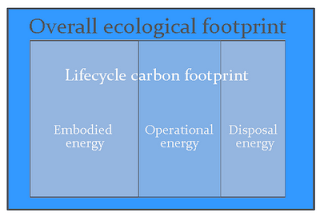
embodied energy and ecological footprint

What is embodied energy?


To reduce the level of climate change it is necessary to reduce emissions of global warming gases. These occur at every point in the life of a material or product, giving rise to the "life-cycle carbon footprint".

The “embodied energy" component of this overall figure is that used in the manufacturing process and is distinguished from the "operational energy" – that used in its lifetime. Then there is the environmental cost of its final disposal – whether it is landfilled or recycled etc.

If, for example, the product is concrete, it will take account of all the energy involved in quarrying, transportation and manufacture.

Usually, the impacts of other global warming gases like methane and HCFCs are converted into carbon-equivalent values for ease of comparison.

Why is it useful?


All products contain materials and in particular buildings can be with us for between 30 and 100 or more years. The building sector is responsible for 21% of global carbon dioxide-equivalent emissions: 8% through emissions from primary fuel types and 13% from the electricity demand for residential and commercial buildings.

As buildings become more energy efficient in operation, the embodied energy component of their overall footprint becomes proportionally more significant.

A recent report from the South West Regional Development Agency (SWRDA) on sustainable offices summarised that the embodied carbon impacts (construction, plus demolition) accounted for about a third of the whole life carbon impact.

Similarly, the RICS redefining zero report estimated the contribution of embodied carbon to be 20% for supermarkets, 30% for houses, 45% for offices and an incredible 60% for warehouses (usually unheated).

Last autumn the final report was published of the UK Low Carbon Construction Innovation and Growth Team (IGT), chaired by Paul Morrell (the UK Government Chief Construction Advisor). It had been asked by the government to consider how the construction sector could meet the low carbon agenda.

It made many recommendations, and on embodied carbon said that "as soon as a sufficiently rigorous assessment system is in place, the Treasury should introduce into the Green Book a requirement to conduct a whole-life (embodied + operational) carbon appraisal and that this is factored into feasibility studies on the basis of a realistic price for carbon".

Further, "that the industry should agree with Government a standard method of measuring embodied carbon for use as a design tool for the purposes of scheme appraisal".

A wealth of information


ICE is such a tool. It includes annexes on methodologies for metal recycling and explanations of how the values for carbon impacts have been calculated.

Summary sheets for each material expand into detailed fact sheets and graphs, giving a breakdown of the components of the impact, and how it has varied over the last 15 years.

For example, we learn that the impact of aggregates has been reduced by 1/5, because the UK energy mix has changed to include more natural gas.

In the important area of insulation, we learn that cellulose, typically made from recycled newsprint, has by far the lowest embodied energy (a maximum of 3.3MJ/Kg) even compared to other natural materials.

Rockwool is at 16.8, but polystyrene and other plastic insulation boards and foams, widely used in industry, are in the range of 99-109MJ/Kg. That is 30 times more than cellulose.

This means that cellulose should really be used universally by builders and refurbishment programmes in preference, despite the fact that it might take up more room.

It's important to realise that the global warming effects of the manufacture of products happens from the moment they are made, whereas the energy-saving benefit of insulation is only in the future.

Natural materials also contain carbon that has been locked up from the atmosphere during their growth (although ICE gives an average figure for the embodied energy of timber of 9.43 MJ/Kg).

So if there is a choice between timber and uPVC windows or doors, for example, uPVC has an embodied energy 10 times greater, of 94.7MJ/Kg.

The spreadsheets also include CIBSE data on material properties.

ICE is a major achievement, and is produced with the non-profit Building Services Research & Information Association (BSRIA). It is available to purchase and free to members.

The University of Bath, where project lead Craig Jones is employed, has charitably made a free Excel file version available.

Also for those with an interest in whole life carbon in buildings is this Sustain report on operational versus embodied energy.

Other sources of information


There are are other sources of comparable information:

• The Institute of Civil Engineers (ICE) Civil Engineering Standard Method of Measurement 3 (CESMM3) which includes carbon and prices for every material and unit of work, enabling users to calculate not just the economic, but also the embodied carbon of projects.
• The Hutchins 2010 UK Building Blackbook (The Capital Cost and Embodied CO2 Guide, Volume two: major works) which now includes both cost and embodied carbon for construction works.
• The Royal Institution of Chartered Surveyors (RICS) working group examining embodied carbon.
• The Institution of Structural Engineers (IStructE) soon-to-be published short guide on embodied carbon.
• BS 8903:2010 Principles and Framework for Procuring Sustainably
• PAS 2060:2010 Specification for the Demonstration of Carbon Neutrality.

Wednesday, February 09, 2011

Feed-in Tariffs review: let’s subsidise what works

The Government has announced a review of the Feed-in Tariff subsidies (FITs) for solar photovoltaic installations.

Energy Minister Chris Huhne is worried that large PV 'farms' of over 50kWp will soak up most of the budget for FITs. The Government said it would cut the amount it would spend on FITs up to 2014-15 by 10% to £360 million in the November Spending Review.

The industry is crying 'foul'. It complains that other technologies are allowed up to 5MW per installation and that no solar farms greater than 1MW are in planning. It accuses the Government of attacking jobs in the very green tech sector it says is going to bring growth to the UK economy.

But it's worth asking: what are the subsidies for? Here are a few possible answers:

1. Huhne talks of making renewable technology seem normal by being visible on lots of roofs.

2. It's said that households with the modules become more conscious of green issues and energy efficiency.

3. By increasing demand, the price of modules is supposed to come down over time.

4. It creates jobs in an emerging sector.

5. It cuts carbon emissions.

But do these stand up to scrutiny and represent value for money?

FITs are a fantastic success, particularly for PV, in stimulating demand for renewable energy among the public. There are now over 21,000 schemes of all technologies registered.

Up to the end of December, when there were 16,384 installations, PV had the vast majority with 15,236 - over 15 times more than wind in second place with 977 with hydro lagging at 154.

Are these large PV schemes? No. By the end of last year there was only one over the 50kW size, at 55kW. The vast majority were under 4kW with the average at 2.6kW. Most of these will be receiving the full tariff value of 41.3p per unit.

On the other hand almost all the hydro and wind installations were over 4kW, many over 10kW. Most of these will be receiving only 26.7p per unit.

By contrast, if PV farms were to register for the Renewables Obligation subsidy - an older, different subsidy for larger schemes - they would receive payments of around 8p/kWh plus export payments of 5p/kWh (though this is to be reviewed).

So PV receives almost twice as much under FITs as wind and other technologies. You can see why it is so popular. But is it value for money?

Let's remember that the installed capacity of PV doesn't equate to what will be generated: this depends on the location - the amount of sunshine.

Solar module manufacturers quote figures for the “peak power” of their products. These are what they would generate if one kilowatt per square metre of the sun’s energy were to fall on them.

But for most of England and Wales, the summer insolation is a fraction of that figure. London gets 198W and Edinburgh 172W in July. In December, the figures are 22 and 13 respectively - a lot less - and that’s when you need more power.

By contrast, wind and hydro ratings are significantly closer to what you actually get out of the plant.

So if you're looking for saving the most carbon per £, these technologies are a better choice for support.

But let's remember also who pays for the subsidies. The money comes off a levy on everyone's electricity bills. This means we all help pay the income of those who can afford to install the solar modules.

Since those on low incomes pay a disproportionate amount of their income on fuel, they are essentially subsidising the better-off.

On that basis the Government is right to prevent this subsidy going to large landowners and companies seeking to install solar farms.

Instead, it should support installations by such groups as housing associations like the Peabody Trust, who are putting PVs on the roofs of social housing.

(However it is cheaper to build larger installations than smaller ones – because savings on overheads and systems mean costs are reduced per kW. So these would make financial sense if the cash came instead from investors.)

In America this week, Energy Secretary Steven Chu announced that he wants to spend $27 million to cut the cost of installed solar power by 75 percent to about 6 cents per kilowatt hour in order to let the US compete with China's takeover of the solar market.

Fine for them - the southern states are where solar power works brilliantly. By contrast, even in the UK's southernmost counties, the financial paybacks are 30-50 years - all costs included.

What the UK is rich in are wind and ocean resources. If it wants to generate future jobs and save carbon, with renewable technologies that can work domestically and be exported throughout the world, it should focus its limited resources on these.

Wednesday, January 26, 2011

Latest data confirms the world is warming

graph showing increase in global average temperatures to 2010
Globally, 2010 tied with 2005 and 1998 as being the hottest year on record, despite ending in Britain with a cold spell, according to the World Meteorological Organization.

Last year, global average temperature was 0.53°C (0.95°F) above the 1961-90 mean.

“The 2010 data confirm the Earth’s significant long-term warming trend,” said WMO Secretary-General Michel Jarraud. “The ten warmest years on record have all occurred since 1998.”

The WMO's statistics are based on data sets maintained by the UK Meteorological Office Hadley Centre/Climatic Research Unit (HadCRU), the U.S. National Climatic Data Center (NCDC), and the U.S. National Aeronautics and Space Administration (NASA).

In addition, Arctic sea-ice cover in December 2010 was the lowest on record, with an average monthly extent of 12 million square kilometres - a staggering 1.35 million square kilometres below the 1979-2000 average for December.

This follows the third-lowest minimum ice extent recorded in September. It is this phenomenon that is paradoxically thought to be responsible for the cold weather in northern Europe in December.

The WMO said that over land, few parts of the world were significantly cooler than average in 2010, the most notable being parts of northern Europe and central and eastern Australia.

Another predicted feature of climate change is extreme weather and climate events, and 2010 experienced a high number of these, including the heatwave in Russia and the devastating monsoonal floods in Pakistan. These were described in WMO’s provisional statement on the status of the global climate issued December 2010.

Despite this scientific evidence, climate change denialism is still common, and even increasing in America. The Republican Study Committee last week released a list of proposed budget cuts totaling $2.5 trillion, including a recommendation to withdraw U.S. funding from the Intergovernmental Panel on Climate Change (IPCC).

In the U.S., much anti-climate change rhetoric is funded by the oil industry. Chief amongst these is Koch Industries, as identified by Greenpeace.

Last month they were the target of a hoax by unknown perpetrators, who made a fake website and fake news release that falsely announced the company was discontinuing its funding for denialist organizations such as Americans for Prosperity. Last week, Koch Industries filed a federal lawsuit in Utah seeking the identities of the people behind it.

Sunday, January 23, 2011

Co-op calls for moratorium on shale gas drilling near Blackpool

A new report, sponsored by the Co-op, has called for a moratorium on shale gas operations in the UK just a month before mining company Cuadrilla hopes to launch its first "flare".

The UK's Department of Energy and Climate Change has accepted assurances from Cuadrilla Resources, which is backed by former BP chief Lord Browne, that their operation in the Bowland shale, four miles from Blackpool, Lancashire, will cause no environmental damage.

The secretive company - which doesn't appear to have a website - is about to drill further into what it calls the first true shale gas find in Europe, near Grange Hill.

"We understand that [cases of water contamination] are only in a few cases and that, when carried out correctly, shale gas exploration and development does not pose a threat to aquifers or local communities," DECC said in a letter to the Co-op, which had called for a halt to the drilling.

It added: "Cuadrilla, currently operating near Blackpool, has made it clear that there is no likelihood of environmental damage resulting from its shale gas project, and that it is applying technical expertise and exercising the utmost care as it takes drilling and testing forward."

What is shale gas?

Shale gas is methane that is found within natural fissures and fractures underground. Shale is a type of rock laid down under lakes and seas millions of years ago. The methane was released by rotting vegetation and trapped in millions of small pockets.

Until recently, no method of safely transporting it to the surface existed.

Now, by pumping water, sand and chemicals into rock formations under high pressure using a technique known as "hydraulic fracturing" or "fracking", energy companies believe they have found part of the solution to Europe's energy security problems.

At the moment Europe depends on gas imported from Russia, and disputes between that country and Ukraine have disrupted winter supplies in the last decade.

In the US, shale gas already accounts for over 10% of natural gas production and some analysts predict that could rise to 50% within 20 years. BP's former chief executive Tony Hayward has described shale gas as a "game changer".

But in New York State, a temporary ban has been imposed on shale gas production after an incident of ground water contamination caused by the chemicals used in fracking. These can be foams, nitrogen or carbon dioxide, containing sand, resin-coated sand, man-made ceramics, and even radioactive sand is sometimes used so that the fracture trace along the wellbore can be measured.

Water extracted for drinking can also flow through shale. A new film, 'Gaslands', shows homeowners in the state turning on their water taps and igniting the gas that comes out in areas where shale is being extracted.

Other reports from the US have depicted polluted water killing trees and contaminating land. But shale gas has transformed the American energy market and sent prices spiraling downward. European gas prices are currently much higher.

The Co-op takes a stand

The Tyndall Centre report, funded by the Co-operative, demonstrates how the extraction of shale gas risks seriously contaminating ground and surface waters and calls for a moratorium on shale gas development until there is a much more thorough understanding of the extraction process.

Paul Monaghan, head of social goals at the Co-operative, added there was no evidence the use of shale gas in the US was driving people away from using dirtier coal for energy.

Tim Yeo, who chairs the House of Commons’ energy and climate change committee, said drilling for shale gas raised ‘some new environmental and related questions’

Environmentalists expressed concern that calls for a ban were going unheeded. "It is absolutely dangerous because they are using technology which is not proven yet," said Darek Urbaniak, extractive industries campaign coordinator at Friends of the Earth Europe.

More fundamentally, the Tyndall centre report concludes that in an energy hungry world, any new fossil fuel resource will only lead to additional carbon emissions. In the case of shale gas there is also a significant risk its use will delay the introduction of renewable energy alternatives.

"Consequently, if we are serious in our commitment to avoid dangerous climate change, the only safe place for shale gas remains in the ground" said Professor Kevin Anderson at the Tyndall Centre and the University of Manchester, referring to the Copenhagen Accord’s commitment to limiting global warming at 2°C.

The report also says that the demand for water in shale gas extraction could put considerable pressure on water supplies at the local level in the UK.

These concerns were dismissed by Marlene Holzner, spokesperson for EU Energy Commissioner Günther Oettinger. "We believe that shale gas is an opportunity," she said. "We need gas and gas demand will increase over the years so if we're able to extract this gas, it will help us to rely less on imports," adding that this need had to be balanced against "environmental concerns".

Friday, January 14, 2011

Feed-in Tariffs budget to be slashed by 10%

The level of support for Feed-in Tariffs is to be reviewed, as the budget must be slashed in 2014/15 by at least £40m or 10 per cent.

Energy minister Chris Huhne has praised FITs for introducing renewables to individuals who would not have traditionally considered installing them, but said that there has to be a review because the recent Spending Review called for a reduction in the scheme's projected costs.

Huhne was responding to questions on the Financial Times' Energy Source blog last week on a wide range of questions covering feed-in tariffs, the Renewables Obligation, emissions targets and green jobs in the UK.

"These savings will be achieved through the planned first review of the scheme in 2012, to take effect in April 2013, unless higher than expected deployment requires an early review," he said.

Solar panel and other installers have expressed alarm over Government noises that there is to be a review. If the tarrif rates are to be changed this would affect decisions on whether to invest in micro-renewables by householders.

Huhne also said his department was keeping an eye on whether FITs were encouraging the development of "large, industrial-scale, greenfield based solar farms", which would "distort the available funding for domestic solar and other technologies".

"Whilst we won't act retrospectively, we stand ready to take measures to limit the access of such schemes to FITs if that is shown to be necessary", he said.

The Government is also to consult on the proposed support levels for the Renewables Obligation after 2013 in summer 2011, and give its response in autumn 2011, says Secretary of State Chris Huhne.

Attempting to assure investors, he said that changes to bands, if any, will come into effect from 1 April 2013 (2014 for offshore wind).

"The RO will remain in place until 2017, so developers can make decisions now, knowing what their support mechanism will be" he continued. "We are also consulting on whether to give developers the choice between the two mechanisms in advance of 2017, and would genuinely welcome views. From 2017, the whole RO mechanism will be grandfathered, so developers can know that investments made now will be protected."

Support levels for new projects between 2013 and 2017 are decided by last March's banding review, and the Government recently announced that it is speeding up that process.

Tuesday, January 11, 2011

Mark Kennedy: should the Met prosecute itself for crimes committed by its double agent?


News that the trial against climate change activists has collapsed because an undercover cop working with them for seven years decided to switch sides and give evidence in their favour has prompted widespread reactions - of glee, surprise and outrage.

It's being questioned whether he was more than an informer but an agent provocateur - he arranged meetings, provided cash, climbed fences and much more.

Such undercover work is nothing new, but the turning of an undercover operator is relatively uncommon.

Ever since Lord Monteagle was planted by Elizabeth I's Secretary of State Robert Cecil amongst the Gunpowder Plotters and helped them obtain the gunpowder they needed, not to mention the cellar under the Houses of Parliament when Cecil felt their tunnelling waas taking too long, the State has used this type of agent.

When I was part of a co-op producing a grassroots newspaper called Monochrome in Brixton during the '80s, an MI5 informant used to come to the open co-op meetings.

He stood out a mile, though, unlike PC Kennedy. He was older, dressed conservatively and shabbily, and his "street level" language was laughably out-of-date. We used to make fun of him.

He claimed to be a sympathetic lawyer offering legal advice, and also attended meetings at the anarchist centre at 121 Railton Road, Brixton.

He was exposed by the then Time Out / City Limits journalist Duncan Campbell and disappeared. He seemed a lonely, isolated chap.

We had our own undercover agent who infiltrated far right groups, such as National Front football supporters, to get stories for our paper. His technique was to say little, appear pliant, agree with everythng, and use personal contacts to gain trust.

A few years later the protest group London Greenpeace (nothing to do with the larger Greenpeace) imploded when it was found that there were more agents (seven) within the group than members! Several were private investigators employed by McDonalds, who were the target of their actions.

Each did not know the identity of the others, another innovation of Robert Cecil's to keep check on his own agents to ensure they could be trusted, one well used later by Stalin.

The subsequent McLibel trial established the argument that "those who employ agents are responsible or liable for any action they take within the scope of their employment".

Are we now to suppose then that the Metropolitan Police will prosecute itself for the offences committed by Mark Kennedy, aka Mark Stone, and his as yet unnamed female accomplice?

Sunday, January 09, 2011

Join me for a free webcast on sustainable home renovation


Join me for a free Webcast presentation on sustainable home renovation, and ask any questions you like. It's Wed. 12th January at 5pm. Register here! http://www.earthscan.co.uk/tabid/101760/Default.aspx

Thursday, January 06, 2011

After the cold December - is climate change real?

ice floes on the Dyfi Estuary, mid-Wales on 24 December 2010. Photo: Richard Collins
Many sectors of the media suggested last month that the exceptionally cold weather that gripped the UK and other parts of northern Europe challenged the science of climate change.

Sceptics, however, tend to look for easy, local, black-and-white answers to the problem of climate change and whether it is caused by human activity. Unfortunately, the climate is much more complex than this, and scientists are still struggling to adapt the models to the observed and collected data.

However, this does not mean that climate change is not happening: it is, and extreme weather events are part of the expected pattern.

Weather and climate

A basic mistake is to confuse weather with climate. The weather is not the same as the climate. A pattern of 'climate' in a region changes over a number of years. 'Weather' is local and changes by the hour.

There is no doubt than in general, the Earth is warming - global average annual temperatures are increasing. This is a view held by the vast majority of climate scientists.

The term 'climate change' is used because in the chaotic transition from one stable climate pattern (recent centuries) to whatever the future holds, there is and will be turbulence and unpredictability locally - an increased number of extreme weather events.

For example, last year saw also a Russian heat wave resulting fires that killed 56,000 people and the loss of 39% of the grain harvest. Furthermore, 15 nations around the world reported large scale coral bleaching events , as a result of record sea surface temperatures, including 94oF in the waters of the 'Coral Triangle'.

In fact, 2010 was one of the hottest on record around the world. The weather in north-west Europe is just one part of the global picture. Many variable factors affect it, meaning cold winters are perfectly possible in a warming world.

So what did cause the cold weather?

A big high centred on Greenland - one of the most intense ever, say meteorologists - spread south and blocked warm westerly winds from crossing the Atlantic. To fill the vacuum, bitterly cold air from the Arctic flowed down over Europe.

The culprit is widely blamed as the North Atlantic Oscillation (NAO).

The NAO has two phases: the positive phase when air pressure is low over Iceland, but high down south over the Azores islands off West Africa, driving strong westerly winds and weather fronts, whipping up storms and sometimes causing floods; and the negative phase as occurred in December.

According to science writer Fred Pearce, "the NAO has been in a generally positive phase for the past 25 years. As a result, winters have usually been mild since the late Eighties, encouraging one climatologist to predict an end to winter snow in Britain.

"But in the middle of summer 2009, it slipped back into a negative phase that has persisted month after month since, bringing us last winter's snow and now our current record-breaking December freeze."

What has caused the change? Well, fingers are being pointed at the thawing of the Arctic ice due to global warming. This has had two effects: the sea absorbs more heat from the sun than the white ice, which reflects the radiation back into space; and it also warms the air above the sea, which ice does not. It's a positive feedback loop for warming, and it has given rise to the high pressure.

The Arctic Dipole

But the climate is more complex even than this. According to climate-watcher John Mason, "a new atmospheric circulation pattern has been identified: the Arctic Dipole, which has become an increasingly-important feature of the Arctic climate during the first decade of the 21st Century."

He says that Arctic weather has until recently been driven by the NAO and its close relative, the Arctic Oscillation (AO), both of which broadly produce a circumpolar airflow from west to east. But the newly identified Arctic Dipole pattern features anomalously high and low pressure systems - they are occurring and persisting where previously they did not.

"Now, with the Dipole, they have competition and it is having some strange affects on the climate of the Arctic and further afield," says Mason.

The open water in the Barents-Kara seas reaches its maximum extent in mid-September: during the Autumn, the research has found, it returns some of that heat back to the lower atmosphere, driving up air temperatures and thereby affecting pressure and atmospheric circulation patterns, which in return go on to cause further excessive summer ice-loss in subsequent years.

This potential influence - the 'B-K Effect' - has been analysed using a global atmospheric circulation model by Vladimir Petoukhov of the Potsdam Institute for Climate Impact Research and Vladimir Semenov of the Leibniz Institute of Marine Sciences at Kiel University in a study submitted in November 2009 and recently published in the Journal of Geophysical Research.

They found that the model responded in a non-linear fashion: rather than resulting in a warming over adjacent continents as might have been expected, a strong regional cooling was generated  within a certain range of sea-ice cover.

In the abstract, they state: "Here we show that anomalous decrease of wintertime sea-ice concentration in the Barents-Kara (B-K) seas could bring about extreme cold events like winter 2005-2006."

Changing climate models

Climate models may need to be updated to account for the readings observed. Rasmus Benestad of the Norwegian Meteorological Institute, writing on the Realclimate blog on December 14th 2010, said that, while Petoukhov and Seminov's findings sound plausible, "There is a limit to what they are able to describe in terms of local regional details, and it is reasonable to ask whether the response to changes in regional sea-ice cover is beyond the limitation of the global model."

The extremity of the NAO is measured by an index from negative to positive. Whilst 2009-10 caused major problems in parts of the UK and had an index just under -4.0, it was not as cold as the 1962-63 winter, which had a lower NAO index of -4.0.

That winter had a Central England Temperature (CET) of -0.3C. The CET for the equivalent period in 2009-10 was 2.4C.

If the NAO was the only control-mechanism with respect to the severity of our winters, then by rights 2009-10 should have been colder than 1962-3. But it wasn't, and the difference might be due to overall average global temperatures increasing. The jury is still out.

Climate trends are multidecadal affairs and the research discussed above is relatively recent. The influence of open sea water in the Arctic, where at one time there was extensive sea-ice, is clearly crucial to watch in the coming years. As with most matters of science, the truth will come out in due course.

Other references:

> Budikova, D. (2009): Role of Arctic sea ice in global atmospheric circulation: A review. Global Planet. Change, 68(3), 149–163.
> Honda, M., J. Inoue, and S. Yamane (2009): Influence of low Arctic sea-ice minima on anomalously cold Eurasian winters. Geophys. Res. Lett., 36, L08707, doi:10.1029/2008GL037079.
> Overland, J.E., and M. Wang (2010): Large-scale atmospheric circulation changes associated with the recent loss of Arctic sea ice. Tellus, 62A, 1–9.

Thursday, December 23, 2010

Permit to pollute sales should benefit households, not taxman

The new proposal from the Treasury to tax companies that introduce fossil fuels into the UK economy, which is at the heart of the current consultation on UK energy policy, has come under attack – by a group proposing that fuel supplier sales are controlled – but by a permit scheme that benefits the public, not the Treasury.

Under the Treasury's proposals, a single pensioner's fuel bill could rise by between 16% and 35% in 2020. Critics say that to compensate people for such bill increases, the cash should instead go to households.

The criticism comes from a group advocating Cap and Share, a policy measure which the Irish Government was giving consideration to trialling before that country's fiscal crisis. They call Cap and Share "a simple solution to climate change that is easy and relatively cheap to implement and puts cash in the hands of every citizen".

Just as with the Treasury's new proposal, Cap and Share argues that it's easier to cut down on the fossil fuels entering the economy than for each citizen to cut their individual use, and they think the 255 companies responsible should therefore pay for the right to pollute.

If they can be made to buy permits, as under the EU Emissions Trading Scheme, and the government issues only sufficient permits to match the country’s target CO2 emissions, reducing them year on year, this provides the cap.

The 'Share' part of 'Cap and Share' entails that all households would each receive an equal share of the permits which they may then sell to the fossil fuel companies. This would put cash in their pockets to compensate them for higher energy prices.

In other words the proceeds of the Fossil Fuel Levy - at a projected average £30/tCO2 - would come to households, not the Treasury.

Richard Douthwaite (author of The Growth Illu$ion: How Economic Growth Has Enriched the Few, Impoverished the Many and Endangered the Planet) says that Cap and Share is based on the Commons principle, and assumes that everyone has an equal share in the atmosphere.

As the Carbon Trust knows from experience, the most popular and successful climate-friendly policies are those which also save or give businesses and householders money.

By contrast, explains Cap and Share spokesperson Brian Davey, the EU Emissions Trading Scheme has seen allowances to pollute - carbon credits - given away to the big greenhouse gas-emitting companies, which they have been able to sell on and generate profits for themselves. In the case of the energy companies, they have also posted huge profits.

Davey and Douthwaite believe that on the other hand, if this benefit were split between every adult in the country, it would be both fair and popular.

Davey said, "With the perception that most climate change legislation is punitive and restricting freedom fuelling wider public scepticism of climate change, such a move by the Government could help swing public opinion back to favour the green economy."

Davey argues that the Treasury's proposal has not been thought through in its relationship to the EU ETS. "It is being made due to the failure of the ETS to provide sufficient stable incentives for the development of renewables. It's not just the low price of carbon but its volatility and unpredictability.

"However the criticism of the EU-ETS is muted and fudged. The result is that the proposal is to impose the scheme in addition to the ETS, but the interaction effects on an unreformed ETS are likely to be counterproductive.

"It is admitted in the Treasury document that the new scheme would likely lead to a fall in the demand for ETS permits and thus a fall in the ETS price but the implications of this are glossed over (in paragraph 5.24)," he continued. "Put bluntly, wWithout tackling the ETS, a rise in the UK carbon price may be matched by an offsetting fall in the European carbon price. What is needed is a revisit of the whole EU-ETS, which has been a complete disaster".

Carbon tax to hit electricity generators

A second effective 'carbon tax' is to be levied - in addition to the Carbon Reduction Commitment for large electricity users - this time targeting all companies that import fossil fuels into the economy.

The proposal, together with various ideas as to the level of the tax, comes in two linked consultations being conducted by the Treasury and DECC in a search for policies that will stimulate the investment necessary to meet the targets set by the Climate Change Committee (CCC) and others for de-carbonising the economy and reducing overall greenhouse gas emissions.

The specific CCC target is a reduction in carbon-intensity of power generation to below 100gCO2/kWh by 2030. In 2009 this figure was around 490gCO2/kWh.

Ofgem has estimated that to achieve such a drastic reduction in nineteen years implies the investment of around £200bn in new generation, electricity networks and gas infrastructure.

Only reform of the electricity market can deliver this, DECC says. The consultation argues that such reform must include support for the price of carbon - the creation of a floor price - to provide long-term certainty for investors around the additional cost of running polluting plant.

This is an admission of the failure of the EU-ETS (Emissions Trading Scheme) to deliver this support so far. Currently the price of carbon is remaining stubbornly below 15 Euros, and needs to be at least double this to stimulate investment. It is also volatile and unpredictable.

Supporting the price of carbon

The proposals state that from 1 April 2013 a 'carbon price support mechanism' will be introduced by applying the climate change levy (CCL) to all fossil fuels used in electricity generation and taxing their use and, in the case of oil, removing rebates.

According to HM Revenue and Customs, there are 255 of these companies, which break down as follows:

Energy product No. of registered suppliers
Electricity: 117
Gas: 71
Solid fuels: 36
LPG: 31

The Treasury says that the exact rates for the tax will take account of the commodities’ average carbon content and will be known as the ‘CCL carbon price support rates’. The consultations discuss different levels - from £20/tCO2 to £50/tCO2, with the preferred rate being £30/tCO2.

According to the Treasury's own reckoning, the only scenario that leads to the required carbon-intensity of power generation by 2030 is a carbon price support starting at £3/tCO2 on top of the prevailing EU ETS price in 2013, rising to target a combined carbon price (support plus EU ETS) of £40/tCO2 in 2020 and £70/tCO2 in 2030.

However this scenario also results in the highest rise in domestic energy bills. A single pensioner's bill would rise by 35% in 2020, compared to 16% if the starting support price was £1/tCO2, rising to £30/tCO2 in 2020. Adopting that scenario, however, leads to a carbon-intensity drop to only about 120gmCO2/kWh.

Other policies

DECC, in a linked consultation about the best policy context for the tax, offers four scenarios, of which it prefers a combined set of policy tools that include contracts for difference and carbon price support plus Emissions Performance Standards and a capacity mechanism. One reason for this is that "the [cash] flows from government to generators would be lower than without carbon price support."

An Emissions Performance Standard (EPS) would limit how much carbon the most carbon intensive power stations - coal - can emit, and encourage carbon capture and storage.

Long-term contracts for feed-in tariffs, a revised Renewables Obligation, much more low-carbon generation, and demand-management strategies also figure in the consultation as collectively being necessary to secure the targets.

Capacity payments would be introduced to encourage security of supply through the construction of flexible reserve plants, a policy which acknowledges the intermittent and inflexible nature of much low-carbon generation.

"The key factor in the effectiveness of the policy is the reaction of potential investors, and whether the mechanism is “bankable” for the purposes of raising finance for new low-carbon generation investments," says DECC.

Saturday, December 18, 2010

Government removes 2.8 million from fuel poverty - by redefining it

The Government is proposing to change the definition of eligibility to its Warm Front scheme - which provides help to those on benefits in leaky homes - which will slash by 65% the number of households it has to help.

The Scheme - which has been so badly run that it is now temporarily closed to new applicants while it catches up with the backlog - aims to target those who need it most, such as the ill, elderly, and those with children on receipt of certain benefits.

The new proposals for eligibility introduce a thermal efficiency test for the home under which households can access Warm Front assistance only if they have a SAP rating of 55. Recipients would also need to be eligible for Cold Weather Payments - which means not just receiving Child Tax Credit (with an income of less than £16,040), as at present, but an award of Child Tax Credit that also includes an element for a disabled, or severely disabled, child or young person, or a child under the age of five.

Currently some 4.3 million households in England could qualify for assistance from Warm Front, of which 53% are believed to be fuel poor. But applying the new criteria would reduce the number to approximately 1.5 million households.

At a stroke, many households on low incomes with children will become ineligible for support. We also know that applying a benefits criteria to fuel poverty is problematic: an English House Condition Survey found that 57% of vulnerable households in fuel poverty do not claim the relevant benefits to qualify for the scheme, so would be ineligible despite needing help.

SAP - "Standard Assessment Procedure" - is a measure of how warm a building is, and the lower the number, the harder it is to heat. 100 is the most efficient. SAPs are related to Energy Performance Certificates (EPC) - a result below 55 will yield an 'E' rated certificate.

A SAP target of 65 to be achieved “wherever practicable” has been used in Warm Front since June 2005 (in Scotland the target figure is 60), so using a figure of 55 would capture fewer homes than before – another way for the Government to dodge its responsibilities.

One reason why this change is regressive is because the fuel prices used in the SAP calculation are normally fixed for 3 to 4 years. With the volatility in prices recently seen, this could mean that a home could need help when prices rise, without being considered eligible.

Another problem is that simply by installing a condensing boiler, 47 SAP points can be added - and a box ticked - but this measure alone would do nothing to improve insulation or remove draughts.

The Warm Front Scheme was criticised last year by the National Audit Office for being inefficient, and not well targeted. It said that over 635,000 households were helped between June 2005 and March 2008, "but as there were 1.9 million vulnerable households in 2006, this rate of progress will still leave many in fuel poverty in 2010".

Warm Front has experienced extremely high demand and diminishing budgets. In 2008-9, the last year for which statistics are yet available, the figure for homes helped was 233,594, down from 268,900 the previous year. Next year will see a reduction of 63,594 homes – 27% down - on an already very low figure.

Earlier this year, therefore, the House of Commons Energy and Climate Change Committee recommended that "the Government to move resources away from the Warm Front Scheme towards a CESP-style, street-by-street approach as advocated earlier, and for the Warm Front Scheme to move towards providing an emergency service for the most vulnerable people in fuel poverty with urgent heating needs."

This proposed change is part of the Government's response to this recommendation, as is the new Warm Home Discount, under which, from April next year, energy companies will be required to give a discount on energy bills to more of their most vulnerable customers.

But these proposed new criteria have more to do with reducing Government spending than providing proper help to those who need it most.

Monday, December 13, 2010

Emissions credits surplus means developed countries need do nothing

Was Cancun a success? Well, countries, except brave Bolivia who dared to quote the science, did agree on something - which is an achievement of sorts.

But although progress was made on a number of issues to do with accounting for a nation's emissions and verifying their actions, none of the decisions made at Cancun are yet sufficient to lead to quantifiable changes.

According to Climate Action Tracker, which provides an independent peer-reviewed assessment of emission reduction proposals, the largest factors limiting emissions savings are:

Surplus emissions allowances

Countries will currently be able to sell and buy allowances originally meant for the period up to 2012 beyond that date. If so, this could mean that taken together, developed countries wouldn't need to do anything further to curb emissions until at least 2020. This would add about 3-9% relative to 1990 to the emission limits, and credits would still not be exhausted until 2025-2030.

Forests and land use
The options for accounting for the impact of a country's forests, land-based emissions, deforestation and reforestation are not finally agreed. By 2020 they could cause a nation's emissions to be 3% more than they would otherwise be relative to 1990.

Japan's get-out
Japan has a relatively ambitions 25% reduction target below 1990 by 2020, but it is likely to be met by offsetting in developing countries. As these actions would be counted by those countries, this would mean double-accounting.

American inaction
There's scant chance of federal greenhouse gas legislation in the USA. This means their 2050 target is unlikely to be met. Double counting of offsets is a problem for America and its partners too.

The gap between hope and action
With business carrying on as at present, global emissions by 2020 will be 56 billion tonnes CO2equiv/year. To limit warming to 2°C or 1.5°C, they would need to be in the range of 44-40 billion tonnes by 2020, a reduction of 22-29%, or 12-16 billion tonnes, at a rate of over two billion tonnes per year.

The promises made at Cancun lie in a range from low ambition to high. If the lowest were attained by 2020, there would be a reduction of just 3 billion tonnes, leading to an average global temperature raise that is highly unacceptable, of 3.2oC.

If the highest ambition targets were reached in 2020, this would only add another 1.3 billion tonnes of cuts, to 51.7 billion tonnes per year.

The gap is therefore between 8 and 12 billion tonnes per year in 2020.

How can the gap be closed?
The Climate Action Tracker has identified several options which would achieve more than enough to close the gap:

• The decision on how many emissions allowances could be carried over by nations after 2012 has yet to be taken. Therefor it is possible to eliminate new surplus emissions ‘built into’ 2020 reduction pledges; options for this are included in the negotiating text
• Remove crediting for forestry and land use that allow developed countries to increase their emissions
• Reduce international aviation and marine emissions up to half of the projected levels in 2020
• Increase ambition level of developed countries as a group - in line with the European Union's aspiration - to a 30% cut below 1990 in 2020 (without forestry credits)
• Ensure reductions of emissions in developing countries of 1.5 - 6.2 billion tonnes
• Halt deforestation by 2020.

Crucially, global long-term emission reductions are required as well: at least 50% below 1990 by 2050. The UK's Climate Change Committee advocated 60% last week. The Cancun climate conference did not include a goal for 2050.

Friday, December 10, 2010

Who's going to pay for new nuclear waste disposal?

The government has published a new consultation on the decommissioning of new nuclear power stations and what to do about all the new radioactive waste they'll create.

It specifies guidelines and principles for developers of new nuclear power stations in how to set up a Funded Decommissioning Programme. It underlines the principle that developers alone, not taxpayers, should pay for the decommissioning of plants and the storage and disposal of waste, which is covered under a separate consultation.

But the question is, will the cap on developers' costs be set high enough to avoid taxpayers one day footing some of the bill?

What does it cost now?

Existing nuclear waste is currently managed by the Nuclear Decommissioning Authority. Its 2010-11 budget is £2.8bn, of which £1.69 billion comes from the taxpayer via DECC. DECC's overall budget in this year is £2.9bn.

This means that the cost of managing existing radioactive waste is a staggering 58% of the Department's total expenditure. Because of its nature, this expenditure cannot, of course, be cut.

What will it cost in the future?

To avoid future waste adding to this bill, the Government says that a fund should be set up by developers to pay for new costs, and the consultations explain how the funds should be managed and what they should be used for.

The cost for each new power station is estimated to be about £1 billion. The question is, whether this estimate is sufficient, given the history of escalating costs in this area.

A parallel Waste Transfer Pricing Methodology explains how the cost of disposal will be determined, since the hypothetical (currently) Geological Disposal Facility has yet to be constructed. Rough costs for such a facility were estimated by the NDA a year ago, at around £20 billion, at current prices, but are dependent on the geology of the site.

The government expects that a cap will be set on the waste transfer price, but at a very high level - three times current cost estimates. But it's impossible to be certain that costs will not exceed this figure, so there will be an additional "risk free" to compensate the taxpayer for accepting this risk.

Companies interested in building new nuclear power stations have been lobbying the government furiously in an attempt to keep the cap amount down. But if the cap is set at the wrong level, the taxpayer will end up footing the extra bill.

The first plant is expected to be built by EDF and Centrica by 2018. However, on Tuesday, Alistair Philips-Davies, energy supply director at Scottish and Southern Energy, said he was now unsure whether this schedule could be maintained. "Often these things are a little bit more expensive than you think and come in a little bit later than you think," he told a committee of MPs, raising some wry smiles.

The current position held by the Committee on Radioactive Waste Management (CoRWM), which advises the government on this matter, is that "a range of issues, including social, political and ethical issues, arising from a deliberate decision to create additional wastes should be considered as an integral part of the new build public assessment process."

These issues are not covered in the consultation, however.

There is also a new consultation on the Strategy for the Management of Solid Low Level Radioactive Waste from the Non-Nuclear Industry in the United Kingdom. This includes waste from hospitals, the pharmaceutical sector, research and education establishments.

Wednesday, December 01, 2010

Loft and cavity wall insulation figures down

Figures have been released that show that the number of cavity wall and loft insulations in Great Britain is falling.

Cavity wall insulations in the last quarter fell from 128,000 to 95,000, a fall of 25%, and a staggering 45% below those installed in the same quarter last year.

Also, the number of professional loft installations fell by 32%, and is 38% below the number installed in the same quarter last year.

DECC has published the figures, which also show that at the start of July 2010:
• 12.3 million homes had loft insulation of at least 125mm
• 10.3 million homes had cavity wall insulation.

In Great Britain 23.2 million homes have lofts and 18.6 million have cavity walls. This means that 47% of eligible homes do not have sufficient loft insulation and 45% have no cavity wall insulation.

What the figures do not reveal is the level of effectiveness of the installations. Those which the author of this article has seen leave much to be required, i.e. gaps that mean that their ability to keep heat in is severely curtailed.

This implies that they cannot be relied upon to generate the carbon savings that will be assumed in government figures.

Moreover, the figure of 125mm for loft insulation is not sufficient. Current building regulations require a roof to have a thermal resistance U-value (a measure of their insulation value) of at least 0.13W/m2K, which would typically be achieved with 300mm of loft insulation.

DECC says that a threshold of 125mm is used in these statistics since homes with less than this would expect to see significant improvements in energy efficiency from a top-up.

It also says in its Departmental Business Plan 2011-15 that this measure will be one of its key impact indicators to track progress on insulating homes.

But if it really wants to show the scale of work required and monitor improvements, it should be using its own Building Regs figure of 300mm of loft insulation.

In addition, the width of cavities in walls varies considerably. Just because a wall has cavity insulation does not mean that it meets any building regulation requirements for thermal resistance of outer walls.

The figures are obtained via surveys from the English Housing Survey and equipment for Scotland, Wales and Northern Ireland.

Most of the statutory work has been carried out through the Carbon Emissions Reduction Target requirements. Only a small proportion has come from Warmfront, which targets the fuel poor. DIY loft insulation is currently done at around twice the rate of professional work.