Tuesday, May 01, 2012

Warm Front fiasco: This Government doesn't care about the fuel poor


The Government has betrayed thousands of people who suffer in fuel poverty by deliberately not spending £50.6 million of its budget last year allocated to help them and then refusing to give it back, and is betraying millions more by cutting its future budget.

The £50.6 million, being unspent, has returned immediately to the Treasury general coffers.

The figure came out of a Parliamentary answer by Greg Barker this week to questioning by opposition Energy Minister Caroline Flint, who has been persistently badgering the government to do more about fuel poverty.

The end result of the fiasco is that 22,000 households remain in fuel poverty that could have been helped.

Four million people


Four million of the most vulnerable people in the country are unable to pay their energy bills and suffer ill-health, days off work and poor quality of life as well as having less to spend on other necessities as a result, according to the latest figures.

The underspend happened despite the rejection of nearly 30,000 families who applied for help with insulation, because they didn't qualify under the new, stricter, eligibility criteria.

Ron Campbell, the policy officer for National Energy Action, calls the situation “a cock-up".

“The low take-up of Warm Front help, is due partly to the stringent eligibility requirements," he told me, "but mostly to the fact that a decision was taken not to promote the help available, because it was felt that with a reduced level of funding it would run out too quickly.

“The installers, such as Carillion, haven't been promoting it on the assumption that existing referrals from councils and Citizens Advice Bureaux would ensure uptake, but it just hasn't happened partly because of the stringent requirements."

“The Government thought that 57,000 households would be helped, but in it the event there was a 22,000 shortfall."

Warm Front is the main measure directly funded by the government to support those in fuel poverty and is ending next year.

The last report of the Fuel Poverty Advisory Group said it was a matter of “serious concern" that the government is ending this scheme.

Under the Warm Homes and Energy Conservation Act 2000 the government is legally obliged to eradicate fuel poverty by 2016.

At this rate it is going in exactly the wrong direction and will fail spectacularly.

Carillion's failure


The company with the contract to deliver Warm Front is construction giant Carillion. It is among the 22 companies first in the queue of providers of Green Deal energy efficiency installations.

Its failure to fulfill its Warm Front duty casts doubt on its ability to deliver Green Deal measures successfully.

As a result of its underspend last year, DECC forced it to repay £14 million of the money was given to fulfill his contract.

I tried repeatedly to get a statement from Carillion on how much money it did receive and how the £14 million figure was arrived at.

It refused to give this transparency and would not answer the question. It also refused to say why it did not promote the scheme especially when it knew that there was to be an underspend, referring all questions back to DECC.

A spokesman did provide a statement saying "Following changes to the funding and the qualifying criteria, take up of Warm Front has been lower than in previous years, and this has resulted in an under-spend for the latest financial year."

It called this “clearly disappointing and naturally we would encourage anyone who feels they may qualify to apply".

"Funding for Warm Front and the rules of the scheme, including expenditure on publicity, are all managed by Government and therefore these are not issues we can comment on," it added.

DECC did respond, and its statement is at the bottom of this piece, but adds little and certainly does not contain an apology for its incompetence.

How the money is drying up


In 2011-12, 43,585 applications were accepted for a Warm Front grant; a further 28,789 applications were turned down for assistance. 8,297 further applications are still awaiting a survey.

The total budget of £143 million for Warm Front consisted of £110 million allocated through the spending review 2010. Of this, £108 million was directly allocated to Warm Front measures.

In addition, DECC allocated £25 million to support the completion of outstanding work from 2010-11 with a further £10 million allocated to Warm Front in 2011-12 from the Department of Health.

Next year, the funds allocated to Warm Front will be reduced even further, to £100 million. Mr Campbell says he believes that the Treasury thinks the level of support should be more like £30m.

When Warm Front ceases in 2013, for the first time since 1978 there will be no taxpayer-funded scheme to install energy efficiency measures in dwellings occupied by vulnerable and low-income households.

This is where the Coalition's public spending cuts really hit home.

It is nothing short of scandalous.

But how many are in fuel poverty?


Official figures on fuel poverty lag considerably behind real-time increases in fuel prices, meaning that officials have no chance of keeping up with the situation on the ground.

The latest fuel poverty statistics, published on 14th July 2011, only relate to 2009, when four million were found to be in fuel poverty.

But energy prices have risen considerably since then. In the last year alone the Big Six energy companies have raised average domestic gas and electricity bills by £183, and uSwitch research says that up to 4 million households may be in debt to their energy suppliers.

The figure for those who do pay but are still cold due to poor insulation in their homes may be higher.

Under the government’s Warm Home Discount Scheme, 800,000 of the poorest families qualify for a £120 fuel bills rebate. But Save the Children says that just 3% of eligible families were receiving it last year, another chronic underspend.

Data on the final number of households assisted under the Warm Front scheme from 1 April 2011 to 31 March 2012 will not be known until Ofgem have conducted a review of suppliers’ spending in that year.

The most recent report of DECC's Fuel Poverty Advisory Group covers 2010.

No wonder the Government cannot get on top of the situation when it is so hard to get up-to-date figures.

150,000 are out of 2.9 million


Professor John Hills’s Fuel Poverty Review, published last month, shows the extent of the scandal yet to be caused by the cuts: the policies the Coalition has put in place are so ineffectual that they will reduce the number of fuel poor households by just 150,000 by 2016. And that is including the Green Deal.

A staggering 8.5 million individuals within 2.9 million households will still be in fuel poverty, with an aggregate fuel poverty gap of over £1.7 billion, compared to a gap of £1.1 billion in 2009.

Prof. Hill says fuel poverty contributes "not just to the excess winter deaths that occur each year (a total of 27,000 each year over the last decade in England and Wales), but to a much larger number of incidents of ill-health and demands on the National Health Service and a wider range of problems of social isolation and poor outcomes for young people".

Condemnation


This Government incompetence has already been condemned by the Association for the Conservation of Energy.

It said the Government's reaction to the Hill report, that it will spend nine months deciding on a new definition of fuel poverty, “beggars belief... instead they should spend that time agreeing a watertight plan to ensure that their statutory commitment to eradicate fuel poverty by 2016 is met in full.

"Without that, millions of fuel poor households will feel, quite rightly, that the Government has simply abandoned them.”

Caroline Flint has this week labelled the state of affairs "a shambles" and called for DECC ministers to come to the House of Commons and explain how they have left Warm Front in such a state.

The Speaker remarked that this was unlikely.

Further funding reductions


Here is more evidence of how Government funding cuts to the fuel poverty budget are biting.

The Deputy Prime Minister recently announced “at least £540m to fund energy saving improvements in the worst-off homes”.

This sounded impressive, but masks a reduction of 47% in Government help to tackle fuel poverty, from the 2010/11 figure of £1.15bn.

The Conservation of Energy (ACE) calculates it this way. In 2010-11, the budget for Warm Front was £345m and for CERT as a whole (the measure by which energy companies are supposed to assist households with bills), £1.3bn.

According to DECC, half of the CERT budget (53%) is spent on fuel poverty Priority Groups: £689m. Adding the whole of the £116.7m Community Energy Saving Programme (CESP) you reach a total on fuel poverty and priority groups of vulnerable households of £1,150.7m.

New money of £540m is therefore only 47% of the previous year's total expenditure.

ACE asserts that Clegg’s £540m figure was in fact only an increase in the share of the Affordable Warmth part of the new Energy Company Obligation (ECO) budget. The £1.3bn ECO budget for home energy efficiency and the Green Deal stays the same.

Instead of handing it back the £50.6m Warm Front underspend to the Treasury, as has happened, the Deputy Prime Minister should announce that it will be carried over to this year’s budget.

Without this help those in fuel poverty will have to wait until hell freezes over before the last one of them is given assistance.

Or maybe this Government thinks that's where they ought to go to stay warm.


Appendix 1: What is Warm Front?


The Warm Front scheme provides some heating and insulation improvements to households.

Qualifying households can get improvements worth up to £3,500 (£6,000 where oil central heating and other alternative technologies are recommended).

But the eligibility criteria are very stringent; for instance households must at least contain someone who has a pensioner premium, a disability premium, a disabled child or a child under the age of five, as well as being on other benefits and living in a poorly insulated house and/or without central heating.

To date, around £2.8 billion has been spent through the Scheme, which has resulted in around 2.3 million households receiving assistance, at an average of some £1,200 per household, according to the Hill Review.

Appendix 2: The figures behind the underspend


According to Hansard (Citation: HC Deb, 23 April 2012, c620W) the energy minister, Greg Barker, confirmed that the original budget for Warm Front and associated fuel poverty expenditure for 2011-12 was £110m.

During 2011-12 total expenditure was almost £108 million with a further £0.6
million committed but not yet paid. Therefore, of the original Warm Front
budget £1.4 million was unspent.

But, the budget was increased by £35 million during the year as a result of £25 million allocated to support the completion of outstanding works from 2010-11, with a further £10 million provided by the Department of Health.

The Department of Energy and Climate Change (DECC) also received agreed rebates from Carillion Energy Services of nearly £14 million.

These rebates were used to offset expenditure in 2011-12 bringing a total reported expenditure for the year to £94.4 million. Against the new budget of £145 million for 2011-12, £50.6 million was unspent.

DECC’s statement


When asked to explain this, DECC issued the following statement:

"Money is allocated to Carillion at the start of each month based on the projected spend for the month, taken from the overall budget.

"In 2011/12 total expenditure on Warm Front and associated activities was £108.6 million.

"During 2011/12 Carillion was able to return £14 million to DECC as a result of rebates such as energy companies paying for the measures under CERT.

"These rebates were used to offset expenditure in 2011/12 bringing a total reported expenditure for the year to £94.4m.

"Out of a total budget of £145 million for 2011/12, £50.6 million was therefore not spent and was returned to the Treasury."

When asked why they did not promote the grants sufficiently, DECC provided the following response:

"Marketing of Warm Front through Carillion ceased in 2010/11 because the scheme was heavily oversubscribed. It was anticipated that demand would, as with previous years, exceed supply.

"We did a major marketing push earlier this year by contacting 675,000 homes in areas where we know there’s high levels of fuel poverty like Birmingham, Leeds, Bradford, County Durham and Sheffield to alert them about the Warm Front scheme.

"We also worked with the Citizens Advice Bureau, Consumer Focus, National Energy Action and energy companies to promote the scheme through their advice services."

This was clearly too little, too late. A "cock-up" for sure.

The carbon emissions cost of an 80mph speed limit on motorways


80 mph speed limit on motorways

The Government is to take forward its proposal for increasing the motorway speed limit to 80 mph by trialling the new limit on selected managed motorways.

Roads Minister Mike Penning said this week that his Department "is carrying out work to assess the potential economic, safety and environmental impacts of trialling 80mph speed limits on motorways where variable limits are currently in place”.

He said it hadn't yet been decided which stretches of managed motorway would be included in any proposed trial.

“We plan to bring forward detailed proposals and start consultation during the next few months,” he said.

Ministers are also believed to be pressing the police to use a lower enforcement threshold than the current guideline of 10% +2mph that equates to 90mph, which is the reason why motorists aren't presently stopped for driving over 70 mph.

Carbon emissions


Environmentalists have criticised the proposal for upping speed limits on the grounds that it would increase carbon emissions.

But how much difference would it make?

Greenhouse gas emissions from transport currently account for 21% of total UK domestic emissions.

Motorways account for less than 1% of Britain's total road length, yet account for 19% of total annual road mileage, of which 75% is accounted for by cars and taxis.

This means motorway traffic accounts for emissions of 21.917 MtCO2e per year, given that UK total annual emissions last year were 549.3 MtCO2e (million tonnes of carbon dioxide equivalent).

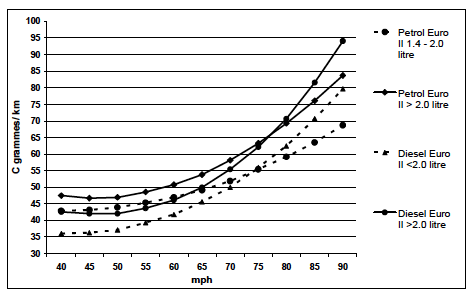
Under relatively steady speed driving conditions carbon dioxide emissions increase by around 14% between 70 and 80 mph and decrease by around 10% between 70 mph and 60 mph, according to modelling done for the carbon reduction strategy, said Lord Shutt of Greetland (the Deputy Chief Whip in the House of Lords, a Liberal Democrat) in a Parliamentary answer recently.

An increase of 14% would therefore mean an increase of half of one percent of UK total current annual emissions.

When asked whether he would support an increase in the speed limit given its impact on carbon emissions, Energy Minister Ed Davey said last month that the increasing number of vehicles on the roads in the coming years with lower emissions would offset any increase caused by higher speeds.

Is this true? The Department for Transport’s Carbon Reduction Strategy is arguing that by 2022, vehicles will be “vastly more fuel-efficient”.

“This will primarily be delivered through advances in the efficiency of the internal combustion engine. Alongside this, new ultra-low emission vehicles will have made their transition onto the mass-market,” it says.

On the other hand, the International Energy Agency has previously suggested that a temporary reduction of motorway speed limits to 90kph as a way of addressing fuel shortages would be a low cost measure that can lead to ‘large oil savings’ and, in a report, Saving Oil and Reducing CO2 Emissions in Transport, has recommended a general lowering of motorway speed limits that would not be restricted in time.

 The effect of vehicle speed on carbon emissions, from the Environmental Change Institute at the University of Oxford
What difference would this make? An enforced 70mph speed limit could cut carbon emissions by 1 million tonnes of carbon (MtC) per year by 2010, and a new 60mph limit could double this to 1.94 MtC, according to research by the Environment Change Institute, at the University of Oxford.

If added to the transport measures in the UK Climate Change Programme, carbon savings would increase by 15% (70 mph) or 29% (60 mph), they calculated.

What next?


It was last September, when Philip Hammond was Transport Secretary, that the Government announced it would be consulting on an increase in the speed limit, but it has yet to happen.

Mr Penning has said that any proposals would come with an impact assessment that would include research about road safety as well as emissions.

The Government is currently reliant for this on 2010 research about the relationship between road safety and speed limits.

Yesterday, a consultation ended on a call for evidence on the impact of speed limit changes to support the development of an appraisal tool to help local authorities assess the full costs and benefits of local speeds.

There is currently no published timescale for the initiative.

Tuesday, April 17, 2012

Dash for shale gas will not help save the climate or lower prices

how fracking works


Hydraulic fracturing, or fracking, for shale gas, is said to be seismically "safe" in the UK, but critics say it will impede us from meeting our greenhouse gas reduction targets and stall investment in renewables. 

DECC has published an independent evaluation of the seismic risks from hydraulic fracturing for shale gas, which argues that it is safe as long as certain basic precautions are put in place.

The report, now out for comments from the general public, was commissioned following two earthquakes last year with magnitude 2.3 and 1.5 in the Blackpool area, which subsequent investigations linked to hydraulic fracture treatments in nearby underground layers of Bowland shale by Cuadrilla Resources Ltd. as part of their commercial project to extract natural gas from the shale.

Cuadrilla subsequently provided DECC with a technical report, which has now been analysed by independent experts in the fields of seismology, induced seismicity and hydraulic fracturing: Dr Brian Baptie, head of seismology at the British Geological Survey; Professor Peter Styles of Keele University, and Dr Christopher A. Green, GFRAC.

Speaking on BBC Radio 4, Dr. Baptie said that there is only a "very small" risk of damage from earthquakes caused by hydraulic fracturing (known as fracking), and the highest would be around magnitude three, which poses no greater danger than that from conventional coal mining.

He said that as long as the four main recommendations of the report were adhered to then there would be minimal risk, adding that there was "no evidence of structural damage from these kinds of earthquakes".

The report was welcomed by Mark Miller, chief executive of Cuadrilla. "We are pleased the experts have come to a clear conclusion that it is safe to allow us to resume," he said.

DECC’s chief scientific advisor David MacKay commented that “if shale gas is to be part of the UK’s energy mix we need to have a good understanding of its potential environmental impacts and what can be done to mitigate those impacts”.

He added that the report “suggests a set of robust measures to make sure future seismic risks are minimised - not just at this location but at any other potential sites across the UK”.

Recommendations


The recommendations are that:


  • the hydraulic fracturing procedure should include a smaller pre-injection and monitoring stage

  • an effective monitoring system to provide near real-time locations and magnitudes of any seismic events should be part of any operations

  • future fracking operations should be subject to a “traffic light” control regime, similar to that recommended by Cuadrilla’s consultants

  • unusual seismic activity, even at lower levels than the magnitude 1.7 proposed by Cuadrilla, should be carefully assessed before operations proceed.


For any future operations elsewhere in the UK the review recommends suitable actions to assess the seismic risk before any operations take place, including:


  • establishing the background seismicity in the area of interest

  • characterisation of any possible active faults in the region

  • modelling to assess the potential impact of any induced earthquakes.


The report was criticised by Tony Juniper, former director of Friends of the Earth and chairman of Action for Renewables (A4R), who cited reports from Deutsche Bank and others which showed that the environmental impact of fracking is "comparable to coal and possibly worse", partly due to so-called "fugitive emissions" of methane from drilling sites.

Government support for fracking would cast "grave doubt" over the government's legal obligation to reduce greenhouse gas emissions by 80% by 2050, he said, adding that money would be better put into financing and developing renewable sources of energy.

Furthermore, he said that shale gas would be much more expensive than conventional gas to extract because of the precautionary measures required, and asked who would pay for the damage should anything go wrong.

Joss Garman, Greenpeace’s senior energy campaigner, agreed that "there’s absolutely no indication that fracking for shale gas will reduce soaring household energy bills, while scientific studies suggest that this kind of gas could be as polluting as coal. This would also be a major blow for the British renewable energy industry, which would see investment hijacked by a new dash for gas."

Rhian Kelly, CBI Director for Business Environment policy, welcomed the report, arguing that “shale gas could unlock significant new infrastructure investments, help meet our carbon reduction goals and create many new jobs around the UK.”

But Garman worried that this could be at the expense of jobs in the renewables industry. "Our home-grown renewable energy companies could provide thousands of jobs and develop world-leading cutting-edge technologies,” he said.

Speaking for the industry, Richard Moorman, CEO of Canadian company Tamboran Resources which has permits to operate in Northern Ireland, said that fracking is "perfectly safe if properly regulated", and that in his experience of fracking in Arkansas, US, accidents occurred at a low rate of one in every thousand drilling operations.

He said that it is likely to be at least two years before any commercial shale gas is extracted in the UK.

Other reports are still to be received, including one on the danger of pollution of watercourses from the chemicals used in the hydraulic fracturing process, and, even if drilling goes ahead, it is unlikely to provide a source of gas cheaper than current prices.

The risks of hydraulic fracturing


There are two problems with flushing methane gas from shale, a rock with low permeability.

Firstly, flowing liquids don't easily penetrate and open cracks through which the gas can be extracted, therefore the fluid used has to contain a range of chemicals to dissolve the rocks and create cracks in order to increase the amount of rock in contact with the fluid, and it has to be introduced under high pressure; up to 1,000bar or 15,000psi.

Secondly, this process produces sludge which can clog the cracks, which requires the addition of further chemicals; however, many of the hundreds of chemicals that may be used for this purpose have the potential to leak into the surrounding environment and contaminate water courses.

Their impact depends upon the geology of the area, and each operation would require its own environmental investigation before being allowed to proceed.

If the casing of the well below the drilling platform isn't properly sealed, fluid can leak back up the well bore and reach strata nearer to the surface, which may be used to supply drinking water or feed natural springs.

Even at depth, the release of fracking fluids might still cause contamination over the longer term, should the chemicals be lighter than water and given the presence of geological faults through which they could rise.

Campaign group Free Range Network has produced a report on hydraulic fracturing and unconventional gas in the UK, which attempts an assessment of whether the available resources in the UK could make up for the loss of North Sea production in coming years.

It estimates that in order to achieve this “we'll need to find another three fields over the next two decades. Taking the statements from Cuadrilla Resources in the press, its eight fields would require up to 6,400 wells to be drilled – far in excess of the couple of hundred analysed by DECC in their strategic environmental appraisal of the 14th Licensing Round".

It, too, says the price wouldn't be cheap and it would not provide the bonanza some in the industry have been touting.

The engineers' response


The Institution for Gas Engineers & Managers (IGEM) hosted a conference on the subject at Durham University on 28 March, off the back of its report: Shale Gas – A UK Energy Miracle?

This recommends that fracking liquid storage tanks should be able to withstand a once-in-a-300-year weather event. It also recommends the need for one body to bring all the standards together.

At the meeting, Tony Grayling, head of climate change at the Environment Agency, told the audience the organisation had made visits to established test sites and the UK had to learn lessons from the poor management of environmental standards across in North America.

He told the conference that in the UK “there is no significant, extraordinary ground water risk. The water aquifier tables are several kilometres above” where Cuadrilla is planning to drill.

Like IGEM, he recommends that flowback water is stored in double-lined tanks.

"We need to take the risks seriously and the necessary powers, as we are conscious that public confidence is low,” he said.

Huw Clarke, the exploration geologist from Cuadrilla Resources, told the meeting that “our wells are some 7,000 ft away from the water table”.

He added that each well has seismic censors and investment in 3D seismic imaging will search for fault lines, reducing the impact of small shocks.

Monday, April 16, 2012

Civil war breaks out in Government over green policies

Latent divisions in the coalition government have broken out into a war of words, as Tories challenge the Green Deal and wind farm plans, in a bid to influence next session's legislative programme before May 9th's Queen's Speech.

Energy minister Greg Barker appeared to signal a shift in policy over the weekend by saying that Britain already has “the wind we need” either being built, developed or in planning. “It’s about being balanced and sensible,” he said.

“We inherited a policy from the last government which was unbalanced in favour of onshore wind. There have been some installations in insensitive or unsuitable locations - too close to houses, or in an area of outstanding natural beauty,” he added.

Senior Conservatives in the Coalition are plotting how to reduce support for onshore wind power, with one eye on their electoral chances in rural areas.

They have seen Chris Huhne's resignation as an opportunity to take curb green policies. "Chris Huhne’s zealous ambition is being reined back,” one top Whitehall source is reported as saying. “There’s already enough [wind farms] being built and developed."

But a Department for Energy and Climate Change spokesperson said there was ‘no U-turn on wind farms’, adding: ‘This is not a change in policy.”

Telegraph campaign


Leading Conservatives have also launched a campaign to kill the Green Deal in the Telegraph, which seems to be running a persistent campaign against the coalition government's energy policies.

The paper reports the communities secretary, Eric Pickles, the housing minister Grant Shapps, and the employment minister Chris Grayling, calling the Green Deal a stealth “conservatory tax” on householders. They claim it will add around 10% to a typical bill for home improvements, But they fail to consider the longer term benefits of reduced energy bills.

"We don't think this should extend to a 'conservatory tax' situation. The compulsion elements are over-the-top," a Government source said.

The ministers called for the entire Green Deal to be scrapped. The Sunday Telegraph quoted them as saying: "The Green Deal was Chris Huhne's baby. He has gone now and it is the right time to kill it off. Forcing people to pay thousands of pounds for unwanted extra home insulation is the last thing hard-pressed families need at the moment. It's madness."

A new Energy Bill containing the latest policies will form part of the Queen’s Speech, and is due in a few weeks' time.

DECC fights back

Deputy prime minister Nick Clegg hit back, calling reports that householders would have to pay thousands of pounds extra to do “simple things like insulating their homes”...“ludicrous scare stories”.

Chris Huhne has also responded, saying, "Top Tories should stop posturing on green plans that help hard-hit households".

And Greg Barker has called the attacks on the Green Deal "bonkers", and pointed out that the policy was in the Coalition agreement and had been developed by the Conservatives in opposition.

Nick Clegg only last week mounted a strong public defence of the Green Deal, promising customers will never be "charged more for the home improvements than we expect them to make back in cheaper bills. Plus the charge is attached to the property, rather than the person, so if you move, you stop paying. That is maximum affordability, with savings that should more than cover costs."

The facts about the coalition's green policies


It's worth restating a few salient facts around the issues of the coalition’s climate change and energy policies:

  1. 463 MPs voted for the Climate Act, and only three against it.

  2. Other countries are following suit, with Mexico passing a Climate Act next month, and Germany and Australia also having targets to cut emissions by 80% by 2050.

  3. The clean technology sector is one of the few areas of the economy experiencing growth, and the CBI has consistently called for no further changes to energy policies to give investors confidence.

  4. The impact of green policies on energy bills is minimal: according to Ofgem, the cost of nuclear decommissioning is about £266 per year for a UK household, whereas support for solar power adds £2 per year, or about 0.15% of the UK average dual fuel bill.


On the Green Deal:

  1. The standard assessment procedure (SAP), used to calculate how much households will save from the Green deal measures, is as accurate as possible, as it is based on a survey of thousands of homes and is being constantly updated to take account of the latest research and experience of energy saving measures.

  2. The cost of the measures will be calculated to be less than the savings achieved by the measures applied, known as the 'golden rule', and will be financed by applying a pre-agreed charge to the building's electricity bill.

  3. The government says that there will still be enough cash left over for occupiers to experience reduced bills as well.

  4. The length of the repayment period can be adjusted to make the golden rule work; up to 25 years in some cases.

  5. Assessment can only be done by UKAS-accredited certification companies in much the same way as EPCs are presently done, i.e. by a competent person who has been trained and is certificated.

  6. Assessments will not be free, but usually carried out as a loss-leader by companies who are also providing the installations. It’s therefore only fair that they will be given some of the resulting work.

  7. There will be a requirement for schemes to comply with British Standard EN 45011, and for installation to be under a Publically Available Standard now under consultation (PAS 2030) which will define the skills required through National Occupational Standards (NOS).

The Green Deal will be attractive to large organisations, but the processes for subcontracting specialist installation services, in compliance with the code of conduct, still needs to be developed.

A number of local authorities are gearing up to deliver Green Deal schemes themselves, including Birmingham City Council and a cluster in the North East led by Newcastle City Council.

Councils are trusted and in a prime position to accept this responsibility. They would also be in a good position to recover the loan repayments, as they already have a property-based system in place for council tax collection.

The government is currently putting together a system of checks, guarantees and insurance schemes to try and ensure the quality of the work.

Wednesday, April 04, 2012

European climate policy in disarray as carbon crashes


Drax power station and the falling price of carbon

An ineffective record low price for carbon, the dilution of energy efficiency targets, and failure to agree on which nations should have seats at a UN meeting are contributing to an impression that Europe can no longer lead the world on climate change policy.

1. Carbon price collapse

On Monday, the price of carbon fell to an all-time low following the release of new figures showing lower than expected greenhouse gas emissions last year from the 12,000-plus facilities registered under the EU Emissions Trading Scheme.

1.7 billion tonnes were emitted in 2011, down 2.45% on the previous year, compared with a total allocation of 1.63 billion tons. Combined with a surplus the previous year due to over-allocation, there is now an accrued total surplus above the current ETS carbon budget of 355 million allowances, including auctions.

The highest emitting manufacturing sectors, steel and cement, have amassed the largest of these surpluses, amounting to 279 million and 195 million credits each.

In the UK, the largest single emitter is still the Drax coal-fired power station, at over 21.47 million tonnes, well over its allocation of 9.5 million tonnes.

As a result of the market glut, allowances are currently trading at €6.39, which represents a 61% fall in the price over the last year. Most analysts now agree that the European carbon market will be oversupplied up to at least 2020, without intervention.

Observers renewed their calls for urgent action by European lawmakers to set aside a number of permits to bolster the market, but this was still seen as unlikely.

“Unless EU governments come up with a surprise decision to strongly support the set-aside or ambitious mid-term emission- reduction targets, I don’t see prices moving up much over the coming months,” Tuomas Rautanen, head of regulatory affairs and consulting at carbon asset management company First Climate.

Damien Morris, Senior Policy Adviser from the climate campaign group Sandbag said: "The window is rapidly closing to fix the ETS before the next trading period commences in 2013". He said it was therefore "imperative that the European Council move swiftly ... to withdraw ETS allowances.”

But Per Lekander, UBS’ global head of utilities research, said that prices would probably have to fall about €3 before European legislators would act.

2. Compromised energy efficiency targets

The latest proposed draft from Denmark on the Energy Efficiency Directive contains further weaknesses following previous drafts which failed to attract universal approval.

As a result, the Coalition for Energy Savings estimates that it would close as little as one third of the gap to Europe's 20% energy saving target for 2020.

The new draft rejects MEP's requests for binding national targets and weakens nearly all the binding measures in previous drafts, including:
  • requirements to renovate public buildings
  • long-term targets for cutting energy use of the European building stock
  • national end-use saving targets, which would result in no genuine improvement or even standards lower than those in the Energy Services Directive which the EED will replace
  • targets for the public procurement of more efficient combined heat and power generation.

Ambassadors are meeting today to try and agree on a negotiating position in preparation for discussions in the European Parliament on 11th of April.

Stefan Scheuer, Secretary General of the Coalition, accused the Council of "a lack of responsibility in light of the energy challenges Europe is facing".

"Exploding energy costs, high unemployment and a slow economic recovery call for urgent investment in energy efficiency within Europe rather than spending money on energy imports", he said.

"Member States need to focus less on finding ways to wriggle out of taking action and more on how to agree on effective legislation."

3. Squabbling over Climate Fund

Finally, at the end of last week, European ambassadors failed to agree on who should have a seat on a committee which will negotiate directly with developed countries about the allocation of funds to help them fight climate change, which meant that now none of them will take part.

They had until 31 March to reach agreement on the allocation of seats between member states on the UN Framework Convention on Climate Change’s Green Climate Fund (GCF), but couldn't do so.

Thirteen of the 27 member states wanted a seat to ensure they had a say in the funding decisions of the $100 billion Green Climate Fund, that was agreed at Cancun in 2010.

Britain, France, and Germany were lobbying for a permanent seat in addition to an alternating seat that each would share with another country. But this idea was apparently stonewalled by Germany and Poland, who both demanded exclusively non-rotational seats, according to an anonymous source.

“(The Commission) has tried to rob us so many times before,” a Polish government source told Reuters. “This time around we want to wear a second jacket - just in case - and let nothing we are eligible for miss us.”

Members of the European bloc will now have to negotiate directly with other developed countries to determine the makeup of the governing board.

“Despite willingness to compromise and adequately share board seats, it has, unfortunately, not been possible to come to an agreement within the EU,” said Danish presidency spokesman Jakob Alvi.

“It shows that the EU unity we had in Durban has been eroded and that could damage Europe’s image in global climate change talks.”

Coal-addicted Poland is particularly to blame for Europe's collective failure to agree both on the energy efficiency standards and this issue. It also recently succeeded in vetoing Brussels’ carbon reduction roadmap.

All these developments give an impression elsewhere of a waning of Europe's confidence in leading the world on fighting climate change.

This corresponds to an increased assertiveness in climate change discussions amongst the richer developing countries, especially Brazil, India and China, and to a lesser extent other South American and African nations. But that is far from a guarantee of effective action.

Energy-from-waste set for expansion

energy from waste
An anaerobic digestion (AD) plant in Scotland.
Waste management group Shanks has announced that it has signed a £750 million contract with the BDR Waste Partnership (Barnsley, Doncaster, Rotherham Metropolitan Borough Councils) to build a mechanical biological treatment (MBT) and anaerobic digestion (AD) plant in Rotherham in South Yorkshire, with the capacity to treat 265,000 tonnes of municipal waste per year.

The contract will be executed by 3SE, a partnership between Shanks and Scottish and Southern Energy (SSE), which holds a 25% stake in 3SE and will use half of the solid recovered material produced in the MBT for power generation.

In the UK, and globally, energy-from-waste, whether from AD, gasification or incineration, is experiencing long-awaited growth.

On Friday, the UK Government won a long-standing battle with protesters against an incineration plant in Cornwall when a court of appeal upheld Secretary of State Eric Pickles' judgement to grant planning permission for SITA UK's £117 million waste to energy facility in St Denis.

The Cornwall Energy Recovery Centre (CERC) will now go ahead and be able to treat some 240,000 tonnes of non-recyclable residual waste each year, generating around 16 MW of electricity.

The facility had been granted planning permission by Mr Pickles in May last year but this was challenged by the Cornwall Waste Forum, with the High Court in London up holding their challenge last October. Eric Pickles appealed this decision and has now won.

However, opponents have vowed to take the fight to Europe. Campaigner Ken Rickard said: "We've already started exploring various avenues. It's not the end, the fight goes on, even to Europe."

A rearguard battle is also going on to prevent the construction of an incinerator in King's Lynn, Norfolk. However construction of this does seem likely following Defra officials advising West Norfolk Council last week that its legal challenge stands no chance of succeeding.

Last November, environment secretary Caroline Spelman decided to award Norfolk County Council £91m in waste infrastructure credits to build the energy-from-waste plant at Saddlebow.

Ministers are hoping that new financial support for energy-from-waste and changes to the planning regime will speed up the construction of such plants, especially the uncontroversial AD ones.

Global trend


The global trend is for the construction of far more plants that produce energy from waste, in particular incineration, despite opponents' claims that this reduces the demand for recyclable materials and is less efficient in the long run.

New research by consultants Pike Research says that globally, the market for thermal and biological waste-to-energy technologies will reach at least $6.2 billion in 2012 and grow to $29.2 billion over the next 10 years.

They estimate that in 2011 the world generated over 2 billion tonnes of municipal solid waste, a figure that will dramatically increase over this period, making an increase in waste-to-energy processes inevitable, such that by 2022 these systems will convert more than 261 million tonnes of waste each year into an estimated 283 terawatt-hours of electricity.

Over 800 thermal waste-from-energy plants currently operate in nearly 40 countries around the world, which in 2011 treated just 11% of MSW generated, compared to the 70% that was landfilled.

Although combustion technologies continue to dominate the market, AD and advanced thermal treatment (ATT) technology deployments such as pyrolysis are expected to pick up as diminishing landfill capacity improves the economics.

Opponents of incineration point to Denmark, which burns the highest proportion of its municipal waste in Europe, 54%, most of which generates electricity, but which lags behind nine countries in its rate of recycling. They say that if it incinerated less it would recycle more.

Waste per person


The picture is reflected across Europe, where Britain came below average in a ranking of European countries of how much municipal waste they sent to landfill in 2010, which ministers believe indicates the need for more energy-from-waste plants to meet Waste Directive targets for landfill avoidance.

The average percentage of such waste sent to landfill in 2010 of all EU 27 countries was 38%, whereas the United Kingdom sent 49%, according to figures just published by Eurostat.

The European average figures were: 38% to landfill, 22% incinerated, 25% recycled and 15% composted.

The United Kingdom's figures for the same year were: 49% to landfill, 12% incinerated, 25% recycled and 14% composted.

The United Kingdom would be more likely to have met or exceeded the average figures for land filling and incineration had energy-from-waste plant proposals not been so consistently opposed by local people. There are no figures for mechanical biological treatment and anaerobic digestion, a relatively new technology.

The amount of waste generated per person varies widely in each country.

Cyprus (just the Greek half, remember) produces by far the greatest amount of waste per head at 760 kg; a great deal for a small island.

Luxembourg, Denmark and Ireland throw away between 600 and 700 kg per person, while the UK is with the Netherlands, Malta, Austria, Germany, Spain, France, Italy, and Portugal in discarding between 500 and 600 kg per person.

Finland, Belgium, Sweden, Greece, Slovenia, Hungary and Bulgaria throw out between 400 and 500 kg, while the lowest amounts were recorded in the countries with the lowest income per head: Lithuania, Romania, Slovakia, the Czech Republic, Poland, Estonia and Latvia (under 400 kg per person).

Treatment methods vary


The figures show how the different methods of waste treatment vary across different countries.

Incineration is favoured by Denmark (54% of waste treated), Sweden (49%), the Netherlands (39%), Germany (38%), Belgium (37%), Luxembourg (35%) and France (34%), whereas 10 other Member States incinerate 1% or less of waste.

Recycling was popular in Germany (45% of waste treated), Belgium (40%), Slovenia (39%), Sweden (36%), Ireland (35%) and the Netherlands (33%).

Composting forms a significant percentage of waste treatment in Austria (40%), the Netherlands (28%), Belgium (22%), Luxembourg (20%), Denmark (19%) and Spain (18%).

Recycling and composting together accounted for 50% of waste treated or more in Austria (70%), Belgium and Germany (both 62%), the Netherlands (61%) and Sweden (50%).

However, in five Member States less than 10% of waste was recycled or composted.

A study carried out for the European Commission indicates that full implementation of EU Waste Directive could save €72 billion a year.

“This is why our priority is to improve the implementation of the existing legislation across the EU by bringing landfilling down and increasing recycling,” said EU Environment Commissioner Janez Potočnik on Friday.

Progress in Wales


Separately, Wales has just posted figures on how its own waste was processed between October 2010 and March 2011, revealing that just 3,950 tonnes were incinerated for energy.

The Welsh Government prefers recycling to incineration, priding itself on its progress to a Zero Waste Wales target.

The figures reveal that 60,000 tonnes of waste were processed into new materials or products and nearly 50,000 tonnes composted. Less than 10,000 tonnes were recycled and about the same amount sent to landfill.

Environment Minister, John Griffiths, said: “Wales has the highest recycling rate of any UK country and publication of a report like this shows people what happens to their waste. Next year (2012/13) local authorities will have to recycle 52% of waste to comply with new Welsh Government statutory targets“.

Friday, March 30, 2012

Nuclear power can't happen without subsidy. So it shouldn't happen.

Wylfa nuclear power station
Wylfa nuclear power station on Anglesey/Ynys Mon.

“A new generation of nuclear power stations will only be possible with vast taxpayer subsidies or a rigged market.”

Guess who said that? Well, it was our very own Secretary of State for Energy and Climate Change, Ed Davey, when he was the Liberal Democrat's Shadow Trade and Industry Secretary, on 17th July 2006.

And, on 6th February this year he followed this up with: “new nuclear can go ahead so long as it’s without subsidy".

Put these two statements together, and what do you get?

Quite. Mr. Davey was right in 2006, and he is even more right in 2012: nuclear power can't happen without subsidy.

The decision by Horizon, the consortium run by German energy firms EON and RWE npower to pull out of developing new nuclear power projects in the UK supports this thesis and has brought dismay to the governments in Westminster and Cardiff.

The Welsh Assembly Government feels particularly let down because it had only just published its Energy Wales policy document which, for the first time, had committed Wales to support nuclear power and had placed Horizon's anticipated new power station on Anglesey as a key plank of its policy to ‘create a sustainable, low carbon economy for Wales’.

What will it now do to make sure it meets its policy targets? A spokesperson for the Welsh government would add no more to the official line that "there is live and significant interest in the site", and "we are seeking the full support of the UK Government as we work with Horizon to deliver this investment and secure jobs for workers at Wylfa in the future".

Perhaps it hadn't really sunk in that Horizon is no longer interested. And what did he mean by support from the UK Government? It couldn't be the S-word, could it?

Volker Beckers, CEO of RWE npower, told BBC Radio 4's Today programme that the decision has been made purely on strategic grounds, both adding that the recession was a factor.

Westminster is putting a brave face on this major setback to its masterplan. There is interest from other companies, but the undeniable truth is that the capital intensity of constructing and underwriting the costs of nuclear power makes it impossible for any player to enter the market without state support.

This was in effect admitted on Friday morning by Malcolm Grimston, associate fellow at the Energy, Environment and Development programme at Chatham House, when he said that "electricity is too important to be left to the free market and therefore the government has a central role to play".

Existing nuclear subsidies

Of course, subsidies already exist. Here are six of them:

1. Charles Hendry, Minister of State for Energy, has just made nuclear power even more expensive for operators (although this move was widely expected), by announcing on Friday that the operator's liability in the event of a nuclear accident will be raised from £140 million to €1.2bn, or just over £1 billion.

This removes some of what is an effective subsidy from the taxpayer to nuclear operators. However, in the event of a really serious accident, there is no doubt that the cost of reparation would be much higher than £1 billion: £800 billion is the current level of the cleanup bill at Fukushima. And this will be borne by the taxpayer.

2. Under the proposed Electricity Market Reform, the Contracts for Difference Feed in Tariffs will provide a subsidy of between £63 billion and £75 billion to EDF, the only nuclear player left in town, over the next 35 years. That is nearly £2.0 billion a year.

3. Waste disposal costs will also be subsidised since the Government has proposed capping the nuclear industry’s liabilities. Currently, DECC spends £6.93 billion a year, 86% of its budget, on managing nuclear waste and other liabilities from Britain’s current nuclear power programme: over eight times more than it spends on securing our future energy and climate security.

4. The four campaigners calculate that it is likely that new nuclear build in Britain will require the creation of special purpose financing mechanisms to protect the balance sheets of the proposers, even a well-apitalised company like EDF in the form of loan guarantees.

5. Dozens of agencies, offices, quangos and departments support the nuclear industry, costing billions of pounds per year. Similar levels of support do not exist for other low carbon technologies.

6. Finally, it is impossible to have nuclear power without huge security and counter-terrorism costs. Most of this is paid for by the taxpayer, but official secrecy prevents us from knowing how much.

These and other ways in which the taxpayer supports nuclear power and will support new nuclear power stations, are summarised in a briefing prepared for the government this week by antinuclear ex-directors of Friends of the Earth, Tom Burke, Tony Juniper, Jonathon Porritt and Charles Secrett.

It's not just the UK

The same S-word dilemma is occurring everywhere and getting worse. And it's not just woolly eco-freaks saying so.

At a symposium this week on the Future of Nuclear Power hosted by the Dick Thornburgh Forum for Law and Public Policy of the University of Pittsburgh, this extremely authoritative and august body, speaking from the birthplace of nuclear power, admitted the following in a comprehensive report on Nuclear Safety and Nuclear Economics, written by Mark Cooper, Ph.D., Senior Fellow for Economic Analysis, at the Institute for Energy and the Environment:

"The subsidy problem in nuclear reactor construction has actually become much more severe," he writes.

Besides increased liabilities resulting from heightened safety awareness following the Fukushima accident, "The utilities proposing new nuclear reactors have demanded many more and larger direct subsidies".

He continues: "Since construction of nuclear reactors cannot be financed in normal capital markets, federal loan guarantees and partnership with public power that has independent bonding authority appear to be necessary ingredients to move projects forward."

We shouldn't have to point out the ludicrous irony of the Tory part of the coalition, which is the half that actively supports nuclear power, relying on a socialist French government, which supports a nationalised industry, to bring about with British subsidies the nuclear power it wants in the UK.

Why not just abandon nuclear power?

All of this makes absurd the claim that nuclear power is the cheapest form of new generation that is continually made by the Government, most recently in its 2011 update of the costs of new generation capacity.

If even just one of EDF's proposed new nuclear power stations goes ahead (and they still haven't submitted a timetable for construction) there is absolutely no doubt that the country will regret it in the future.

And to those who say we need nuclear newbuild to combat climate change, I say with the billions saved from scrapping all the currents subsidies listed above we could build the equivalent amount of new renewable generation plant and install more energy saving products far quicker and with far better value for money and far more British jobs.

Government leaves domestic biogas and microbes CCS out of its heat strategy


solar water heating

The Government has launched a consultation on its strategy for decarbonising heat which omits domestic biogas and the method favoured by Richard Branson for carbon capture.

This is the second consultation on the topic of heat in three years; the last one resulted in the Renewable Heat Incentive and the Green Deal. This one attempts to envisage how the market will be transformed as a result, and as part of the goal of supplying 15% of UK energy from renewables by 2020.

Launching the consultation, Energy and Climate Change Secretary Edward Davey spoke of the need to cut emissions from the way we generate heat and said that many towns, cities and communities across the UK are already switching from fossil fuels to low carbon forms of heating like biomass, heat pumps and solar thermal.

“I want to give the opportunity to others to follow the pioneers," he said, “so that in time, our buildings are no longer dependent on burning fossil fuels for heat but using affordable and reliable alternatives to help create a flourishing, competitive low carbon manufacturing industry."

Alongside the consultation DECC published a series of electronic maps which show the heat demand from buildings across England, aimed at developers so they might identify areas in most need of low carbon heating projects and local authorities.

Demand reduction


The document envisages different solutions for different locations and geographies, as households, businesses and local authorities choose the approach that will work best for their circumstances.

It proceeds logically through an examination of measures to reduce the wastage of heat and hence demand, through to an examination of means to supply the remaining demand.

In particular there is emphasis on the potential for expansion in the heat pumps market and the solar thermal market. In 2010, the UK heat pump market alone was worth nearly £50m, and the solar thermal market grew 24% to £25m.

Heat networks

There is also hope expressed that more heat networks will be installed by, for example, integrating them with local authority plans for urban growth and regeneration.

The document notes that such networks can be the most effective way of supplying low carbon heat to buildings, offering the benefit of flexibility, since a number of different heat sources, such as biomass and gas boilers, combined heat and power (CHP) plants and heat from energy-from-waste plants, can supply the same network.

However, they have a high upfront cost due to the need to install the pipework, and to their dependence on municipal vision. Hence, although widespread in Europe, there are a few examples in this country, exceptions being Nottingham, Sheffield, Birmingham, Aberdeen, Southampton and a new project in Newcastle which is to be supplied from geothermal heat.

The Newcastle borehole will eventually reach 1821m and tap into water at a temperature of 80 deg. C, which will be used to heat a new science park.

Nottingham's one of the largest district heating networks in the UK, with a 65km network serving over 4,600 homes and 100 businesses and public sector properties; roughly 3.5% of the city’s entire heat consumption.

Measures for industry

The consultation also examines the decarbonisation of process heat for industry to create a separate strategy. "By focusing on biomass, biogas and electrification, as well as innovative technologies like Carbon Capture and Storage, we have the opportunity to achieve a competitive advantage, winning contracts abroad in a new and thriving global market," it says.

It recognises six major subdivisions of industry which will need their own specialised attention. These are: Coke and refined petroleum, food and drink, pulp and paper, basic metals, non-metallics and chemicals.

It sees particular opportunities for combined heat and power, which is ironic considering that George Osborne removed support from the technology in his budget two weeks ago.

Biogas

Responding to the Heat Strategy, Energy Networks Association (ENA) Chief Executive, David Smith, expressed disappointment that “domestic use of bio-gas has not been considered. As the Strategy points out, currently 81% of the UK uses gas for its heat and hot water.

"To ignore a potential fuel source which can use existing domestic heat infrastructure seems bizarre to say the least.

“With the proposal that gas for domestic heat be phased in only a decade or so the Strategy has also failed to consider the cost implications for the public."

The ENA is undertaking a major study on domestic heat out to 2050 that will be published in early May.

The Strategy does refer to biomethane injection into the gas grid for the industrial sector. It notes that the Renewable Heat Incentive (RHI) currently only gives support for biogas from anaerobic digestion, sewage gas and syngas for heating equipment with a capacity of less than 200kWh.

It says that the Government will consult on removing this limit or setting a higher limit in September.

Hot air

The RHI is currently limited to supporting installations which generate hot water or steam through a boiler or engine, as these can be metered relatively easily.

The Government is also considering the inclusion of equipment which can heat air directly, thereby potentially expanding the type and number of industrial uses of bioenergy which the RHI supports.

Electrification and carbon storage

The strategy also notes the potential for carbon capture and storage at a small, industrial scale. But it does not seem to be aware of the latest technologies such as the use of microbes, as supported by Richard Branson's Virgin Atlantic.

In the short term it expects industry to concentrate on energy efficiency, switching to low temperature processes and sustainable biomass, using CHP and fuel switching.

After 2020 is looking for even greater efficiency of thermal processes using heat recovery or reuse between high and low temperature processes, greater use of biogas and sustainable biomass, and further electrification of lower temperature processes, for example through direct electric steam generation as the grid itself is the carbonised.

In the longer term wider deployment of carbon capture and storage is anticipated to capture the remaining inherent process emissions. Further fuel switching to electricity and biomass for the remaining high-temperature processes is also expected.

Roger Webb, director of the Heating and Hot Water Industry Council (HHIC), thought this could be a problem. "From the strategy it seems there is a big push on electricity rather than fossil fuels - so the main question is how quickly can we move forward to low carbon electricity?"

DECC expects to receive responses by May 24, expand its evidence base and produce a range of policy proposals around the beginning of next year.

Renewables generated 9.5% of UK electricity in 2011

wind turbine

Renewable energy generation expanded by 10% and carbon emissions fell by 7% in 2011.

Renewable energy generation was responsible for 9.5% of all electricity supplied in the UK in 2011, failing to hit the magic 10% mark that had been predicted, according to the latest energy statistics from DECC - but renewable transport fuels are lagging behind targets.

But this is an increase of 35.1% on the previous year, when renewables accounted for 6.8% all electricity.

The lion's share of this was from thermal renewables, i.e. biomass, landfill gas and waste-to-energy, which accounted for 13.27TWh, and onshore wind which accounted for 10.42TWh.

Renewable electricity capacity also rose, by 32.1% on the previous year to 12.2 GW at the end of 2011.

Latest figures (March 25) show that the U.K.'s solar photovoltaic capacity for installations under the feed-in tariff is now 1.02 GW spread over a total of 298,762 installations.

Greenhouse gas emissions fall

The U.K.'s greenhouse gas emissions also fell by 7% last year, according to new figures released today.

This means that since 1990, the baseline year for the Kyoto Protocol, the U.K.'s carbon dioxide emissions have decreased by 23%, while overall energy consumption has decreased by 5%.

The fall last year is mainly due to reduced use of gas in the domestic sector, where emissions fell by 22%, but also due to more nuclear coming back on stream after outages the previous year, and reduced energy overall consumption due to the recession.

Total consumption of fuel fell by 2.2% last year, with gas taking the largest hit with a fall of 8.9%. Consumption of coal and other solid fuels rose by 9.3%

Emissions from the energy supply sector were estimated to be around 24% lower in 2011 than they were in 1990.

Commenting on the figures, Energy and Climate Change Secretary, Edward Davey said: “This is more evidence of how the UK is leading the way in the fight against climate change. Carbon emissions are down, homes are more energy efficient and low carbon power is up. Thanks to the Green Deal and the Government’s reforms to the electricity market I hope to see this trend continue and gather pace.”

Expansion continues

The improved renewable generation figures were helped by high rainfall in areas where hydroelectric generation takes place, and increased wind speeds. Hydro had a 58% increase on the previous year.

In fact, all renewable energy sources experienced expansion as the following table shows:

Renewable electricity sourceTWh% change on 2010
Onshore wind10.42+45.9
Offshore wind5.11+67.9
Hydro5.69+58.0
Thermal renewables (inc. co-firing)13.27+11.4
All renewables34.75 +35.1

Primary electricity consumption from nuclear and non-thermal renewables rose by 16.3%.

Nuclear generation rose by 11.1% mainly because there were extensive outages the previous year.

This means that low carbon generation including renewables accounts for 28.4% of all electricity generation in 2011 compared to 23.3% the previous year.

Renewable transport fuel

In the area of renewable transport, in 2011, biofuels accounted for just 3.5% of all transport fuels, less than the previous year.

The UK has a target of 5% under the Renewable Transport Fuels Obligation (RTFO) and now has one year to reach that target.

1,577 million litres of liquid biofuels were consumed in 2011, a fall of 5.9% on 2010's record annual high of 1,676 million litres,

A spokesperson for the Department for Transport said that despite the figures the UK is on track to meet the target because suppliers are stockpiling certificates to surrender in the future, representing the difference between what is used and what is held in stock by them.

Under the RTFO, suppliers can either produce or buy biofuels, or pay into a buy-out fund or purchase certificates from another company. Certificates can account for no more than 25% of the biofuels they hold. One Renewable Transport Fuel Certificate (RTFC) is equivalent to one litre of biofuel or kg of biogas.

The official said that companies hold certificates over from one year to the next if it is profitable for them to do so. They are currently betting that they will get a better prices in the coming year.

Transport is the hardest area to tackle in terms of reducing emissions. Its emissions are roughly unchanged from 1990 levels. Between 2010 and 2011 transport emissions decreased by 1.4%, and are now at their lowest since 1992, but they had been rising up until the recession began in 2007.

Since December 2011, the RTFO includes mandatory sustainability criteria, which included accounting for the carbon emissions of growing and transporting the fuels, and the impact on land use for food production.

Prices

Average industrial gas prices, including the CCL, were 15.9% higher in real terms in the last quarter of 2011 compared to the same period in 2010, whilst prices excluding CCL were 16.1% higher.

Average industrial electricity prices worth 3.5% higher including the CCL and 3.6% excluding it in the last quarter of 2011 compared to the corresponding quarter a year earlier.

Prices of all fuels, of course, rose last year, by an average of 9.5%, but within this electricity prices rose the least, by only 3.5%.

In fact it was heavy fuel oil which rose the most, by a staggering 19.1%, followed by gas prices which rose by 15.9%. Despite this, the price of unleaded petrol rose by only 4.6% and diesel by 5.1%.

UK industrial gas prices were the lowest in the EU15 for all types of consumer including and excluding tax.

During the last half of the year, industrial medium, large and extra large electricity consumers suffered prices higher than the median for the EU15 countries but small and domestic consumers had lower than average prices.

This means that the average domestic gas bill rose by £61 and the average electricity bill rose by £36 last year, the lowest and fourth lowest in the EU 15 respectively.

Monday, March 26, 2012

UK Solar industry predicts 1GW of installations in the next year

ground-mounted solar farm in the UK
We're going to see a lot more of these in the UK.

The UK solar industry now sees a bright future for itself following last Friday's decision by the Supreme Court to refuse the Government permission to appeal on the ruling that solar PV installations registered after December 12 last year and before March 3 this year could qualify for the 43.3p kWh subsidy rather than the 21p rate the Government tried to enforce.

Many companies have plans for large-scale solar in particular because they see new possibilities from the Renewables Obligation Certification scheme (ROCs), which gives two ROCs for each MWh for schemes over 5MW, and under which there is no size limit.

There is even talk of solar farms as large as those found in Europe, up to even 40MW in size, in the south of England. One player predicts 1GW of plant installed in the UK over the next year.

Emma Hughes of Solar power Portal says that "now that the feed-in tariff fiasco has reached a conclusion many are looking forward to working in the UK solar industry in 2012, especially now there is opportunity under the Renewables Obligation."

REC Solar, Canadian Solar, Q-Cells and many others are all of the opinion that if the component prices decline as expected, and energy bills continue to rise, opportunities for ground-mounted solar to become cost-effective will increase.

REC Solar is hoping to double its capacity this year by installing approximately 60MW, a large proportion of which will be ground mounted.

Superhomes


At the domestic and business consumer level, more than anything else the government has done, the installation of panels on so many roofs across the country has got people talking about energy and its importance.

All over the country this weekend, owners of homes who had installed green equipment or upgrades threw open their doors for visitors interested in doing eco-refits themselves.

Besides solar PV systems, visitors to the 'green showhomes' on these tours saw every type of upgrade from simple insulation and draught proofing measures to complete overhauls and rebuilds, involving many types of green heating from woodchip fired boilers to solar water heating systems, and even in one case, a tank which combined four different kinds of heating.

Many of those on the tours had had their interest in the subject first aroused by seeing solar panels on neighbours roofs.

This indicates that a chief aim of government policy has succeeded: increasing public awareness in energy matters, even though investment in photovoltaic technology in this country is not cost-effective at the level of subsidy initially set by the feed in tariffs.

But although many of the thousands of people on these tours knew about the Feed-in Tariffs, a high level of ignorance was revealed about the follow-up schemes, the Renewable Heat Incentive and the Green Deal, indicating the huge amount of work that the Government yet has to do to publicise these initiatives.

The 'Superhomes' tours were organised by volunteers in many towns and cities in England and Wales, either by the network members themselves, or local Transition Towns groups.

Several were oversubscribed, indicating the increased popularity of the subject, further evidence of which was the changed nature of last week's Ecobuild exhibition in London, which was far more upbeat, corporate and mainstream than it had been in previous years, with much floor space taken up by solar and heat pump installers.

Speaking at the Ecobuild exhibition, Energy and Climate Change Minister, Greg Barker said: “This is an aspirational agenda. We know people are always looking to improve their home even in times of austerity. It’s part of the British DNA.”

John Gaffney, who organised a tour in and around Llandeilo in Carmarthenshire, said “many of the homes we have seen this weekend who have solar photovoltaic panels installed still think it is worth the investment even with the reduced tariff."

“It seems so complicated from the outside, knowing what to do," said one of the super homes tourists, Peter Jones of Llangadog, "But seeing what other people have already done is a terrific help in getting ideas about what is possible in your own circumstances."

A highlight of this tour was a home which had both water and space heating supplied by both a ground source heat pump and solar water heating panels, with the electricity for the pumps supplied by photovoltaic solar panels supported by FITs. “We generate more energy than we need, so we are still actually paid by the energy supplier after we have used all the energy ourselves," said owner Caroline Langdon.

Green Deal red tape removed


Last week, Greg Barker sought to remove doubts that the Green Deal implementation would be delayed, but did say there will be a “managed” roll-out of the scheme, meaning that some aspects will launch before others, chief of which may be the Energy Company Obligation, which is simpler to arrange.

He said that the Government would be responding to the Green Deal consultation in April and secondary legislation would appear “by summer recess”.

"This doesn't affect the planned October launch,” he said.

He told attendees to the exhibition that red tape was being removed from those who wanted to become accredited installers, including the requirements to have a surety bond in place prior to being authorised; to hold warranties for the 25 year length of the plan when they were longer than standard industry warranties, e.g. for boilers,; and the requirement that installers pay for an Independent Conciliation Service.

Instead, a new Green Deal Ombudsman capable of handling complaints will be appointed.

"Remove stamp duty"


UK Green Building Council chief Paul King has called the Government’s handling of the solar FITs “catastrophic” and said it is now crucial that the Government instills confidence in businesses preparing for the Green Deal.

This weekend, many visitors on the superhomes tours expressed fears that if they invested in renewable heat systems that the tariff rate for these would be reduced in the future. Many appeared unaware that tariff rate reductions did not affect those whose installations had met the deadlines.

In this respect the public perception arising from the solar FITs fiasco has been extremely damaging.

To rebuild confidence, and create more publicity, Paul King has called on the Government to link the Green Deal with stamp duty and council tax, making less energy efficient homes pay more through the tax system.

He said it didn't matter if the implementation of the Green Deal was delayed if it meant that its integrity would be preserved and the fine detail was in place and did not have to be amended subsequently.

He said: “I would much rather delay it rather than go and blunder it as it will take 10 years to get it out of the public consciousness.

Collective energy purchasing


In a further bid to engage consumers with energy purchasing, today, Ed Davey has written to all of the energy suppliers asking them to support collective purchasing schemes as another way of helping householders engage easily with the electricity market and bring prices down.

He wrote: "I want to make it easier for consumers to club together and use their collective purchasing power to engage with the market and to get good deals on their gas and electricity."

This was a key part of the Consumer Empowerment Strategy that Ed Davey launched as a Minister in the Department for Business Innovation and Skills last year.

He said particular you want to see schemes that reached out to “include more vulnerable customers and people who don't shop around for their gas and electricity".

The purpose of the letter is to encourage all energy suppliers to engage with these organisations on their ideas.

Could the Climate Change Act be used to curb new gas-fired plants?


DECC's decision to set EPCs at 450gCO2/kWh could be open to legal challenge.

It is now fashionable to term natural gas a “transitional" fuel on the road to a low or zero carbon economy at some vague point in the fuzzy future.

Just as many thought carbon capture and storage would be a “get out of jail free" card enabling business as usual (note: this does not include the International Panel on Climate Change), in the same way that many people once believed that quack doctors' miracle cures for ailments actually worked, gas is now the favourite conventional temporary solution to our climate change problems.

In January, I wrote that "low gas prices are the biggest threat to renewables", and this was borne out by the Chancellor's Budget and Ed Davey's announcement this week.

Ed Davey has decided that Emissions Performance Certificates for new gas-fired power stations can be set at 450g of CO2 per kilowatt hour until 2045, 15 years beyond the date recommended by the Committee on Climate Change.

To comply with the recommendations of the Committee, the emissions level would need to fall to 50g/kWh at 2030.

In that column, I wrote that "we must particularly guard against constructing more gas-fired power stations as this would lock us into higher emissions for twenty or more years".

Tory George Osborne and Lib-Dem Ed Davey seem to be united in this Coalition vision. We may not have shale gas in this country (yet) and it's unlikely that we ever will, nor is gas currently as cheap as coal to burn in power stations.

No, its big advantage is that a gas-fired power station can be up and running in two years, making electricity cheaper than wind power, with around half the emissions of coal.

Last week, Green MP Caroline Lucas asked Charles Hendry if he thought that the Committee's requirement that an 80% reduction in emissions by 2050 required that electricity generation be almost entirely decarbonised by 2030.

His response referred to last December's Carbon Plan, which looked at different scenarios consistent with meeting carbon budgets. He said that "Government are not setting an explicit decarbonisation goal for electricity generation in 2030 at this point, given the uncertainties involved in setting a target this far out, which include levels of electricity demand and cost-effectiveness of different technologies".

But the Government is setting the level of the playing field which helps define the cost-effectiveness of different technologies. Davey's pronouncement is part of that.

And it can also estimate very well for how long a gas-fired power station will continue generating if built in the next three to four years; it will certainly be doing so by 2030, just 14 years later.

According its own recent estimates, published in DECC’s Updated Emissions Projections in October 2011, an additional 4.9 gigawatts (GW) of new gas-fired electricity generation capacity is projected to come online by 2020.

Of this, 4.1GW is projected by 2016, but in reality it's even more than this: new gas projects with government consent currently amount to 16.2GW.

Information from National Grid and New Power shows that all of these projects could be online before 2020.

This level of unabated gas operating at 450g/kWh at 2030, let alone 2045, would make it impossible for the UK to meet its long-term carbon emission reduction goals.

Hendry is talking disingenuous nonsense.

The wind/gas future


Recent analysis by Platts on the electricity market argues that 'transitional' gas and wind power will form the backbone of the system in the near future.

They write: "This will be combined with baseload power from biomass and a declining amount of legacy coal and nuclear.

"Gas will act as the hydrocarbon bridge to a more sophisticated low carbon smart energy system that will include a greater range of RES, backed by demand response, storage and other clever means of balancing electricity supply with demand."

Platts' conclusion is that energy companies have two choices: either enter a declining competitive market or pursue renewables.

Platts calls renewables “subsidy-backed", but as we have seen from the Budget gas and oil are subsidised in their own way, by tax breaks for example, just as any other form of electricity generation.

Nevertheless, in simple levelised cost terms, seen from this point of view, wind has just about reached what we could term grid parity.

In this picture, gas is required to fill in the gaps when the wind isn't blowing sufficiently, and the gas power stations will remain idle when it is.

This gives us a picture of the future. In a competitive market, with a smart grid, buyers will choose whichever is the cheapest power source at that moment.

In the UK, the question is whether such a pattern will bring down emissions sufficiently to meet the U.K.'s legally-binding requirements under the Climate Change Act.

The next legal challenge


I have no doubt that Friends of the Earth, currently celebrating their third victory over the Department for Energy and Climate Change over solar feed-in tariffs that was announced on Friday, will be watching carefully to see if they can to mount a legal case themselves against Ed Davey's decision, on the grounds that it could lead to the UK failing to meet its carbon budgets under the provisions of the Climate Change Act.

Under this, the UK must have reduced its carbon emissions by 35% by 2022 and 50% by 2027.

As they have calculated, with this amount of gas generation that will be impossible.

Rhian Kelly, CBI Director for Business Environment policy, has commented on the Supreme Court’s ruling on feed-in tariffs, saying: “What’s important now is that the Government learns the lessons from this sorry solar saga.

“As it puts the finishing touches to reforms to electricity markets and the Green Deal, it must be sure it creates a stable, predictable policy framework which leads to investor confidence and generates jobs.”

Rhian Kelly, that is a nice dream. Government energy policy remains as stable as a galleon in a gale.

Thursday, March 22, 2012

Osborne's carbon-fuelled budget sets the scene for a gas-fired future

George Osborne
Would you trust this man to lower carbon emissions?
Budget 2012 will be remembered in the future as the trigger for a new era of gas-fired generation and oil exploration.
  • "A bad day for the environment" (John Sauven, executive director of Greenpeace).
  • “I am concerned about the focus that the Budget took on fossil fuels" (Mark Kenber, CEO of The Climate Group).
  • "Despite small green shoots of recovery, investor confidence, instability and uncertainty remain" (Michael Lunn, Environmental Industries Commission’s Director of Policy and Public Affairs).
  • "Sticks two fingers up at David Cameron's promise to build a clean future – and gives a massive thumbs down to new jobs and cutting our reliance on expensive gas and oil" (Andy Atkins, executive director of Friends of the Earth).
  • "We had hoped for greater clarity around future energy and emissions policies to enable better business and investment planning." (Melanie Leech, Director General of the Food and Drink Federation).
  • "We urgently need a long term, consistent policy framework to provide businesses with the confidence to invest in low carbon and energy efficient improvements" (Martin Baxter, Executive Director of Policy, Institute of Environmental Management and Assessment, who believes the Budget does not deliver this).
This fair sprinkling of reactions paints the broad brush picture. Read on for the Low Carbon Kid's comprehensive summary of the sector highlights of Mr. Osborne's third budget.

Carbon Reduction Commitment (CRC)

The Chancellor announced a review of the Carbon Reduction Commitment (CRC). Mr. Osborne said it is "cumbersome, bureaucratic and imposes unnecessary cost on business", and that if ways of improving it "cannot be found, I will bring forward proposals this autumn to replace the revenues with an alternative environmental tax".

The CRC has few friends. The CBI, the Engineering Employers' Federation (EEF) and others felt he should have gone the whole way and announced its immediate dissolution. “The Government is wasting time by announcing yet another consultation," said the CBI's Director-General John Cridland.

Gareth Stace, head of environment and climate policy at the EEF, welcomed the news, saying "no amount of tinkering with this doomed tax on British business will ever make it work and therefore the government should scrap the scheme".

But the CRC is not completely isolated. KPMG's lead CRC advisor, Ben Wielgus, cautioned that "the introduction of a tax alone would be unlikely to deliver on all aspects of the CRC: namely the reputational drivers and focus on energy usage that are core to the scheme at present".

"Any reporting requirements would create an administrative burden on business and would need to be carefully designed to ensure that any replacement actually reduces administrative costs compared to the CRC," he added.

Michael Lunn of the Environmental Industries Commission was even more sceptical: "Having previously diverted funds raised from the CRC Scheme from green initiatives into general taxation, the Chancellor has now announced that it must be simplified, or scrapped. This sends a very unhelpful message to those companies working their internal budgets and committing funds to comply with a regulation that may become redundant in just a few months’ time," he said.

"Constant policy changes are detrimental to business and growth in the green economy, and we need to put in place a long-term, predictable and ambitious environmental policy framework right across the UK economy."

Martin Baxter, Executive Director of Policy, Institute of Environmental Management and Assessment (IEMA), said he was "disappointed that the government has not taken a longer term approach, as this would provide business with more certainty for investment and effective action on climate change″.


He said he was looking forward to an announcement on mandatory GHG reporting for business, "which will provide benefits for both the UK economy and the environment, by delivering cost and carbon savings”.

The Chancellor said that allowances sold with respect to 2012–13 emissions will be set at £12 per tonne of carbon dioxide, half as much again as the current carbon market price.

Carbon price floor

The Carbon Price Floor is designed to ensure that greenhouse gas emitters pay a price for their emissions, and will be set at £9.55 per tonne of carbon dioxide from 2014–15.

The EEF estimates this will lead to a 6-7% increase in industrial electricity prices and “locks the UK into higher energy taxes than our competitors, regardless of the European carbon price".

Its Gareth Stace said this "contradicts the government’s stance that the UK will go no faster than our partners in Europe.”

Greenpeace slammed it as a "stealth tax" which the Chancellor regards as an opportunity to raise revenue. "To drive investment in the clean technologies that would cut carbon and bring down bills he should instead have said the revenues would be ring-fenced to support ending our addiction to dirty fossil fuels,” said Dr Doug Parr, policy director for Greenpeace.

The CBI called the new level a “33% rise" that would "hit UK energy-intensive businesses hard, and underlines the need for a more coherent strategy to unlock low-carbon industrial growth".

“In the meantime, we urgently need support to those companies most at risk from the increase,” said John Cridland, which the Chancellor already has announced he is doing with £100 million over the Spending Review period.

Combined Heat and Power

"Combined Heat and Power plants will not be liable to carbon price support rates on fuels used for heat," said the Chancellor, in a move which only partially reinstates the tax break on CHP he removed last year.

This was criticised by Graham Meeks, director of the Combined Heat and Power Association, who said that the break "was what allowed these plants to compete in the power market. He has not restored this, and that's very negative".

The positive effect of not applying carbon price support charges to fuels used for Combined Heat and Power (CHP) is offset by the decision to remove the associated Climate Change Levy (CCL) exemption certificates, he said.

Climate Change Levy

Plants must generate at least 2MW of electricity before they become liable for the carbon price support rates of the Climate Change Levy (CCL).

CCL rates themselves will increase in line with inflation from 1 April 2013.

As announced in 2011's Budget, Climate Change Agreements (CCAs) will be extended to 2023, and as the Chancellor said in his Autumn Statement 2011, the Climate Change Levy discount on electricity for CCA participants available from 1 April 2013 will be increased to 90% to support energy-intensive industries.

The removal of exemption certificates to the Levy will bring in £110m in 2013-14, rising to £165m in 2016-17. This will go some way to paying for the carbon price floor and support for combined heat and power, which is estimated to cost £45m in 2013-14, rising to £145m in 2016-17.

Oil and gas

The Chancellor made significant announcements to support expansion of fossil fuels, especially gas, in a move that, together with Ed Davey's announcement of support for gas-fired generation earlier this week, is more than likely to stimulate a new building programme of gas-fired plants.

“Gas is cheap, has much less carbon than coal and will be the largest single source of our electricity in the coming years,” he said, adding that there will be a new strategy for gas generation published by DECC in the Autumn.

The statement was welcomed by Energy Networks Association (ENA), which represents the transmission and distribution network operators for gas and electricity in the UK and Ireland.

It claimed credit in a press release for advising him to do so, in what it called "our" Redpoint report, published a year ago, a claim which throws doubt on the impartiality of this key consultation document.

Mr. Osborne announced a programme of support to make it more economical to exploit small oil fields; action to open new fields to the West of Shetland; and promised primary legislation to permit measures to support investment in brown-fields.

The package was decried by environmentalists and welcomed by the industry, with Richard Forrest, partner in the oil & gas practice of global management consultancy A.T. Kearney, saying it "will entice oil and gas players who have investment options in many basins around the world".

Kearney felt that the introduction of a new £3 billion field allowance for particularly deep fields with sizeable reserves targeted at the West of Shetland "will help drive innovation and capability in the UK oil and gas service sector and have the knock-on effect of supporting competitiveness beyond the UK."

But Charlie Kronick, senior energy advisor for Greenpeace, said: “George Osborne hasn’t learned any of the lessons after the disaster in the Gulf of Mexico. Any oil spill in the west of Scotland would wreak untold devastation on some of the UK’s most fragile habitat and the local economy."

Mark Kenber, CEO of The Climate Group, said this move ridiculed David Cameron's pledge to create the “greenest government ever”. "To drive forward clean technologies we need a government that is willing to invest in low-carbon technologies while displaying strong and inspiring leadership," he said.

To secure billions of pounds of additional investment in the UK Continental Shelf, the Government will introduce a contractual approach to offer long term certainty on decommissioning old rigs.

Kronick said this would mean that "UK taxpayers will continue to pick up the tab for cleaning up the oil companies’ mess," observing that the UK’s tax regime for the oil industry is already among the lowest in the world.

Renewable energy

In a speech notable for few mentions of renewables other than referring to support measures already in the Government's workstream and the updated national infrastructure plan, the Chancellor did affirm that “renewable energy will play a crucial part in Britain’s energy mix – but I will always be alert to the costs we are asking families and businesses to bear.

"Environmentally sustainable has to be fiscally sustainable too.”

Gaynor Hartnell, head of the Renewable Energy Association, welcomed the “noticeably more positive tone” than in the Autumn Statement on renewables, but observed that the government’s own advisers had found that ″volatile gas prices, not renewable energy costs, were responsible for recent soaring electricity bills″.

Enhanced capital allowances

Expenditure on solar panels will be designated as special rate expenditure for capital allowances purposes from next month under the Finance Bill 2012.

While plant eligible for Feed-in Tariff support is ineligible for tax-free enhanced capital allowances, other designated energy-saving and water-efficient technologies do qualify, and the ECA list of eligible technologies will be updated during this summer.

The Government is also extending the 100 per cent FYA (first-year allowance) for businesses purchasing low emissions cars until 31 March 2015, a move welcomed by Mark Kenber, CEO of The Climate Group.

"The Climate Group’s EV20 Plugged-In Fleets report which was published in February 2012 highlighted that electric vehicles (EVs) can be commercially viable in business fleets," he said.

Less cash for DECC and Defra

The Department for Energy and Climate Change will see its Programme and Administration budget cut in real terms after 2012-13; currently it is £1.1 billion, which will rise to £1.4 billion for the next two years before falling to just £1 billion in the last year of this Parliament.

Defra's Programme and Administration budget will also fall, from £2 billion now to £1.8 billion by 2016-17, which will be around an 6% cut with inflation taken into account.

DECC's capital budget will almost double, however, from £1.4 billion to £2.7 billion by 2016-17, reflecting the need to support investment in more energy infrastructure, and a trend that has been ongoing for several years.

This support was broadly welcomed, but the ESA's Matthew Farrow said the waste industry "would have liked to see specific ‘green infrastructure allowances’ to incentivise investment in the sector, as the loss of industrial building allowances has made some potential waste management investment less economically viable".

By contrast, Defra's capital budget will fall in real terms, remaining at £0.4 billion.

Transport

The Chancellor announced plans and support for more roads, rail investment and even potential enlargement of Gatwick Airport.

Greenpeace said this "flies in the face of the Coalition agreement that specifically ruled it out".

Amongst the announcements on rail was support for Network Rail to invest a further £130 million to improve transport links between cities in the North of England which will enable the number of fast trains to double.

Vehicle excise duty (VED) rates will increase in line with the Retail Price Index from April 2012 but VED rates for heavy goods vehicles will be frozen.

For fleets and company cars there are changes to the capital allowance regime for business cars to strengthen the incentive to purchase more fuel-efficient cars.

Environment

Alongside the revolutionary Red Tape Challenge changes to environmental legislation announced by Defra this week, Mr. Osborne said the Government is to set up a Major Infrastructure and Environment Unit that will at an early stage look at the impact of nationally significant infrastructure projects on potential Habitats Directive issues.

The appointment of Dieter Helm as Chair of the new UK Natural Capital Committee was announced by the Chancellor. This body provides advice on the state of English Natural Capital to the Economic Affairs Cabinet Committee (chaired by the Chancellor of the Exchequer).

To coincide with this, the Global Legislators Organisation (GLOBE) released a new Rio+20 draft of its original Natural Capital Action Plan which helped shape the creation of the UK Natural Capital Committee last year by the Government, and which will form part of the central agenda of the Rio+20 meetings and World Legislators Summit meeting this June that GLOBE is helping organise with the UN.

Landfill tax

The standard rate of landfill tax will increase by £8 per tonne to £72 per tonne from 1 April 2013. The lower rate of landfill tax will remain frozen at £2.50 per tonne in 2013–14.

The value of the landfill communities fund for 2012–13 will remain unchanged at £78.1 million. As a result, the cap on contributions by landfill operators will be reduced to 5.6%.

Packaging recycling targets

These will increase annually by 3% for aluminium, 5% for plastic and 1% for steel from 2013 to 2017. Glass recycling targets will be split by end use.

Matthew Farrow, the Environmental Services Association’s Director of Policy said this was right. “The higher targets and five year timescale will give confidence to investors in recycling and reprocessing facilities."

He added, "We also support the splitting of glass PRNs by end use, to reflect the environmental benefits of glass recyclate going to remelt".

Aggregates levy

The Government is delaying the planned increase in the aggregates levy rate from £2.00 to £2.10 per tonne until 1 April 2013 to avoid putting additional pressure on the aggregates industry in Northern Ireland.

That's it. The Chancellor barely mentioned or ignored the Contract for Difference Feed-in Tariff, the Renewable Heat Incentive, the Green Deal, Electricity Market Reform policies, UK Green Investments (UKGI), changes to the Renewables Obligation, or the Energy Efficiency Deployment Office.

But perhaps that is just as well.