Wednesday, December 09, 2009

Targeting the climate change denialists (2)

Senator Inhofe likes to think he's a big obstacle to President Obama's ambition to secure a meaningful deal at the Copenhagen talks beginning Dec 7.


He is influential in certain circles and therefore an obstacle to the world's attempt to secure climate justice. This blog is about undermining his argument - also used by other American denialists.

In an interview last Sunday on the BBC's World at One radio news programme, he said that no matter what Obama says at the negotiations, he will not get his bill passed through the Senate.

In defence of this claim he was using the statistic that it will cost $330 billion a year to bring climate change down to Obama's climate bill's aim of 17% reduction in greenhouse gas emissions by 2020.

He justified this with references to figures drawn from old statistics - produced by Al Gore up to 10 years ago.

It is therefore imperative that everybody who cares about climate change targets Senator Inhofe's arguments, the basis for his arguments, and his absurd claims.

Somebody also needs to take him and any other sceptics to Bangladesh to see the effects of climate change now upon individuals and their livelihoods so that he understands in human terms what it means.

My previous tangle with Senator Inhofe


Inhofe was one of those duped by a hoax perpetrated by George Monbiot and myself a couple of years ago (George must take most of the credit for this).

Although his department tried to deny it, they posted this hoax briefly upon their website as if it was true.

Meeting Inhofe's claims


The claim that it will cost $330 billion a year needs to be challenged. Here are a few ideas.

One way of doing this is to use the table or costs reproduced by Nicholas Stern, updated by McKinsey in January 2009, which shows that many of the measures required to fight climate change come at zero or less than zero cost, when their impact is measured over a short time to show their paybacks.
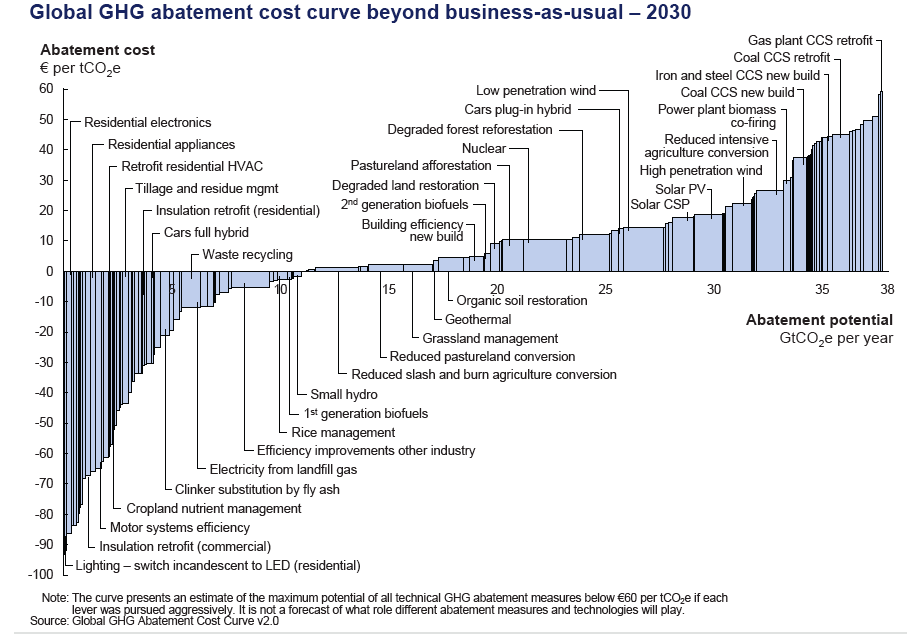
Global Greenhouse Gas Emissions cost abatement curve showing how many costs are negative and zero

Their cost abatement curve provides a quantitative basis for discussions about what action will be most effective in delivering emissions reductions and what they might cost.

The report says that "there is potential by 2030 to reduce greenhouse gas emissions by 35% compared with 1990 levels, or by 70% compared with the level we would see if the world collectively made little attempt to curb current and future emissions. This will be sufficient to have a good chance of holding global warming below the 2°C threshold according to the Intergovernmental Panel on Climate Change".

The report identifies areas in which energy efficiency, low carbon energy supply and terrestrial carbon in forestry and agriculture can deliver efficient, low-cost savings. The low hanging fruit is available in the graph on the left hand side below the horizontal line.

Each bar represents the potential of that opportunity to reduce greenhouse gas emissions in a specific year compared to the business as usual development. The potential of each opportunity assumes an aggressive global action starting in 2010 to capture that specific opportunity. The height of each bar represents the average cost of avoiding one tonne of CO2 equivalent by 2030 through that opportunity. The cost is a weighted average across sub opportunities, regions and years. All costs are in 2005 real euros. The graph is ordered left to right from the lowest cost abatement opportunities to the highest cost. The uncertainty can be significant for individual opportunities for both volume and cost estimates, in particular for the forestry and agriculture sectors, and for emerging technologies," the McKinsey report says.

It says that the total cost of doing this for the whole world will be less than 1% of forecasted global GDP in 2030.

I haven't seen the basis of Inhofe's figures, but you can bet that they do not include the savings that energy efficiency can bring.

Why should illogical wasteful American behaviour be defended?


To use one example - whereas everybody else in the world who can, dries their washing in the sun and wind on clothes lines, Americans use tumble dryers. Apparently the reason for this is that it is considered shameful not to use a tumble dryer. [See this New Scientist article]

It brings down property prices, because it seems only the poor hang their clothes out to dry and no one wants to look poor in America.

How ludicrous. Is the Senate really to defend this kind of behaviour against the reality of millions being forced to leave their homes because of rising sea levels?

"If Americans would hang their laundry out to dry - and committed 16 other acts of environmental kindness - they could slash US carbon dioxide emissions by 7.4 per cent by 2019" [ See this New Scientist article]. At little or no cost. In fact they would save money.

McKinsey also found in a July 2008 report that it would cost the world $170 billion to halve the projected global energy demand.

They said, "The average internal rate of return (IRR) of these investments would be 17 percent, and each of them would generate an IRR of at least 10 percent." (assuming that oil costs $50 a barrel — far less than today’s prices, which would generate higher returns)

"The total annual energy savings would come to roughly $900 billion by 2020."

At the same time, making these investments would avoid having to invest in generating capacity and other forms of energy infrastructure that would otherwise be necessary to keep pace with accelerating demand.

The International Energy Agency (IEA) estimates that, on average, $1 spent on more efficient electrical equipment, appliances, and buildings avoids more than $2 of investment in electricity supply (World Energy Outlook 2006, International Energy Agency, 2006).

"All of the investments, representing just 0.4 percent of current global GDP a year, involve existing technologies—and none require compromising the consumer’s comfort or convenience," McKinsey said.
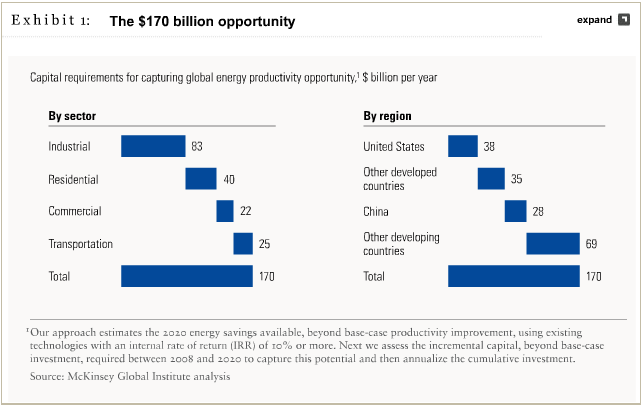
The $170 billion opportunity to curb climate change

How much of this would the US have to pay? Just $38bn a year.

Nearly 10% of Inhofe's claim.

Inhofe and his friends want to protect industry from saving money - because it's too much like hard work to change.

Because as the report goes on to say:

"Why does so much of the potential energy productivity opportunity in the industrial and commercial sectors remain untapped? One important reason is that many companies around the globe continue to be government owned (for instance, those that control much of China’s industrial capacity) or enjoy high levels of regulatory protection that shields them from competition (such as steel, until recently, in the United States and many other countries). Improving performance is hard work for managers. Without market pressure to do so, many companies just will not take advantage of all the available opportunities to boost their energy productivity."

This exposes that inhofe and his friends are not only addicted to current goverment subsidies and handouts, but actively oppose market solutions to delivering cost-efficiencies.

If concern for the victims of climate change won't reach them, let's get them on their own terms, guys.

Tuesday, December 08, 2009

Resources to tackle climate denialists

Pew Centre Statement on CRU affair [PDF] - Answers main slurs against CRU and, by implication, against climate science

Also:

Royal Society answer 8 misleading arguments about climate change

Current national policies mean an average rise of 4.4 degrees


Image: Climate Circus
Click on the image to the right to go to Climate circus and see the results of the developed countries' policies in terms of projected temperature rises.

None of them come below four degrees Celsius at present.

At Copenhagen they need to be forced to limit emissions by 40% by 2020 to get down to two degrees Celsius.

Cap and Share meets Environment Minister Ruddock

Three members of the Cap and Share group met Environment Minister Joan Ruddock yesterday in the House of Commons.

Cap and Share is the most efficient way of cutting Greenhouse gas emissions at source while spreading the financial benefits of carbon trading throughout the population.

Her message was that she will think about Cap and Share but she believes that the government has all the policies that it needs to deliver on its climate mitigation commitments and she couldn't see that they needed any more - they have a whole department full of officials working on policies (DECC) so why did they need any more ideas?

Indeed, as she was the minister, if she felt they were not doing enough already then she would have felt obliged to resign...

No comment.

We said that so far they had merely gone for the "low hanging fruit" and it would soon get much tougher - especially when they had reduce emissions at a faster rate (5% or more per annum) so that, merely offering inducements to people to change behaviour would not be enough.

We also said that if the EU ETS and other policies went pear shaped and failed to deliver then, with a cap and share policy in place they could extend it to the rest of the economy at that point and would have a plan B in place already.

Predictably she didn't think there were any problems with the EU ETS which couldn't be fixed - we didn't pursue that argument as it would clearly have been futile.

She appeared to enjoy the discussion and said that our viewpoint was very clear - three officials were present, listened and took notes but said nothing - just smiled enigmatically now and then.

Cap and Share has many benefits to offer it as a policy, not least of which is its efficiency, it is cheaper to introduce and fairer than a carbon tax or other carbon credits systems, and helps to engender behaviour change and wider awareness.

Sunday, December 06, 2009

The Wave

The climate change march in London on December 5 -- "the Wave" - was inspiring -- 40,000 people, and we encircled the Houses of Parliament.

I met Peter Capaldi from The Thick Of It, as we were walking near the front with the group I was with, Cap and Share.
Peter Capaldi with Cap and Share banner in the background!

Two of our group were amongst those selected to go and meet Environment Secretary Ed Miliband afterwards.

But it was quiet! The first march I've ever been on where a policeman said to me "you're not making enough noise!"

The police kept a low profile, and perhaps the reason that the march did not achieve more prominence in the news was that there was no trouble.

The British government knows that it has to go to Copenhagen to secure the best possible legally binding deal to secure a result that will keep global warming below 2°C. The problem is that this is virtually impossible and the slogan that we shall be uniting up around of we are totally serious about addressing the problem is zero carbon-equivalent emissions from now on.

This is because the emissions already in the atmosphere will result in a temperature rise over 2°C.

Thursday, December 03, 2009

World headed for 3.5 degree warming based on current pre-Copenhagen promises

Antonio M. Claparols, president of the Ecological Society of the Philippines has published a heartfelt account of climate change and deforestation on eco-friendly website www.ecoboom.co.uk.

The article, entitled “Will Copenhagen Save the World?” evokes stark images of the catastrophic devastation caused by climate change. In an extract from the article Claparols comments: “As I write this, the entire world is talking about climate change and its effects to the environment, agriculture and humankind. The effects of climate change have manifested itself all over the world. In the Philippines the effects of typhoon Ondoy and Pepeng are still fresh in mind. But the real issue is-do we have enough political will to abate climate change?”

A fair deal at Copenhagen is absolutely crucial, but at the moment the world is heading towards disaster.

A sobering new assessment by the “Climate Action Tracker” of the emission commitments and pledges put forward by industrialized and developing countries for the Copenhagen climate negotiations shows that the world is headed for a global warming of well over 3oC by 2100. Carbon dioxide concentrations are projected to be over 650 ppm, with total GHG concentrations close to 800 ppm CO2 equivalent.

This will mean catastrophic sea level rises that will directly affect low-lying areas like Bangladesh, the Pacific Islands and the Philippines.

Everybody must push hard against their political leaders to get them to deliver a legally binding agreement as part of the COP-15 talks.

“The pledges on the table will not halt emissions growth before 2040, let alone by 2015 as indicated by the IPCC and are far from halving emissions by 2050, as has been called for by the G8. Instead global emissions are likely to be nearly double 1990 levels by 2040 based on present pledges”, said Dr Niklas Höhne of Ecofys.

“In 2020 we project total GHG emissions to be around 55 billion tonnes CO2 equivalent per year from all sources, a reduction of about 3 billion tonnes compared to business as usual. In ten years from now global emissions will already have to be well below current levels of about 46 billion tonnes (in 2008) to have much chance of meeting temperature goals such as 2°C, as called for by the major emitters globally, or below 1.5°C as put forward by the Small Island States and Least Developed Countries as essential for their survival”, said Dr (h.c.) Bill Hare of Climate Analytics and the Potsdam Institute for Climate Impact Research.

“After accounting for the new position of Russia, the announcement of President Obama of a US emission reduction pledge for Copenhagen, the developed country emission reductions as a whole are currently projected to be 13-19% below 1990 levels by 2020. However the proposed forest credits these countries want would degrade this by about 5% with the effective reductions in industrial GHG emissions being 8-14% below 1990 levels by 2020. The low reduction target (8%) is unconditional for most countries and the highest reduction target (14%) is linked by most countries to a strong agreement in Copenhagen”, said Dr. Michiel Schaeffer of Climate Analytics.

Around 25-40% reductions by industrialized countries by 2020 from 1990 GHG emissions levels are described as necessary by the Intergovernmental Panel on Climate Change (IPCC).

“Recent announcements such as the Chinese carbon intensity reduction target for 2020, and the Korean emission goals for 2020 and 2050, are very important and useful. However the overall effect on greenhouse gas emissions (excluding deforestation) is disappointing; with overall developing country emissions projected to be close to, or significantly above, the IPCC range for 2020” said Dr Niklas Höhne of Ecofys.

“Faster economic growth than expected, particularly combined with slower improvements in carbon intensity in China explain part of this. China has ambitious policies on energy efficiency and renewable energy, but the new international target falls short of that ambition. A reduction from “business as usual emissions” by the developing countries as a group is needed in 2020 of 15-30% is needed to limit global warming to 2°C or even lower.

“On deforestation, we have accounted for the announcement of Brazil and of Indonesia which taken together would reduce deforestation emissions globally by about 40% from recent levels by 2020 (or about the same from estimated 1990 deforestation emissions), which is a very important contribution” said Dr Michiel Schaeffer.

“With no concrete pledges on the table for international aviation and marine CO2 emissions these are projected to grow to over double 1990 levels in 2020, reaching about 1.8 billion tonnes per year, and to nearly 4 times 1990 levels in 2050, about 3 billion tonnes per year” said Dr Niklas Höhne of Ecofys.

Sunday, November 29, 2009

Sustainable Business presentation

David Thorpe on MTVA 3.5MB Powerpoint of a talk on sustainable business opportunities is here.

I gave the talk at the ESPM University Sao Paulo on November 18th.

At the venue I was astonishingly ambushed by a crew from MTV and here's a clip from the MTV interview with David Thorpe.

Wall Street versus climate science

We must not underestimate the pressure against a coherent deal at COP-15.

The on going controversy about the hacking into the e-mails of the Climate Research Unit in the UK exemplifies how extreme in the battle is becoming.

We must fight this anti-science and anti-democratic attitude at every chance. I am taking the opportunity to pass on comment on this by a colleague in the Cap and Share campaign group of which I am a part. (And if any of you don't know the difference between Cap and Share and Cap and Trade, see http://www.capandshare.org/. )

Lets not mince words - what we have in the CRU hacking is a financial sector and carbon economy sector attack on climate science, indeed on the scientific method in general.

For those who think this view is extreme then I invite them to read the following article in the Wall Street Journal about this crisis:

http://online.wsj.com/article/SB10001424052748703499404574559630382048494.html?mod=WSJ_hp_us_mostpop_read

In order to get maximum clarity about the issues at stake I have cut out and selected phrases from this article to thrown them into maximal relief:

"much-ballyhooed scientific consensus on global warming"

"how a single view of warming and its causes is being enforced"

"the climate-tracking game has been rigged from the start."


"this privileged group" (climate scientists who published in peer reviewed journals)

Note the phraseology - peer review is "enforcing a single view" "rigging climate tracking right from the start" by a "clique".

"only those whose work has been published in select scientific journals, after having gone through the "peer-review" process, can be relied on to critique the science."

" critics outside this clique are dismissed and disparaged."


note the words. Climate scientists who submit to a peer review process are regarded as a: "clique"

Climate Research Journal "blackballed"

"The response from the defenders of Mr. Mann and his circle has been that even if they did disparage doubters and exclude contrary points of view, theirs is still the best climate science. The proof for this is circular. It's the best, we're told, because it's the most-published and most-cited—in that same peer-reviewed literature. The public has every reason to ask why they felt the need to rig the game if their science is as indisputable as they claim."

Comment:
What is at stake here is nothing less that the future of scientific method - and whether it is going to be subordinated to commercial interests. The climate crisis is not going away - and nor will the financial interests who want to stop action on climate change. This crisis will get worse and the pressure on the scientific method will get worse too.....

Consider how climate science - or any other science - will evolve if not subjected to peer scrutiny by qualified colleagues: any explanation that you want will prevail to explain how the world works - as long as you have the money to pay "scientists" or " Institutes" in Washington and elsewhere to selectively and uncritically pick the data that suits the case you want to make. Scientific "truth" will be made by lawyers and the PR industry and will be available to the highest bidder.

...and the people with the most money to give will be in the banking and fossil fuel sectors......

Brian/ David

Thursday, November 12, 2009

Meeting Diego

Tonight I met one of my Brazilian fans, Diego Remus, at the place where he works, The Hub, which coincidentally is right near the restaurant where we were the previous night during the power cut.

When we met he first took me to a bookshop on Avenida Paulista and surprised me by finding on the shelves a copy of my book Hybrids in English as well as Portuguese and made me stand there while he took a photograph.

I'm getting kind of used to this while I'm here. in

Diego is a specialist in social networking and electronic media, a consultant to start-ups and interested in applying sustainability theory as well as communication theory to new models of business enterprise. He set up a Portuguese language fan club for Hybrids.

He works also for Startupi, which is a pun, because the Tupi is an old indigenous culture.

We especially talked about industrial symbiosis, resource efficiency and the potential of the sustainable economy new business model to benefit Brazilian businesses. He's going to arrange for me to give a talk at The Hub on the subject at the end of next week when I'm back in town from Porto Alegri and Curitiba.

Blackout in Brazil

I don't know whether it's because the Low Carbon Kid is in town, but yesterday was the biggest power cut in the history of Brazil, so big it made the front page of the Guardian newspaper.

I was in a Brazilian restaurant near the Avenida Paulista with Katey Moran, the author I am sharing the trip with, and two of her friends who teach at the St Paul's School where we are working this week. We were waiting for the main course when suddenly all the lights went out except for the emergency exit lights. These went out soon after.

Used to this kind of thing back home in Wales, I expected them to come on quite soon. I am well aware that there are frequent small power cuts in local areas here in Brazil. Then somebody got a call on their mobile from a relative in Rio de Janeiro who said the power was out there too, and in Brasilia, and we realised that it was big.

The waiter didn't bring candles until I asked for them! But then he bought a rather elegant oil-fed light also.

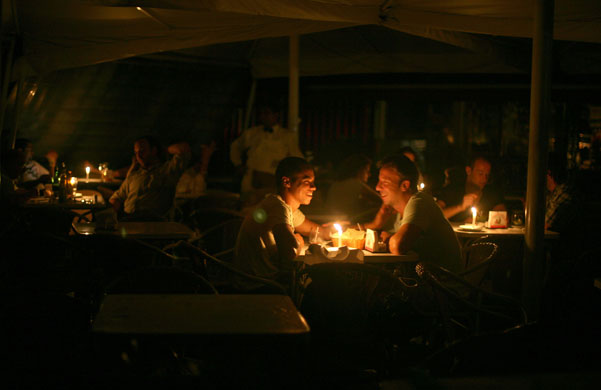
dining by candlelight in the Sao Paulo blackout. This is not us, but very much like us and in the same area!

We looked out the window - some places had lights on, most of them were dark and people were thronging the pavements talking in the light of the headlamps of passing cars. We speculated as to the cause and agreed that it was probable that it was the Itaipu hydroelectric plant as in fact it turned out to be.

Perhaps we'll never find out exactly what the cause was, but one thing is the sure: it's what happens if you put all your energy eggs into one supply basket.

Luckily the rest of the kitchen was cooking on gas and we got our main course. Luckily we didn't see any looting.

Unluckily we still had to pay our restaurant bill even though the cash till wasn't working!

We came back through darkened streets in the taxi. The hotel had a generator and some of the lifts were working though there were no lights in the rooms.

There's nothing like the power going out to make you appreciate electricity when it is there. Perhaps it's a signal to President Lula, but if so he's getting the wrong message. Today he pledged to use the revenue from the potential future exploitation of the Pre-Salt oil fields to strengthen the grid infrastructure.

As I said in my previous blog, this absolutely must be left under the sea where it is now, for the sake of the planet. Brazil is blessed with a variety of potential sources of energy, and solar power is one of them. A feed-in tariff like the one coming in in the UK and already in force in many European countries would be a brilliant incentive to diversify and localise the energy supply while creating wealth amongst the population. There's no shortage of other potential sources of sustainable energy.

Brazil needs to continue with its own development of renewable energy, not go backwards into the fossil age.

Sunday, November 08, 2009

Brazil is going backwards to Copenhagen

There is nothing more urgent in the world than a meaningful settlement at the talks on climate change in Copenhagen in December.

The perspective here in Brazil is that it would seem to be on the right side of the battle to save the planet's climate. In fact, the truth is a bit more murky.

38% of Brazil's energy is from renewable sources; of the rest, 60% is fossil fuel at 1% nuclear. According to the International Energy Agency this puts the country on one of the lowest per capita carbon dioxide emissions (111th in the world) and certainly one of the lowest in terms of unit of gross domestic product. However it is the world's 17th biggest greenhouse gas emitter (UN figures) because of the fires used to clear land for pasture in the Amazon rainforest.

Brazil has pioneered the world in the production of ethanol from sugarcane and mandated that biofuels are blended with petroleum to fuel cars with 20-25% of ethanol and most cars bought in Brazil can run on either ethanol or this blend. Renewables account for 45%. It produces a large amount of hydroelectric power, which itself has been blamed for displacing indigenous people, but the number of droughts is increasing. As a result Brazil is actually going backwards.

To compensate it is using more and more gas, oil and coal and is planning to build five more nuclear power stations. This is in a country which is blessed with a huge amount of solar power. According to the United Nations Environment Programme's data set most other industrialised and populated areas of the country receive an average of 4-5.5 kWh/m2/day, with some receiving much more, making it an ideal place for solar water heating and photovoltaic power. As most of the rain and the hydroelectric power is in the north west of the country far away from these areas there will be much fewer transmission and distribution costs associated with the use of solar power.

Brazil also has a huge potential capacity - 100Mt/yr - to use biochar to fertilise the soil and lock carbon from the growth of sugarcane back into the soil as a fertiliser. This after all is where biochar was first discovered -- in the Amazon. (source: Perera, K.K.C.K. et. al., 29 Biomass & Bioenergy 199, 204 (2005).)

But is Brazilian President Luiz Inacio Lula da Silva doing this? No, instead he is increasing state control over huge newly-discovered offshore oil reserves. Brazil is sitting on reserves bigger than any discovered in the Americas since 1976. He is following his friend Chavez in Venezuela by netting the government company Petroleo Brasileiro take control of these so-called 'Pre-Salt" reserves. This may help Brazil more than double oil production and turn the state-controlled company into one of the world’s biggest producers, according to Adriano Pires, head of the Brazilian Center for Infrastructure.

The pre-salt Tupi field alone holds an estimated 5 billion to 8 billion barrels of oil equivalent but it is over 200 miles off the coast and beneath over 7,000 meters of water, rock and a thick layer of salt. Companies are rubbing their hands in glee at the prospect of getting at this oil, but it will itself cost a huge amount of energy and environmental damage to retrieve it.

Brazil wants to develop and the revenue would be the engine of funding its infrastructure - and of course the corruption in the government that everybody here talks about.

In fact while I am here Lula has been in London trying to seek investment in his country, which he says will be the fifth largest economy in the world by 2019. The huge emerging middle class is greatly expanding its energy consumption as everyone wants the same standard of living as the developed world.

Ironically, accompanying Lula on his London trip is Jaime Lerner, the former mayor of what is supposed to be the greenest city in the world or at least of the developing world, Curitiba. I hope to go there in just over a week myself to see if the miracle that is proclaimed to have happened there is true. Lerner has been showing Boris Johnson, London's mayor, what the possibilities are.

It would be better if Lula were to leave the oil in the ground beneath the sea and to roll out throughout the whole of Brazil the types of reforms that have happened in Curitiba.

He should also halt deforestation of the Amazon rainforest. 20% of it has already gone. In 2000-2005 deforestation in the Amazon, which is shared by eight countries, denuded an area nearly the size of Venezuela. Less well-known is deforestation in the Cerado biomass, which Environment Minister Carlos Minc says generates the same amount of greenhouse gases as Amazonian deforestation.

Lula has promised to reduce deforestation by 80% by 2020. But the government is under pressure to release more land to the farmers, and was widely criticised in June when Lula legalised in the stealing of 60,000,000 ha of Amazon rainforest by farmers that had been taken illegally.

However some states are going it alone, just as they are in North America. Here in São Paulo a month ago it became the first Brazilian state to approve a statewide climate change policy that calls for a 20% reduction in emissions from 2005 levels by 2020. The head of the São Paulo Forum on climate change and biodiversity, Fabio Feldmann, has criticised Lula for his exploration programme of the pre-Salt oil reservoirs.

Brazil is going to Copenhagen with a flawed plan and an unclean conscience. Mind you, so is everybody else.

Thursday, October 29, 2009

Even the military want a deal at Copenhagen

A group of serving and retired military officers from Africa, Asia, Europe, Latin America and the US released a statement today calling on all governments to “work for an ambitious and equitable international agreement” at the global climate talks in Copenhagen in December.


The statement, presented at a meeting today at Brookings in Washington, and issued simultaneously in Brussels, Dhaka, Georgetown, London, New Delhi and The Hague, says that “incremental, and at times, abrupt, climate change is resulting in an unprecedented scale of human misery, loss of biodiversity and damage to infrastructure with consequential security implications that need to be addressed urgently.”

The officers are part of an international initiative on Climate Change and the Military led by the Institute for Environmental Security (IES) in The Hague and 10 other think tanks from Asia, Europe and North America.

IES Vice-Chair, Tom Spencer, former President of the European Parliament's Committee on Foreign Affairs, Human Rights and Defence Policy, said the aim of the statement was to stress that “climate change creates a common security problem that requires global and comprehensive co-operation.”

Quoting from the statement, Air Marshal (ret) AK Singh of India, Chairman of the project’s Military Advisory Council and Project Director, Climate Change & Security, Centre for Air Power Studies, New Delhi warned that “failure to recognise the conflict and instability implications of climate change, and to invest in a range of preventative and adaptive actions will be very costly in terms of destabilising nations, causing human suffering, retarding development and providing the required military response.”

Maj Gen (ret) Joseph Singh, Former Chief of Staff, Guyana Defence Force, added that, “Based on the fact that we have been involved in disaster relief operations, we know the trauma, the human misery, the damage to infrastructure. So that hands on experience gives us the confidence that we have some knowledge and expertise that we can share and work in a collaborated way with decision-makers to anticipate, to pre-empt and to be involved in contingency planning.”

Asked to illustrate an experience from his region, U.S. Brig Gen (ret) Wendell C. King replied, “The hurricane Katrina that hit New Orleans.” He added that America’s ability to respond was severely stressed and if such a technologically capable nation such as the USA thus struggled, the picture was not too rosy for nations not having adequate capabilities.

At its first meeting in Brussels earlier this month the group of officers were especially concerned about the rapid increase in glacial melt in the Himalayas, which will result in increased flooding followed by devastating water shortages throughout the region.

Maj Gen (ret) Muniruzzaman, President of the Bangladesh Institute of Peace and Security Studies, said that the affects of climate change could lead to the migration of millions of people in places like Bangladesh where the impact of climate change would cause an estimated annual loss to the economy of $ 1 billion of GDP by 2010 and $ 5 billion by 2070.

Water scarcity will have severe adverse impact on human access to fresh water, food production, fisheries and wildlife, river transports, hydropower and human health according to a report by his institute.

The joint statement calls on all governments to ensure that the security implications of climate change are integrated into their respective military strategies and also calls upon the military to be part of the solution by reducing its own carbon “bootprint”.

> Institute for Environmental Security (IES)

Monday, October 26, 2009

Don't use the European Trading Scheme as a model for Copenhagen

The EU Emissions Trading Scheme (ETS) is important because the scheme covers half of all EU carbon emissions produced by power companies and industry.

If the Emissions Trading Scheme (ETS) is not helping to cut these, the EU as a whole will not meet its targets.

The first phase of the EU’s Emissions Trading Scheme (ETS), from 2005 to 2007 was a failure.

Huge over-allocation of permits led to a collapse in the price of carbon from €33 to €8 per tonne, meaning that the system did not reduce emissions at all.

In 2007 energy suppliers' 1.8% cut in carbon dioxide emissions was just higher than the UK's average of 1.7% down on 2006.

The residential sector and business sector both achieved better emissions cuts than the power sector in 2007, 4.6% and 2.6% respectively.

Meanwhile, there were increases in emissions from the transport sector (up 1%) and from industry (up 9.5%). [source:NewEnergyFinance/DECC]

The reason why the recession hasn't hurt big companies signd up to the ETS (according to International pro-business NGO The Climate Group) is because allocation of free permits to energy-intensive participants has helped them to ride out the recession, passing any price increases on to consumers.

Companies mentioned by The Climate Group include Centrica, Johnson & Johnson, Tesco, cement producer Lafarge, a British glass manufacturer, a German engineering firm, a global steel maker, a global aluminum firm and a financial services company. Fluctuations in energy prices and the economic downturn had more substantial effects on businesses than the price of carbon.

The only way that the ETS can work is if all of the permits to pollute are auctioned off and industry pays the price for abusing the atmosphere - which actually belongs to every single global citizen, as well as every other living organism.

Sandbag, another NGO, has used the large amount of information generated by participants in the scheme to create a Google map.

You can search it by country or year, sector, company, plant name, permits allocated, used and surrendered, and so on. London, for example, contains 44 registered emitters.

It has issued a report which highlights the harms that overallocation of permits has caused: "industry is likely to have nearly 400,000,000 tons worth of surplus permits across the period 2008-2012" they say. As a result they weren't out to reduce their emissions and instead will be old to sell their surplus for windfall profits of over Euros5 billion. There may also be an estimated surplus in the New Entrance Preserve of over 300 million permits by 2012.

All of this is because the caps were set too high and there is no way in the market to bring down the supply permits.

Sandbank concludes by saying that there could be 1.6 billion surplus permits and credits available during phase 2 of the scheme. this will permit European companies "to stand still on cutting domestic emissions further next seven years".

Sandbag recommends that the next phase of the emissions trading scheme should be immediately increased to deliver at least a 30% reduction in emissions by 2020 rising to 40% if a deal is reached at Copenhagen.

They should also take steps to effectively tighten caps in phase 2 of the scheme.

The scheme undoubtably has great potential to cut carbon emissions using the market and uncover the most cost-effective abatement opportunities.

The Low Carbon Kid says that it just needs designing so that it isn't one of the greatest rip-offs of all time (banking bonuses excluded), that's all.

And if any deal being pushed for by American industry wants to follow the current ETS model you know why. It will benefit their pockets and it won't make the slightest dent in carbon emissions.

What's the solution? Oliver Tickell has researched and developed it in his book and website Kyoto 2.

Monday, October 12, 2009

The Tories' mad energy policy

With the relief that EON decided not to build its coal-fired power station at Kingsnorth last week, it is with dismay that we also heard the Tories policy which is to initiate the building of 5 GW coal power stations as soon as they take office.

Labour may not be much good, but the Tories would be a disaster for energy policy. Railroading big business interests through planning to an even greater extent than Labour, under the pretext of environmentalism.

There's perhaps one good policy and that is the right for every community hosting wind farms to keep for 6 years the business rates generated.

It is the fact that local communities have felt ripped off by big developers not caring about their interests that has held back wind farms in this country.

But a real revolution would be for community owned wind farms to be massively supported as they have been in Denmark for many years, as a result of which there has not been the level of public antipathy towards wind farms that there has been here.

It is the stop-start nature of British energy policy under the NFFO policy that has created this antipathy because only the big developers could stay the field and community developers were squeezed out.

The other Tory policies are to give every household in the country £6,500 to upgrade the energy efficiency of homes; and publication of the planning guidance needed for new nuclear power stations.

The first is limited: some homes will cost more to upgrade than others, and the financial support should be in the form of loans that are paid back on the property from the energy savings created.

Housing authorities also need support to do a mass roll out of renovations of particular districts and streets at the same time which is more cost effective.

It is my argument that we can do without nuclear power because it is not cost efficient and the timescale is too great. The figures produced by the nuclear industry cannot be trusted. Taxpayers will end up supporting the industry to an extent that we can afford even less now than we could before.

"Clean coal" relies on carbon sequestration which is an unproven technology that will be incredibly expensive to implement.

EON gave as their reason for not going ahead with Kingsnorth a reduction in electricity demand. If electricity demand is further reduced by a mass roll-out of energy efficiency making everybody's bills cheaper (hooray!), then why would we need to build all these power stations anyway?

The catch 23 of electric cars


Ah - is it so that we can have an electric cars? But that's robbing Peter to pay Paul! - it's a more efficient use of fossil fuels to burn them directly in a car than it is to burn it in a power station and use the electricity to drive a car.

Why? The output from a coal-fired power station fitted with carbon sequestration is around 10% less in efficiency than one without - so you will only get 20-25% of the original energy in the fossil fuel from such a power station at the plug in your wall.

By the time you have factored in the conversion factors inside the engine of the car converting that electrical energy back into motor energy, you will be lucky to get 10%. Whereas around 50% off the energy in petrol or diesel goes straight into transmission.

The only way of implementing electric cars that makes any sense is if they are fuelled from renewable electricity generated locally to the charging point to minimise transmission losses. That means building more solar, tidal and wind.

Thursday, October 08, 2009

Heat pumps - should you believe the hype?

It is not at all clear to the Low Carbon Kid why heat pumps are described as renewable energy technologies. Since they use electricity, they are not. It is especially clear that air source heat pumps, unless powered by renewable electricity, and unless replacing electric heating, should not be used at all.


Read on to find out why... this is an extract from my forthcoming book The Expert Guide To Sustainable Home Refurbishment, to be published by Earthscan next summer.

How heat pumps work


Heat pumps can take heat from the ground, air or a nearby body of water if it’s available. All of them basically work like a fridge backwards.

For example, typically, in an air-source heat pump, air flows over two refrigerant-filled heat exchangers, similar to those in a fridge, one outdoor and one indoor. In the heating mode, liquid refrigerant within the outside coil extracts heat from the outside air, making the refrigerant evaporate into a gas. It then is pumped to the indoor coil, which reverses the process. The refrigerant condenses back into a liquid and returns to begin the cycle again. As the volume of air outside is much greater, the amount of heat in it, when transferred to a smaller volume, results in a higher temperature.

Ground source heat pumps work the same way, but the element containing the coolant is buried in the ground, and so takes the heat from there.

Judging efficiency


Heat pumps are judged by their coefficient of performance (CoP). This is the ratio of the amount of heat produced divided by the electricity consumption of the pump. So for example a heat pump with a CoP of 3 (or 3:1) will produce three times as much heat energy as the electrical energy it consumes. The higher the CoP the better the performance.

You can maximise the CoP by choosing a heating system requiring a lower final water temperature - radiant heating like underfloor or skirting board heating rather than domestic hot water and radiators - and by choosing a heat source with a high average temperature (e.g. the ground rather than air).

The final efficiency will be significantly better for underfloor heating covered by solid screed (tiled etc.) finishes than timber, and/or carpets.

Benefits of heat pumps


Other benefits of heat pumps over conventional boilers include:

• no combustion or explosive gases in the building

• no need for flues or ventilation

• no local pollution (although noise from the outside fan may be a problem if air-source)

• long life expectancy

• low maintenance costs

• the payback period can be as short as 4-5 years and save up to 75% of conventional heating costs.

Ground source heat pumps


These require a network of underground coils or loops to extract heat from the ground. A hole must be dug and the collecting coil buried - usually a closed circuit loop of 20-40mm high-density polyethylene piping filled with a mixture of water and glycol anti-freeze. Holes take two forms: the commonest is a series of horizontal trenches (wet ground is better than dry); or one or more boreholes. The system also includes a heat exchanger, pump and delivery pipes passing under an exterior wall (typically a French window or other door) to the destination.

Care must be taken that the coil makes good contact with the ground. As the depth increases the maximum and minimum soil temperatures begin to lag the surface temperature. At a depth of about 1.5m the lag is about one month. Below 10m the ground temperature remains effectively constant at around the annual average air temperature. Sizing is complex and specialised software is required, available, amongst other places, via the website of The International Ground Source Heat Pump Association (IGSHPA).

Ground-source heat pumps are more expensive but the payback is reduced, financially and carbon-wise, if a hole is being dug anyway, for example for foundations. However they have a long life expectancy (typically 20-25 years and up to 50 years for the ground coil) and are a great idea if the opportunity’s there.

One where the ground is well above freezing (ten degrees) outputting to radiant heating (underfloor or skirting) would be ideal, especially if it is replacing electric heating. It will yield significant carbon savings.

But if it is replacing a modern gas-condensing boiler, which can have over 95% efficiency, the carbon savings are much less.

Air-source heat pumps


Like air-conditioners, they suck in outside air, the units being placed a distance from the dwelling to reduce noise. Despite their reduced efficiency, an advantage of air-source heat pumps over the ground-source variety is their lower installation cost. They are thus more appropriate for renovation projects than ground-source models.

Air-source heat pumps extract heat from the outside air, even in the coldest months. However, the colder it is, the less efficient they become and the more warmth you need.

In mild weather, the COP may be around 4, but at temperatures below around 8°C (17°F) an air-source heat pump can achieve a COP of 2.5 - below the magic 3 level at which carbon savings are realised.

The average COP over seasonal variation is typically 2.5-2.8, but obviously this depends how cold it gets in the winter. As soon as it drops below freezing, the CoP plummets. Of course, it will never reach 1, but it will be much less carbon-efficient than gas or biomass.

Further questions have been raised about the power used by the pump to de-ice itself. Professor David Strong, chief executive of Inbuilt, has observed that “ice build-up on the evaporator of an air-source heat pump is a serious problem, with icing typically occurring whenever outdoor air temperatures fall below about 5°C (this can be as high as 7°C with some systems). In these situations COPs fall to less than one (i.e. worse than direct acting electric heating).”

The de-icing process means that the outdoor heat exchanger becomes the condenser, hot refrigerant being used to melt the ice. But electricity continues to be used by the compressor and pulls heat from inside the building - not you want in cold weather. Some systems use hot gas bypass or direct acting electric elements. Professor Strong has called for an objective assessment of the technology's effectiveness. One is being conducted by the Fraunhofer Institute, and preliminary results show average annual CoP was 2.99. For ground source it was 3.72, significantly better.

Are they noisy? The exterior pump - around 1.2m x 0.7m x 1m tall - generates around 50dB at full fan speed at one metre distance. This is similar to that of an air conditioning unit. The heat exchanger unit, inside - fridge-sized, around 1.8m tall - is about 42dB at one metre distance, similar to a large refrigerator.

Whole house passive stack ventilation with incoming air pre-warmed using a heat pump


Heat pumps can transfer their heat to air or water. If to air, it is directed through vents in the ground floor. The air is drawn through and up the building by pressure differences (heat rises). An advantage of air destination heat pumps is that air into which the heat is passed usually needs a lower temperature than water heating for the same level of comfort, resulting in a higher CoP and increased heat output.

Borderline efficiency


Once the COP descends to 3 or less, if the electricity supplying it is not from a renewable source, and if it is replacing electrical heating, then there is no carbon saving from using the heat pump, since generation and distribution inefficiencies account for two thirds of the energy in the original carbon fuel.

Most of the time air source heat pumps will not achieve a CoP which saves carbon emissions - it will happen only if the air is at or above zero degrees and the target temperature is 35 degrees. A ground source heat pump will perform better.

This is because during the heating season (winter) the outside air temperature is often much lower than the ground temperature (at a depth at which heat is extracted by a ground-source heat pump).

Hot water and heating can be provided 365 days a year; the hot water can be at 55°C; but the CoP will be low, though not as low as 1 - that of a gas or immersion water heater. In other words, it will be more cost-efficient but not as carbon efficient.

Tuesday, September 22, 2009

Babcock picks up a bargain

The United Kingdom Atomic Energy Authority's commercial arm, UKAEA Ltd, has been snapped up by defence engineering contractor Babcock. UKAEA specialises in nuclear decommissioning, waste management and nuclear new build support services.

It was sold by Peter Mandelson for a mere £50 million. Yet the government has commitments to clean up Britain's massive nuclear waste legacy, the cost of which is estimated to be around £113.7 billion by the Nuclear Decommissioning Authority. Lord Mandelson claimed the deal "generates good value for taxpayers". Quite how this is so remains to be seen.

Last year the firm operating Sellafield nuclear site appealed for former workers to come forward if they remembered where they had deposited nuclear waste. Perhaps Babcock's first job will be to try and find it.

Windsave goes bust revealing the truth about micro wind power

The residential arm of Scottish micro wind generation company Windsave, which supplied roof-mounted wind turbines to former energy minister Brian Wilson, has gone into liquidation.

Hands up those who aren't surprised - even that it took so long.

In 2003 this Scottish company began promoting roof mounted domestic turbines using Photoshopped montages. Despite cries from practitioners in the field -- including this blogger - that the performance figures it was quoting didn’t make any sense - and in fact broke the laws of physics - Brian Wilson, the then UK energy minister, and another Scot, became convinced.

A PR exercise was mounted with his help that succeeded amongst other things in persuading DIY chain B&Q to retail them. In June 2006 their Plug’n’Save system won the title of “Best New Product” at the European Business Awards for the Environment. Hundreds of optimistic householders parted with their cash.

At the beginning of 2009 B&Q finally admitted that they didn’t work and withdrew them from sale in response to many disgruntled owners' angry complaints. They had been told they would be able to generate a good proportion of their electricity and recoup their costs in a few years. Some were lucky to generate a miserable few kilowatt-hours over the entire year.

Real data


The results of a substantial monitoring exercise of real micro-wind turbines in situ both on urban rooftops and free standing in rural areas was published in July 2009 by the Energy Saving Trust and confirmed what the technical experts and those unfortunate householders already knew: that wind speeds in urban areas coupled with the turbulence caused by nearby buildings mean that the speed of 5m/s required for contemporary turbines to operate efficiently is never reached in an urban situation.

To put it bluntly: domestic scale wind turbines only work in the countryside.

And there they work very well: the results of the field monitoring show that “a properly sited and positioned 6kW rated free standing pole mounted turbine with a similar annual performance would be expected to generate approximately 18,000 kWh per annum.” In today’s English money that is £2,340. It represents a very quick payback.

The success of a wind turbine is measured by its load factor and the higher the number the better. The performance of free standing turbines in the survey frequently exceeded the manufacturers’ quoted annual load factors of 17%; the average was 19%, and the best were 30%. By abysmal contrast, “No urban or suburban building mounted sites generated more than 200kWh or £26 per annum, corresponding to load factors of 3% or less.”

No wonder those B&Q customers were upset.

Where micro wind works


Turbines need an uninterrupted wind flow and the higher above the ground the more wind there is. This is why they are commonly mounted on 10m or 25m poles and in exposed places. The same survey by the Energy Saving Trust estimates that in the UK 1.9% of homes are situated in conditions like this and can make use of wind power. That is 455,650 households.

If they all installed 6kW wind turbines than the annual generation from them would be in the order of 3,459GWh. This is the amount of electricity used by twice that number of homes - approximately 870,000, or nearly 1% of the UK is electricity requirements and over 3% of its domestic demand. So they would need to be grid connected - and they could generate an income from their sales. This would then decrease the payback period, especially if feed-in tariffs are available. Without them, the payback period is something like six or seven years under these conditions.

In other words, it’s worth doing in these places and nowhere else. The annual average wind speed needs to be greater than 5 m/s and is preferably measured with an anemometer for 12 months before designing the system, but desktop evaluation can be made first to see if it’s worthwhile doing this by looking at figures from the Met Office. But because local conditions can vary enormously - for example due to thermal updraughts, local topography or sea breezes - there is nothing like real on-site measurement.

Windsave's directors are blaming the planning laws for the fact that they have gone bust. No, gentlemen, it's the laws of physics, something an energy minister ought to be aware of.

Tuesday, July 28, 2009

Can Britain follow Germany with feed-in tariffs?

The government plans to implement feed-in tariffs by April 2010 to incentivise renewable electricity installations up to a maximum capacity of 5 MW. The consultation document looks at how it could work and best practices from other countries.

It does a good job of setting out the options, but stops short of specific proposals. The following variables are considered:

A fixed tariff pays an overall amount per unit of electricity generated, independent of market price. A premium tariff is an amount paid on top of the market price. In a stepped tariff the amount varies according to type of technology, scale, and local conditions. A flat tariff takes no account of this.

Proposals by the working groups for the Renewable Energy Association, mentioned in the last issue, suggested that all renewable energy generators would be paid a fixed renewable tariff for all energy produced (a “generation tariff”), and an additional price for that exported to the grid, set at a level established between the supply company and the beneficiary and subject to market competition. This is Taken up in one of these consultation documents but not others, which argue on the whole for fixed, stepped tariffs.

At a domestic scale most individuals will use much of their generated electricity themselves, and their use may be unpredictable so they may still be cautious about investing in these technologies because the payback period will, even with these subsidies, be considerable without other grants for installation. The main document says that a generation tariff will be a fixed price, set at different levels for different technologies and installation sizes. "We expect to lower the tariff levels for new projects over the years, but any individual installation, once starting to receive a tariff at a certain level, will continue to receive the same generation tariff level throughout its entire support period under the FITs".

To give long-term certainty to investors, the consultation process to "require suppliers to purchase exports from FITs generators at a guaranteed minimum price". The tariff level will have to be sufficiently high to attract the level of uptake needed to meet targets. The report notes that "due to the fact that small generators provide only small amounts of electricity to the grid, they may have difficulty in securing the same wholesale price for exports that a large-scale generator can access, and may receive a much lower price".

Criticism has been made that the proposals are not being examined at the same time as those for renewable heat, which is to be introduced a year later. This is especially bizarre since the report does look at the electricity-only component of combined heat and power technologies.

FITs or RO?


The consultation proposes that from 1 April 2010 installations of 50kW and below eligible for FITs will only get the option of receiving FITs. However, those from 50kW to 5MW will be able to choose between the RO and FITs.

Deadline for responses: 15 October 2009. See the DECC consultation page

How it might work in practice


A house (it could be an office building) generates 2,500 kilowatt hours (kWh) per annum (e.g. from a solar PV panel). They use 1,500kWh of the electricity they generate. 1,000kWh is exported, because it is generated at times when the household does not use it. The household uses a total of 4,500kWh per annum. Therefore, it needs to import 3,000kWh from an electricity supplier.

If the tariff for generation is, for example, 30p/kWh, the householders will receive a FITs payment of £750 per annum (2500kWh x 30p) for the electricity they generate. They will also receive a payment for the electricity they export; assuming a price of 5p/kWh this would be £50 (1000kWh x 5p). They also derive a benefit from the 1,500kWh they generate and use on-site as that will offset 1,500kWh they would otherwise have had to buy from their electricity supplier. Assuming an import price of 10p/KWh this would be a saving of £150 (1500kWh x 10p).

If FITs were delivered by a "generation only" tariff, and generators were required to pay import rates for all electricity used (including that generated on-site) the household would receive much more: £950 per annum (2500kWh x 38p).

Wednesday, July 01, 2009

Breakthough ideas for this century

At the SDC Breakthroughs event.

There were 19 brilliant ideas for how to save the planet - or at least the UK. It's a shame to single out just a few, but apart from Cap and Share (www.capandshare.org), there were biochar and algae - with a working model - ways of financing eco-refurb and educating kids about SD, and ideas for building communities and gardening.

Ed Miliband made a speech supporting CCS and growth. Boo, hiss.

HRH Charles made a speech which I've forgotten.

Porritt, in his swan song speech (he's retiring this month), criticised this and really laid into the Treasury. I mean REALLY - what has he got to lose now?

The new head of the SDC, Will Day, made a speech that didn't yet give a flavour of what his tenure will be like.

I nobbled Hilary Benn (to whom I got an intro from Welsh Evironment Minister Jane Davidson), and spieled him on Cap n Share, which he'd never heard of! He seemed to take it in and went off with the Feasta brochure.

Jane Davidson made an inspiring speech (I wish she had Benn's position and worked for Westminser instead of Cardiff). However, although Wales now has loads of inspiring targets like getting to a ecological fotprint of on plaet from he curret 2.77 in 20 years, the Welsh Assembly Gov's latest document on open cast coal mining basically has so many holes in it, it is not going to stop anyone open cast mining.

So, lots of hopeful and inspiring ideas and fabulously creative wannabe policies. All we need is joined-up government and strong leadership. Is that all?

Tuesday, June 30, 2009

Breakthrough Ideas for the 21st Century

I'm off to the Sustainable Development Commission's Breakthrough Ideas for the 21st Century event tomorrow.

See: www.sd-commission.org.uk/pages/the-short-listed-breakthrough-ideas.html

It will showcase a selection of 39 ‘breakthrough’ ideas, as chosen by the SDC from around 300 ideas submitted from sustainable development experts and enthusiasts from business, academia, government and communities. They will be some of the best ideas that, if put in place, would truly put the UK on the path to becoming a sustainable society. It will also celebrate the talent, creativity and enthusiasm for sustainable development breakthroughs in the UK, and provide a space where others can demonstrate the good work that they are doing on sustainability.

The event will provide a platform for taking these ideas forward, by bringing together people who have the ability to make change happen, and inspiring them to do so, with workshops and other opportunities for delegates to learn and engage with the breakthrough ideas and sustainable development more generally.

The event will be hosted by Jonathon Porritt, Jonathan Dimbleby, Anna Ford and Rosie Boycott, and will include high-level speakers and others like Prince Charles.

I'm with the group supporting Cap and Share: see www.capandshare.org.

Monday, June 22, 2009

The Commons debates personal carbon trading

This took place on 18.6.09: debating the Goernment's response to the Environmental Audit Commission's report. David Fleming was present at this debate.

Many of the objections to PCT put here, simply don't apply to Cap & Share, which is not mentioned in the whole debate... or the AEA report. It seems most parliamentarians are still unaware of Cap and Share despite the Irish Government's interest.

Joan Ruddock says on PCT "a significant number of low-income households would lose out, and we cannot ignore that. More than 2 million low- income households could be doubly disadvantaged. Not only would they pay the cost of the scheme, which could be around £40 to £80 per household per year, but if they lived in a rural area and had to use their car regularly, for example, they would exceed their free allocation and incur the cost of buying additional allowances. We cannot find a way of overcoming that."

The EAC wants to see a pilot. Ruddock wants it funded by the private sector. She puts faith in the 'upstream' ETS (C&S is also upstream - capping emissions where they enter the economy): "With regard to the upstream schemes, we estimate that it would cost about £50 million to cover a few dozen fuel companies, compared with the £1 billion to £2 billion to introduce a trading scheme that would have to involve 50 million participants. So what additional benefit could be gained by the downstream approach?". But as Yeo observes, the ETS doesn't deliver, and is not value for money.

Simon Hughes (North Southwark & Bermondsey, Liberal Democrat) does say: "One of our proposals is to switch from the climate change levy to a carbon tax, which would apply to "primary fuels as they enter the economy, once our energy efficiency measures have become effective in tackling fuel poverty, using revenues to cut other taxes."" Then he says: "I have decided that my party has an obligation to respond formally to the proposition in the report, and that we need to do so quickly, so I have decided that we will have a short period of formal but open consultation, picking up on what has come from the Committee's report and from the Government response, which makes arguments against it. We will complete that process by September, by the time of our conference."

Gregory Barker (Shadow Minister, Energy and Climate Change; Bexhill & Battle, Conservative) is against PCT on the grounds it is too Big Brother.

> http://www.theyworkforyou.com/whall/?id=2009-06-18a.141.0

Thursday, April 09, 2009

We need a budget for green homes

New Guardian piece: We need a budget for green homes - Alistair Darling must set up a co-ordinated plan to encourage energy efficiency and refurbish the nation's dwellings.

Tuesday, February 10, 2009

Tell Sammy to step down

Sammy Wilson is Northern Ireland’s DUP Environment Minister, and he is persuaded that man-made global warming as an ‘hysterical pseudo-religion’. And so he has halted a government advertising campaign – which gave people ‘the impression that by turning off the standby light on their TV they could save the world from melting glaciers and being submerged in 40ft of water’ – denouncing it as ‘insidious New Labour propaganda’.

Send Sammy Wilson [lewisp@parliament.uk] an email:

"To ignore all of the overwhelming scientific evidence that climate change exists and is a man-made, means that you are completely unqualified for those responsible political position that you hold. You would be well advised to step down now and seek an alternative ministerial post more suited to your views."

> www.wikio.co.uk/uk_politics/parties/democratic_unionist_party/sammy_wilson

Friday, January 30, 2009

Age of Stupid's fantastic trailer

Age of Stupid is set to make its impact on March 15th with a London premier and then general release.

Oscar-nominated Pete Postlethwaite (In The Name of the Father, Brassed Off) stars as a man living alone in the devasted world of 2055, looking back at “archive” footage from 2007 and asking: why didn’t we stop climate change when we had the chance?


> Read my article and interview with the director.

Wednesday, January 28, 2009

Climate change, George Monbiot, Agas, oil, blame, and guilt

Unusually for this blog, I'm directing you to a poem - on my other blog - about climate change - I like playing games - but not the Blame Game . The attitudes of some greenies really pisses me off. So this is about climate change, George Monbiot, Agas, oil, blame, guilt and so on.

Tuesday, January 27, 2009

Emission allowance auction to be held as price crashes

The second auction in Phase II of the European Union's Emissions Trading System will be held on behalf of the government on 24th March.

But the scheme has come under attack again, as the owners of registered installations - large energy generators, cement manufacturers, chemical plants and the like - have been selling off credits which they are not using on account of the recession - to the tune of 75 to 150 million euros a day - to raise funds to balance their books.

Big polluters must purchase allowances corresponding to the tonnes of carbon they expect to emit. 7% of the UK's allowance cap is auctioned - about 86 million allowances over Phase II.

West European iron and steel output is expected to fall by at least 14% this year compared to 2008, and EU cement production by 20-25%, meaning there will be a surplus of carbon allowances of 66 million tons for those two sectors alone. This is worth about 750 million euros. But the sell-off is causing a glut and a price collapse - by up to a third in January. Analysts said it could drop as low as 5 euros from a peak of 31 euros last summer.

"This was not designed as a scheme to give corporates cheap short-term funding options in a credit crunch meltdown," said Mark Lewis, Deutsche Bank carbon analyst. "But that appears to be what's happening."

A low price undermines incentives for companies to cut emissions. "It demonstrates that the targets after 2012 (to 2020) are too lax, especially in combination with a large use of carbon offsets," said Cambridge University's Karsten Neuhoff. But Barbara Helfferich, EU Commission environment spokeswoman brushed off criticism, saying "If those companies were smart they would take those profits and invest them in greener technology". But will they?

The allowances are one of the worst investments so far in 2009, falling more than almost any other energy commodity or index of global stocks. Only the energy guzzlers have benefited - so it looks as if this auction won't raise nearly as much cash for the government as the first one.

This is yet another reason why the ETS needs a complete overhaul - it is just not fit for purpose.

Monday, January 26, 2009

"5,000 to 7,000 more offshore wind turbines" - report

Environmental study to inform location of future offshore energy developments


A new Government study of the UK's shores has recommended that between 5,000 to 7,000 more offshore wind turbines could be installed. This would be enough to power the equivalent of almost all the homes in the UK (assuming 3.6MW to 5MW turbines).

An Offshore Energy Strategic Environmental Assessment (SEA), produced by Hartley Anderson Ltd, assesses the potential for further development in offshore wind, as well as oil and gas licensing and natural gas storage. The environmental report, the bulk of it, records vital information on bird populations, mammals, plankton and more. Following a twelve week consultation on this report, the Government will propose an "acceptable" level of offshore wind development, as well as offshore oil and gas licensing.

Energy and Climate Change Secretary Ed Miliband said: "This report provides a real advance in our understanding of the ecology and geology of the UK marine environment so we can continue to ensure that projects like wind farms are built in the most suitable places and that we will also protect the natural environment."

The Government has already proposed increases in the financial incentives to make the UK an attractive place for offshore wind development. Seven wind farms (North Hoyle, Scroby Sands, Kentish Flats, Barrow, Burbo Bank, Lynn and Inner Dowsing) are already operating off the UK coast, five more are being built, nine have been approved and two are in the planning process.

> www.offshore-sea.org.uk
> DECC's offshore wind pages

Severn tidal power shortlist contains two lagoon proposals

Up to 5% of UK electricity could be generated

Both controversial barrages and innovative tidal lagoons favoured by conservationists have made it onto the shortlist of schemes to generate electricity in the Severn estuary. If the largest were to go ahead, it could produce enough electricity to supply all of Wales' needs.

New funding of £500,000 has also been announced to further develop new technologies like tidal reefs and fences. Their progress will be taken into account before a final decision is made. The tides in the Severn estuary are the second highest in the world.

A year-long feasibility study has been investigating ten options that are now whittled down to five. A consultation is now underway until 23 April on which projects to take forwards (which includes the five schemes that didn't make the shortlist). The five schemes are:
  • Cardiff Weston Barrage: crossing the estuary from Brean Down, near Weston-super-Mare to Lavernock Point, near Cardiff. Estimated capacity: over 8.6 gigawatts - nearly 5% of UK electricity
  • Shoots Barrage: further upstream of the Cardiff Weston scheme. Capacity: 1.05GW (similar to a large fossil fuel plant)
  • Beachley Barrage: just above the Wye River. Capacity: 625MW
  • Bridgwater Bay Lagoon: on the English shore between east of Hinkley Point and Weston-super-Mare. Capacity: 1.36GW
  • Fleming Lagoon: on the Welsh shore between Newport and the Severn road crossings. Capacity: 1.36GW.
The projected costs range from £2.1bn to £21bn. PricewaterhouseCoopers is reporting on financing options.

Rare habitat

The estuary is designated as a Special Protection Area (SPA), under the European Union Birds Directive, in recognition of its internationally important overwintering bird populations.

Energy and Climate Change Secretary Ed Miliband said: "We have tough choices to make. Failing to act on climate change could see catastrophic effects on the environment and its wildlife, but the estuary itself is a protected environment, home to vulnerable species including birds and fish.

"We need to think about how to balance the value of this unique natural environment against the long-term threat of global climate change," Miliband concluded.

Under the Habitats laws a development can proceed if it is within the overriding public interest to do so, even if it may damage protected sites, but only if it can ensure that the appropriate compensatory measures to secure the coherence of the Natura 2000 network of sites and replace lost habitats before the project proceeds.

The study has considered this up to a point but come to no firm conclusion yet on whether it would be possible to deliver compensation on the scale required, calling it "a significant challenge".

The shortlisted schemes are based on relatively well understood hydroelectric technologies, with a mix of existing and new engineering structures.

The scope of the Strategic Environmental Assessment has also been published to ensure a detailed understanding.

> Severn Tidal Power Consultation

Tuesday, December 30, 2008

What EDF doesn't want, Npower picks up

Npower has bought the farmland next to Wylfa nuclear power station, which EDF bought in the summer and then hurriedly sold.

While the ignorant local MP, Albert Owen, and the council, equally ignorant, are in favour of a new nuclear power station here, a recent survey found opposition running at 80%.

The fact is, as I have blogged before, marine current turbines would represent a much more sustainable, long-lasting and low impact solution to any perceived energy or jobs crisis on the island of Anglesey.

Such turbines are already being installed by Marine Current Turbines.

There is an opposition campaign to Wylfa-B called, appropriately enough, People Against Wylfa B - PAWB. Go there and sign the petition.

As they point out, the fact that EDF sold the land next to Wylfa A, demonstrates that Wylfa is a weak contender for a second nuclear plant anyway.

Sunday, December 21, 2008

Obama puts science and climate change at America's heart

"It's about ensuring that facts and evidence are never twisted nor obscured by politics nor ideology."

With these words, Barack Obama has drawn a line under the faith-based, oil-industry-biased policies of his predecessor.

He has made the following highly significant appointments which are fantastic news for climate-change campaigners, and which mean the world can now begin to hope that America can lead the way to a speedy about-turn in fossil-fuel dependence, and make up for eight lost years of Bush Presidency:
  • respected climatologist Jane Lubchenco is to head the National Oceanic and Atmospheric Administration
  • Steven Chu, a Nobel prizewinner, is to be Secretary of the Department of Energy
  • Harvard physicist John Holdren has been made director of the White House Office of Science and Technology Policy.
Steven Chu believes, rightly, that the best way to reduce greenhouse emissions is to waste less energy, by investing in energy efficiency.

He believes America can reduce its energy use without reducing its wealth, and has worked with the Helios Project, the research initiative Berkeley Lab launched for breakthrough renewable energy and efficiency technology - nanotech photovoltaics, microbial and cellulosic biofuels, and chemical photosynthesis. This despite the fact that his Nobel Prize was for his work in atomic physics.

In this video he explains his philosophy:


Holdren, an entrepreneur-supporting scientist who has worked with Paul Ehrlich and received the Nobel Peace Prize, knows about the new figures that show the rapid acceleration in the loss of Arctic sea ice, as well as dramatic acidification of the ocean.

Lubchenco (the first woman to hold the position of head of the National Oceanic and Atmospheric Administration) has said that even if the world abruptly shifts away from fossil fuels, the oceans will continue to soak up carbon dioxide and become more acidic. She recommends protecting marine life by reducing overfishing, cutting back on nutrient run-off and creating marine reserves to protect marine eco-systems.

Friday, December 19, 2008

New grants for renewable energy

The Government has announced £12 million in funding for industry, businesses and community groups investing in biomass-fuelled heating and combined heat and power systems, including anaerobic digesters, in England.

It's a pittance, a drop in the ocean, but it's better than a kick in the gonads.

Round 5 of the Bio-energy Capital Grants Scheme is now open for applications until at least 30 April 2009.

It will pay 40% of the difference in cost of a biomass boiler and the fossil fuel alternative up to £500,000. “Nearly half of the UK’s carbon emissions come from heating, so it’s essential to change how we heat businesses, hospitals, schools and community buildings,” says Sustainable Development and Energy Innovation Minister, Lord Hunt of Kings Heath.

Since the scheme was launched in 2002, £55 million has been used to set up biomass power stations, biomass-fuelled heat and power plants and biomass heating systems.

Schools, hospitals, charities and local authorities can also apply for a slice of £7 million from the Low Carbon Buildings Programme for microgeneration technologies.

Get your hot ROCS off!

Renewable electricity supplier Good Energy has launched HotROCs, the UK's first Renewable Heat Incentive.

It intends to pay domestic solar heat generators for the heat energy they produce.

Over 450 businesses and homes have also signed up to its HomeGen scheme, which pays 10p for every unit of renewable electricity generated - including the units they use at home.

> www.good-energy.co.uk

Health test for new nuclear power stations

A government consultation ending in March is asking whether we regard four designs put forward for new nuclear power stations in the UK meet health criteria, when balanced against their alleged benefits.

The criteria include the health detriment, defined as an estimate of the risk of reduction in length and quality of life occurring in a population following exposure to ionising radiations.

The Nuclear Industry Association (NIA) has put forward the proposals, which are being examined as stage one of a legal process on the road to the potential construction of a new generation of nuclear power stations.

They are being tested under the Justification of Practices Involving Ionising Radiation Regulations 2004, a piece of EU legislation transposed into UK law.

These stipulate that before any new type of practice involving ionising radiation can be introduced in the UK, it must first undergo a high-level, generic assessment to determine whether its overall benefit outweighs any associated health detriment.

The Minister for Energy and Climate Change Mike O'Brien will decide the result of the consultation, which ends in March. It will be followed by a further consultation between September and December 2009 on his draft decision.

The Low Carbon Kid says no health detriment is acceptable. And what about the health of future generations, and those in the nuclear fuel and decommissioning life cycle? But we're not allowed to comment on that, so narrow are the terms of this consultation.

> Consultation on whether new nuclear power stations in the UK meet health criteria

Saturday, December 13, 2008

Poznan and Brussels: Failure

The news from Poznan and from the European Union is deeply depressing.

In Europe what we are seeing is a last ditch attempt by the dinosaurs of the old industrial system to hang on to what they once had.

The transition to a low carbon economy to cope with the pressures of climate change was always going to be either chaotic and disruptive, or managed and planned well. It looks like it is more the first than the last.

Governments pay far too much attention to the demands of the old industries. At the very least they should be giving concessions to them only in exchange for targeted, rapid evolution to reliance on post-carbon technology.

At Poznan it is the developed countries who have blocked the establishment of rigorous targets. At Brussels, it was Germany s trying to protect its heavy industry in a bizarre alliance with Poland and Berlusconi.

Poznan also saw little progress in helping the developing world make the necessary transition -- the developed world is now too caught up in a financial crisis of its own making.

Is this the worst possible outcome? Not quite. There are still more negotiations to come in the post-Kyodo process. But one thing we don't have is time.

Representatives of the Cap and Share group of which the Low Carbon Kid is a member who went to Poznan reported back on the almost futility of their visit. Thousands of campaigners, each with their own particular message actually locked out of the area where the real decision-making was taking place.

Our own strategy will now be to target decision-makers here. Beginning with the policymakers at DECC and the new Climate Change Committee led by Lord Turner who put out their own sadly inadequate report two weeks ago. Why inadequate? Because the climate is changing more rapidly than predicted two years ago by the IPCC.

In case anybody doubts that the hour is not late, do read the evidence amassed in this report by my colleagues at the Public Information Research Centre.

Thursday, December 11, 2008

300 NGOs agree - Keep nuclear power out of climate talks

The Low Carbon Kid is not alone! In only one week, over 300 NGOs representing millions of individuals from 50 countries in every corner of the planet signed on to the public appeal to keep the nuclear power option out of the climate talks.

Three dozen environmental leaders from 16 countries braved icy cold weather yesterday morning in front of the UN Framework Convention on Climate Change (UNFCCC) Meeting in Poznan, Poland where they called nuclear power “a Mickey Mouse solution” to climate change.

The activists were carrying banners and posters with lively slogans including “Don’t Nuke the Climate,” “No Nuclear Power in The Clean Development Mechanism (CDM)” and “Nuclear Power, No Thanks!”

Most were wearing T-shirts with the familiar “Mickey Mouse ears” emblazoned with the radiation symbol.

The activists, representing non-governmental organizations from European countries, Taiwan, South Korea, Kyrgystan, Tajikistan, California and elsewhere, announced the release of a global call for the elimination of proposals to include nuclear power as an approved investment for greenhouse gas mitigation in the 2nd commitment period of the Kyoto Protocol of the UNFCCC.

Spokespeople from the four organizers of today’s action made their case throughout the morning by talking one-on-one to hundreds of government delegates and non-governmental organizations (NGOs) as they entered the conference site for morning sessions.

Speaking to the press, Sabine Bock, coordinator of energy and climate protection for Women in Europe for a Common Future (WECF) said: “Nuclear energy has proven in the past that it is a threat not only to our health and the environment, but also to human rights.”

“In our work at WECF with local communities,” Bock continued, “we have encountered severe health problems and human rights abuses of populations due to the harmful effects of nuclear energy and radiation.” Bock added: “We can’t understand why governments still promote this dangerous technology rather than taking the opportunity to develop safe and sustainable new, renewable, and clean energy solutions.”

Jan Van de Putte, Nuclear Campaign Coordinator for Greenpeace described nuclear power as an obstacle to effective climate protection saying that money invested in nuclear power is not nearly as effective as money invested in wind power, for example.”

“Nuclear power is a dangerous and dirty energy source – it provides too little energy for mitigation at too slow a pace and at too great a cost.” Van de Putte continued, “the cost per Kwh of nuclear power is double that of wind energy. It just doesn’t make sense to pursue this outdated energy source.”

Vladimir Slivyak, Co-Chair of Ecodefense Russia called upon his national government as well as other delegations, to stop promoting nuclear power into the Kyoto Protocol via provisions for Joint Implementation and the Clean Development Mechanism. “78 % of Russians are opposed to nuclear power,” Slivyak said. “We demand that the Russian delegation stop any plans to develop new nuclear plants.” “We further call on all governments to stop new nuclear development.”

Claire Greensfelder, Deputy Director of the International Forum on Globalization of San Francisco, California, said: “Despite year after year of rejection by the state parties to the Convention, the nuclear industry (and a small group of states) continues to promote the economic and public health disaster of nuclear power.” Greensfelder continued: “We also have grave concerns about the health and environmental impacts of increased uranium mining, milling and nuclear waste storage, much of which is on indigenous peoples’ lands, many of whom are opposed to continued nuclear development.” “Indigenous peoples’ right to free prior and informed consent of development on their lands, as established by the UN Declaration on the Rights of Indigenous Peoples, (passed in the UN General Assembly in September 2007), must be taken into consideration.”

Holding a colorful homemade banner proclaiming “No Fishy Nukes!,”, Gloria Hsu, Chair, of the Taiwan Environmental Protection Union (TEPU) said: “Using nuclear power for CO2 reduction is the same as drinking some poison to quench your thirst.”

“We have managed thus far to keep nuclear power out of the Kyoto Protocol,” said Peer de Rijk, executive director of World Information Service on Energy (WISE) speaking from Amsterdam. “We will continue to do whatever we can to achieve the same for a much be-needed post Kyoto agreement. Nuclear energy is a deadlock, blocking real solutions. Don’t nuke the climate! »

> the statement on NIRS' website

> A list of the organizational signers on NIRS' website

Monday, December 08, 2008

The undiscussed supply chain

Below is the original, longer version of my latest Guardian Comment is Free piece,
Extracting a disaster
.

The extraction of uranium is dangerous, leaves a toxic legacy for millions of years in vulnerable parts of the world, and is hardly conducted in an ethical fashion, yet British ministers - while sourcing FSC timber - are complacent about the supply-chain consequences of their enthusiasm for nuclear new build.

The Government is in a hurry to get eight new nuclear plants built around the country. It is even manipulating the planning laws to achieve this end: the Planning Act, Climate Change Act and Energy Act became law this week, all of which pave the way for a new generation of nuclear power stations. Nuclear power is the Government's magic ticket not only to meet its 2020 carbon emission goals and "stop the lights going out" but to export British nuclear know-how around the globe.

One can condemn ministers' gung-ho enthusiasm for this technology from any number of angles: the threat of terrorist attack; nuclear proliferation; global insecurity; the waste legacy, and so on.

I want to discuss one that is rarely raised: the fuel supply chain.

The UK Government has in place guidelines for the ethical and sustainable sourcing of many raw materials. The Government promotes Corporate Social Responsibility, and in this context Tony Blair launched something called the Extractive Industries Transparency Initiative [http://eitransparency.org/ ] t the World Summit for Sustainable Business Development in 2001. The Government's Sustainable Procurement Action Plan includes purchasing advice for its departments and agencies in order to reduce waste production, energy and water use, and reduce impact upon biodiversity. The most obvious example is timber; Government departments and agencies are supposed to source timber using the internationally recognised auditing trails.

But you won't find anything about uranium sourcing in that document, because the government itself does not buy uranium: British Energy does that. And yet the increased sourcing of raw uranium that will arise from nuclear new build is directly due to the U-turn in government policy on nuclear power that has come in the last three years.

The World Nuclear Association (WNA), the trade body for the ten companies that make up 90% of the industry, has convinced politicians that "Nuclear energy is one of the very few available large-scale sources of clean energy (CO2 free)" [http://www.iaea.org/OurWork/ST/NE/NEFW/documents/RawMaterials/CD_TM_IBPinUM&P%20200810/02WNA%20pres%20-%20IAEA-WNA%20TM%20-%20u%20mining%20EH&S%20-%2015oct08.pdf].

The WNA admits that in "emerging uranium producing countries" there is frequently no adequate environmental health and safety legislation, let alone monitoring. It is considerately proposing a Charter of Ethics containing Principles of Uranium Stewardship for its members to follow. But this is a self-policing voluntary arrangement. Similarly, the International Atomic Energy Agency's Safety Guide to the Management of Radioactive Waste from the Mining and Milling of Ores are not legally binding on operators.

The problem is that transparency is not a value enshrined in the extractive or the nuclear industries. Put the two together and you have a major quality of information problem. Access to the truth is, to say the least, uncertain. Journalists and others trying to obtain reliable information find themselves blocked. Recently, to tackle this issue, Panos Institute West Africa (IPAO) held a training seminar for journalists in Senegal which highlighted that only persistent investigation - or, in the case of the Tuareg, violent rebellion - has a chance of uncovering the truth.

The co-editor of The Republican in Niger, Ousseini Issa, said that only due to local media campaigns was there a revision of the contract linking Niger to the French company Areva. "We realized then that the country drew little benefit from uranium. As a result of our efforts, the price of a kilogram of uranium increased from 25,000 to 40,000 CFA francs," he said. This means that the local community receives a decent income from the extraction of their resources.

IPAO has plenty of evidence that in Africa the legacy of mining is often terrible health, water contamination and other pollution problems. The health and safety of workers and local communities is frequently a low priority. IPAO would laugh at the Extractive Industries Transparency Initiative – an Orwellian creation.

What is the effect of uranium mining specifically? Under current world market conditions, nuclear fuel from fresh uranium is cheaper than from recycled uranium or recycled plutonium (MOX), which is why there is a uranium rush going on worldwide.

To produce enough uranium fuel - about 25 tonnes - to keep your average (1300 MW) reactor going for a year entails the extraction of half a million tonnes of waste rock and over 100,000 tonnes of mill tailings. These are toxic for hundreds of thousands of years. The conversion plant will generate a further 144 tonnes of solid waste and 1343 cubic metres of liquid waste.

Contamination of local water supplies around uranium mines and processing plants has been documented in Brazil, Colorado, Texas, Australia, Namibia and many other sites. To supply the number of power stations worldwide expected to be online in 2020 would mean generating 50 million tonnes of toxic radioactive residue every single year.

The milling process recovers about 95% of the uranium. The residues, or tailings, contain naturally-occurring radioactive elements, including uranium, thorium, radium, polonium, and radon-222 emissions. In countries like the US, the Environmental Protection Agency sets limits of emissions from the dumps and monitors them. This does not happen in many less developed areas.

The current market prices of nuclear fuel do not include all of the costs incurred. For uranium mill tailings, the long-term management cost that is not covered by the uranium price may be as high as the uranium cost itself. The situation for the depleted uranium waste arising during enrichment even may be worse, says the World Information Service on Energy.

No one can convince me that the above process is carbon-free. It takes a lot of – almost certainly fossil-fuelled - energy to move that amount of rock and process the ore. But the carbon cost is often not in the country where the fuel is consumed - certainly in the case of the UK. So that's why it's ‘carbon free’.

And what of the other costs? Over half of the world’s uranium is in Australia and Canada. In Australia the Government is relishing the idea of making money from the nuclear renaissance being predicted, and uranium mining is expanding all over the place. Australian greens are fast losing the optimism they felt when the Labor Party won the last election. The temptation to cash in the expense of the environment and traditional peoples under the pretense of it being 'low carbon' is too much.

Uranium mining has often been a disaster for indigenous peoples. In the Northern Territory plans to expand a nuclear dump at Muckaty station are being pushed forward with no regard for the land's Aboriginal owners. The supposedly greener new Australian government Minister Martin Ferguson has failed to deliver an election promise to overturn the Howard Government's Commonwealth Radioactive Waste Management Act, which earmarks a series of sites for nuclear waste dumps. Senator Ludlam asked him last week at a senate hearing: "How can Martin Ferguson wash his hands of this issue and allow small Aboriginal communities in the Northern Territory to cop this waste in a repeat of the worst nuclear colonialism of the past?"

In South Australia, in August the Australian Government approved the expansion of a controversial uranium mine, Beverley ISL. This was dubbed a “blank cheque licence for pollution”. Groundwater specialist Dr Gavin Mudd, a lecturer in environmental engineering at Monash University, has examined the data from the Commonwealth Scientific and Industrial Research Organisation (CSIRO) and called for it to be “independently verified by people not subservient to the mining industry” (The Epoch Times Sept. 2, 2008).

Elsewhere in the Northern Territory, on Oct. 31 BHP Billiton said it plans to have the first of five planned stages of expansion at its Olympic Dam mine in production by 2013. This will increase production capacity to 200,000 tonnes of copper, 4500 tonnes of uranium and 120,000 ounces of gold. This is a vast open cast mine, from which the wind can carry away radioactive dust.

Not far away locals are fighting a new uranium mine 25 kilometres south of Alice Springs. Elsewhere, at the Ranger mines, on November 17, Energy Resources of Australia - 68.4% owned by Rio Tinto - said it expects to find 30,000 to 40,000 tonnes of ore in the Ranger 3 Deeps area. In October the company signed an agreement to supply uranium oxide to a Chinese utility. At the same time they signed a safety accord. This is how safe the mine in fact is - and you won't find such records at African mines: almost 15,000 litres of acid uranium solution leaked in a 2002 incident, and since then further leaks ranging from 50 to over 23,000 litres have been reported on the South Australian Government's Primary Industries website. The most recent was on April 22, 2006 when 14,400 litres of solution containing approx. 0.5% uranium leaked out.

The list goes on.

The bottom line is this: UK ministers are blind to the consequences of their pro-nuclear evangelism. Their hypocrisy is breath-taking. Carbon credits under the Kyoto mechanism have to be independently audited by a global body to ensure that new renewable energy is unique, additional and lives up to its claims. At the very least there should be an independent, global body verifying the ethics, health and long-term safety of the nuclear supply chain.

Better, just leave it in the ground.


© David Thorpe

Thursday, December 04, 2008

Energy and Environmental Management - new issue

The latest (Nov/Dec) issue of Energy and Environmental Management is now live to read online at the e-reader here.


There are articles on the credit and nature crunch, the Climate Change Act, and how environmental businesses are faring in the downturn, plus a Focus on emissions and pollution control.

Stop Climate Chaos Recharge the Media

The Low Carbon Kid is taking part in Recharge the Media week.

He's just asked the Prime Minster on the Simon Mayo show why he doesn't institute a green new deal to tackle climate change and the recession.

Register here NOW for the Stop Climate Chaos Recharge the Media action alerts from 1 –7 December. They’ll tell you how climate change is being covered in the media throughout the week and where you can influence the debate in newspapers, online, on the radio and in your local news.

In addition, Stop Climate Chaos is aiming to get 100,000 messages to the government to say ‘no’ to coal’ and ‘yes’ to renewable energy by Spring. To help the Stop Climate Chaos campaign click here.